Category: Business

  • CoreLogic: 11.1 Million U.S. Properties with Negative Equity in Q4, Calculatedriskblog.com


    CoreLogic released the Q4 2011 negative equity report today.

    CoreLogic … today released negative equity data showing that 11.1 million, or 22.8 percent, of all residential properties with a mortgage were in negative equity at the end of the fourth quarter of 2011. This is up from 10.7 million properties, 22.1 percent, in the third quarter of 2011. An additional 2.5 million borrowers had less than five percent equity, referred to as near-negative equity, in the fourth quarter. Together, negative equity and near-negative equity mortgages accounted for 27.8 percent of all residential properties with a mortgage nationwide in the fourth quarter, up from 27.1 in the previous quarter. Nationally, the total mortgage debt outstanding on properties in negative equity increased from $2.7 trillion in the third quarter to $2.8 trillion in the fourth quarter.

    “Due to the seasonal declines in home prices and slowing foreclosure pipeline which is depressing home prices, the negative equity share rose in late 2011. The negative equity share is back to the same level as Q3 2009, which is when we began reporting negative equity using this methodology. The high level of negative equity and the inability to pay is the ‘double trigger’ of default, and the reason we have such a significant foreclosure pipeline. While the economic recovery will reduce the propensity of the inability to pay trigger, negative equity will take an extended period of time to improve, and if there is a hiccup in the economic recovery, it could mean a rise in foreclosures.” said Mark Fleming, chief economist with CoreLogic.

    Here are a couple of graphs from the report:

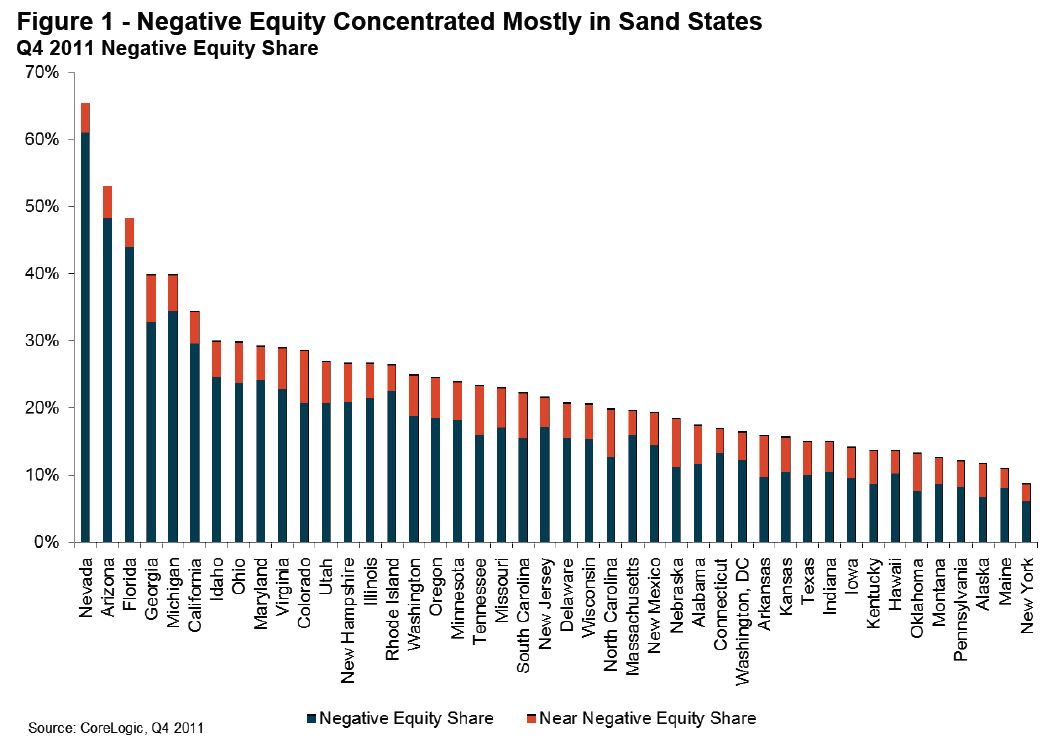
    CoreLogic, Negative Equity by StateClick on graph for larger image.

    This graph shows the break down of negative equity by state. Note: Data not available for some states. From CoreLogic:

    Nevada had the highest negative equity percentage with 61 percent of all of its mortgaged properties underwater, followed by Arizona (48 percent), Florida (44 percent), Michigan (35 percent) and Georgia (33 percent). This is the second consecutive quarter that Georgia was in the top five, surpassing California (29 percent) which previously had been in the top five since tracking began in 2009. The top five states combined have an average negative equity share of 44.3 percent, while the remaining states have a combined average negative equity share of 15.3 percent.”

    CoreLogic, Distribution of EquityThe second graph shows the distribution of equity by state- black is Loan-to-value (LTV) of less than 80%, blue is 80% to 100%, red is a LTV of greater than 100% (or negative equity). Note: This only includes homeowners with a mortgage – about 31% of homeowners nationwide do not have a mortgage.

    Some states – like New York – have a large percentage of borrowers with more than 20% equity, and Nevada, Arizona and Florida have the fewest borrowers with more than 20% equity.

    Some interesting data on borrowers with and without home equity loans from CoreLogic: “Of the 11.1 million upside-down borrowers, there are 6.7 million first liens without home equity loans. This group of borrowers has an average mortgage balance of $219,000 and is underwater by an average of $51,000 or an LTV ratio of 130 percent.

    The remaining 4.4 million upside-down borrowers had both first and second liens. Their average mortgage balance was $306,000 and they were upside down by an average of $84,000 or a combined LTV of 138 percent.”


  • America’s Credit and Housing Crisis: New State Bank Bills, Marketoracle.co.uk


    Seventeen states have now introduced bills for state-owned banks, and others are in the works.  Hawaii’s innovative state bank bill addresses the foreclosure mess.  County-owned banks are being proposed that would tackle the housing crisis by exercising the right of eminent domain on abandoned and foreclosed properties.  Arizona has a bill that would do this for homeowners who are current in their payments but underwater, allowing them to refinance at fair market value.

    The long-awaited settlement between 49 state Attorneys General and the big five robo-signing banks is proving to be a majordisappointment before it has even been signed, sealed and court approved.  Critics maintain that the bankers responsible for the housing crisis and the jobs crisis will again be buying their way out of jail, and the curtain will again drop on the scene of the crime.

    We may not be able to beat the banks, but we don’t have to play their game.  We can take our marbles and go home.  The Move Your Money campaign has already prompted more than 600,000 consumers to move their funds out of Wall Street banks into local banks, and there are much larger pools that could be pulled out in the form of state revenues.  States generally deposit their revenues and invest their capital with large Wall Street banks, which use those hefty sums to speculate, invest abroad, and buy up the local banks that service our communities and local economies.  The states receive a modest interest, and Wall Street lends the money back at much higher interest.

    Rhode Island is a case in point.  In an article titled “Where Are R.I. Revenues Being Invested? Not Locally,” Kyle Hence wrote in ecoRI Newson January 26th:


    According to a December Treasury report, only 10 percent of Rhode Island’s short-term investments reside in truly local in-state banks, namely Washington Trust and BankRI. Meanwhile, 40 percent of these investments were placed with foreign-owned banks, including a British-government owned bank under investigation by the European Union.

    Further, millions have been invested by Rhode Island in a fund created by a global buyout firm . . . . From 2008 to mid-2010, the fund lost 10 percent of its value — more than $2 million. . . . Three of four of Rhode Island’s representatives in Washington, D.C., count [this fund] amongst their top 25 political campaign donors . . . .

    Hence asks:

    Are Rhode Islanders and the state economy being served well here? Is it not time for the state to more fully invest directly in Rhode Island, either through local banks more deeply rooted in the community or through the creation of a new state-owned bank?

    Hence observes that state-owned banks are “[o]ne emerging solution being widely considered nationwide  . . . . Since the onset of the economic collapse about five years ago, 16 states have studied or explored creating state-owned banks, according to a recent Associated Press report.”

    2012 Additions to the Public Bank Movement

    Make that 17 states, including three joining the list of states introducing state bank bills in 2012: Idaho (a bill for a feasibility study), New Hampshire (a bill for a bank), and Vermont (introducing THREE bills—one for a state bank study, one for a state currency, and one for a state voucher/warrant system).  With North Dakota, which has had its own bank for nearly a century, that makes 18 states that have introduced bills in one form or another—36% of U.S. states.  For states and text of bills, see here.

    Other recent state bank developments were in Virginia, Hawaii, Washington State, and California, all of which have upgraded from bills to study the feasibility of a state-owned bank to bills to actually establish a bank.  The most recent, California’s new bill, was introduced on Friday, February 24th.

    All of these bills point to the Bank of North Dakota as their model.  Kyle Hence notes that North Dakota has maintained a thriving economy throughout the current recession:

    One of the reasons, some say, is the Bank of North Dakota, which was formed in 1919 and is the only state-owned or public bank in the United States. All state revenues flow into the Bank of North Dakota and back out into the state in the form of loans.

    Since 2008, while servicing student, agricultural and energy— including wind — sector loans within North Dakota, every dollar of profit by the bank, which has added up to tens of millions, flows back into state coffers and directly supports the needs of the state in ways private banks do not.

    Publicly-owned Banks and the Housing Crisis

    A novel approach is taken in the new Hawaii bill:  it proposes a program to deal with the housing crisis and the widespread problem of breaks in the chain of title due to robo-signing, faulty assignments, and MERS.  (For more on this problem, see here.)  According to a February 10th report on the bill from the Hawaii House Committees on Economic Revitalization and Business & Housing:

    The purpose of this measure is to establish the bank of the State of Hawaii in order to develop a program to acquire residential property in situations where the mortgagor is an owner-occupant who has defaulted on a mortgage or been denied a mortgage loan modification and the mortgagee is a securitized trust that cannot adequately demonstrate that it is a holder in due course.

    The bill provides that in cases of foreclosure in which the mortgagee cannot prove its right to foreclose or to collect on the mortgage, foreclosure shall be stayed and the bank of the State of Hawaii may offer to buy the property from the owner-occupant for a sum not exceeding 75% of the principal balance due on the mortgage loan.  The bank of the State of Hawaii can then rent or sell the property back to the owner-occupant at a fair price on reasonable terms.

    Arizona Senate Bill 1451, which just passed the Senate Banking Committee 6 to 0, would do something similar for homeowners who are current on their payments but whose mortgages are underwater (exceeding the property’s current fair market value).  Martin Andelman callsthe bill a “revolutionary approach to revitalizing the state’s increasingly water-logged housing market, which has left over 500,000 ofArizona’s homeowners in a hopelessly immobile state.”

    The bill would establish an Arizona Housing Finance Reform Authority to refinance the mortgages of Arizona homeowners who owe more than their homes are currently worth.  The existing mortgage would be replaced with a new mortgage from AHFRA in an amount up to 125% of the home’s current fair market value. The existing lender would get paid 101% of the home’s fair market value, and would get a non-interest-bearing note called a “loss recapture certificate” covering a portion of any underwater amounts, to be paid over time.  The capital to refinance the mortgages would come from floating revenue bonds, and payment on the bonds would come solely from monies paid by the homeowner-borrowers. An Arizona Home Insurance Fund would create a cash reserve of up to 20 percent of the bond and would be used to insure against losses. The bill would thus cost the state nothing.

    Critics of the Arizona bill maintain that it shifts losses from collapsed property values onto banks and investors, violating the law of contracts; and critics of the Hawaii bill maintain that the state bank could wind up having paid more than market value for a slew of underwater homes. An option that would avoid both of these objections is one suggested by Michael Sauvante of the Commonwealth Group, discussed earlierhere: the state or county could exercise its right of eminent domain on blighted, foreclosed and abandoned properties.  It could offer to pay fair market value to anyone who could prove title (something that with today’s defective title records normally can’t be done), then dispose of the property through a publicly-owned land bank as equity and fairness dictates.  If a bank or trust could prove title, the claimant would get fair market value, which would be no less than it would have gotten at an auction; and if it could not prove title, it legally would have no claim to the property.  Investors who could prove actual monetary damages would still have an unsecured claim in equity against the mortgagors for any sums owed.


    Rhode Island Next?

    As the housing crisis lingers on with little sign of relief from the Feds, innovative state and local solutions like these are gaining adherents in other states; and one of them is Rhode Island, which is in serious need of relief.  According to The Pew Center on the States, “The country’s smallest state . . . was one of the first states to fall into the recession because of the housing crisis and may be one of the last to emerge.”

    Rhode Islanders are proud of having been first in a number of more positive achievements, including being the first of the 13 original colonies to declare independence from British rule.  A state bank presentation was made to the president of the Rhode Island Senate and other key leaders earlier this month that was reportedly well received.  Proponents have ambitions of making Rhode Island the first state in this century to move its money out of Wall Street into its own state bank, one owned and operated by the people for the people.

    Ellen Brown is an attorney and president of the Public Banking Institute, http://PublicBankingInstitute.org.  In Web of Debt, her latest of eleven books, she shows how a private cartel has usurped the power to create money from the people themselves, and how we the people can get it back.  Her websites are http://WebofDebt.com and http://EllenBrown.com

    Ellen Brown is a frequent contributor to Global Research.  Global Research Articles by Ellen Brown

    © Copyright Ellen Brown 2012

    Disclaimer: The views expressed in this article are the sole responsibility of the author and do not necessarily reflect those of the Centre for Research on Globalization. The contents of this article are of sole responsibility of the author(s). The Centre for Research on Globalization will not be responsible or liable for any inaccurate or incorrect statements contained in this article.

    http://www.marketoracle.co.uk/Article33365.html

  • MERS


    What we need to do is take a survey, the population being made up of mortgage borrowers between the years 2002-2008. Why these years would become apparent with the results, which can be predicted before ever tallying the results. It would be a one question survey:

    “Upon loan origination, was it required, in addition to completing a loan 1003 loan application, that you also provide specific documents for verification and loan qualification purposes, or did you simply have to complete a loan 1003 loan application?”

    My bet would be that most everyone who was in receipt of a loan prior to September 2005 was required to submit documents to a human person which were used to verify loan qualification. Most nearly everyone subsequent that date was not required to submit anything by way of supporting documents.

    This gives us two separately defined groups:

    GROUP A: borrowers whose loans were humanly underwritten and verified

    GROUP B: borrowers whose loans were underwritten entirely by automation

    We can argue about the underlying reasons for economic collapse all day long, as there are certainly many, but one fact remains as being integral. This is acknowledging that there were borrowers that never, ever should have been approved for a loan, yet were. It was this very small subset of borrowers in Group B however, those that defaulted nearly immediately, that is within the first through third months out of the gate. It was these ‘early payment defaults (EPD’s ) that spread throughout the investment community causing fear, bringing into question the quality of all loan originations, thereby freezing the credit markets in August 2007, a year later the entire economy collapsed.

    Of course, it is much more complex than that, but the crucial piece that provided the catalyst was these EPD’s. It was the quality of the borrowers from these EPD’s that became the model by which was used to stigmatize all borrowers. What was needed was a fall guy, to first lessen the anger towards the bailouts in providing a scapegoat, and second to divert attention away from the facts underlying the lending standards the failed and/or intentionally purposeful failure of the automation. From my research, it was with purposeful intent come hell or high water is my mission in life to bring forth into the public light.

    Putting intent aside for the moment and just focusing on the EPD’s and the domino effect they caused which resulted in millions of borrowers, from both Groups A and B, to lose their homes or struggling to hold on. How could one small group of failed borrowers affect millions of other borrowers, especially those who were qualified through the traditional methods of underwriting?

    The answer is an obvious one, coming down to the one common element that is the structuring of the loan products, that as it relates to the reset. Anyone whose reset occurred just prior and certainly after the economic collapse was as the saying goes…..Screwed. It is within is this, that the Grand Illusion lay intentionally concealed and hidden. It is within the automation wherein all the evidence clearly points to the fact that a mortgage is not a mortgage but rather a basket of securities….Not just any securities, but debt defaultable securities. In other words, it was largely planned to intentionally give loans to those whom were known to result in default.

    But, even without understanding any of the issues as to the ‘basket of securities” there is one obvious point that looms, hiding in plain sight, which I believe should be completely exploited. This as it directly relates to our mortal enemy, that which takes the name of MERS. I know there are those that disseminate the structure of Mortgage Electronic Registration Systems, Inc and Merscorp as it relates to the MIN number and want to pick it apart, and all this is well and good. However, they miss the larger and more obvious point that clearly gives some definition.

    There is one particular that every one of those millions upon millions of borrowers, those in both Group A and Group B along with the small subset of Group B, all have in common. ……MERS. MERS was integrated into every set of loan documents, slide past the borrowers without explanation without proper representation in concealing the implied contracts behind the trade and service mark of MERS.

    MERS does not discriminate between a good or a bad loan, a loan is a loan as far it is concerned, whether it was fraudulently underwritten or perfectly underwritten. If it is registered with MERS the good, the bad, the ugly all go down, and therein lays an issue that is pertinent to discussion.

    MERS was written into all Fannie and Freddie Uniform Security Instrument, not by happenstance, rather mandated by Fannie and Freddie. It was they who crafted verbiage and placement within the document. Fannie and Freddie are of course agency loans, however nearly 100% of non-agency lenders utilized the same Fannie and Freddie forms. Put into context, MERS covers both agency and non-agency, and not surprisingly members of MERS as well. Talk about fixing the game!!

    It would seem logical, considering we, the American Taxpayer own Fannie Mae, that we should be entitled some answers to some very basic questions……The primary question: If Fannie Mae and Freddie Mac mandated that MERS play the role that it does, why than were there no quality control measures in place, and should they not have been responsible for putting in some safety measures in place?

    The question is a logical one; any other business would have buried in litigation had a product it sponsored or mandated, as the case may be here, resulted in complete failure. From the standpoint of public policy, MERS was a tremendous failure. Why? The answer derives itself from the facts as laid out above regarding the underwriting processes and the division of borrowers: Group A and B.

    This becomes a pertinent taking into account Fannie Mae on record in its recorded patents.

    US PATENT #7,881,994 B1– Filed April 1, 2004, Assignee: Fannie Mae

     ‘It is well known that low doc loans bear additional risk. It is also true that these loans are

    charged higher rates in order to compensate for the increased risk.’


    System and method for processing a loan

    US PATENT # 7,653,592– Filed December 30, 2005, Assignee: Fannie Mae

    The following from the Summary section states:

    ‘An exemplary embodiment relates to a computer-implemented mortgage loan application data processing system comprising user interface logic and a workflow engine. The user interface logic is accessible by a borrower and is configured to receive mortgage loan application data for a mortgage loan application from the borrower. The workflow engine has stored therein a list representing tasks that need to be performed in connection with a mortgage loan application for a mortgage loan for the borrower. The tasks include tasks for fulfillment of underwriting conditions generated by an automated underwriting engine. The workflow engine is configured to cooperate with the user interface logic to prompt the borrower to perform the tasks represented in the list including the tasks for the fulfillment of the underwriting conditions. The system is configured to provide the borrower with a fully-verified approval for the mortgage loan application. The fully-verified approval indicates that the mortgage loan application data received from the borrower has already been verified as accurate using information from trusted sources. The fully-verified approval is provided in a form that allows the mortgage loan application to be provided to different lenders with the different lenders being able to authenticate the fully-verified approval status of the mortgage loan application’

    Computerized systems and methods for facilitating the flow of capital

    through the housing finance industry

    US PATENT # 7,765,151– Filed July 21, 2006, Assignee: Fannie Mae

    The following passages taken from patent documents reads:

    ‘The prospect or other loan originator preferably displays generic interest rates (together with an assumptive rate sheet, i.e., current mortgage rates) on its Internet web site or the like to entice online mortgage shoppers to access the web site (step 50). The generic interest rates (“enticement rates”) displayed are not intended to be borrower specific, but are calculated by pricing engine 22 and provided to the loan originator as representative, for example, of interest rates that a “typical” borrower may expect to receive, or rates that a fictitious highly qualified borrower may expect to receive, as described in greater detail hereinafter. FIG. 2b depicts an example of a computer Internet interface screen displaying enticement rates.’

     ’If the potential borrower enters a combination of factors that is ineligible, the borrower is notified immediately of the ineligibility and is prompted to either change the selection or call a help center for assistance (action 116). It should be understood that this allows the potential borrower to change the response to a previous question and then continue on with the probable qualification process. If the potential borrower passes the eligibility screening, the borrower then is permitted to continue on with the probable qualification assessment.’

    ‘Underwriting engine 24 also determines, for each approved product, the minimum amount of verification documentation (e.g., minimum assets to verify, minimum income to verify), selected loan underwriting parameters, assuming no other data changes, (e.g., maximum loan amount for approval, maximum loan amount for aggregating closing costs with the loan principal, and minimum refinance amount), as well as the maximums and minimums used to tailor the interest rate quote (maximum schedule interest rate and maximum number of points) and maximum interest rate approved for float up to a preselected increase over a current approved rate. It should be appreciated that this allows the potential borrower to provide only that information that is necessary for an approval decision, rather than all potentially relevant financial and other borrower information. This also reduces the processing burden on system.’

    The two patents above was Fannie Mae’s means of responding to its competition, that being the non-agency who had surpassed the agencies in sales volume (those stats I will have to dig up and repost as they are not handy at the moment), as the non-agencies had dropped all standards back in and around September 2005.

    The point being though, Fannie Mae and Freddie Mad were the caretakers of MERS, so to speak, inasmuch as mandating MERS upon the borrowers. Had there been safety measures in place that caught the fact that the loans that were dumping out quickly, that is the EPD’s, there might have been a stoppage in place, thereby preventing MERS from executing foreclosures upon every successive mortgage.

    I know that this is all BS though, because it is a cover up, a massive one that cuts into the heart of the United States government. This is perhaps one avenue by which to get there, as the questions asked are easily understood, as opposed to digging into the automation processes which people apparently are not ready to accept as of yet.
  • Prototype of Standardized Monthly Mortgage Statement is Released, by Jim Puzzanghera, Los Angeles Times


    The Consumer Financial Protection Bureau‘s proposed statement is designed to provide clear information about the loan on a single page and wouldn’t change each time your loan is sold to a new servicer.


    Reporting from Washington—

    Your monthly mortgage bill soon could get easier to understand, and it wouldn’t change each time your loan is sold to a new servicer.

    The Consumer Financial Protection Bureau has developed a proposed standardized mortgage servicer statement designed to provide clear information about the loan on a single page.

    The prototype released Monday included a breakdown of how much of the monthly payment went to principal, interest and escrow. The form also detailed the outstanding principal, maturity date, prepayment penalty and, for adjustable-rate mortgages, the time when the interest rate could change.

    “This information will help consumers stay on top of their mortgage costs and hold their mortgage servicers accountable for fixing errors that crop up,” said Richard Cordray, the agency’s director. “Given the widespread mortgage servicing problems we’ve seen over the past few years, consumers need clear disclosures they can count on.”

    Although many servicers already provide such information on their monthly statements, there are no industrywide standards, the agency said.

    Such standards are a good idea, and initial reaction from servicers to the agency’s proposal was positive, said Rod J. Alba, senior counsel in the mortgage markets division at the American Bankers Assn.

    The agency posted a working draft of the standardized statement on its website,http://www.consumerfinance.gov to solicit input from the public and industry before a version of the form formally is proposed this summer.

    Ed Mierzwinski, consumer program director for the U.S. Public Interest Research Group, said simplified mortgage statements would help resolve the broad mortgage servicing problems that were at the heart of last week’s federal and state settlement with five of the nation’s largest banks over botched foreclosure paperwork.

    The consumer agency is required under the 2010 financial reform law to put new mortgage servicing rules in place to help consumers, Cordray said. The law has specific requirements for mortgage statements, including a phone number and email address for the customer to get information about the loan, as well as information about housing counselors.

    The new mortgage statement is the latest consumer financial paperwork the agency is trying to simplify.

    In May, it released two prototypes for shorter, easier-to-understand disclosure forms that lenders would have to give home buyers before they close on a mortgage. The agency has been receiving comments on the forms and tested them last month in Philadelphia.

    And in December, the agency proposed a simplified credit card agreement form to make it easier to understand interest rate terms and comparison shop.

    The agency also is developing a new disclosure rule for hybrid adjustable-rate mortgages that would require consumers to be notified months before their first interest rate increase, as well as to be provided with a good-faith estimate of the new monthly payment.

    jim.puzzanghera@latimes.com

  • Fannie, Freddie overhaul unlikely, by Vicki Needham, Thehill.com


    An overhaul of Fannie Mae and Freddie Mac is unlikely again this year despite recent Republican efforts to move the issue up the agenda.

    Congressional Republicans, along with some Democrats — and even GOP presidential candidate Newt Gingrich — are renewing calls to craft an agreement to reduce the involvement of Fannie and Freddie in the nation’s mortgage market.

    But without a broader accord, passage of any legislation this year is slim, housing experts say.


    Jim Tobin, senior vice president of government affairs for the National Association of Home Builders, concedes that despite a mix of Democratic and Republican proposals, including a push by the Obama administration last year, congressional leaders probably won’t get far this year on a plan for Fannie and Freddie, the government-controlled mortgage giants.


    Tobin said there are “good ideas out there” and while he expects the House to put some bills on the floor and possibly pass legislation, the Senate is likely to remain in oversight mode without any “broad-based legislation on housing finance.”

    “We’re bracing for a year where it’s difficult to break through on important policy issues,” he said this week.

    While the issue makes for a good talking point, especially in an presidential election year, congressional efforts are largely being stymied by the housing market’s sluggish recovery, prohibiting the hand off between the government and private sector in mortgage financing, housing experts say.

    David Crowe, chief economist with NAHB, said that the market has hit rock bottom and is now undergoing a “slow climb out of the hole.”

    The House has taken the biggest steps so far — by mid-July the Financial Services Committee had approved 14 bills intended to jump-start reform of the government-sponsored enterprises.

    “As we continue to move immediate reforms, our ultimate goal remains, to end the bailout of Fannie, Freddie and build a stronger housing finance system that no longer relies on government guarantees,” panel Chairman Spencer Bachus (R-Ala.) said last summer.

    Meanwhile, a number of GOP and bipartisan measures have emerged — Democrats and Republicans generally agree Fannie and Freddie are in need of a fix but their ideas still widely vary.

    There are a handful of bills floating around Congress, including one by Reps. John Campbell (R-Calif.) and Gary Peters (D-Mich.), and another by Reps. Gary Miller (R-Calif.) and Carolyn Maloney (D-N.Y), which would wind down Fannie and Freddie and create a new system of privately financed organizations to support the mortgage market.

    “Every one of those approaches replaces them [Fannie and Freddie] with what they think is the best alternative to having a new system going forward that would really fix the problem and would really give certainty to the marketplace and allow housing finance to come back, and therefore housing to come back, as well,” Campbell said at a markup last month.

    There’s another bill by Rep. Jeb Hensarling (R-Texas) and bills in the Senate being pushed by Sens. Bob Corker (R-Tenn.) and Johnny Isakson (R-Ga.).

    Corker, a member of the Senate Banking Committee, made the case earlier this week for unwinding government support for the GSEs while promoting his 10-year plan that would put in place the “infrastructure for the private sector to step in behind it.”

    “A big part of the problem right now is the private sector is on strike,” Corker said.

    He has argued that his bill isn’t a silver bullet, rather a conversation starter to accelerate talks.

    “So what we need to do is figure out an orderly wind-down,” Corker said in November. “And so we’ve been working on this for some time. We know that Fannie and Freddie cannot exist in the future.”

    He suggested getting the federal government this year to gradually wind down the amount of the loans it guarantees from 90 percent to 80 percent and then to 70 percent.

    “And as that drops down, we think the market will send signals as to what the difference in price is between what the government is actually guaranteeing and what they’re not,” he said.

    Even Gingrich, who has taken heat for his involvement with taking money while doing consulting work for the GSEs, called for an unwinding during a December interview.

    “I do, in fact, favor breaking both of them up,” he said on CBS’ Face the Nation. “I’ve said each of them should devolve into probably four or five companies. And they should be weaned off of the government endorsements, because it has given them both inappropriate advantages and because we now know from the history of how they evolved, that they abused that kind of responsibility.”

    In a white paper on housing last week, the Federal Reserve argued that the mortgage giants should take a more active role in boosting the housing market, although they didn’t outline suggestions for how to fix the agencies.

    The central bank did argue that “some actions that cause greater losses to be sustained by the GSEs in the near term might be in the interest of taxpayers to pursue if those actions result in a quicker and more vigorous economic recovery.”

    Nearly a year ago, Treasury Secretary Timothy Geithner asked Congress to approve legislation overhauling Fannie Mae and Freddie Mac within two years — that deadline appears to be in jeopardy.

    The Obama administration’s initial recommendations called for inviting private dollars to crowd out government support for home loans. The white paper released in February proposed three options for the nation’s housing market after Fannie and Freddie are wound down, with varying roles for the government to play.

    About the same time last year, Bachus made ending the “taxpayer-funded bailout of Fannie and Freddie” the panel’s first priority.

    While an overhaul remains stalled for now there is plenty of other activity on several fronts.

    In November, the Financial Services panel overwhelmingly approved a measure to stop future bonuses and suspend the current multi-million dollar compensation packages for the top executives at the agencies.

    The top executives came under fire for providing the bonuses but argued they need to do something to attract the talent necessary to oversee  $5 trillion in mortgage assets.

    Earlier this month, the Federal Housing Finance Agency announced that the head of Fannie received $5.6 million in compensation and the chief executive of Freddie received $5.4 million.

    Under the bill, the top executives of Fannie and Freddie could only have earned $218,978 this year.

    Last week, Fannie’s chief executive Michael Williams announced he would step down from his position once a successor is found. That comes only three months after Freddie’s CEO Charles Haldeman Jr. announced that he will leave his post this year.

    The government is being tasked to find replacements, not only for the two mortgage giants which have cost taxpayers more than $150 billion since their government takeover in 2008, but there is talk that the Obama administration is looking to replace FHFA acting director Edward DeMarco, the overseer of the GSEs.

    In a letter to President Obama earlier this week, more than two dozen House members said DeMarco simply hasn’t done enough to help struggling homeowners avoid foreclosure.

    The lawmakers are pushing the president to name a permanent director “immediately.”

    Also, in December, the Securities and Exchange Commission (SEC) sued six former executives at Fannie and Freddie, alleging they misled the public and investors about the amount of risky mortgages in their portfolio.

    In the claims, the SEC contends that as the housing bubble began to burst, the executives suggested to investors that the GSEs were not substantially exposed to sub-prime mortgages that were defaulting across the country.

  • Mortgage Slang 101 – Mortgage Insurance, Brett Reichel, Brettreichel.com


    Mortgage insurance is viewed nearly universally as a bad thing, but in reality, it’s a tool to be used that is very good for home buyers, the housing market and the economy in general.

    Why do many complain about mortgage insurance?  Because it’s expensive, and sometimes difficult to get rid of when it’s no longer necassary.  If that’s the case, why do I say it’s good for buyers and the economy?  Because it’s a tool that allows people to buy a home with less than twenty percent down.

    Mortgage insurance insures the lender against the risk of the buyers default on the loan.  It does NOT insure the buyers life, like many people think.

    The single biggest hurdle for home buyers is accumulating an adequate down payment.  Lenders want buyers to put twenty percent down for two reasons.  First, a buyer with a large down payment is less likely to quit making their payments.  Second, if a buyer does default, the more the buyer put down usually means more equity in the house when the lender forecloses, which means the lender loses less money.

    But, if a buyer wants to buy a $200,000 and has to put up a twenty percent down, that will equal a $40,000 down payment!  Hard to save up, for most buyers.  BUT, with the use of mortgage insurance, that buyer might be able to put as little as $6,000 down!  A lot easier to save.

    So, mortgage insurance can be a very benficial tool.

    With that being said, don’t let your lender shoehorn you into only considering monthly mortgage insurance.  There are other options such as single premium mortgage insurance, or “split” mortgage insurance.  These programs can be more expensive up front, but sometimes much less expensive over time.  They don’t work for everyone, but they certainly should be looked into.


    Brett Reichel
    Brettreichel.com

  • Real Estate News On The National Scene, by Phil Querin, Q-Law.com


    The credit and real estate meltdowns, coupled with the subsequent foreclosure crisis, caused many politicians, all with differing motives, to shift into high legislative gear.  Without commenting on motivation, which is an admittedly fertile area for discussion, let’s take a look at the national legislative scene to see what has occurred[1], and whether things are better today than in 2008.

    MERS. I am addressing this issue at the beginning, primarily to get it out of the way.  I for one am suffering from “MERS Fatigue,” which is a malady afflicting many of us who watch and wait for something new to occur on this front.

    It’s important to understand that MERS, which is the catchy acronym for the “Mortgage Electronic Registration System”, was never a creature of statute.  It was born and bred by the lending and title industries in the late 1990s, for reasons that most people already know.  But because of its national scope – affecting approximately 60% of all home mortgages – MERS bears mentioning here.

    Despite all the national attention, the MERS controversy is really one that can only be resolved on the local level, since real estate recording and foreclosure statutes occur on a state – not national – level.  In Oregon, although there have been several federal court rulings, MERS’ legality is still up in the air.  This is because the local federal judges, who are supposed to follow Oregon law, have no binding Oregon appellate court precedent to follow when it comes to MERS.  The result is that there have been divergent federal court rulings.  And, the topic is so contentious at the Oregon legislature that there is little political appetite to tackle the problem, since few can agree on a solution.

    So, the news is that there is no news.  It will take months for the one state court case currently on appeal to find its way to the Oregon Court of Appeals or Supreme Court.  And, although there is a slight chance of a breakthrough in the upcoming session, 2012 does not appear to be a year in which we will see a legislative answer.

    Fannie and Freddie. Since the fall of Lehman Brothers in 2008, these two Government Sponsored Enterprises or “GSEs” have come under government ownership and control.  For a summary of the issues from the Congressional Budget Office, go to  the link here.  Since the private secondary mortgage market effectively disappeared between 2007-2008, this means that today, there is no viable buyer of residential loans except the federal government. To some observers, depending on their political bent, this is a good thing; but to others, it’s bad.

    One thing is certain; as long as the federal government, through Fannie and Freddie, dictate borrower qualifications, LTVs, and conforming loan limits[2], the conventional mortgage market will continue to be tight.  This does not bode well for higher end homes, especially.  Unfortunately, we don’t have to go back very far in time to remember what happened in the “private label” secondary mortgage market (i.e. non-GSE market) where home loans were handed out like party favors, and those who should never have qualified did.

    While there is much talk about doing away with Fannie and Freddie, it is unlikely any time soon.  However, what is occurring, albeit slowly and somewhat quietly, is a move to shift some of the GSEs’ loans to the private sector, where the risk would not be backed by the federal government.  If this works, perhaps more will follow.  While there may be some investors for such loans, it is likely that without a governmental safety net, the nascent private secondary market will demand a higher rate of return to offset the higher risk.


    In the meantime, the loans of choice appear to be through the FHA.  While the paperwork may be daunting, the LTVs are good and the bar to borrower qualification is much lower and more flexible than conventional loans.

    The Consumer Finance Protection Bureau. In recognition of Wall Street’s role in the credit and mortgage meltdowns, Congress established the Consumer Financial Protection Bureau (CFPB) through the Dodd-Frank Wall Street Reform and Consumer Protection Act. On July 21 of this year, it was opened for business. This is no ordinary federal agency.  It is a super agency, responsible for regulating many, many areas of consumer finance and mortgage loans.[3]

    Elizabeth Warren, a Harvard law professor and Presidential Advisor, was the driving force behind the Agency’s creation.  She was a zealous advocate for the consumer.  Unfortunately, the political reality was that she may have been too zealous.  Instead of being appointed director, Richard Cordray, former Ohio Attorney General, was appointed to head the agency.  However, his nomination is currently tied up in Congress, and he may not be confirmed.  Many Republicans oppose the idea of so much power being wielded by a single person rather than a board of Senate-confirmed appointees.  So as it stands, the CFPB – this mega agency that was created to oversee so many aspects of consumer law – has a website, is hard at work making manuals and processing paperwork, yet has no director to oversee enforcement of anything.

    Risk Retention, Skin in the Game, and the QRM. Mindful of the risks created when banks used their own safety net capital to trade in high risk loans, known as “proprietary trading,” the 2010 Dodd-Frank Act enacted Section 619, which placed severe restrictions on the ability of banks to use their funds to place risky bets (known as the “Volker Rule”).  Billions of dollars of these bets failed in 2008, leading up to the massive government bailouts that taxpayers funded.  What is the status of the Volker Rule today?  It’s still out for public comment, with banks arguing that the Rule will reduce their revenues and thereby force them to increase the cost of loans to borrowers. Given that big banks are still suffering the reputational fallout from the bailouts, the Volker Rule -with most of its teeth – may actually become law. When? Who knows.[4]

    Also mindful of the risks created through sloppy underwriting of securitized loans, Dodd-Frank sought to require that banks retain a 5 percent interest in the risk of loss on those loans. This risk retention rule has been referred to as “skin in the game,” and was intended to require banks to share a portion of the risks they securitized to others.  Instead of investors taking on the entire risk of a slice of securitized loans, banks would have to hold back 5% on their own balance sheet.

    However, the law made a major exception; it provided that through rule making, a standard be set for certain loan types with statistically lower default rates for which risk retention would be unnecessary.  This exception became known as the “Qualified Residential Mortgage” or “QRM.”  The QRM rules were intended to impose high standards for documentation of income, borrower performance, low debt-to-income ratios and other quality underwriting requirements.  Although they were to be the exception, not the rule, today, most lenders want these standards to be flexible rather than inflexible, so that there is more wiggle room for their loans to qualify as QRMs and thereby remain exempt from risk retention.  The argument in favor of looser loan standards is the fear that an inflexible QRM exemption will impair access to home loans by low and moderate income borrowers. This debate continues today, and there is some reason to believe that these rules will be substantially diluted before becoming law.


    PCQ Editorial Comment: It was not so long ago that certain banks criticized borrowers of 100% home financing as creating “moral hazard” – i.e. they took risks because they had no financial risk of default since they had no down payment to lose.  Today, the concept of “moral hazard” seems to have been forgotten by those same banks opposing risk retention rules.  They now expect their borrowers to have “skin in the game” – hence the higher down payment rules – but deny the need to do so themselves.  “Pot meet Kettle.”

    Conclusion. So, notwithstanding the fact that this country teetered on the brink of disaster in 2008, the politicians’ rush to legislate has continued to move at a snail’s pace.  Query:  Is the American consumer really better off today than in 2008?


    [1] This article will not cover Mortgage Assistance Relief Services (“MARS”), since the much ballyhooed national law was never intended to apply to Realtors®, even though that realization did not come soon enough to avoid all sorts of unnecessary industry handwringing and forms creation. All of the Oregon-specific legislation has been discussed in my prior articles.

    [2] On September 30, 2011, Fannie’s high loan limits for certain high housing cost parts of the country expired.  In portions of California, this may result in otherwise qualified buyers having to wait a year or two to save for the additional down payments.

    [3] Here is a listing of its responsibilities: Board of Governors of the Federal Reserve: Regulation B (Equal Credit Opportunity Act); Regulation C (Home Mortgage Disclosure); Electronic Fund Transfers (Regulation E); Regulation H, Subpart I (Registration of Residential Mortgage Loan Originators); Regulation M (Consumer Leasing); Regulation P (Privacy); Regulation V (Fair Credit Reporting); Regulation Z (Truth in Lending); Regulation DD (Truth in Savings); FDIC: Privacy of Consumer Financial Information; Fair Credit Reporting Registration of Residential Mortgage Loan Originators; Office of the Comptroller of the Currency: Adjustable Rate Mortgages Registration of Residential Mortgage Loan Originators; Privacy of Consumer Financial Information; Fair Credit Reporting;  Office of Thrift Supervision: Adjustments to home loans; Alternative Mortgage  transactions; Registration of Mortgage Loan Originators; Fair Credit Reporting; Privacy of Consumer Financial Information; National Credit Union Administration: Loans to members and lines of credit to members; Truth in Savings; Privacy of Consumer Financial Information; Fair Credit Reporting Requirements for Insurance; Registration of Mortgage Loan Originators; Federal Trade Commission: Telemarketing Sales Rule; Privacy of Consumer Financial Information; Disclosure Requirements for Depository Institutions Lacking Federal Depository Insurance; Mortgage Assistance Relief Services; Use of Pre-notification Negative Option Plans; Rule Concerning Cooling-Off Period for Sales Made at Homes or at Certain Other Locations; Preservation of Consumers’ Claims and Defenses; Credit Practices; Mail or Telephone Order Merchandise Disclosure Requirements and Prohibitions Concerning Franchising Disclosure Requirements and Prohibitions Concerning Business Opportunities Fair Credit Reporting Act Procedures for State Application for Exemption from the Provisions of the Fair Debt Collection Practices Act; Department of Housing and Urban Development: Hearing Procedures Pursuant to the Administrative Procedure Act; Civil Monetary Penalties; Land Registration Purchasers’ Revocation Rights; Sales Practices, and Standards Formal Procedures and; Rules of Practice Real Estate Settlement Procedures Act; Investigations in Consumer Regulatory Programs. For source, link here.

    [4] It is rumored that Morgan Stanley and Goldman Sachs, both of whom changed their charters from securities firms to become “banks”, in order to be eligible for taxpayer funded bailout money, are now considering exiting that status, precisely so they will not have to comply with the Volker Rule – if it passes.

  • Refinancing your Underwater Fannie Mae home loan


    The Fannie Mae DU Refi Plus home loan program is extended through this year and into 2012. This program may be able to help you refinance if you owe more than your home is worth. Check out this quick video:

    The Fannie Mae DU Refi Plus – Basics

    First of all, you need to make sure that your current loan is owned by Fannie Mae. You can check that at Fannie Mae’s website. All you need is your full address.

    You also need to be on time with your mortgage payments. If you are behind in your mortgage, you will need to discuss loan modification or other options with your lender.

    The biggest impediment when discussing the DU Refi Plus program is the issue of mortgage insurance. The best case scenario is if you do not have mortgage insurance on your current home loan.

    If you need to figure out your options when it comes to refinancing your home in Oregon or Washington, shoot me an email. You may not always like the answer, but knowing is better than the alternative.

    Thanks for taking a minute to check this post out!


    Picture: Jason HillardJason Hillard – homeloanninjas.com

    Mortgage Advisor in Oregon and Washington MLO#119032

    Pinnacle Mortgage Bankers

    a div of Pinnacle Capital Mortgage Corp

    503.799.4112

    jason@mypmb.us

    1706 D St Vancouver, WA 98663

    NMLS 81395 WA CL-81395

    Equal Housing Lender

  • Bank of America Offers $20,000 Short-Sale Incentive to Homeowners, by Kimberly Miller, The Palm Beach Post


    Bank of America, the nation’s largest mortgage servicer, is offering Florida homeowners up to $20,000 to short sale their homes rather than letting them linger in foreclosure.

    The limited-time offer has received little promotion from the Charlotte, N.C.-based bank, which sent emails to select Florida Realtors earlier this week outlining basic details of the plan.

    Only homeowners whose short sales are submitted for approval to Bank of America before Nov. 30 will qualify. The homes must have no offers on them already and the closing must occur before Aug. 31, 2012.

    A short sale is when a bank agrees to accept a lower sales price on a home than what the borrower owes on the loan.

    Realtors said the Bank of America plan, which has a minimum payout amount of $5,000, is a genuine incentive to struggling homeowners who may otherwise fall into Florida’s foreclosure abyss.

    The current timeline to foreclosure in Florida is an average of 676 days — nearly two years — according to real estate analysis company RealtyTrac. The national average foreclosure timeline is 318 days.

    “I think this is a positive sign that the bank is being creative to try and help homeowners and get things moving,” said Paul Baltrun, who works with real estate and mortgages at the Law Office of Paul A. Krasker in West Palm Beach. “With real estate attorneys handling these cases, you’re talking two, three, four years before there’s going to be a resolution in a foreclosure.”

    Guy Cecala, chief executive officer and publisher of Inside Mortgage Finance, called the short sale payout a “bribe.”

    “You can call it a relocation fee, but it’s basically a bribe to make sure the borrower leaves the house in good condition and in an orderly fashion,” Cecala said. “It makes good business sense considering you may have to put $20,000 into a foreclosed home to fix it up.”

    Homeowners, especially ones who feel cheated by the bank, have been known to steal appliances and other fixtures, or damage the home.

    “This might be the banks finally waking up that they can have someone in there with an incentive not to damage the property,” said Realtor Shannon Brink, with Re/Max Prestige Realty in West Palm Beach. “Isn’t it better to have someone taking care of the pool and keeping the air conditioner on?”

    A spokesman for Bank of America said the program is being tested in Florida, and if successful, could be expanded to other states.

    Wells Fargo and J.P. Morgan Chase have similar short-sale programs, sometimes called “cash for keys.”

    Wells Fargo spokesman Jason Menke said his company offers up to $20,000 on eligible short sales that are left in “broom swept” condition. Although the program is not advertised, deals are mostly made on homes in states with lengthy foreclosure timelines, he said.

    And caveats exist. The Wells Fargo short-sale incentive is only good on first-lien loans that it owns, which is about 20 percent of its total portfolio.

    Bank of America’s plan excludes Ginnie Mae, Federal Housing Administration and VA loans.

    Similar to the federal Home Affordable Foreclosure Alternatives program, or HAFA, which offers $3,000 in relocation assistance, the Bank of America program may also waive a homeowner’s deficiency judgment at closing.

    A deficiency judgment in a short sale is basically the difference between what the house sells for and what is still owed on the loan.

    HAFA, which began in April 2010, has seen limited success with just 15,531 short sales completed nationwide through August.

    But Realtors said cash for keys programs can work.

    Joe Kendall, a broker associate at Sandals Realty in Fort Myers, said he recently closed on a short sale where the seller got $25,000 from Chase.

    “They realize people are struggling and this is another way to get the homes off the books,” he said.

  • House is Gone but Debt Lives On; Expect Huge Surge in Deficiency Lawsuits, by Mike “Mish” Shedlock


    Forty-one states allow lenders to sue for mortgage debt if a home fetches less than the mortgage in a foreclosure sale. It always will. Such lawsuits are one of the reasons I have consistently advised people to consult an attorney before walking away.

    For a nice write-up on deficiency judgments please consider the Wall Street Journal article House Is Gone but Debt Lives On.

    Joseph Reilly lost his vacation home here last year when he was out of work and stopped paying his mortgage. The bank took the house and sold it. Mr. Reilly thought that was the end of it.

    In June, he learned otherwise. A phone call informed him of a court judgment against him for $192,576.71. It turned out that at a foreclosure sale, his former house fetched less than a quarter of what Mr. Reilly owed on it. His bank sued him for the rest.

    The result was a foreclosure hangover that homeowners rarely anticipate but increasingly face: a “deficiency judgment.”

    Until recently, “there was a false sense of calm” among borrowers who went through foreclosure, Mr. Englett says. “That’s changing,” he adds, as borrowers learn they may be financially on the hook even after the house is gone.

    Some close observers of the housing scene are convinced this is just the beginning of a surge in deficiency judgments. Sharon Bock, clerk and comptroller of Palm Beach County, Fla., expects “a massive wave of these cases as banks start selling the judgments to debt collectors.”

    Because most targets have scant savings, the judgments sell for only about two cents on the dollar, versus seven cents for credit-card debt, according to debt-industry brokers.

    Silverleaf Advisors LLC, a Miami private-equity firm, is one investor in battered mortgage debt. Instead of buying ready-made deficiency judgments, it buys banks’ soured mortgages and goes to court itself to get judgments for debt that remains after foreclosure sales.

    Silverleaf says its collection efforts are limited. “We are waiting for the economy to somewhat heal so that it’s a better time to go after people,” says Douglas Hannah, managing director of Silverleaf.

    Investors know that most states allow up to 20 years to try to collect the debts, ample time for the borrowers to get back on their feet. Meanwhile, the debts grow at about an 8% interest rate, depending on the state.

    Laws vary from state to state and things may depend on whether or not the loan is a recourse loan or not. Once again, before walking away, and before considering a short-sale or bankruptcy, please consult an attorney who knows real estate laws for your state.

    Mike “Mish” Shedlock
    http://globaleconomicanalysis.blogspot.com

  • Why Isn’t The Unemployment Crisis a National Emergency?, Economist’s View Blog


    Even though the president has pivoted “from deficit reduction to job creation,” and even though job creation was the theme of the weekly address Obama gave today, I can’t say I’m any more encouraged about the prospects for a significant job creation package than I was when I wrote this.]

    Labor markets are in terrible shape. Fourteen million people are unemployed, long-term unemployment remains near record highs, the ratio of job seekers to job openings is 4.3 to 1, and the employment to population ratio has dropped precipitously. Even if the economy grows at a robust average of 3.5% beginning in 2013, labor markets won’t fully recover until 2017. And if average growth is only 3.0% – well within the range of possibility – it will take until 2020. In short, labor markets are in crisis and the longer the crisis persists, the more permanent and growth-inhibiting the damage becomes.

    So it was welcome news to see President Obama pivot from deficit reduction to job creation in his widely anticipated speech last week. The president proposed a combination of spending and tax reduction policies, and he surprised many people with the boldness of his proposals and his passion and commitment to the issue. Unfortunately, it’s unlikely to do much to help with the unemployment problem.

    There plenty of time to provide help, the dismal prospects for recovery detailed above make that clear. So the time it takes to implement job creation policies – the objection that there are not enough shovel ready projects – is not the issue. And while concerns over the deficit are valid for the long-run, they shouldn’t prevent us from doing more to help the jobless. The long-run debt problem is predominantly a health care cost problem, and whether or not we help the jobless doesn’t much change the magnitude of the long-run problem we face.

    The problem is the political atmosphere. Republicans may go along with doing just enough to look cooperative rather than obstructionist, but no more than that and the policies that emerge are unlikely to be enough to make a substantial difference in the unemployment problem. It won’t be anywhere near the $445 billion program the president has called for, which itself is short of what is needed to really make a difference.

    I don’t expect we’ll get much more help from the Fed either. There is quite a bit of disagreement among monetary policymakers over whether further easing would do more harm than good, and inflation hawks are standing in the way of those who want to aggressively attack the unemployment problem. As with Congress, the Fed is likely to adopt a compromise position and do the minimum it can while still looking as though it is trying to meet its obligation to promote full employment.

    Thus, despite the President’s newfound interest in job creation, and the call from some at the Fed to treat the unemployment problem the same way they would treat elevated inflation – as though “their hair was on fire” – the actual policies that come out of Congress and the Fed are unlikely to be sufficient to make much of a dent in the problem.

    It’s time for this to change. The loss of 8.75 million payroll jobs since the recession began should be a national emergency. But it’s not, and the question is why. Why has deficit reduction taken precedence over job creation? Why is our political system broken to the extent that a whole segment of the population is not being adequately represented in Congress?

    That brings me to an important difference between the response to this recession and the policies that followed the Great Depression. Many of the policies that were enacted during and after the Great Depression not only addressed economic problems, they also directly or indirectly reduced the ability of special interests to capture the political process. Polices that imposed regulations on the financial sector, broke up monopolies, reduced inequality through highly progressive taxes, accorded new powers to unions, and so on shifted the balance of power toward the typical household.

    But since the 1970s many of these changes have been reversed. Inequality has reverted to levels unseen since the Gilded Age, monopoly power has increased, financial regulation has waned, union power has been lost, and much of the disgust with the political process revolves around the feeling that politicians have lost touch with the interests of the working class. And it would be hard to disagree with that sentiment.

    We need a serious discussion of this issue, followed by changes that shift political power toward the working class, but who will start the conversation? Congress has no interest in doing so, things are quite lucrative as they are. Unions used to have a voice, but they have been all but eliminated as a political force. The press could serve as the gatekeeper, but too many outlets are controlled by the very interests that the press needs to take on and this gives them the ability to cloud most any issue. Presidential leadership could make a difference, and Obama’s election brought hope for change, but this president does not seem inclined to take a strong stand on behalf of the working class despite the surprising boldness of his job creation speech.

    Another option is that the working class itself will say enough is enough and demand change. There was a time when I would have scoffed at the idea of a mass revolt against entrenched political interests and the incivility that comes with it. We aren’t there yet – there’s still time for change – but the signs of unrest are growing and if we continue along a two-tiered path that ignores the needs of such a large proportion of society, it can no longer be ruled out.

  • Battle Brews Over Responsibility For Defaulted West Coast Bank Home Loans in Oregon, By Jeff Manning, The Oregonian The Oregonian


    Did former Bend banker Jeff Sprague go rogue during the housing boom and make a series of dishonest loans egregious enough to get him charged with bank fraud?

     
    Or was he a low-level flunky just following orders from his bank-executive bosses who knew and approved of what he was doing?
     
    Those are the questions at the heart of a legal battle between Sprague and his former employer, West Coast Bank. Sprague, facing criminal fraud charges stemming from a series of 2007 loans he handled to employees of Desert Sun Development, has subpoenaed the Lake Oswego bank attempting to force it to hand over internal documents, including the findings of its own investigation into loans that Sprague handled.
     
    Federal prosecutors have asked for many of the same documents.
     
    The bank has handed over some of the requested material. But it has refused to give up about 100 documents claiming they are protected by attorney-client privilege.
     
    The material could shine a new light on the behavior and lending standards of the Lake Oswego bank during the crazy days of the real estate boom. Banks all over the country dispensed with their characteristic caution during much of the last decade and made billions of dollars worth of residential loans with little if any due diligence.
     
    The industry came to regret its recklessness after borrowers defaulted in enormous number. The industry’s slipshod lending helped send the American economy into a tailspin from which it has yet to recover.
     
    Robert Sznewajs, West Coast Bank CEO, declined comment, as did the bank’s Portland attorney David Angeli.
     
    Sprague’s fight over the documents may be a long-shot. Attorney-client privilege is a well-accepted legal doctrine that ensures the confidentiality of communications between a client and attorney.
     
    But the bank’s refusal also begs the question: What is it hiding?
     
    CRIMES AND INVESTIGATIONS

    The stakes are high for Sprague. He and his former assistant, Barbara Hotchkiss, were among 13 indicted on fraud or related charges in November 2009 in the Desert Sun case. Prosecutors allege that the Central Oregon real estate developer convinced West Coast and several other banks to loan the company or its employees $41 million through falsified and forged loan applications.
     
     
    The West Coast loans handled by Sprague went to Desert Sun employees, who were participating in the company’s home ownership program. Designed to capitalize on Central Oregon’s red-hot housing market, the company offered to build homes for employees and associates and then split the sales proceeds. But Desert Sun allegedly pocketed the loan proceeds, sometimes completing little if any work on the home for which the employee now owed hundreds of thousands of dollars.
     
     
    Several of the defendants have agreed to plead guilty, including Shannon Egeland and Jeremy Kendall, two former senior executives of the company. Desert Sun CEO Tyler Fitzsimons maintains his innocence.
     
     
    Scott Bradford, the Eugene-based prosecutor leading the case for the government, declined to comment.
     
     
    Desert Sun remains the biggest criminal case in Oregon to emerge from the housing boom and bust. It is also one of the few cases nationally in which bankers were charged with crimes. Senior executives from the financial industry have gone virtually untouched in the subsequent wave of investigations and prosecutions.
     
     
    No West Coast executives have been accused of wrongdoing, either in criminal or civil jurisdictions.
     
     
    Federal prosecutors allege that Sprague and Hotchkiss knowingly helped originate and process phony loans. The loan applications contained forged signatures and inflated claims of the borrowers’ financial wherewithal.
     
     
    Attorneys for Sprague and Hotchkiss say their clients were simply following the West Coast Bank playbook.
     
     
    Sprague helped originate so-called stated-income loans, a widely use during the boom in which the lender made no effort to verify an applicant’s earnings. Sprague routinely offered general guidelines to loan applicants as to the income or assets they would have to list in order to qualify.
     
     
    “I think the bank is hiding that they knew that this loan process was in place and that they approved of it,” said Marc Friedman, a Eugene attorney representing Sprague.
     
     
    John Kolego, attorney for Hotchkiss, agreed. “I think these lending practices originated pretty high up in the organization,” he said. “There’s a pretty good chance there’s a smoking gun here, if we could just get the documents.”
     
     
    Hotchkiss was Sprague’s assistant who did the routine work of processing loans. “She worked for the bank for less than two years,” Kolego said. “She was making $28,000 a year.”
     
     
    Sprague did decidedly better, earning both a salary and commissions on loans he originated. Reports that Sprague was bringing home a six-figure salary during the boom is an exaggeration, Friedman said, adding that he didn’t know exactly how much his client made.
     
     
    In any case, the material withheld by the bank is necessary to support Sprague’s defense and “may, in fact, show that he initiated the investigation after discovering hints of fraudulent activity,” according to his court filings.
     
     
    Court filings make clear the bank did hand over to the government material it did not feel was privileged. Following the typical rules of discovery, the U.S. attorney’s office then shared those documents with Friedman and other attorneys for the defendants.
     
     
    Court filings also include a list of about 100 other documents the bank refused to hand over. It filed a motion to quash Sprague’s subpoena arguing that the materials are shielded from discovery under attorney-client privilege.
     
     
    Federal Magistrate Thomas Coffin is expected to rule shortly on the bank’s motion.


    FAILURE DOESN’T EQUAL FRAUD


    The scrap over the documents is another reminder of West Coast Bank’s ill-fated “two-step” loan program.
     
     
    Though not historically a big home mortgage lender, the bank pushed aggressively into some of the hotter housing markets around the Northwest with its “two-step” program, a short-term construction loan. By most accounts, the program was the brainchild of David Simons, a bank senior vice president and manager of residential lending.
     
     
    West Coast linked up with U.S. Funding, a Vancouver mortgage brokerage, for more client referrals. Two-step was geared for flippers, investors who had every intention of immediately selling the new home rather than living in it. Bank officials agreed to 100 percent financing even for borrowers they never met.
     
     
    By the end of 2007, West Coast had grown its two-step portfolio from next to nothing to $341 million, more than 16 percent of its total loans.
     
     
    Then, the boom ended.
     
     
    The bank’s loan portfolio suffered on all fronts, but its two-step loans went bad in enormous numbers. In Lebanon, where West Coast loaned home flippers nearly $16 million for about 45 homes in a new, relatively high-end subdivision, it eventually repossessed more than 40 of them. In all, the bank repossessed 422 properties from failed two-step loans, according to SEC filings.
     
     
    West Coast reported in its 2009 10-k annual report that its non-performing two-step loans peaked at $127.7 million in the third quarter of 2008, nearly a third of the total.
     
     
    Sprague and Simons left the bank after its Desert Sun investigation.
     
     
    Criminal investigators from the FBI and other federal agencies continue to probe West Coast’s two-step lending in Lebanon, Happy Valley and elsewhere.
     
     
    Ken Roberts, a Portland attorney noted for his work with local banks, said its unfair to equate the failure of West Coast’s two-step program with fraud or other wrongdoing. Thousands of banks jumped on the housing bandwagon last decade and few of them anticipated the boom ending, let alone a painful crash leading, millions of foreclosures and 30 percent declines in home values, Roberts said.
     
     
    Federal and state bank regulators did single out West Coast in October 2009, issuing a cease and desist order requiring the bank to raise new capital and clean up its act. The FDIC and the Oregon Department of Finance and Corporate Securities did so after they had determined the bank “had engaged in unsafe and unsound practices.” The agencies ordered the bank to, among other things, cut all ties with employees, borrowers or anyone else suspected of fraudulent activity.
     
     
    That same month, West Coast raised $155 million by essentially selling an 80 percent equity stake in the bank to outside investors. The transaction and the new capital probably saved the bank. It also vastly diluted the value of the stock held by existing investors.
     
     
    The West Coast board of directors in 2010 awarded CEO Sznewajs $870,89, a hefty raise from the $407,545 he got paid the year before.
     
     
    Sprague, meanwhile has left banking and is working as a carpenter. His marriage ended. “He’s taken some really big hits,” Friedman said.
  • U.S. To Have Tough Time in Suits Against 17 Banks Over Mortgage Bonds, by Jim Puzzanghera, Los Angeles Times


    Federal regulators allege the banks misled Fannie Mae and Freddie Mac over the safety of the bonds. But analysts say the two mortgage giants should have known that the loans behind the bonds were toxic.

    Reporting from Washington—

    The government’s latest attempt to hold large banks accountable for helping trigger the Great Recession could fall as flat as earlier efforts to punish Wall Street villains and compensate taxpayers for bailing out the financial industry.

    Federal regulators, in landmark lawsuits this month, alleged that 17 large banks misled Fannie Mae and Freddie Mac on the safety and soundness of $200 billion worth of mortgage-backed securities sold to the two housing finance giants, sending them to the brink of bankruptcy and forcing the government to seize them.

    Targets of other federal lawsuits and investigations have deflected such claims by arguing, for example, that the collapse of the housing market and job losses from the recession caused the loss in the value of mortgage-backed securities.

    The big banks, though, might have a more powerful defense: Fannie Mae and Freddie Mac were no novices at investment decisions.

    The two companies were major players in the subprime housing boom through the mortgage-backed securities market they helped create, and they should have known better than anyone that many of the loans behind those securities were toxic, some analysts and legal experts said.

    “I can’t think of two more sophisticated clients who were in a better position to do the due diligence on these investments,” said Andrew Stoltmann, a Chicago investors’ lawyer specializing in securities lawsuits. “For them to claim they were misled in some form or fashion, I think, is an extremely difficult legal argument to make.”

    But the Federal Housing Finance Agency, which has been running Fannie Mae and Freddie Mac since the government seized them in 2008, argued that banks can’t misrepresent the quality of their products no matter how savvy the investor.

    “Under the securities laws at issue here, it does not matter how ‘big’ or ‘sophisticated’ a security purchaser is. The seller has a legal responsibility to accurately represent the characteristics of the loans backing the securities being sold,” the FHFA said.

    The sophistication of Fannie and Freddie is expected to be the centerpiece of the banks’ aggressive defense. Analysts still expect the suits to be settled to avoid lengthy court battles, but they said the weakness of the case meant that financial firms would have to pay far less money than Fannie and Freddie lost on the securities.

    Stoltmann predicted that a settlement would bring in only several hundred million dollars on total losses estimated so far at about $30 billion.

    In the 17 suits, the FHFA alleged that it was given misleading data.

    For example, in the suit against General Electric Co. over two securities sold in 2005 by its former mortgage banking subsidiary, the FHFA said Freddie Mac was told that at least 90% of the loans in those securities were for owner-occupied homes.

    The real figure was slightly less than 80%, which significantly increased the likelihood of losses on the combined $549 million in securities, the suit said.

    GE said it “plans to vigorously contest these claims.” The company said it had made all its scheduled payments to date and had paid down the principal to about $66 million.

    The federal agency also has taken on some of the titans of the financial industry, including Goldman Sachs & Co., Bank of America Corp. and JPMorgan Chase & Co., to try to recoup some of the losses on the securities. That would help offset the $145 billion that taxpayers now are owed in the Fannie and Freddie bailouts.

    The suits represent one of the most forceful government legal actions against the banking industry nearly four years after the start of a severe recession and financial crisis brought on in part by the crash of the housing market.

    The FHFA had been negotiating separately with the banks to recover losses from mortgage-backed securities purchased by Fannie and Freddie, but decided to get more aggressive.

    “Over the last couple of years, they’ve been doing sort of hand-to-hand combat with each of the banks,” said Michael Bar, a University of Michigan law professor who was assistant Treasury secretary for financial institutions in 2009-10. “The suits are an attempt to consolidate those fights over individual loans.”

    Bar thinks the government has a legitimate case.

    “The banks will say, ‘You got what you paid for,’” he said. “And the investors will say, ‘No we didn’t. We thought we were getting bad loans and we got horrible loans.’”

    Edward Mills, a financial policy analyst with FBR Capital Markets, said the FHFA has a fiduciary responsibility to try to limit the losses by Fannie and Freddie. But the independent regulatory agency also probably felt political pressure to ensure that banks be held accountable for their actions leading up to the financial crisis, he said.

    “There’s still a feeling out there that most of these entities got away without a real penalty, so there’s still a desire from the American people to show that someone had to pay,” Mills said.

    Although the suits cover $200 billion in mortgage-backed securities, the actual losses that Fannie and Freddie incurred are much less. For example, the FHFA sued UBS Americas Inc. separately in July seeking to recover at least $900 million in losses on $4.5 billion in securities.

    The faulty mortgage-backed securities contributed to combined losses of about $30 billion by Fannie and Freddie, but a final figure is likely to change as the real estate market struggles to work its way through a growing number of foreclosures.

    Some experts worry that the uncertainty created by the lawsuits makes it more difficult for the housing market to recover, which adds to the pressure on the FHFA and the banks to settle.

    The government case also could be weakened by an ongoing Securities and Exchange Commission investigation into whether Fannie and Freddie did to their own investors what they’re accusing the banks of doing — not properly disclosing the risks of their investments.

    Banks are expected to make that point as well. But both sides have strong motives to settle the cases and move on, said Peter Wallison, a housing finance expert at the American Enterprise Institute for Public Policy Research.

    “Within any institution there are people who send emails and say crazy things, and the more these things are litigated, the more they get exposed,” Wallison said.

    Because of flaws in its case and political pressures, the FHFA also will be motivated to settle, Wallison said.

    “There will be a settlement because the settlement addresses the political issue … that the government is going to get its pound of flesh from the banks,” he said.

    jim.puzzanghera@latimes.com

  • The New Homestead Act: Update, by Dr. Ed’s Blog


    President Barack Obama recently promised that he has a plan to create jobs, which will be disclosed in September, after he takes 10 days off in Martha’s Vineyard. I certainly hope he comes up with a good plan. If he needs one, how about the one that Carl Goldsmith and I proposed at the beginning of August? [1] I met with my congressman, Gary Ackerman, last Tuesday to pitch the plan. He liked it well enough to issue a press release on Wednesday of this week endorsing it and promising to introduce the “Homestead: Act 2” when Congress returns from its August recess.[2]

    The Act aims to reduce the huge overhang of unsold homes by offering a matching down payment subsidy of up to $20,000 for homebuyers, who do not currently own a home, and exempting newly acquired rental properties from taxation for 10 years. The cost of these incentives would be offset by the tax revenues collected by lowering the corporate tax rate on repatriated earnings to 10%. 

    Congressman Gary Ackerman is presently serving his fifteenth term in the US House of Representatives. He represents the Fifth Congressional District of New York, which encompasses parts of the New York City Borough of Queens and the North Shore of Long Island, including west and northeast Queens and northern Nassau County. Ackerman serves on the powerful Financial Services Committee, where he sits on two Subcommittees: Financial Institutions and Consumer Credit as well as Capital Markets and Government-Sponsored Enterprises (of which he is the former Vice Chairman). The stock market rose sharply after March 12, 2009, when Mr. Ackerman, during a congressional hearing, leaned on Robert Herz, the head of FASB, to suspend the mark-to-market rule. FASB did so on April 2. I had brought this issue to the congressman’s attention in a meeting we had during November 2008.


    Dr. Ed’s Blog
    http://blog.yardeni.com/


  • The Meat of the Matter – In Re: Veal Analyzed, by Phil Querin, Q-Law.com


    “When a note is split from a deed of trust ‘the note becomes, as a practical matter, unsecured.’ *** Additionally, if the deed of trust was assigned without the note, then the assignee, ‘having no interest in the underlying debt or obligation, has a worthless piece of paper.’” [In re Veal – United States Bankruptcy Appellate Panel of the Ninth Circuit (June 10, 2011)]

    Introduction. This case is significant for two reasons: First, it was heard and decided by a three-judge Bankruptcy Appellate Panel for the Ninth Circuit, which includes Oregon.  Second, it represents the next battleground in the continuing foreclosure wars between Big Banks and Bantam Borrowers: The effect of the Uniform Commercial Code (UCC”)on the transferability of the Promissory Note (or “Note”).

    Remember, the Trust Deed follows the Note.  If a lender is the owner of a Trust Deed, but cannot produce the actual Note which it secures, the Trust Deed is useless, since the lender is unable to prove it is owed the debt.  Conversely, if the lender owns the Note, but not the Trust Deed, it cannot foreclose the secured property. [For a poetic perspective on the peripatetic lives of a Note and Trust Deed, connect here. – PCQ]

    By now, most observers are aware that Oregon’s mandatory recording statute, ORS 86.735(1), has been a major impediment to lenders and servicers seeking trying to foreclose borrowers.  Two major Oregon cases, the first in federal bankruptcy court, In re McCoy, and the other, in federal district trial court, Hooker v. Bank of America, et. al, based their decisions to halt the banks’ foreclosures, squarely on the lenders’ failure to record all Trust Deed Assignments.  To date, however, scant mention has been made in these cases about ownership of the Promissory Note. [Presumably, this is because a clear violation of the Oregon’s recording statute is much easier to pitch to a judge, than having to explain the nuances – and there are many – of Articles 3 and 9 of the UCC.  – PCQ]

    Now we have In re: Veal, which was an appeal from the bankruptcy trial judge’s order granting Wells Fargo relief from the automatic stay provisions under federal bankruptcy law.   Such a ruling meant that Wells Fargo would be permitted to foreclose the Veals’ property.  But since this case arose in Arizona – not Oregon – our statutory law requiring the recording of all Assignments as a prerequisite to foreclosure, did not apply.  Instead, the Veals’ lawyer relied upon the banks’ failure to establish that it had any right under the UCC to enforce the Promissory Note.

    Legal Background. For reasons that do not need to be explained here, the Veals filed two contemporaneous appeals. One was against Wells Fargo Bank, which was acting as the Trustee for a REMIC, Option One Mortgage Loan Trust 2006–3, Asset–Backed Certificates Series 2006–3.  In the second appeal, the Veals challenged the bankruptcy court’s order overruling their objection to a proof of claim filed by Wells Fargo’s servicing agent, American Home Mortgage Servicing, Inc. (“AHMSI”).

    Factual Background. In August 2006, the Veals executed a Promissory Note and Mortgage in favor of GSF Mortgage Corporation (“GSF”). On June 29, 2009, they filed a Chapter 13 bankruptcy.  On July 18, 2009, AHMSI filed a proof of claim, on behalf of Wells Fargo as its servicing agent.  AHMSI included with its proof of claim the following documents:

    • A copy of the Note, showing an indorsement[1] from GSF to “Option One”[2];
    • A copy of the GSF’s Mortgage with the Veals;
    • A copy of a recorded “Assignment of Mortgage” assigning the Mortgage from GSF to Option One; and,
    • A letter dated May 15, 2008, signed by Jordan D. Dorchuck as Executive Vice President and Chief Legal Officer of AHMSI, addressed to “To Whom it May Concern”, stating that AHMSI acquired Option One’s mortgage servicing business.[3]

    The Veals argued that AHMSI [Wells’ servicing agent] lacked standing since neither AHMSI or Wells Fargo established that they were qualified holders of the Note under Arizona’s version of the UCC.

    In a belated and last ditch effort to establish its standing, Wells Fargo filed a copy of another Assignment of Mortgage, dated after it had already filed for relief from bankruptcy stay.  This Assignment purported to transfer to Wells Fargo the Mortgage held by “Sand Canyon Corporation formerly known as Option One Mortgage Corporation”.

    The 3-judge panel noted that neither of the assignments (the one from GSF to Option One and the other from Sand Canyon, Option One’s successor, to Wells) were authenticated – meaning that there were no supporting affidavits or other admissible evidence vouching for the authenticity of the documents.  In short, it again appears that none of the banks’ attorneys would swear that the copies were true and accurate reproductions of the original – or that they’d even seen the originals to compare them with.  With continuing reports of bogus and forged assignments, and robo-signed documents of questionable legal authority, it is not surprising that the bankruptcy panel viewed this so-called “evidence” with suspicion, and did not regard it as persuasive evidence.

    • As to the Assignment of Mortgage from GSF (the originating bank) to Option One, the panel noted that it purported to assign not only the Mortgage, but the Promissory Note as well.[4]
    • As to the Assignment of Mortgage from Sand Canyon [FKA Option One] to Wells Fargo[created after Wells Fargo’s motion for relied from stay], the panel said that the document did not contain language purporting to assign the Veals’ Promissory Note.  As a consequence[even had it been considered as evidence], it would not have provided any proof of the transfer of the Promissory Note to Wells Fargo. At most, it would only have been proof that the Mortgage had been assigned.

    After considerable discussion about the principles of standing versus real party in interest, the 3-judge panel focused on the latter, generally defining it as a rule protecting a defendant from being sued multiple times for the same obligation by different parties.

    Applicability of UCC Articles 3 and 9. The Veal opinion is well worth reading for a good discussion of the Uniform Commercial Code and its applicability to the transfer and enforcement of Promissory Notes.  The panel wrote that there are three ways to transfer Notes.  The most common method is for one to be the “holder” of the Note.  A person may be a “holder” if they:

    • Have possession of the Note and it has been made payable to them; or,
    • The Note is payable to the bearer [e.g. the note is left blank or payable to the “holder”.]
    • The third way to enforce the Note is by attaining the status of a “nonholder in possession of the [note] who has the rights of a holder.” To do so, “…the possessor of the note must demonstrate both the fact of the delivery and the purpose of the delivery of the note to the transferee in order to qualify as the “person entitled to enforce.”

    The panel concluded that none of Wells Fargo’s exhibits showed that it, or its agent, had actual possession of the Note.  Thus, it could not establish that it was a holder of the Note, or a “person entitled to enforce” it. The judges noted that:

    “In addition, even if admissible, the final purported assignment of the Mortgage was insufficient under Article 9 to support a conclusion that Wells Fargo holds any interest, ownership or otherwise, in the Note.  Put another way, without any evidence tending to show it was a “person entitled to enforce” the Note, or that it has an interest in the Note, Wells Fargo has shown no right to enforce the Mortgage securing the Note. Without these rights, Wells Fargo cannot make the threshold showing of a colorable claim to the Property that would give it prudential standing to seek stay relief or to qualify as a real party in interest.”

    As for Wells’ servicer, AHMSI, the panel reviewed the record and found nothing to establish that AHMSI was its lawful servicing agent.  AHMSI had presented no evidence as to who possessed the original Note.  It also presented no evidence showing indorsement of the Note either in its favor or in favor of Wells Fargo.  Without establishing these elements, AHMSI could not establish that it was a “person entitled to enforce” the Note.

    Quoting from the opinion:

    “When debtors such as the Veals challenge an alleged servicer’s standing to file a proof of claim regarding a note governed by Article 3 of the UCC, that servicer must show it has an agency relationship with a “person entitled to enforce” the note that is the basis of the claim. If it does not, then the servicer has not shown that it has standing to file the proof of claim. ***”

    Conclusion. Why is the Veal case important?  Let’s start with recent history: First, we know that during the securitization heydays of 2005 – 2007, record keeping and document retention were exceedingly lax.  Many in the lending and servicing industry seemed to think that somehow, MERS would reduce the paper chase.  However, MERS was not mandatory, and in any event, it captured at best, perhaps 60% of the lending industry.  Secondly, MERS tracked only Mortgages and Trust Deeds – not Promissory Notes.  So even if a lender can establish its ownership of the Trust Deed, that alone is not enough, without the Note, to permit the foreclosure.

    As recent litigation has revealed, some large lenders, such as Countrywide, made a habit of holding on to their Promissory Notes, rather than transferring them into the REMIC trusts that were supposed to be holding them.  This cavalier attitude toward document delivery is now coming home to roost.  While it may not have been a huge issue when loans were being paid off, it did become a huge issue when loans fell into default.

    So should the Big Banks make good on their threat to start filing judicial foreclosures in Oregon, defense attorneys will likely shift their sights away from the unrecorded Trust Deed Assignments[5], and focus instead on whether the lenders and servicers actually have the legal right to enforce the underlying Promissory Notes.


    [1] The word “indorsement” is UCC-speak for “endorsement” – as in “endorsing a check” in order to cash it.

    [2] Although not perhaps as apparent in the opinion as it could have been, there were not successive indorsements of the Veals’ Promissory Note, i.e. from the originating bank to the foreclosing bank. There was only one, i.e. from GSF to Option One.  There was no evidence that the Note, or the right to enforce it, had been transferred to Wells Fargo or AHMSI.  Ultimately, there was no legal entitlement under the UCC giving either Wells or its servicer, AHMSI, the ability to enforce that Note.  The principle here is that owning a borrower’s Trust Deed or Mortgage is insufficient without also owning, or have a right to enforce, the Promissory Note that it secures.

    [3] Mr. Dorchuck did not appear to testify.  His letter, on its face, is clearly hearsay and inadmissible.  The failure to properly lay any foundation for the letter, or authenticate it “under penalty of perjury” is inexplicable – one that the bankruptcy panel criticized. This was not the only example of poor evidentiary protocol followed by the banks in this case.  However, this may not be the fault of the banks’ lawyers. It is entirely possible these were the documents they had to work with, and they declined to certify under “penalty of perjury” the authenticity of them. If that is the case, one wonders how long good attorneys will continue to work for bad banks?

    [4] This is a drafting sleight of hand.  Mortgages and Trust Deeds are transferred by “assignment” from one entity to another. But Promissory Notes must be transferred under an entirely different set of rules – the UCC. Thus, to transfer both the Note and Mortgage by a simple “Assignment” document, is facially insufficient, by itself, to transfer ownership of – or a right to enforce – the Promissory Note.

    [5] The successive recording requirement of ORS 86.735(1) only applies when the lender is seeking to foreclose non-judicially.  Judicial foreclosures do not contain that statutory requirement.  However, to judicially foreclose, lenders will still have to establish that they meet the standing and real party interest requirements of the law.  In short, they will have to deal head-on with the requirements of Articles 3 and 9 of the Uniform Commercial Code.  The Veal case is a good primer on these issues.

    Phil Querin
    Attorney at Law
    http://www.q-law.com/
    121 SW Salmon Street, Suite 1100 Portland, OR 97204 
    Tel: (503) 471- 1334