Category: Foreclosure

  • Foreclosure Crisis Triggers Debate on Role of Mortgage Registry, by Thom Weidlich, Bloomberg.com


    On July 1, a federal judge took away Robert Bellistri’s house in Arnold, Missouri.

    Bellistri, who bought the house as an investment after it was seized for non-payment of taxes, failed to notify Mortgage Electronic Registration Systems Inc. of his purchase, the judge said. A state appeals court last year had ruled otherwise, finding Bellistri didn’t need to tell MERS, a company that lets banks electronically register their sales of home loans so they can avoid trudging down to the county land-records office.

    The case highlights a debate raging in courts on the role MERS has, if any, in home foreclosures. How it’s resolved will determine whether MERS’s involvement produced a defective process and clouded millions of property titles. A definitive ruling against MERS might slow any future bundling of mortgages into securities since the company played a role in that process.

    “MERS is the central device by which the banks have tried to opt out of the legal system and the real-property record system,” U.S. Representative Alan Grayson of Florida said in an interview. “They have taken it upon themselves, with the supposed consent of the borrowers, to violate a system of property record-keeping that we’ve had going back centuries.”

    Attorneys general of all 50 states opened a joint investigation into home foreclosures Oct. 13, saying they will seek an immediate halt to any improper practices at banks and mortgage companies. The announcement came after several banks, including Bank of America Corp., halted foreclosures in either all states or the 23 with judicial supervision of foreclosures.

    More Rounds

    MERS, whose parent company is Merscorp Inc., bills itself as a provider of “support services to the mortgage industry,” specifically tracking the servicing rights and ownership interests in mortgage loans on its electronic registry.

    Merscorp, based in Reston, Virginia, was created by industry leaders in 1995 to improve servicing after county offices couldn’t deal with the flood of mortgage assignments, Karmela Lejarde, a spokeswoman for MERS, said in an interview.

    “That bottleneck got mitigated,” she said. The company’s tagline is “Process Loans, Not Paperwork.”

    According to its Website, MERS is owned by the largest lenders in the country including Bank of America, Citigroup Inc., JPMorgan Chase & Co. and Wells Fargo & Co., in addition to Fannie Mae and Freddie Mac, which own or guarantee more than half of the $11 trillion U.S. mortgage market.

    The company’s net operating revenue last year was $32 million, she said.

    Nominee

    Under the MERS system, a borrower who takes out a loan agrees to allow the company to act as the lender’s nominee, or agent, on the mortgage or deed of trust securing the property. That means MERS holds the lien, according to the company.

    MERS continues to be the mortgagee of record as long as the note promising the borrower’s repayment is owned by a MERS member. If it’s sold to an outside entity, the assignment is recorded with the appropriate county.

    About 60 percent of newly originated loans are on the MERS system, Lejarde said. Since its inception in 1995, it has carried 66 million loans and currently has between 23 million and 25 million active loans, she said.

    “The problem with MERS is it takes a public function and puts it into a private entity that doesn’t seem to have any clear accountability,” said Alan White, a law professor at Valparaiso University in Indiana. “And it does it on legal grounds that seem tenuous.”

    Securitization

    MERS played a key role in the bundling of mortgages into securities that reached a frenzy before the economic decline of 2008, critics including Grayson of Florida said. It allowed banks to sell and resell home loans faster, easier and cheaper, he said.

    “MERS was a facilitator of securitization,” said Grayson, a Democratic member of the House Financial Services Committee.

    MERS disagrees. It was created to provide clarity and transparency and not “to enable faster securitization,” it said in an Oct. 9 statement.

    “MERS probably served a necessary purpose given the volume of securitization that went on,”Talcott Franklin, a lawyer in Dallas who represents investors in mortgage-backed securities, said in a phone interview. “But for MERS, do you know how overwhelmed the county recorder offices would have been by the volume of assignments that had to go through there?”

    Fees

    A big selling point for the company is its cost savings. It charges $6.95 for every loan registered, Lejarde said. With an average cost of about $40 for filing a mortgage assignment with local counties, MERS has saved the industry about $2.4 billion, Merscorp Chief Executive Officer R.K. Arnold said in a September 2009 deposition in an Alabama suit.

    The company is accused in two whistleblower suits filed this year of cheating California and Nevada counties out of millions of dollars in recording fees. In 2006, New York State’s highest court told one county it had to record MERS mortgages against its wishes. The county said MERS cost it $1 million a year.

    Several courts have expressed confusion that MERS positions itself as both mortgage owner and representative of a mortgage owner. That stems from its use of mortgage language that typically states it is both the mortgagee and “acting solely as nominee for Lender and Lender’s successors and assigns.”

    Agent and Principal

    “It is axiomatic the same entity cannot simultaneously be both an agent and a principal with respect to the same property right,” Christopher Peterson, a law professor at the University of Utah in Salt Lake City, wrote in a law-review article about MERS this year.

    Peterson wrote that courts should look to the actual economics of the transaction, which some have done, finding that MERS has no standing in proceedings to seize delinquent borrowers’ homes.

    In a March 2009 ruling, U.S. Bankruptcy Judge Linda B. Riegle in Las Vegas decided MERS wasn’t a true beneficiary under a trust deed.

    “If it doesn’t walk like a duck, talk like a duck and quack like a duck, then it’s not a duck,” she wrote.

    Consumer advocates and bankruptcy attorneys who criticize MERS say it has no right to foreclose when it doesn’t hold both the promissory note and the security instrument — the mortgage or trust deed. The U.S. Supreme Court ruled in 1872 that a mortgage has no separate existence from the note, Peterson wrote.

    Legal Right

    “It appears that on a widespread and probably pervasive basis, they did not take the steps necessary to own the note,” Grayson said in a Sept. 30 video he recorded about MERS, “which means that in 45 out of the 50 states they lack the legal right to foreclose.”

    MERS says it has the right to foreclose because the borrower grants the company legal title to the mortgage and it forecloses as agent for the promissory-note holder. “Courts around the country have repeatedly upheld and recognized this right,” MERS said in an Oct. 4 e-mailed statement.

    Since March 2009, supreme courts in Arkansas, Kansas and Maine have found that MERS had no standing in foreclosure proceedings under their states’ laws. The company lends no money and suffers no injury, the panels said.

    MERS’s relationship to the bank that owned a loan in question was “more akin to that of a straw man than to a party possessing all the rights given a buyer,” the Kansas Supreme Court wrote. “What stake in the outcome of an independent action for foreclosure could MERS have?”

    Minnesota Victory

    MERS won a high-court victory last year when the Minnesota Supreme Court declared the company doesn’t have to record the sale of a promissory note, as opposed to a mortgage, at the county office before a foreclosure can begin.

    Citing a 2004 state law it called “the MERS statute,” the Minnesota court said “the legislature appears to have given approval to MERS’s operating system for purposes of recording.” A MERS lawyer helped draft the law, Arnold, the company CEO, said in the deposition last year.

    In response to the Kansas decision, the state legislature there changed court-procedure rules this year to require a “nominee of record” to be made part of such lawsuits.

    Eventually high courts in states with judicial oversight of foreclosures will have to review MERS’s role, Patrick A. Randolph, a professor at the University of Missouri-Kansas City specializing in real-estate law, said in an interview.

    “It’s a question of state law,” Randolph said. “The problem is simply confusion about a word the courts are not used to seeing in this context — the word ‘nominee.’”

    Lien Holder

    Under its contracts, MERS is the mortgage owner’s agent and has the right to foreclose, said Randolph, who is also affiliated with a St. Louis law firm, Husch Blackwell LLP, which works for MERS, though he doesn’t handle those cases he said.

    Complicating matters, MERS doesn’t handle foreclosures itself. Home-loan owners, including trustees of mortgage-backed entities, do so in its name. MERS Inc., which holds the liens, has no employees, and MERSCORP, the parent, has only about 50, Lejarde said.

    MERS has also come under fire for allowing members to appoint their employees as MERS certifying officers — as assistant secretaries or vice presidents of MERS — to sign documents, including assignments. MERS has deputized “thousands” of such certifying officers, Arnold said.

    Vexed

    New York Supreme Court Justice Arthur M. Schack, a trial- level judge in Brooklyn, is particularly vexed by the practice and has tossed foreclosure actions in part because of it.

    He has pointed out what he sees as a potentially serious conflict: The same person, as an “employee” of MERS — with duties owed to the entity selling a mortgage — assigns that mortgage to a bank at presumably market value, and then the same person, as the bank’s employee, swears an affidavit in the foreclosure case.

    Schack has demanded that two-hat-wearing signers provide him with their employment histories.

    Lejarde, the MERS spokeswoman, said the certifying officers are employees of the lenders, not MERS, and must follow both companies’ policies.

    MERS’s certifying officers represent for the company’s critics what they see as its role in muddying mortgage titles, to the point borrowers don’t know who owns their loans — a charge MERS strongly denies.

    Previous Lender

    In his case, Bellistri had notified BNC Mortgage Inc., the previous homeowner’s lender, that he bought the house in Arnold, about 18 miles southwest of St. Louis. He didn’t notify MERS, which was listed as BNC’s nominee on the trust deed.

    By that time, BNC had conveyed the note to Deutsche Bank AG, as trustee of a mortgage-backed investment vehicle, though Bellistri had no way of knowing that. MERS continued to hold “legal title to the beneficial interests in the deed of trust on behalf of Deutsche Bank,” according to the federal judge’s ruling.

    In the proceeding Bellistri initiated, a Missouri state court and the Missouri Court of Appeals in St. Louis named him the property’s rightful owner. Deutsche Bank had hired Ocwen Financial Corp. as servicer. MERS assigned the deed to Ocwen and said the note went with it.

    The appeals court disagreed, saying MERS had no right to grant Ocwen the note because records showed it was still owned by BNC. So Ocwen lacked standing to contest Bellistri’s deed, it said. Under Missouri law, the note and deed go together, and therefore Bellistri keeps the house, the appeals court said.

    Federal Suit

    MERS filed a federal suit at U.S. District Court for the Eastern District of Missouri, where judgeCharles A. Shaw ruled the other way. Shaw said that Bellistri failed to properly notify MERS of its redemption rights and that the state-court decision threatened MERS’s “overall business model — at least in Missouri.”

    Lawsuits elsewhere attack that business model. In Delaware federal court, homeowners accuse MERS of forcing them to pay inflated fees related to their foreclosures.

    MERS and its members have been sued this year for racketeering in New York, Florida and Kentucky federal courts, accused of conspiring to falsely foreclose on loans and “to undermine and eventually eviscerate long-standing principles of real-property law.”

    Dozens of lawsuits claiming MERS itself is a fraud have been consolidated for pretrial proceedings in federal court in Phoenix. The homeowners haven’t fared well there. In September 2009, U.S. District Judge James Teilborg threw out an earlier case with similar accusations. On Sept. 30, he tossed six proposed class-action, or group, lawsuits.

    Defaulting Owners

    Teilborg found the defaulting homeowners failed to sufficiently allege that MERS and its members conspired to commit fraud because it’s not a true beneficiary under the trust deed. They also fail to explain how MERS, as a “’sham’ beneficiary,” diminishes their need to pay back the money they borrowed, the judge said.

    “At most, plaintiffs find the MERS system to be disagreeable and inconvenient to them as consumers,” Teilborg wrote.

    The Bellistri case is Mortgage Electronic Registration Systems Inc. v. Bellistri, 09-cv-731, U.S. District Court, Eastern District of Missouri (St. Louis) and Bellistri v. Ocwen Loan Servicing LLC, ED91369, Missouri Court of Appeals, Eastern District (St. Louis).

    To contact the reporter on this story: Thom Weidlich in Brooklyn, New York, federal court attweidlich@bloomberg.net.

    To contact the editor responsible for this story: David E. Rovella at drovella@bloomberg.net.


  • The Wheels Are Coming Off in MBS Land: All 50 State AGs Join Probe; Banks Abandoning MERS Foreclosures, by Nakedcapitalism.com


    I get on an airplane, and there are more dramatic developments by the time I land.

    Even though the headline item is the fact that the attorneys general in all 50 states are joining the mortgage fraud investigation, the real indicator that the banks are stressed is that they have started abandoning MERS, the electronic database that passes itself off as a registry for mortgages. JP Morgan has quit using it as an agent on foreclosures; it clearly can’t withdraw from it fully, given that it has become a central information service.

    Despite this being treated as a pretty routine event in the JP Morgan earnings call, trust me, it isn’t. The withdrawal of JP Morgan from the use of MERS as the face in foreclosures is a tacit admission that the past practice of using MERS as the stand -in for the trust is problematic. I’ve heard lawyers discuss the possibility of class action litigation to invalidate all MERS-initiated foreclosures in states with strong anti-MERS rulings; this idea no doubt will get more traction given JP Morgan’s move. (An attorney who is in the thick of this situation told me another major bank has made the same move as JPM, but I see no confirmation in the news as of this writing).

    The triggers for the sudden escalation appear to have been the release of a research note by Citigroup which included a grim assessment (which we did not consider to be dire enough) by Professor Levitin to Citi clients on likely path of the mortgage crisis. This was no doubt compounded among the cogoscenti by the research note published by Josh Rosner, that most if not all notes (which are the borrower IOU in a mortgage) were endorsed in blank, which creates near insurmountable problems in foreclosure, worse even for the RMBS ownership of them as de facto mere unsecured paper.

    But the stunner is the withdrawal of JP Morgan from the purported mortgage registry system, MERS. 60% the mortgages in the US are registered through MERS, and not at the local courthouse as was the long established, well settled custom in the US. Countries that have moved to central databases (such as Australia) have them operated by the government, and they are transparent and run with sound standards of data integrity. As noted, banks like JP Morgan can’t fully withdraw; MERS has become too integral, but its announcement is an admission that all is not well.

    The fact that major MERS members are suddenly resigning from MERS is a sign that tectonic plates are moving. MERS has become central in mortgage securitization; Freddie and Fannie have required its use since early in this decade.

    From the Associated Press:

    JPMorgan Chase’s CEO says the bank has stopped using the electronic mortgage tracking system used by major financial institutions.

    Lawyers have argued in court proceedings that the system is unable to accurately prove ownership of mortgages.

    JPMorgan Chase & Co. and other banks have suspended some foreclosures following allegations of paperwork problems in thousands of cases.

    The trigger may have been the publication of a simply devastating analysis at the end of September, “Two Faces: Demystifying the Mortgage Electronic Registration System’s Land Title Theory” by Christopher L. Peterson. Even though I have read the critical MERS unfavorable opinions, this is the first time I am aware of that someone has looked at the operation of MERS from a broader legal perspective. It finds fundamental flaws in virtually every aspect of its operation. To give a partial list: the language used by MERS in its registry at local courthouses is contradictory (it claims to be both the owner of the mortgage and as well as a nominee; legally, a single party can’t play two roles simultaneously), rendering it unenforcable; MERS has employees of servicers and law firms become “MERS vice presidents” or secretaries when fit none of the criteria that fit those roles, and also have clear conflicts of interest given that they are also full time employees of other organizations; MERS record keeping has the hallmarks of being poorly controlled (there have been cases of mortgages basically being stolen from other MERS members; some contacts have suggested that a single MERS member can assign a mortgage, meaning checks are weak; MERS members are not required to update records). And most important, every state supreme court that has looked at the role of MERS has ruled against it.

    As much as I have heard the case against MERS in bits and pieces, and regarding it as very problematic, seeing it assembled in one place (with solid references to judicial decisions) makes for a overwhelming case. The best resolution the author can come up with is that lenders with MERS registered mortgages would be granted an equitable mortgage as a substitute for the flawed MERS registered mortgages:

    While awarding equitable mortgages is surely a better approach for financiers and their investors than simply invalidating liens, it would not solve all their problems. Replacing legal mortgages with equitable mortgages would give borrowers significant leverage. Historically, state law has not uniformly treated equitable mortgagees vis-à-vis other competing creditors. Generally, the holder of an equitable mortgage had priority against judgment creditors. But, it is likely that an equitable mortgage could be avoided in bankruptcy. Moreover, it is likely that financiers would have less luck seeking deficiency judgments when foreclosing on equitable mortgages.

    In Florida, the so-called rocket docket has apparently slowed to a crawl, between some banks suspending foreclosures and at least some judges starting to take borrower allegations of fraud seriously. From Bloomberg:

    Home to more foreclosures than 47 U.S. states, Florida sought to clear out its backlog with a system of special court hearings that dispensed with cases quickly, sometimes in less than a minute.

    Homeowners like Nicole West now threaten to slow that system, Florida’s so-called rocket docket, to a crawl. West, who has been fighting to save her Jensen Beach house from foreclosure, has leveled a new allegation in her three-year battle: the entire process is based on fraud.

    West said her case is rife with the kind of flawed mortgage documents that have caused lenders including Bank of America Corp. and JPMorgan Chase & Co. to stop the process of foreclosures and evictions across the country. The banks said they are investigating homeowner charges like West’s that signatures were forged and documents were backdated…..

    The bank moratoriums are already thwarting the initiative by Florida officials to clear jammed court dockets. Now, efforts by homeowners such as West to bring claims of fraud to the attention of judges are further prolonging evictions, and in turn slowing purchases of foreclosed properties.

    The focus so far has been on what the foreclosure mess means for borrowers. Not enough media attention has been given to the implications for the major banks, particularly their trust businesses, and RMBS investors. Neither the facts nor the law are on the financiers’ side, but they are either in denial or doing a full bore job of obfuscation.


    http://www.nakedcapitalism.com

  • Boiler Rooms, Foreclosure Mills: The Story of America’s Mortgage Industry, by Blacklistednews.com


    The news about the nation’s foreclosure scandal has been coming fast and furious, driven by tales of backdated documentsfalse affidavits and “rocket dockets” that push families into the street. A former employee with one of the nation’s largest lenderstestifies that he signed off on 400 foreclosure documents a day without reading them or verifying the information in them was correct.

    Ex-employees of a law firm that serves as a “foreclosure mill” for major lenders describe a workplace where speed — not accuracy or justice — trumps all. “Somebody would get a 76-day foreclosure,” one recalled, “and then someone else would say, ‘Oh, I can beat that!’”

    Shocking stuff. But surprising? Not for anyone who’s been tracking the recent history of the mortgage machine. Just about every corner of the America’s mortgage industry has been blemished by significant levels of fraud over the past decade.

    On the front end of the process, for example, many mortgage pros used “boiler room” salesmanship to peddle loans to borrowers who didn’t understand what they were getting and couldn’t afford their loans in the long run. To make these deals go through, some workers forged borrowers’ signatures on key documents, pressured real estate appraisers to inflate home values, and created fake W-2 tax forms that exaggerated loan applicants’ earnings.

    At Ameriquest Mortgage, one of the companies I focus on in my new book about the subprime mortgage debacle, The Monster, this sort of cut-and-paste document production was so common employees joked that the work was being done in “The Lab” or the “Art Department.”

    Here’s a snippet from the book, from a passage about Stephen Kuhn, a young Ameriquest salesman who eventually became distraught about the things he had to do to earn his living:

    The pressure to produce began to get to Kuhn. After he became a branch manager, he saw a bigger picture of how Ameriquest was treating its customers. Many nights, he had to drink a twelve-pack of beer to get to sleep. He asked for a demotion. He wanted to go back to being a salesman.

    Even that didn’t work for him. He felt trapped. To hang on to his job, he had to put borrowers in deals that sank them deeper into ruin. One of his customers was a veterinarian who was having tax problems. The IRS was threatening to close down his business. Kuhn arranged a loan for the veterinarian that “had no benefit whatsoever. It was a terrible loan.” Another customer was a small businessman, the owner of a Chinese restaurant. Kuhn put the man into a stated-income loan that raised his payments by $200 a month, even though he was struggling to keep up on his existing mortgage. “He was desperate,” Kuhn said. “So I was told to take advantage of him.” Kuhn said a supervisor ordered him to cut and paste documents to make the loan go through, telling him, “It’s a three-hundred-thousand-dollar loan. Get it done.” The borrower was facing foreclosure on his existing mortgage, so Kuhn forged his mortgage history so it looked like he’d never been late on his mortgage.

    By the summer of 2003 Kuhn couldn’t take it anymore. He told his manager he was having trouble dealing with things, because he thought Ameriquest’s rates, fees, and business ethics were terrible. Soon after, on a day when Kuhn was out sick, his manager left him a cell phone message telling him it would be in everyone’s best interest if Kuhn and Ameriquest parted ways. Kuhn called back and asked why he was being fired. The only answer the manager would give him, Kuhn said, was, “I think you know.”

    Stephen Kuhn was far from alone, at Ameriquest and other lenders around the country.

    As the Center for Public Integrity documented in its 2009 report, Economic Meltdown: The Subprime 25, many of the largest financial institutions in America were key players in the subprime market — and many of them had to make payments to settle claims of widespread lending abuses.

    Little was done to stop the bad practices when they were happening. Former Federal Reserve Chairman Alan Greenspan would later explain to CBS’ 60 Minutes: “While I was aware a lot of these practices were going on, I had no notion of how significant they had become until very late. I didn’t really get it until very late in 2005 and 2006.” The Fed took no action even when it became aware of the problems, he said, because “it’s very difficult for banking regulators to deal with that.”

    With federal officials pushing a soft approach to policing the mortgage market, it was left to the states to do what they could to try and rein in the worst practices. A coalition of state authorities dug into Ameriquest’s tactics, eventually forcing the company to agree to a $325 million loan-fraud settlement.

    Now that a fresh scandal has emerged in the mortgage industry, the states are once again taking the lead in confronting the problem. At least seven states are investigating questionable foreclosures.

    On Wednesday, Ohio Attorney General Richard Cordray sued Ally Financial Inc. and its GMAC Mortgage division, claiming that workers at the company had signed and filed false court documents in an effort to “increase its profits at the expense Ohio consumers and Ohio’s system of justice.” Cordray called the alleged misconduct the “tip of an iceberg of industrywide abuse of the foreclosure process.”

    Now the question becomes: Will federal officials intervene — and, if so, how forcefully? Key members of Congress are pushing U.S. Attorney General Eric Holder and current Fed Chair Ben Bernanke to investigate.

    A spokesman for House Republican Leader John Boehner of Ohio says “it is imperative that we get all of the facts about this situation, and quickly.”

    Congress and other powers in Washington failed to get the facts and act the first time around — when lenders were engaged in a frenzy of predatory lending. The foreclosure scandal is a second chance for lawmakers and bureaucrats to prove that they can ferret out the truth and take action.


  • Ways to Stop Foreclosure Immediately Yes, it is Possible, by Expertforeclosurehelper.com


    Foreclosure auction 2007
    Image via Wikipedia

    If you are facing foreclosure, all hope is not lost. There are ways to stop foreclosure immediately and you may have more power than you think. If you have fallen behind on mortgage payments and think you are – or know you are facing foreclosure due to a notice from your lender. Take action now.

    It is actually more expensive for a lender to foreclose on a home than it is to work with a distressed borrower. The moment you realize you will have trouble making an on-time payment, contact your loan officer and explain your situation. You’ll be amazed at the willingness of many mortgage lenders to offer extensions and foreclosure alternatives to borrowers who make an honest and sincere effort to communicate and cooperate with a lending institution.

    Explore your refinancing opportunities. Despite a sluggish economy, there are still many lenders out there who are willing to refinance home loans. Depending on your credit rating, home equity and ability to repay, you may find the right lender to offer a creative loan package that could actually lower your payments or allow you to miss a payment in the refinance process. If you think you may be in trouble, seek a refinance opportunity before late payments drag your credit rating down.

    A qualified representative can work with your bank to negotiate a settlement. In many cases, mortgage lenders will accept less than is actually owed on a home to avoid the expensive process of foreclosure. In the end, a short sale could have less negative impact on your credit rating than a foreclosure.

    By the way, by researching and comparing the best stop foreclosures services in the market, you will be able to determine the one that meet your specific financial situation, plus the cheaper and quicker options. However, it is advisable going with a trusted and reputable stop foreclosure specialist before making any decision, this way you will save time through specialized advise coming from a seasoned advisor and money by getting better results in a shorter span of time.

    Hector Milla runs the Stop Foreclosure Loans Help website, where you can get immediate assistance from professionals serving your state. We have done all the hard work for you and selected the best 3 rated stop foreclosure services.

  • Loan Modifications Are Getting Better, thetruthaboutmortgage.com


    It appears as if more recently completed loan modifications are performing better than their predecessors, according to the latest Mortgage Metrics Report from the OCC.

    More than 90 percent of loan modifications implemented during the second quarter of 2010 reduced borrowers’ monthly principal and interest payments, while 56 percent reduced payments by more than 20 percent.

    And that focus on sustainable and affordable monthly mortgage payments resulted in lower post-modification delinquency rates (much lower than that 75 percent re-default rate we we’re worried about).

    Six months after modification, roughly 32 percent of the modifications made in 2009 were seriously delinquent or in somewhere in the foreclosure process, compared with more than 45 percent of loan mods made in 2008.

    And the performance of modifications made this year suggests the trend is continuing.

    At three months after modification, just 11 percent of the 2010 modifications were seriously delinquent, compared with 20 percent of modifications made last year and 32 percent of 2008 modifications.

    HAMP Modifications Outperforming Other Loan Mods

    Nearly all modifications made under the Making Home Affordable program (HAMP) reduced borrower principal and interest payments, and 78.9 percent reduced monthly payments by 20 percent or more

    HAMP modifications made during the quarter reduced monthly mortgage payments by an average of $608, while other loan mods reduced payments by just $307 on average.

    As a result, HAMP modifications implemented through the first quarter of 2010 had fewer re-default rates than other modifications implemented during the same period.

    At six months after modification, 10.8 percent of HAMP modifications made in the fourth quarter of 2009 were 60 or more days delinquent, compared with 22.4 percent of other modifications made during that quarter.

    Similarly, 10.5 percent of HAMP modifications made in the first quarter of 2010 were 60 or more days delinquent three months after modification, compared with 11.6 percent of other modifications.

    So perhaps HAMP ain’t so bad after all…and maybe loan modifications actually do work.

  • GMAC Halts Evictions Related to Foreclosures in 23 States When News of Forged and Robo-Signed Documents Comes Out, by Mandelman


    I’m sorry, but is GMAC… no, wait… Ally Financial… I keep forgetting they’re my “ally” now… run by a 40 Mule Team of morons?  Don’t answer that, it was clearly rhetorical.

    Okay, so here’s the story… some attorneys representing homeowners in foreclosure noticed that GAMC was saying things that weren’t true, which is sometimes referred to as “lying,” and then in a deposition it came out that a middle manager at GMAC was actually signing 10,000 foreclosures a month without reading the paperwork like he was supposed to… or, one might consider… like any normal human being would do given they had a job signing 10,000 of anything each month.  I mean… what the… can you even imagine?

    Well, here’s your job.  We’ll need you to sit here and sign your name roughly 10,000 times a month.  So, if there are 21.67 work days per month, which there are, according to Amswers.com, then that would mean signing your name about 462 times per day, or 58 per hour, assuming one were to work eight hours a day without breaks of any kind.  That’s one per minute, and it assumes there’s some sort of catheter involved.

    No problem you say.  Except how will I be able to read what I’m signing? “Oh, no need for that, silly rabbit,” your boss says… “kicks are for trids.”  What in the world was going on here, pray tell?  Why, it’s time to play “Fraudulent Foreclosure Mill,” of course.  It’s the game where laws don’t matter and all the houses go back to the bank no matter what!  I’m not sure, but it sounds like something that might have been developed by Saddam Hussein, no?  Or, maybe Vikram Pandit and Jamie Dimon, I suppose.

    NPR reported: “The company recently halted evictions in dozens of states, after news of the robo-signer came to light.”

    Oh come on… I HATE it when people treat me like I’m six.  Is this “news” to GMAC, or any of the other banksters?  That’s what I’m to believe?  Really?  Well I don’t usually say what I’m about to say but this is my blog and I don’t work for anyone but me, so… GMAC… F#@k you.

    I worked in corporate America for some 20 years, and quite a few of those years I even worked for banksters, including JPMorgan, and there’s absolutely NO CHANCE whatsoever that this is “news” to anyone there.  I absolutely guarantee you that there are secretaries at GMAC that know about this practice… they’ve been having meetings about it for years.  There are enough CYA memos floating about at GMAC that if you stacked them on top of each other they’d be taller than Shaquille O’Neal standing on Lord Blankcheck’s throat in a pair of 4” stilettos while on the roof of a Yukon, an image that I’d go pay-per-view to see, I don’t know about you.

    No, it’s not “news,” although I guess I have to be happy that the lamebrain media has finally caught on that something might be amiss in Foreclosure Land.  And it’s about damn time.  As I recently said to a producer at American Public Television: “Thanks for coming, media people, you’re a little late, but come on in, there’s still plenty of food.”

    No, even though NPR, the Washington Post, the New York Times, and just about every news site, publication and blog on the planet reported on the story, it’s not “news,” except that perhaps because it’s us the taxpayers that actually own most of GMAC, it is.  Yep, it’s “us” that are paying that robo-signer to sign his name a gazillion times a month, thus creating fraudulent documents that are then used by lawyers with fewer ethics than pond scum to throw “US” our of our homes illegally.

    We, the taxpayers, have given GMAC $17.2 billion in TARP funds, none of which have been repaid, by the way.  And I love the way the media reports that the “Treasury invested” in GMAC.  The U.S. Treasury doesn’t have any money, folks.  That’s U.S. citizen paid or borrowed tax payer money they’re “investing”.  And if we the tax payers are going to invest in companies, why do we have to invest in all the shitty ones?  (I apologize for my language in this article, but it’s just not a good day for me to play nice.)

    NPR also reported that:

    “The case — which could allow thousands of homeowners to challenge their evictions — has triggered other reports this week of sloppy foreclosure practices.”

    Now I happen to like NPR, I’ve been listening to them on the radio for years.  But, “sloppy foreclosure practices?”  “SLOPPY?”  “SLOPPY?”  What the hell, have we all forgotten how to use the English?

    Fraudulent, forged, bogus, fake, illegal, spurious, sham, false, phony, suppositious, illicit, unlawful, criminal, immoral, sinful, vicious, evil, iniquitous, peccant, wicked, wrong, vile, in violation of the law… damn it, don’t make me go find my thesaurus.

    It reminds me of when that Senator was molesting that 16 year-old boy… the White House page, by at the very least, sending him repulsive, repugnant emails, and Newt Gingrich referred to them as “naughty emails”.  I mean… OH MY GOD!  “Naughty,” Newt?

    Even the venerable Financial Times chimed in a couple of days ago saying:

    “An official at JPMorganChase said in a deposition earlier this year that she signed off on thousands of foreclosures without verifying the details.”

    Wow, really?  Who could have possibly known about that?  Oh wait… ME, among God-only-knows-how-many-others.  Here’s my story on the JPMorganChase robo-signer from LAST JUNE 4th, 2010.  Yepsiree… they call me “Scoop Mandelman,” yes they do… Oh, please.

    And the Washington Post had their two cents to add:

    “And an employee of a Georgia document processing company falsely claimed to work for dozens of different lenders while signing off on tens of thousands of foreclosure documents over the course of several years.”

    Here’s what GMAC… oh, that’s right they’re my “ally,” had to say:

    “Ally says that its review of the GMAC Finance issue has ‘revealed no evidence of any factual misstatements or inaccuracies’ in the documents that weren’t properly reviewed. And the company says it has fixed its process for reviewing foreclosure documents.”

    Pardon me?  Did you just… I mean, what the… I can’t believe I just heard you say… what the… somebody oughta give you such a…  And what about the other 27 states?  Are they all fine and dandy?  People have lost homes here… God damn it…

    Alright… STOP.

    Look, there’s more to this story and you can bet your boots that I’m going to write about it all weekend… in great detail.  I’m going to tell you WHY they’re having to forge documents in order to foreclose on homes all over the country.  And you’re going to hate this even more than the forgeries themselves.

    (Attorney Max Gardner and attorney April Charney, of Jacksonville Legal Aid, are the country’s leading experts on this and related injustices, and they’ve been gracious enough to give me enough information to write a book covering this topic on a scale of Gone With the Wind, the Next Ten Years.  I’m going to run my next piece by them before I post, but it’ll be up this weekend if it kills me.  Don’t miss it.)

    But not right now, because right now I’m going to head down to my local watering hole to toss back a couple of pints.  Then I’m going to ask a friend of mine to back over me with his car to make the pain go away.

    Oh, and what follows is GMAC’s “CONFIDENTIAL” memorandum… they labeled it “privileged & confidential,” but anyone want to guess how much I care about that?  Read it and weep… I know I did.

    Mandelman out.

    Urgent: GMAC Preferred Agents

    Privileged & Confidential 9/17/10

    Attorney/Client Privilege

    Dear GMAC Preferred Agents:

    GMAC Mortgage has determined that it may need to take corrective action in connection with some foreclosures in the following states:

    Connecticut
    Florida
    Hawaii
    Illinois
    Indiana
    Iowa
    Kansas
    Kentucky
    Louisiana
    Maine
    Nebraska
    New Jersey
    New Mexico
    New York
    North Carolina
    North Dakota
    Ohio
    Oklahoma
    Pennsylvania
    South Carolina
    South Dakota
    Vermont
    Wisconsin

    As a result of the above, effective immediately and until further notice, please take the following actions only in the states identified above:

    Evictions:

    Do not proceed with evictions, cash for keys transactions, or lockouts. All files should be placed on hold, regardless of occupant type.

    REO Closings:

    Do not proceed with REO sale closings. GMAC Mortgage will communicate instructions to the assigned agent regarding the management of the properties in Pending status. If the contract has already been executed by both parties, the Asset Manager will request an

    amendment to extend the closing date by 30 days or as otherwise designated by the Asset Manager. Please provide appropriate notice to the REO purchaser that, pursuant to Section

    1 of the GMAC Mortgage Addendum to Standard Purchase Contract, GMAC Mortgage is exercising its sole discretion to extend the Expiration Date of the Agreement by 30 days at this time. If the REO purchaser wishes to cancel the contract, GMAC Mortgage will terminate the Agreement and return the earnest money deposit.

    You will receive further instructions regarding the status and handling of these assets from your asset manager. There could be asset level exceptions and you will receive direct communication from GMAC on the handling of those exceptions. Please send any questions or concerns regarding these matters to your asset manager.

    Please ensure your staff is aware of these requirements immediately.

    GMAC Mortgage

    GMAC Mortgage LLC 2711 N. Haskell Ave, Suite 900, Dallas, TX 75204

    http://mandelman.ml-implode.com/

  • Multnomahforeclosures.com: Updated Notice of Default Lists and Books for the Week of September 17th, 2010


    Multnomahforeclosures.com was updated today with the largest list of Notice Defaults to date. With Notice of Default records dating back nearly 2 years. Multnomahforeclosures.com idocuments the fall of the great real estate bust of the 21st century.

    All listings are in PDF and Excel Spread Sheet format.

    Multnomah County Foreclosures
    http://multnomahforeclosures.com

  • Ally’s GMAC Mortgage Halts Home Foreclosures in 23 States, Bloomberg.com


    Ally Financial Inc.’s GMAC Mortgage unit told brokers and agents to halt foreclosures on homeowners in 23 states including Florida, Connecticut and New York.

    GMAC Mortgage may “need to take corrective action in connection with some foreclosures” in the affected states, according to a two-page memo dated Sept. 17 and obtained by Bloomberg News. Ally Financial spokesman James Oleckiconfirmed the contents of the memo. Brokers were told to stop evictions, cash-for-key transactions and lockouts, regardless of occupant type, with immediate effect, according to the document, addressed to GMAC preferred agents.

    The company will also suspend sales of properties on which it has already foreclosed. The letter tells brokers to notify buyers that the company will extend the closing date on all sales by 30 days. Buyers will be able to cancel their agreement to purchase and get their deposit back, according to the letter.

    GMAC Mortgage ranked fourth among U.S. home-loan originators in the first six months of this year, with $26 billion of mortgages, according to industry newsletter Inside Mortgage Finance. Wells Fargo & Co. ranked first, with $160 billion, and Citigroup Inc. was fifth, with $25 billion.

    GMAC was created in 1919 to provide financing for buyers of General Motors Co.’s vehicles. GMAC converted into a bank holding company in 2008 as it received more than $17 billion of government funds during the financial crisis. It rebranded itself Ally Financial last year, and continues to offer auto loans and mortgages.

    Following is a table of the affected states.

    Connecticut
    Florida
    Hawaii
    Illinois
    Indiana
    Iowa
    Kansas
    Kentucky
    Louisiana
    Maine
    Nebraska
    New Jersey
    New Mexico
    New York
    North Carolina
    North Dakota
    Ohio
    Oklahoma
    Pennsylvania
    South Carolina
    South Dakota
    Vermont
    Wisconsin
    

    To contact the reporter on this story: Denise Pellegrini in New York atdpellegrini@bloomberg.net.


  • Bill sets 45-day deadline on lender short sale decisions, by Ken Curry, Reoi.com


    Real estate brokers who have long complained about the time it takes to complete a short sale now have two U.S. congressmen in their corner who are sponsoring a bill that would require lenders to respond to consumer short sale requests within 45 days.

    Real estate brokers — and homeowners – have long complained about the length of time it takes to get a short sale done.

    Lenders have been pushing more short sales as the industry recognizes them as a viable alternative to foreclosure. Short sales in the U.S. have tripled since 2008, according to data analyzer CoreLogic.

    At the government-sponsored enterprises (GSEs), short sale volume in the second quarter was up more than 150% from volume in 2Q09, according to the Federal Housing Finance Agency’s “Foreclosure Prevention & Refinance Report.”

    This summer, Bank of America began testing a new short sale program that targets 2,000 pre-screened homeowners to short sell their homes. The participants are borrowers who have been considered for a modification under the Home Affordable Modification Program (HAMP) and a short sale under the Home Affordable Foreclosure Alternatives (HAFA) program, but have fallen out of either program or failed to qualify.

    The National Association of Realtors (NAR) is supporting the bill, H.R. 6133, “Prompt Decision for Qualification of Short Sale Act of 2010.” It was filed Sept. 15 by U.S. Reps. Robert Andrews (D-N.J.) and Tom Rooney (R-Fla.). The bill was referred to the House Committee on Financial Services on Wednesday.

    Immediate comment was not available to the bill from the Mortgage Bankers Association.

    “The short sale, which requires lender approval, is an important instrument for homeowners who owe more than their home is worth,” said NAR President Vicki Cox Golder, owner of Vicki L. Cox & Associates in Tucson, Ariz., said in a news release. “While the lending community has worked to improve the size and training of their short sales staffs, they still have a long way to go on improving response times.”

    In the second quarter, Nevada, California, Florida and Arizona had significant shares of all properties on the market are potential short sales: 32%, 28%, 27% and 24%, respectively, according to NAR data.

    “Unfortunately, homeowners who need to execute a short sale are severely hampered because lenders (loan servicers) are unable to decide whether to approve a short sale within a reasonable amount of time,” she said. “Potential homebuyers are walking away from purchasing short sale property because the lender has taken many months and still not responded to their request for an approval of a proposed short sale price,” Golder said.

    REO Insider is currently running a survey asking readers about the longest time that it has taken to complete a short sale. So far, 81% of respondents have said it takes more than 91 days, with 44% of those saying it takes 91-180 days.

    Write to Kerry Curry.

  • INSIDE CHASE and the Perfect Foreclosure, by Mandelman Matters Blog


    JPMorgan CHASE is in the foreclosure business, not the modification business’.”  That, according to Jerad Bausch, who until quite recently was an employee of CHASE’s mortgage servicing division working in the foreclosure department in Rancho Bernardo, California.

    I was recently introduced to Jerad and he agreed to an interview.  (Christmas came early this year.)  His answers to my questions provided me with a window into how servicers think and operate.  And some of the things he said confirmed my fears about mortgage servicers… their interests and ours are anything but aligned.

    Today, Jerad Bausch is 25 years old, but with a wife and two young children, he communicates like someone ten years older.  He had been selling cars for about three and a half years and was just 22 years old when he applied for a job at JPMorgan CHASE.  He ended up working in the mega-bank’s mortgage servicing area… the foreclosure department, to be precise.  He had absolutely no prior experience with mortgages or in real estate, but then… why would that be important?

    “The car business is great in terms of bring home a good size paycheck, but to make the money you have to work all the time, 60-70 hours a week.  When our second child arrived, that schedule just wasn’t going to work.  I thought CHASE would be kind of a cushy office job that would offer some stability,” Jerad explained.

    That didn’t exactly turn out to be the case.  Eighteen months after CHASE hired Jared, with numerous investors having filed for bankruptcy protection as a result of the housing meltdown, he was laid off.  The “investors” in this case are the entities that own the loans that Chase services.  When an investor files bankruptcy the loan files go to CHASE’S bankruptcy department, presumably to be liquidated by the trustee in order to satisfy the claims of creditors.

    The interview process included a “panel” of CHASE executives asking Jared a variety of questions primarily in two areas.  They asked if he was the type of person that could handle working with people that were emotional and in foreclosure, and if his computer skills were up to snuff.  They asked him nothing about real estate or mortgages, or car sales for that matter.

    The training program at CHASE turned out to be almost exclusively about the critical importance of documenting the files that he would be pushing through the foreclosure process and ultimately to the REO department, where they would be put back on the market and hopefully sold.  Documenting the files with everything that transpired was the single most important aspect of Jared’s job at CHASE, in fact, it was what his bonus was based on, along with the pace at which the foreclosures he processed were completed.

    “A perfect foreclosure was supposed to take 120 days,” Jared explains, “and the closer you came to that benchmark, the better your numbers looked and higher your bonus would be.”

    CHASE started Jared at an annual salary of $30,000, but he very quickly became a “Tier One” employee, so he earned a monthly bonus of $1,000 because he documented everything accurately and because he always processed foreclosures at as close to a “perfect” pace as possible.

    “Bonuses were based on accurate and complete documentation, and on how quickly you were able to foreclosure on someone,” Jerad says.  “They rate you as Tier One, Two or Three… and if you’re Tier One, which is the top tier, then you’d get a thousand dollars a month bonus.  So, from $30,000 you went to $42,000.  Of course, if your documentation was off, or you took too long to foreclose, you wouldn’t get the bonus.”

    Day-to-day, Jerad’s job was primarily to contact paralegals at the law firms used by CHASE to file foreclosures, publish sale dates, and myriad other tasks required to effectuate a foreclosure in a given state.

    “It was our responsibility to stay on top of and when necessary push the lawyers to make sure things done in a timely fashion, so that foreclosures would move along in compliance with Fannie’s guidelines,” Jerad explained.  “And we documented what went on with each file so that if the investor came in to audit the files, everything would be accurate in terms of what had transpired and in what time frame.  It was all about being able to show that foreclosures were being processed as efficiently as possible.”

    When a homeowner applies for a loan modification, Jerad would receive an email from the modification team telling him to put a file on hold awaiting decision on modification.  This wouldn’t count against his bonus, because Fannie Mae guidelines allow for modifications to be considered, but investors would see what was done as related to the modification, so everything had to be thoroughly documented.

    “Seemed like more than 95% of the time, the instruction came back ‘proceed with foreclosure,’ according to Jerad.  “Files would be on hold pending modification, but still accruing fees and interest.  Any time a servicer does anything to a file, they’re charging people for it,” Jerad says.

    I was fascinated to learn that investors do actually visit servicers and audit files to make sure things are being handled properly and homes are being foreclosed on efficiently, or modified, should that be in their best interest.  As Jerad explained, “Investors know that Polling & Servicing Agreements (“PSAs”) don’t protect them, they protect servicers, so they want to come in and audit files themselves.”

    “Foreclosures are a no lose proposition for a servicer,” Jerad told me during the interview.  “The servicer gets paid more to service a delinquent loan, but they also get to tack on a whole bunch of extra fees and charges.  If the borrower reinstates the loan, which is rare, then the borrower pays those extra fees.  If the borrower loses the house, then the investor pays them.  Either way, the servicer gets their money.”

    Jerad went on to say: “Our attitude at CHASE was to process everything as quickly as possible, so we can foreclose and take the house to sale.  That’s how we made our money.”

    “Servicers want to show investors that they did their due diligence on a loan modification, but that in the end they just couldn’t find a way to modify.  They’re whole focus is to foreclose, not to modify.  They put the borrower through every hoop and obstacle they can, so that when something fails to get done on time, or whatever, they can deny it and proceed with the foreclosure.  Like, ‘Hey we tried, but the borrower didn’t get this one document in on time.’  That sure is what it seemed like to me, anyway.”

    According to Jerad, JPMorgan CHASE in Rancho Bernardo, services foreclosures in all 50 states.  During the 18 months that he worked there, his foreclosure department of 15 people would receive 30-40 borrower files a day just from California, so each person would get two to three foreclosure a day to process just from California alone.  He also said that in Rancho Bernardo, there were no more than 5-7 people in the loan modification department, but in loss mitigation there were 30 people who processed forbearances, short sales, and other alternatives to foreclosure.  The REO department was made up of fewer than five people.

    Jerad often took a smoke break with some of the guys handing loan modifications.  “They were always complaining that their supervisors weren’t approving modifications,” Jerad said.  “There was always something else they wanted that prevented the modification from being approved.  They got their bonus based on modifying loans, along with accurate documentation just like us, but it seemed like the supervisors got penalized for modifying loans, because they were all about finding a way to turn them down.”

    “There’s no question about it,” Jerad said in closing, “CHASE is in the foreclosure business, not the modification business.”

    Well, now… that certainly was satisfying for me.   Was it good for you too? I mean, since, as a taxpayer who bailed out CHASE and so many others, to know that they couldn’t care less about what it says in the HAMP guidelines, or what the President of the United States has said, or about our nation’s economy, or our communities… … or… well, about anything but “the perfect foreclosure,” I feel like I’ve been royally screwed, so it seemed like the appropriate question to ask.

    Now I understand why servicers want foreclosures.  It’s the extra fees they can charge either the borrower or the investor related to foreclosure… it’s sort of license to steal, isn’t it?  I mean, no one questions those fees and charges, so I’m sure they’re not designed to be low margin fees and charges.  They’re certainly not subject to the forces of competition.  I wonder if they’re even regulated in any way… in fact, I’d bet they’re not.

    And I also now understand why so many times it seems like they’re trying to come up with a reason to NOT modify, as opposed to modify and therefore stop a foreclosure. In fact, many of the modifications I’ve heard from homeowners about have requirements that sound like they’re straight off of “The Amazing Race” reality television show.

    “You have exactly 11 hours to sign this form, have it notarized, and then deliver three copies of the document by hand to this address in one of three major U.S. cities.  The catch is you can’t drive or take a cab to get there… you must arrive by elephant.  When you arrive a small Asian man wearing one red shoe will give you your next clue.  You have exactly $265 to complete this leg of THE AMAZING CHASE!”

    And, now we know why.  They’re not trying to figure out how to modify, they’re looking for a reason to foreclose and sell the house.

    But, although I’m just learning how all this works, Treasury Secretary Geithner had to have known in advance what would go on inside a mortgage servicer.  And so must FDIC Chair Sheila Bair have known.  And so must a whole lot of others in Washington D.C. too, right?  After all, Jerad is a bright young man, to be sure, but if he came to understand how things worked inside a servicver in just 18 months, then I have to believe that many thousands of others know these things as well.

    So, why do so many of our elected representatives continue to stand around looking surprised and even dumbfounded at HAMP not working as it was supposed to… as the president said it would?

    Oh, wait a minute… that’s right… they don’t actually do that, do they?  In fact, our elected representatives don’t look surprised at all, come to think of it.  They’re not surprised because they knew about the problems.  It’s not often “in the news,” because it’s not “news” to them.

    I think I’ve uncovered something, but really they already know, and they’re just having a little laugh at our collective expense… is that about right?  Is this funny to someone in Washington, or anyone anywhere for that matter?

    Well, at least we found out before the elections in November.  There’s still time to send more than a few incumbents home for at least the next couple of years.

    I’m not kidding about that.  Someone needs to be punished for this.  We need to send a message.

  • Home Prices Drop in 36 States; Beazer Warns on Orders; 8 Million Foreclosure-Bound Homes to Hit the Market; Prices to Stagnate for a Decade, by Mike Shedlock,


    The small upward correction in home prices from multiple tax credit offerings died in July. Worse yet, inventory of homes for sale as well as shadow inventory both soared. 8 million foreclosure-bound homes have yet to hit the market according to Morgan Stanley.

    Home Prices Drop in 36 States

    CoreLogic reports Growing Number of Declining Markets Underscore Weakness in the Housing Market without Tax-Credit Support

    CoreLogic Home Price Index Remained Flat in July

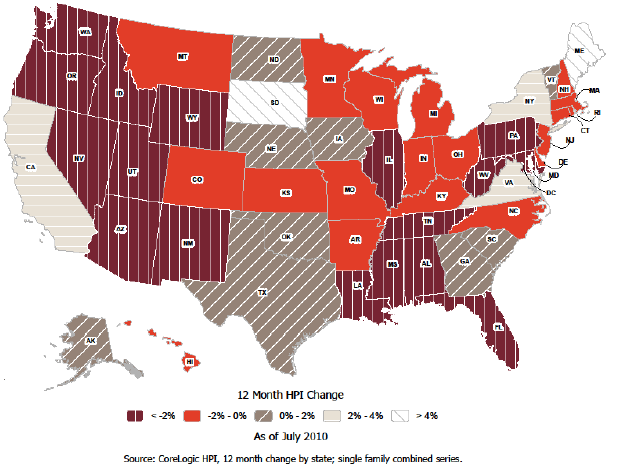
    SANTA ANA, Calif., September 15, 2010 – CoreLogic (NYSE: CLGX), a leading provider of information, analytics and business services, today released its Home Price Index (HPI) that showed that home prices in the U.S. remained flat in July as transaction volumes continue to decline. This was the first time in five months that no year-over-year gains were reported. According to the CoreLogic HPI, national home prices, including distressed sales showed no change in July 2010 compared to July 2009. June 2010 HPI showed a 2.4 percent* year-over-year gain compared to June 2009.

    “Although home prices were flat nationally, the majority of states experienced price declines and price declines are spreading across more geographies relative to a few months ago. Home prices fell in 36 states in July, nearly twice the number in May and the highest since last November when national home prices were declining,” said Mark Fleming, chief economist for CoreLogic.

    Methodology

    The CoreLogic HPI incorporates more than 30 years worth of repeat sales transactions, representing more than 55 million observations sourced from CoreLogic industry-leading property information and its securities and servicing databases. The CoreLogic HPI provides a multi-tier market evaluation based on price, time between sales, property type, loan type (conforming vs. nonconforming), and distressed sales. The CoreLogic HPI is a repeat-sales index that tracks increases and decreases in sales prices for the same homes over time, which provides a more accurate “constant-quality” view of pricing trends than basing analysis on all home sales. The CoreLogic HPI provides the most comprehensive set of monthly home price indices and median sales prices available covering 6,208 ZIP codes (58 percent of total U.S. population), 572 Core Based Statistical Areas (85 percent of total U.S. population) and 1,027 counties (82 percent of total U.S. population) located in all 50 states and the District of Columbia.


    See the above article for additional charts

    Beazer Homes Warns on Orders

    The Wall Street Journal reports Beazer Homes Warns of Order Miss

    Beazer Homes USA Inc. said Wednesday it might miss order expectations for its fiscal-fourth quarter, as it also cut estimates for the year’s land and development spending, reflecting the sector’s weakness following the expiration of home-buyer tax credits.

    Last month, Beazer reported that its fiscal third-quarter loss was little changed because of a prior-year gain, while it reported a 73% surge in closings as buyers raced to qualify for the tax credit. Orders fell 33%.

    Inventory Soars

    Bloomberg reports U.S. Home Prices Face Three-Year Drop as Supply Gains

    The slide in U.S. home prices may have another three years to go as sellers add as many as 12 million more properties to the market.

    Shadow inventory — the supply of homes in default or foreclosure that may be offered for sale — is preventing prices from bottoming after a 28 percent plunge from 2006, according to analysts from Moody’s Analytics Inc., Fannie Mae, Morgan Stanley and Barclays Plc. Those properties are in addition to houses that are vacant or that may soon be put on the market by owners.

    “Whether it’s the sidelined, shadow or current inventory, the issue is there’s more supply than demand,” said Oliver Chang, a U.S. housing strategist with Morgan Stanley in San Francisco. “Once you reach a bottom, it will take three or four years for prices to begin to rise 1 or 2 percent a year.”

    Sales of new and existing homes fell to the lowest levels on record in July as a federal tax credit for buyers expired and U.S.

    Rising supply threatens to undermine government efforts to boost the housing market as homebuyers wait for better deals. Further price declines are necessary for a sustainable rebound as a stimulus-driven recovery falters, said Joshua Shapiro, chief U.S. economist of Maria Fiorini Ramirez Inc., a New York economic forecasting firm

    There were 4 million homes listed with brokers for sale as of July. It would take a record 12.5 months for those properties to be sold at that month’s sales pace, according to the Chicago-based Realtors group [National Association of Realtors].

    “The best thing that could happen is for prices to get to a level that clears the market,” said Shapiro, who predicts prices may fall another 10 percent to 15 percent. “Right now, buyers know it hasn’t hit bottom, so they’re sitting on the sidelines.”

    About 2 million houses will be seized by lenders by the end of next year, according to Mark Zandi, chief economist of Moody’s Analytics in West Chester, Pennsylvania. He estimates prices will drop 5 percent by 2013.

    Douglas Duncan, chief economist for Washington-based Fannie Mae, said in a Bloomberg Radio interview last week that 7 million U.S. homes are vacant or in the foreclosure process. Morgan Stanley’s Chang said the number of bank-owned and foreclosure-bound homes that have yet to hit the market is closer to 8 million.

    Defaulted mortgages as of July took an average 469 days to reach foreclosure, up from 319 days in January 2009. That’s an indication lenders — with the help of the government loan modification programs — are delaying resolutions and preventing the market from flooding with distressed properties, said Herb Blecher, senior vice president for analytics at LPS.“The efforts to date have been worthwhile,” Blecher said in a telephone interview from Denver. “They both helped borrowers stay in their homes and kept that supply of distressed properties on the market somewhat limited.”

    I disagree with Herb Blecher. I see little advantage stretching this mess out for a decade, and that is what the government seems hell-bent on doing. Everyone wants the government to “do something”. Unfortunately tax credits stimulated the production of new homes, ultimately adding to inventory. Prices need to fall to levels where there is genuine demand.

    The short-term rise in the Case-Shiller home price index and the CoreLogic HPI was a mirage that will soon vanish in the reality of an inventory of 8 million homes that must eventually hit the market.

    Lost Decade

    About 2 million houses will be seized by lenders by the end of next year, according to Mark Zandi, chief economist of Moody’s Analytics in West Chester, Pennsylvania. He estimates prices will drop 5 percent by 2013.

    After reaching bottom, prices will gain at the historic annual pace of 3 percent, requiring more than 10 years to return to their peak, he said.

    Home Price Pressures

    Last Bubble Not Reblown

    After the bottom is found, remember the axiom: the last bubble is not reblown for decades. Look at the Nasdaq, still off more than 50% from a decade ago.

    The odds home prices return to their peak in 10 years is close to zero. Houses in bubble areas may never return to peak levels in existing owner’s lifetimes. Zandi is way overoptimistic in his assessment of 3% annual appreciation after the bottom is found.

    Price Stagnation 

    I expect small nominal increases after housing bottoms, but negative appreciation in real terms as inflation picks up in the second half of the decade. Yes, deflation will eventually end. Alternatively the US goes in and out of deflation for a decade (depending on how much the Fed and Congress acts to prevent a much needed bottom). Either way, look for price stagnation in one form or another.

    Thus, if you have come to the conclusion there is no good reason to hold on to a deeply underwater home, nor any reason to rush into a home purchase at this time, you have reached the right conclusions.

    Hyperinflation? Please be serious.

    When Will Housing Bottom?

    Flashback October 25, 2007: When Will Housing Bottom?

    On the basis of mortgage rate resets and a consumer led recession I mentioned a possible bottom in the 2011-2012 timeframe. See Housing – The Worst Is Yet To Come for more details.

    Let’s take a look at housing from another perspective: new home sales historic averages and housing from 1963 to present.

    New Home Sales 1963 – Present

    New home sales reached a cyclical high in 2004-2005 approximately 50-60% higher than previous peaks.This happened in spite of a slowdown in population growth and household formation as compared to the 1960-1980 timeframe.

    From 1997-1998 and 2001-2002 to the recent peak, the average sales level was 1.1 million units, or 45-50% higher than the 40 year average. This translates to an average of 300,000-400,000 excess homes for nearly a decade, and arguably as many as 3-4 million excess homes.

    Such excess inventory may require as many as 5-7 years at recessionary average sales to absorb this inventory.

    Cycle Excesses Greatest In History

    The excesses of the current cycle have never been greater in history. The odds are strong that we have seen secular as opposed to cyclical peaks in housing starts and new single family home construction. With that in mind it is highly unlikely we merely return to the trend. If history repeats, and there is every reason it will, we are going to undercut those long term trendlines.

    There will be additional pressures a few years down the road when empty nesters and retired boomers start looking to downsize. Who will be buying those McMansions? Immigration also comes into play. If immigration policies and protectionism get excessively restrictive, that can also lengthen the decline.

    Finally, note that the current boom has lasted well over twice as long as any other. If the bust lasts twice as long as any other, 2012 just might be a rather optimist target for a bottom.

    When I wrote that in 2007, most thought I was off my rocker. Now, based on inventory, I may have been far too optimistic.

    Mike “Mish” Shedlock
    http://globaleconomicanalysis.blogspot.com See the above article for additional charts

    Beazer Homes Warns on Orders

    The Wall Street Journal reports Beazer Homes Warns of Order Miss

    Beazer Homes USA Inc. said Wednesday it might miss order expectations for its fiscal-fourth quarter, as it also cut estimates for the year’s land and development spending, reflecting the sector’s weakness following the expiration of home-buyer tax credits.

    Last month, Beazer reported that its fiscal third-quarter loss was little changed because of a prior-year gain, while it reported a 73% surge in closings as buyers raced to qualify for the tax credit. Orders fell 33%.

    Inventory Soars

    Bloomberg reports U.S. Home Prices Face Three-Year Drop as Supply Gains

    The slide in U.S. home prices may have another three years to go as sellers add as many as 12 million more properties to the market.

    Shadow inventory — the supply of homes in default or foreclosure that may be offered for sale — is preventing prices from bottoming after a 28 percent plunge from 2006, according to analysts from Moody’s Analytics Inc., Fannie Mae, Morgan Stanley and Barclays Plc. Those properties are in addition to houses that are vacant or that may soon be put on the market by owners.

    “Whether it’s the sidelined, shadow or current inventory, the issue is there’s more supply than demand,” said Oliver Chang, a U.S. housing strategist with Morgan Stanley in San Francisco. “Once you reach a bottom, it will take three or four years for prices to begin to rise 1 or 2 percent a year.”

    Sales of new and existing homes fell to the lowest levels on record in July as a federal tax credit for buyers expired and U.S.

    Rising supply threatens to undermine government efforts to boost the housing market as homebuyers wait for better deals. Further price declines are necessary for a sustainable rebound as a stimulus-driven recovery falters, said Joshua Shapiro, chief U.S. economist of Maria Fiorini Ramirez Inc., a New York economic forecasting firm

    There were 4 million homes listed with brokers for sale as of July. It would take a record 12.5 months for those properties to be sold at that month’s sales pace, according to the Chicago-based Realtors group [National Association of Realtors].

    “The best thing that could happen is for prices to get to a level that clears the market,” said Shapiro, who predicts prices may fall another 10 percent to 15 percent. “Right now, buyers know it hasn’t hit bottom, so they’re sitting on the sidelines.”

    About 2 million houses will be seized by lenders by the end of next year, according to Mark Zandi, chief economist of Moody’s Analytics in West Chester, Pennsylvania. He estimates prices will drop 5 percent by 2013.

    Douglas Duncan, chief economist for Washington-based Fannie Mae, said in a Bloomberg Radio interview last week that 7 million U.S. homes are vacant or in the foreclosure process. Morgan Stanley’s Chang said the number of bank-owned and foreclosure-bound homes that have yet to hit the market is closer to 8 million.

    Defaulted mortgages as of July took an average 469 days to reach foreclosure, up from 319 days in January 2009. That’s an indication lenders — with the help of the government loan modification programs — are delaying resolutions and preventing the market from flooding with distressed properties, said Herb Blecher, senior vice president for analytics at LPS.

    “The efforts to date have been worthwhile,” Blecher said in a telephone interview from Denver. “They both helped borrowers stay in their homes and kept that supply of distressed properties on the market somewhat limited.”

    I disagree with Herb Blecher. I see little advantage stretching this mess out for a decade, and that is what the government seems hell-bent on doing. Everyone wants the government to “do something”. Unfortunately tax credits stimulated the production of new homes, ultimately adding to inventory. Prices need to fall to levels where there is genuine demand.

    The short-term rise in the Case-Shiller home price index and the CoreLogic HPI was a mirage that will soon vanish in the reality of an inventory of 8 million homes that must eventually hit the market.

    Lost Decade

    About 2 million houses will be seized by lenders by the end of next year, according to Mark Zandi, chief economist of Moody’s Analytics in West Chester, Pennsylvania. He estimates prices will drop 5 percent by 2013.

    After reaching bottom, prices will gain at the historic annual pace of 3 percent, requiring more than 10 years to return to their peak, he said.

     Home Price Pressures

    Last Bubble Not Reblown

    After the bottom is found, remember the axiom: the last bubble is not reblown for decades. Look at the Nasdaq, still off more than 50% from a decade ago.

    The odds home prices return to their peak in 10 years is close to zero. Houses in bubble areas may never return to peak levels in existing owner’s lifetimes. Zandi is way overoptimistic in his assessment of 3% annual appreciation after the bottom is found.

    Price Stagnation 

    I expect small nominal increases after housing bottoms, but negative appreciation in real terms as inflation picks up in the second half of the decade. Yes, deflation will eventually end. Alternatively the US goes in and out of deflation for a decade (depending on how much the Fed and Congress acts to prevent a much needed bottom). Either way, look for price stagnation in one form or another.

    Thus, if you have come to the conclusion there is no good reason to hold on to a deeply underwater home, nor any reason to rush into a home purchase at this time, you have reached the right conclusions.

    Hyperinflation? Please be serious.

    When Will Housing Bottom?

    Flashback October 25, 2007: When Will Housing Bottom?

    On the basis of mortgage rate resets and a consumer led recession I mentioned a possible bottom in the 2011-2012 timeframe. See Housing – The Worst Is Yet To Come for more details.

    Let’s take a look at housing from another perspective: new home sales historic averages and housing from 1963 to present.

    New Home Sales 1963 – Present

    New home sales reached a cyclical high in 2004-2005 approximately 50-60% higher than previous peaks.This happened in spite of a slowdown in population growth and household formation as compared to the 1960-1980 timeframe.

    From 1997-1998 and 2001-2002 to the recent peak, the average sales level was 1.1 million units, or 45-50% higher than the 40 year average. This translates to an average of 300,000-400,000 excess homes for nearly a decade, and arguably as many as 3-4 million excess homes.

    Such excess inventory may require as many as 5-7 years at recessionary average sales to absorb this inventory.

    Cycle Excesses Greatest In History

    The excesses of the current cycle have never been greater in history. The odds are strong that we have seen secular as opposed to cyclical peaks in housing starts and new single family home construction. With that in mind it is highly unlikely we merely return to the trend. If history repeats, and there is every reason it will, we are going to undercut those long term trendlines.

    There will be additional pressures a few years down the road when empty nesters and retired boomers start looking to downsize. Who will be buying those McMansions? Immigration also comes into play. If immigration policies and protectionism get excessively restrictive, that can also lengthen the decline.

    Finally, note that the current boom has lasted well over twice as long as any other. If the bust lasts twice as long as any other, 2012 just might be a rather optimist target for a bottom.

    When I wrote that in 2007, most thought I was off my rocker. Now, based on inventory, I may have been far too optimistic.

    Mike “Mish” Shedlock
    http://globaleconomicanalysis.blogspot.com

  • Could 62 Million Homes be Foreclosure Proof?, Fox News


    Homeowners’ Rebellion: Could 62 Million Homes Be Foreclosure-Proof?


    In fear of losing your home? Good news … there is a loophole in the system that could keep you right where you are! So what’s the secret? Watch Attorney Bob Massi’s solution below, and may we suggest a paper and pen to jot down all the details.

    Over 62 million mortgages are now held in the name of MERS, an electronic recording system devised by and for the convenience of the mortgage industry. A California bankruptcy court, following landmark cases in other jurisdictions, recently held that this electronic shortcut makes it impossible for banks to establish their ownership of property titles—and therefore to foreclose on mortgaged properties. The logical result could be 62 million homes that are foreclosure-proof.

    Mortgages bundled into securities were a favorite investment of speculators at the height of the financial bubble leading up to the crash of 2008. The securities changed hands frequently, and the companies profiting from mortgage payments were often not the same parties that negotiated the loans. At the heart of this disconnect was the Mortgage Electronic Registration System, or MERS, a company that serves as the mortgagee of record for lenders, allowing properties to change hands without the necessity of recording each transfer.

    MERS was convenient for the mortgage industry, but courts are now questioning the impact of all of this financial juggling when it comes to mortgage ownership. To foreclose on real property, the plaintiff must be able to establish the chain of title entitling it to relief. But MERS has acknowledged, and recent cases have held, that MERS is a mere “nominee”—an entity appointed by the true owner simply for the purpose of holding property in order to facilitate transactions. Recent court opinions stress that this defect is not just a procedural but is a substantive failure, one that is fatal to the plaintiff’s legal ability to foreclose.

    That means hordes of victims of predatory lending could end up owning their homes free and clear—while the financial industry could end up skewered on its own sword.

    California Precedent

    The latest of these court decisions came down in California on May 20, 2010, in a bankruptcy case called In re Walker, Case no. 10-21656-E–11. The court held that MERS could not foreclose because it was a mere nominee; and that as a result, plaintiff Citibank could not collect on its claim. The judge opined:

    Since no evidence of MERS’ ownership of the underlying note has been offered, and other courts have concluded that MERS does not own the underlying notes, this court is convinced that MERS had no interest it could transfer to Citibank. Since MERS did not own the underlying note, it could not transfer the beneficial interest of the Deed of Trust to another. Any attempt to transfer the beneficial interest of a trust deed without ownership of the underlying note is void under California law.

    In support, the judge cited In Re Vargas (California Bankruptcy Court); Landmark v. Kesler (Kansas Supreme Court); LaSalle Bank v. Lamy (a New York case); and In Re Foreclosure Cases (the “Boyko” decision from Ohio Federal Court). (For more on these earlier cases, see here, here and here.) The court concluded:

    Since the claimant, Citibank, has not established that it is the owner of the promissory note secured by the trust deed, Citibank is unable to assert a claim for payment in this case.

    The broad impact the case could have on California foreclosures is suggested by attorney Jeff Barnes, who writes:

    This opinion . . . serves as a legal basis to challenge any foreclosure in California based on a MERS assignment; to seek to void any MERS assignment of the Deed of Trust or the note to a third party for purposes of foreclosure; and should be sufficient for a borrower to not only obtain a TRO [temporary restraining order] against a Trustee’s Sale, but also a Preliminary Injunction barring any sale pending any litigation filed by the borrower challenging a foreclosure based on a MERS assignment.

    While not binding on courts in other jurisdictions, the ruling could serve as persuasive precedent there as well, because the court cited non-bankruptcy cases related to the lack of authority of MERS, and because the opinion is consistent with prior rulings in Idaho and Nevada Bankruptcy courts on the same issue.

    What Could This Mean for Homeowners?

    Earlier cases focused on the inability of MERS to produce a promissory note or assignment establishing that it was entitled to relief, but most courts have considered this a mere procedural defect and continue to look the other way on MERS’ technical lack of standing to sue. The more recent cases, however, are looking at something more serious. If MERS is not the title holder of properties held in its name, the chain of title has been broken, and no one may have standing to sue. In MERS v. Nebraska Department of Banking and Finance, MERS insisted that it had no actionable interest in title, and the court agreed.

    An August 2010 article in Mother Jones titled “Fannie and Freddie’s Foreclosure Barons” exposes a widespread practice of “foreclosure mills” in backdating assignments after foreclosures have been filed. Not only is this perjury, a prosecutable offense, but if MERS was never the title holder, there is nothing to assign. The defaulting homeowners could wind up with free and clear title.

    In Jacksonville, Florida, legal aid attorney April Charney has been using the missing-note argument ever since she first identified that weakness in the lenders’ case in 2004. Five years later, she says, some of the homeowners she’s helped are still in their homes. According to a Huffington Post article titled “‘Produce the Note’ Movement Helps Stall Foreclosures”:

    Because of the missing ownership documentation, Charney is now starting to file quiet title actions, hoping to get her homeowner clients full title to their homes (a quiet title action ‘quiets’ all other claims). Charney says she’s helped thousands of homeowners delay or prevent foreclosure, and trained thousands of lawyers across the country on how to protect homeowners and battle in court.

    Criminal Charges?

    Other suits go beyond merely challenging title to alleging criminal activity. On July 26, 2010, a class action was filed in Florida seeking relief against MERS and an associated legal firm for racketeering and mail fraud. It alleges that the defendants used “the artifice of MERS to sabotage the judicial process to the detriment of borrowers;” that “to perpetuate the scheme, MERS was and is used in a way so that the average consumer, or even legal professional, can never determine who or what was or is ultimately receiving the benefits of any mortgage payments;” that the scheme depended on “the MERS artifice and the ability to generate any necessary ‘assignment’ which flowed from it;” and that “by engaging in a pattern of racketeering activity, specifically ‘mail or wire fraud,’ the Defendants . . . participated in a criminal enterprise affecting interstate commerce.”

    Local governments deprived of filing fees may also be getting into the act, at least through representatives suing on their behalf. Qui tam actions allow for a private party or “whistle blower” to bring suit on behalf of the government for a past or present fraud on it. In State of California ex rel. Barrett R. Bates, filed May 10, 2010, the plaintiff qui tam sued on behalf of a long list of local governments in California against MERS and a number of lenders, including Bank of America, JPMorgan Chase and Wells Fargo, for “wrongfully bypass[ing] the counties’ recording requirements; divest[ing] the borrowers of the right to know who owned the promissory note . . .; and record[ing] false documents to initiate and pursue non-judicial foreclosures, and to otherwise decrease or avoid payment of fees to the Counties and the Cities where the real estate is located.” The complaint notes that “MERS claims to have ‘saved’ at least $2.4 billion dollars in recording costs,” meaning it has helped avoid billions of dollars in fees otherwise accruing to local governments. The plaintiff sues for treble damages for all recording fees not paid during the past ten years, and for civil penalties of between $5,000 and $10,000 for each unpaid or underpaid recording fee and each false document recorded during that period, potentially a hefty sum. Similar suits have been filed by the same plaintiff qui tam in Nevada and Tennessee.

    By Their Own Sword: MERS’ Role in the Financial Crisis

    MERS is, according to its website, “an innovative process that simplifies the way mortgage ownership and servicing rights are originated, sold and tracked. Created by the real estate finance industry, MERS eliminates the need to prepare and record assignments when trading residential and commercial mortgage loans.” Or as Karl Denninger puts it, “MERS’ own website claims that it exists for the purpose of circumventing assignments and documenting ownership!”

    MERS was developed in the early 1990s by a number of financial entities, including Bank of America, Countrywide, Fannie Mae, and Freddie Mac, allegedly to allow consumers to pay less for mortgage loans. That did not actually happen, but what MERS did allow was the securitization and shuffling around of mortgages behind a veil of anonymity. The result was not only to cheat local governments out of their recording fees but to defeat the purpose of the recording laws, which was to guarantee purchasers clean title. Worse, MERS facilitated an explosion of predatory lending in which lenders could not be held to account because they could not be identified, either by the preyed-upon borrowers or by the investors seduced into buying bundles of worthless mortgages. As alleged in a Nevada class action called Lopez vs. Executive Trustee Services, et al.:

    Before MERS, it would not have been possible for mortgages with no market value . . . to be sold at a profit or collateralized and sold as mortgage-backed securities. Before MERS, it would not have been possible for the Defendant banks and AIG to conceal from government regulators the extent of risk of financial losses those entities faced from the predatory origination of residential loans and the fraudulent re-sale and securitization of those otherwise non-marketable loans. Before MERS, the actual beneficiary of every Deed of Trust on every parcel in the United States and the State of Nevada could be readily ascertained by merely reviewing the public records at the local recorder’s office where documents reflecting any ownership interest in real property are kept….

    After MERS, . . . the servicing rights were transferred after the origination of the loan to an entity so large that communication with the servicer became difficult if not impossible …. The servicer was interested in only one thing – making a profit from the foreclosure of the borrower’s residence – so that the entire predatory cycle of fraudulent origination, resale, and securitization of yet another predatory loan could occur again. This is the legacy of MERS, and the entire scheme was predicated upon the fraudulent designation of MERS as the ‘beneficiary’ under millions of deeds of trust in Nevada and other states.

    Axing the Bankers’ Money Tree

    If courts overwhelmed with foreclosures decide to take up the cause, the result could be millions of struggling homeowners with the banks off their backs, and millions of homes no longer on the books of some too-big-to-fail banks. Without those assets, the banks could again be looking at bankruptcy. As was pointed out in a San Francisco Chronicle article by attorney Sean Olender following the October 2007 Boyko [pdf] decision:

    The ticking time bomb in the U.S. banking system is not resetting subprime mortgage rates. The real problem is the contractual ability of investors in mortgage bonds to require banks to buy back the loans at face value if there was fraud in the origination process.

    . . . The loans at issue dwarf the capital available at the largest U.S. banks combined, and investor lawsuits would raise stunning liability sufficient to cause even the largest U.S. banks to fail . . . .

    Nationalization of these giant banks might be the next logical step—a step that some commentators said should have been taken in the first place. When the banking system of Sweden collapsed following a housing bubble in the 1990s, nationalization of the banks worked out very well for that country.

    The Swedish banks were largely privatized again when they got back on their feet, but it might be a good idea to keep some banks as publicly-owned entities, on the model of the Commonwealth Bank of Australia. For most of the 20th century it served as a “people’s bank,” making low interest loans to consumers and businesses through branches all over the country.

    With the strengthened position of Wall Street following the 2008 bailout and the tepid 2010 banking reform bill, the U.S. is far from nationalizing its mega-banks now. But a committed homeowner movement to tear off the predatory mask called MERS could yet turn the tide. While courts are not likely to let 62 million homeowners off scot free, the defect in title created by MERS could give them significant new leverage at the bargaining table.

    Ellen Brown wrote this article for YES! Magazine, a national, nonprofit media organization that fuses powerful ideas with practical actions. Ellen developed her research skills as an attorney practicing civil litigation in Los Angeles. In Web of Debt, her latest of eleven books, she shows how the Federal Reserve and “the money trust” have usurped the power to create money from the people themselves, and how we the people can get it back. Her websites are webofdebt.com, ellenbrown.com, and public-banking.com.

  • Facing Foreclosure? What To Do Right Now, by Jerry DeMuth, HouseLogic.com


    If you’re facing foreclosure, don’t panic: Take steps right now to save your home or at least lessen the blow of its loss.

    A record high 2.8 million properties were hit with foreclosure notices (http://www.realtytrac.com/contentmanagement/pressrelease.aspx?channelid=9&accnt=0&itemid=8333) in 2009. That’s the bad news. The good news: About two-thirds of notices don’t result in actual foreclosures, says Doug Robinson of NeighborWorks, a nonprofit group that offers foreclosure counseling.

    Many homeowners find alternatives to foreclosure by negotiating with lenders, often with the help of foreclosure counselors. If you’re facing foreclosure, call your lender right now to determine your options, which can include loan modification, forbearance, or a short sale.

    Foreclosure process takes time

    The entire foreclosure process (http://portal.hud.gov/portal/page/portal/HUD/topics/avoiding_foreclosure/foreclosureprocess) can take anywhere from two to 12 months, depending on how fast your lender acts and where you live. Some states allow a nonjudicial process that’s speedier, while others require time-consuming judicial proceedings.

    Once you miss at least one mortgage payment, the steps leading up to an actual foreclosure sale can include demand letters, notices of default, a recorded notice of foreclosure, publication of the debt, and the scheduling of a foreclosure auction. Even when an auction is scheduled, however, it may never occur, or it may occur but a qualified buyer doesn’t materialize.

    Bottom line: Foreclosure can be a long slog, which gives you enough time to come up with an alternative. Meantime, if your goal is to salvage your home, think about keeping up with payments for homeowners insurance and property taxes. Otherwise, you could compound your problems by getting hit with an uncovered casualty loss or liability suit, or tax liens.

    Read the fine print

    Start by reviewing all correspondence you’ve received from your lender. The letters–and phone calls–probably began once you were 30 days past due. Also review your mortgage documents, which should outline what steps your lender can take. For instance, is there a “power of sale” clause that authorizes the sale of your home to pay off a mortgage after you miss payments?

    Determine the specific foreclosure laws (http://www.foreclosurelaw.org) for your state. What’s the timeline? Do you have “right of redemption,” essentially a grace period in which you can reverse a foreclosure? Are deficiency judgments that hold you responsible for the difference between what your home sells for and your loan’s outstanding balance allowed? Get answers.

    Pick up the phone

    Don’t give up because you missed a mortgage payment or two and received a notice of default. Foreclosure isn’t a foregone conclusion, but it’s heading in that direction if you don’t call your lender. Dial the number on your mortgage statement, and ask for the Loss Mitigation Department. You might stay on hold for a while, but don’t hang up. Once you do get someone on the line, take notes and record names.

    The next call should be to a foreclosure avoidance counselor (http://www.hud.gov/offices/hsg/sfh/hcc/fc/) approved by the U.S. Department of Housing and Urban Development. One of these counselors can, free of charge, explain your state’s foreclosure laws, discuss alternatives to foreclosure, help you organize financial documents, and even represent you in negotiations with your lender. Be wary of unsolicited offers of help, since foreclosure rescue scams (http://www.houselogic.com/articles/avoid-foreclosure-rescue-scams/) are common.

    Be sure to let your lender know that you’re working with a counselor. Not only does it demonstrate your resolve, but according to NeighborWorks, homeowners who receive foreclosure counseling are 1.6 times more likely to avoid losing their homes than those who don’t. Homeowners who receive loan modifications with the help of a counselor also reduce monthly mortgage payments (http://www.nw.org/newsroom/pressReleases/2009/netNews111809.asp) by $454 more than homeowners who receive a modification without the aid of a counselor.

    Lender alternatives to foreclosure

    Hope Now (http://www.hopenow.com), an alliance of mortgage companies and housing counselors, can aid homeowners facing foreclosure. A self-assessment tool will give you an idea whether you might be eligible for help from your lender, and there are direct links to HUD-approved counseling agencies and lenders’ foreclosure-prevention programs.

    There are alternatives to foreclosure that your lender might accept. The most attractive option that’ll allow you to keep your home is a loan modification that reduces your monthly payment. A modification can entail lowering the interest rate, changing a loan from an adjustable rate to a fixed rate, extending the term of a loan, or eliminating past-due balances. Another option, forbearance, can temporarily suspend payments, though the amount will likely be tacked on to the end of the loan.

    If you’re unable to make even reduced payments, and assuming a conventional sale isn’t possible, then it may be best to turn your home over to your lender before a foreclosure is completed. A completed foreclosure can decimate a credit score, which will make it hard not only to purchase another home someday, but also to rent a home in the immediate future.

    Your lender can approve a short sale, in which the proceeds are less than what’s still owed on your mortgage. A deed-in-lieu of foreclosure, which amounts to handing over your keys to your lender, is another possibility. The earlier you begin talks with your lender, the more likelihood of success.

    Explore government programs

    The federal government’s Making Home Affordable (http://www.makinghomeaffordable.gov/) program offers two options: loan modification (http://www.houselogic.com/articles/making-home-affordable-modification-option/) and refinancing (http://www.houselogic.com/articles/making-home-affordable-refinance-option/). A self-assessment will indicate which option might be right for you, but you need to apply for the program through your lender. A Making Home Affordable loan modification requires a three-month trial period before it can become permanent.

    Fannie Mae and Freddie Mac have their own foreclosure-prevention programs as well. Check to determine if either Fannie (http://www.fanniemae.com/loanlookup) or Freddie (http://www.freddiemac.com/mymortgage) owns your mortgage. Present this information to your lender and your counselor. Fannie and Freddie also have rental programs under which former owners can remain in recently foreclosed homes on a month-to-month basis.

    The federal Home Affordable Foreclosure Alternatives (https://www.hmpadmin.com/portal/programs/foreclosure_alternatives.html) program, which takes full effect in April 2010, offers lenders financial incentives to approve short sales and deeds-in-lieu of foreclosure. It also provides $3,000 in relocation assistance to borrowers. Again, talk to your lender and counselor.

  • Multnomahforeclosures.com: Bank Owned Property List Update for August 2010


    August REO list for bank owned property has been added to Multnomahforeclosures.com . REO lists for Clackamas, Multnomah and Washington County has been addd to the site. The homes listed in these files were deeded back or returned to the investor or lender due to the finalizing of the foreclosure process. Many of these homes may already be on the market or will soon will be. It would not be a bad idea to contact the new owner of these properties and find out what their plans are when it comes to their future ownership of the property.

    Multnomah County Foreclosures
    http://multnomahforeclosures.com

  • Multnomahforeclosures.com: Updated Notice Of Default Lists and Books


    Multnomahforeclosures.com was updated with the largest list of Notice Defaults to date. With Notice of Default records dating back over 2 years. Multnomahforeclosures.com documents the fall of the great real estate bust of the 21st centry. The lists are of the raw data taken from county records.

    It is not a bad idea for investors and people that are seeking a home of their own to keep an eye on the Notice of Default lists. Many of the homes listed are on the market or will be.

    All listings are in PDF and Excel Spread Sheet format.

    Multnomah County Foreclosures

    http://multnomahforeclosures.com

  • How Ruthless Banks Gutted the Black Middle Class and Got Away With It, by Devona Walker, Truth-out.org


    The real estate and foreclosure crisis has stripped African-American families of more wealth than any single event in history.

    The American middle class has been hammered over the last several decades. The black middle class has suffered to an even greater degree. But the single most crippling blow has been the real estate and foreclosure crisis. It has stripped black families of more wealth than any single event in U.S. history. Due entirely to subprime loans, black borrowers are expected to lose between $71 billion and $92 billion.

    To fully understand why the foreclosure crisis has so disproportionately affected working- and middle-class blacks, it is important to provide a little background. Many of these American families watched on the sidelines as everyone and their dog seemed to jump into the real estate game. The communities they lived in were changing, gentrifying, and many blacks unable to purchase homes were forced out as new homeowners moved in. They were fed daily on the benefits of home ownership. Their communities, churches and social networks were inundated by smooth-talking but shady fly-by-night brokers. With a home, they believed, came stability, wealth and good schools for their children. Home ownership, which accounts for upwards of 80 percent of the average American family’s wealth, was the basis of permanent membership into the American middle class. They were primed to fall for the American Dream con job.

    Black and Latino minorities have been disproportionately targeted and affected by subprime loans. In California, one-eighth of all residences, or 702,000 homes, are in foreclosure. Black and Latino families make up more than half that number. Latino and African-American borrowers in California, according to figures from the Center for Responsible Lending, have foreclosure rates 2.3 and 1.9 times that of non-Hispanic white families.

    There is little indication that things will get much better any time soon.

    The Ripple Effect

    If anything, the foreclosure crisis is likely to produce a ripple effect that will continue to decimate communities of color. Think about the long-term impact of vacant homes on the value of neighborhoods, and about the corresponding increase in crime, vandalism and shrinking tax bases for municipal budgets.

    “The American dream for individuals has now become the nightmare for cities,” said James Mitchell, a councilman in Charlotte, NC who heads the National Black Caucus of Local Elected Officials. In the nearby community of Peachtree Hills, he says roughly 115 out of 123 homes are in foreclosure. In that environment, it’s impossible for the remaining homeowners to sell, as their property values have been severely depressed. Their quality of life, due to increases in vandalism and crime, diminished. The cities then feel the strap of a receding tax base at the same time there is a huge surge in the demand for public services.

    Charlotte, N.C. Baltimore, Detroit, Washington D.C. Memphis, Atlanta, New Orleans, Chicago and Philadelphia have historically been bastions for the black middle class. In 2008, roughly 10 percent of the nation’s 40 million blacks made upwards of $75,000 per year. But now, just two years later, many experts say the foreclosure crisis has virtually erased decades of those slow, hard-fought, economic gains.

    Memphis, where the majority of residents are black, remains a symbol of black prosperity in the new South. There, the median income for black homeowners rose steadily for two decades. In the last five years, income levels for black households have receded to below what they were in 1990, according to analysis by Queens College.

    As of December 2009, median white wealth had dipped 34 percent while median black wealth had dropped 77 percent, according to the Economic Policy Institute’s “State of Working America” report.

    “Emerging” Markets Scam v. Black Credit Crunch

    While the subprime loans were flowing, communities of color had access to a seemingly endless amount of funding. In 1990, one million refinance loans were issued. It was the same for home improvement and refinance loans. By 2003, 15 million refinance loans were issued. That directly contributed to billions in loss equity, especially among minority and elderly homeowners. Also at the same time, banks developed “emerging markets” divisions that specifically targeted under-served communities of color. In 2003, subprime loans were more prevalent among blacks in 98.5 percent of metropolitan areas, according to the National Community Reinvestment Coalition.

    One former Wells Fargo loan officer testifying in a lawsuit filed by the city of Baltimore against the bank says fellow employers routinely referred to subprime loans as “ghetto loans” and black people as “mud people.” He says he was reprimanded for not pushing higher priced loans to black borrowers who qualified for prime or cheaper loans. Another loan officer, Beth Jacobson, says the black community was seen “as fertile ground for subprime mortgages, as working-class blacks were hungry to be a part of the nation’s home-owning mania.”

    “We just went right after them,” Jacobson said, according to the New York Times, adding that the black church was frequently targeted as the bank believed church leaders could convince their congregations to take out loans. There are numerous reports throughout the nation of black church leaders being paid incentives for drumming up business.

    Due in part to these aggressive marketing techniques and ballooning emerging market divisions, subprime mortgage activity grew an average of 25 percent per year from 1994 to 2003, drastically outpacing the growth for prime mortgages. In 2003, subprime loans made up 9 percent of all U.S. mortgages, about a $330 billion business; up from $35 billion a decade earlier.

    Now that the subprime market has imploded, banks have all but abandoned those communities. Prime lending in communities of color has decreased 60 percent while prime lending in white areas has fallen 28.4 percent.

    The banks are also denying credit to small-business owners, who account for a huge swath of ethnic minorities. In California ethnic minorities account for 16 percent of all small-business loans. In the mid-2000s roughly 90 percent of businesses reported they received the loans they needed. Only half of small businesses that tried to borrow received all or most of what they needed last year, according to a survey by the National Federation of Independent Business.

    In addition, minority business owners often have less capital, smaller payrolls and shorter histories with traditional lending institutions.

    Further complicating matters is the fact that minority small-business owners often serve minority communities and base their business decisions on things that traditional lenders don’t fully understand. Think about the black barber shop or boutique owner, who knows there is no other “black” barber shop or boutique specializing in urban fashions within a 30-minute drive. While that lender may understand there is such a niche market as “urban fashions,” they likely won’t understand the significance of being “black-owned” in the market as opposed to corporate-owned. Or think of the Hispanic grocer with significant import ties to Mexico who knows he can bring in produce, spices and inventory specific to that community’s needs, things people cannot get at chain grocery stores. That lender might only understand there is a plethora of Wal-Marts in the community where he wants to grow his business.

    Minority business owners are often more dependent upon minority communities for survival, which of course are disproportionately depressed due to subprime lending. Consequently, minority business owners have a lower chance of success. Banks, understanding that, are even less likely to lend. It’s like a self-fulfilling prophecy, and it’s beginning to resemble the traditional “redlining” of the 1980s and 1990s.

    “After inflicting harm on neighborhoods of color through years of problematic subprime and option ARM loans, banks are now pulling back at a time when communities are most in need of responsible loans and investment,” said Geoff Smith, senior vice president of the Woodstock Institute.

    Believe it or not, no one in a position of power to stop all this from unfolding was blindsided. Ben Bernanke was warned years ago about the long-term implications of the real estate bubble and subprime lending. Still, he set idly by. He told the advocates who warned him that the market would work it all out. Perhaps they thought the fallout would be limited to minority communities, or perhaps they just didn’t care.

    Devona Walker has worked for the Associated Press and the New York Times company. Currently she is the senior political and finance reporter for theloop21.com. 


  • Rescue from foreclosure? Frustration, anger grow, By Sanjay Bhatt, Seattletimes.com


    When he tried to change the terms of his home loan, Michael Guzman was rejected because the bank didn’t consider his joblessness a long-term hardship.

    Kamie Kahlo’s bank offered her a modified mortgage on her Queen Anne home but later told her the lower payments weren’t permanent.

    And Leslie Oldham was stunned her bank moved to foreclose on her Kent home before it gave her a decision on a loan modification.

    “I tried everything I could to work it out with the bank,” said Oldham, 58, “because the last thing I wanted to do was file a bankruptcy.”

    More than a year since President Obama announced an unprecedented national foreclosure-prevention program, many homeowners’ experiences with the program have left them feeling frustrated and angry at mortgage servicers.

    The program gives servicers financial incentives to permanently lower the monthly payments of homeowners who qualify for and successfully complete a three-month trial period. Servicers can modify a mortgage by lowering the interest rate, extending the loan’s terms or deferring payment of principal.

    Federal auditors say the Treasury Department has failed to hold banks and other servicers accountable for following the loan-modification program’s guidelines, and state regulators say there’s little they can do.

    Some examples from the Government Accountability Office:

    • Delayed decisions: After three months of accepting payments on a modified trial loan, banks are supposed to decide whether to make the new terms permanent. But some banks have a backlog of thousands of homeowners who have been making trial payments for six months or longer.

    • Inconsistent treatment: Fifteen of the 20 largest servicers in the program didn’t follow federal guidelines for evaluating borrowers’ loans and may have treated similarly situated borrowers differently.

    • No meaningful appeals: The Treasury does not independently review borrowers’ application or loan files, nor does it have clear penalties for servicers who violate the program’s rules.

    The program was intended to keep 3 million homeowners from foreclosure, but it had produced only about 435,000 permanent modifications through July.

    Treasury officials say the program’s impact can’t be measured by a single statistic. Many homeowners who were deemed ineligible for the federal program have been offered private loan modifications by their servicer.

    Still, six of every 10 seriously delinquent borrowers are not getting help, according to a new study by the State Foreclosure Prevention Working Group. Struggling homeowners are alienated by the mixed messages and long delays, the group said, and almost three-quarters of modified mortgages leave borrowers owing more, not less.

    “That is not a sustainable solution,” said Roberto Quercia, who consulted on the study and is director of the Center for Community Capital at the University of North Carolina, Chapel Hill. “For people underwater, making the hole deeper is a recipe for disaster.”

    Jumbled paperwork

    In March 2009, Treasury officials launched the federal Home Affordable Modification Program (HAMP), its cornerstone effort to rescue the nation’s housing market, in which property values have fallen at a rate not seen since the Great Depression.

    Homeowners must pass three tests to be considered: First, they must have an eligible hardship, such as unemployment. Second, their mortgage must exceed 31 percent of their gross monthly income.

    Finally, the bank applies a “net present value” test to see if it will lose more money from foreclosing on their home than from modifying the mortgage.

    Through July, homeowners in the program saw a median 36 percent, or more than $500, savings in their monthly payment after permanent modification, according to the Treasury.

    But the number of homeowners making trial payments who were dropped from the program — more than 600,000 — now exceeds the number with permanent modifications.

    “Paperwork has been the No. 1 reason homeowners have not been able to convert to permanent modifications,” Treasury spokeswoman Andrea Risotto said.

    The second most common reason, she said, is that homeowners are unable to keep up with payments during the trial period.

    Housing counselors and lawyers for homeowners say servicers misplace documents or wrongly reject eligible applicants for no good reason — even after they’ve made trial payments for six months or longer.

    “The servicers are claiming that the files are a mess or are incomplete,” said Marc Cote, a housing counselor who coordinates Washington state’s foreclosure-prevention hotline. “We have confirmation the fax was received. Then you call back in two days and there’s no record of it. That’s not uncommon.”

    Regulators at the state Department of Financial Institutions say they’ve been flooded with consumer complaints about mortgage issues — such as banks failing to properly credit homeowners for payments.

    Department director Scott Jarvis says a series of federal court decisions since 2002 has made it nearly impossible for regulators to force national banks and thrifts to comply with state consumer-protection laws.

    “It’s a massive shell game,” Jarvis said. “The pea is the consumer, and the consumer ends up getting shuffled around the shells and rarely gets anything resolved.”

    For their part, big banks and other servicers say they’re helping distressed borrowers, while being fair to the majority of homeowners who pay their mortgages on time.

    This year, Chase opened a loan-modification office in Tukwila that focuses on screening homeowners with Chase mortgages in Washington and Oregon.

    And a coalition of big banks recently announced support for a Web portal called HOPE LoanPort that housing counselors can use to submit complete applications, verify their receipt and get status updates.

    “In the end I think we all share a common goal, which is to help as many customers as possible stay in their homes,” said Rebecca Mairone, Bank of America’s national default-servicing executive.

    Left in limbo

    Cote, the housing counselor, recounts this story: On Aug. 6, a national bank told an elderly owner of an Issaquah house that her application for loan assistance — submitted March 3 — was still under review.

    A week later, a trustee let the bank repossess the woman’s house. The bank had denied the woman’s application but never notified her in writing, as required.

    “They’re violating the guidelines,” said Cote, whose agency doesn’t allow him to identify the national bank.

    Some Seattle-area homeowners echo Cote.

    Guzman, of Lake Stevens, has been unemployed for more than two years and was told — incorrectly — by Chase last year that his joblessness did not count as a permanent hardship.

    “Servicers continue to evolve their implementation of HAMP,” Chase said in a statement.

    Moreover, Chase said, it asked Guzman to reapply for loan assistance, but he has refused.

    Guzman said he’s already submitted paperwork three times.

    “Millions of people have gone through this wringer like I have,” he said.

    Kahlo, who bought her Queen Anne home in 1999, said she did everything Bank of America asked her to do to qualify for relief under the federal program.

    After the bank told her it wasn’t permanently modifying her mortgage, she sued, alleging it had violated the federal program’s rules.

    Bank of America sought to dismiss the suit, saying the lower monthly payment it offered her was an alternative to the federal program.

    “A participating servicer is not required to modify every HAMP-eligible loan,” the bank stated in court.

    Without a permanent modification, Kahlo says, she’s in limbo. “I don’t know if I’m sleeping in their home or my home,” she said.

    Declaring bankruptcy was a last resort for Oldham, a widow in Kent who manages payroll for a small construction company.

    But she believed she had no recourse because Bank of America foreclosed on the manufactured home she’s lived in for 15 years.

    Oldham said she got behind on her mortgage because of medical bills.

    She applied for a modification last year, but the bank tacked a foreclosure notice on her door before she received an answer.

    Oldham complained to the state Attorney General’s Office, which passed her on to the state Department of Financial Institutions. That department routinely forwards such complaints — about 540 so far this year — to federal regulators.

    With Oldham, though, the state department lost track of her complaint, finally sending it along last month.

    Sanjay Bhatt: 206-464-3103 or sbhatt@seattletimes.com