Category: Mortgage News

  • Credit Bubble Bulletin, Prudentbear.com


    The S&P 500 recorded a total return for the quarter of 12.59%, the best quarterly performance since 1998.  The S&P 400 Mid-caps returned 13.50%.  Apple gained 48%.  The Morgan Stanley High Tech index jumped 21.7%.  The Morgan Stanley Retail index (trading to a new all-time record high) rose 15.5%.  The S&P 500 Homebuilding index jumped 31.6%.  The German DAX increased 17.8%, Japan’s Nikkei 19.3%, and Brazil’s Bovespa 13.7%.
    For the quarter, total global corporate debt issuance of $1.16 TN just surpassed 2009’s first-quarter record.  According to Bloomberg, the $190bn issuance of developing nation debt was a new first quarter record – and was up about 50% from the year ago quarter.  At $433bn, U.S. corporate debt issuance posted a new first-quarter record.
    Today’s Bloomberg Headline:  “Corporates Beat Governments in Best Start Ever.”  According to Bank of America indices, global corporate bonds returned 3.85% for the quarter.  Investment grade corporate debt earned 3.36%, while junk bonds returned 7.04%.  European corporates returned 12.9%, led by an eye-catching 22% gain on Europe’s lowest rated corporate debt.  U.S. municipal debt returned about 2.0% for the quarter.  The benchmark Markit North American Investment Grade Credit defaults swap index posted its largest quarterly decline (28.6 bps, according to Bloomberg).
    Watching it all, I struggle even more with the notion of “financial repression.”  “Saver repression” and “bear suppression” make sense to me.  Returns for the rationally risk averse investor are being depressed, no doubt about that.  Yet it is an altogether different story for the financial speculator:  Instead of repression, it’s Financial Liberation.  Never has the investment landscape been so stacked against the saver and investor in favor of the speculator community.
    Over the years I’ve enjoyed Bill Gross’s monthly writings.  At times I’ve taken exception with his (and his colleagues’) macro analysis – and I’ve as well tipped my hat.  I look forward to his insights – plus there’s always the intrigue:  Will he don the hat of the savvy analyst, the yearning statesman or the master poker player?  No matter what, Mr. Gross sits enviably in the catbird’s seat overseeing history’s greatest Credit Bubble and financial mania.  These days I read with keen interest.
    Mr. Gross’s latest is cogent and insightful.  Our analytical frameworks share important commonalities, although this month he takes one giant leap of faith that I imagine most readers would easily gloss right over:  From Mr. Gross:  “On the whole, however, because of massive QEs and LTROs in the trillions of dollars, our credit based, leverage dependent financial system is actually leverage expanding, although only mildly andsystemically less threatening than before, as least from the standpoint of a growth rate.”  Systematically less threatening than before?  The $64 Trillion question.
    Along the lines of Mr. Gross’s view, I’ve held that notions of systemic deleveraging are largely urban myth.  Here in the U.S., household debt has been contracting mildly (from a historically extreme level).  The corporate balance sheet keeps expanding, although nothing compared to ballooning federal obligations.  For three years now I’ve posited the “global government finance Bubble” thesis.  There is overwhelming evidence supporting the “granddaddy of all Bubbles” view, not the least of which is that federal liabilities have doubled in only four years.
    I have posited the profound role played by “moneyness of Credit.”  Moneyness, in concert with Federal Reserve and global central bank policymaking, has allowed the U.S. Treasury to issue Trillions of (nonproductive) debt at the most meager of risk premiums.  Unprecedented federal debt issuance has been instrumental in ensuring ongoing total system Credit expansion, in the process inflating incomes, corporate cash flows, local government receipts, and asset prices generally.  The Greek government and economy also enjoyed moneyness for years as it accumulated hundreds of billions of unmanageable debt.  I would argue strongly that nothing could be more threatening to system stability than a massive issuance of public sector debt in response to a bursting private sector Credit Bubble.  Especially when government debt comprises the foundation of a frail mountain of system Credit, one cannot overstate the systemic risks associated with government Credit losing the perception of moneyness in the marketplace.
    This week was loaded plum full of fascinating central bank commentary.  Chairman Bernanke continued with his four-part college lecture series, “The Federal Reserve and the Financial Crisis.”  Defending extraordinary policy measures, Chairman Bernanke commented:  “We did stop the meltdown.  We avoided what would have been, I think, a collapse of the global financial system.”  Monday, Dr. Bernanke’s surprisingly dovish comments regarding labor market and economic weaknesses helped stoke U.S. equities and global risk markets (while pressuring our currency).  His comments emboldened those believing the Chairman is determined to go forward with additional quantitative easing come hell or high water.
    Noted Stanford professor (the “Taylor Rule”) and former Undersecretary of the Treasury, John Taylor, upped the pressure on the Fed a notch with his Wall Street Journal op-ed, “The Dangers of an Interventionist Fed.”  An economist after my own analytical heart, Dr. Taylor argues persuasively against the Fed’s interventionist approach, while reintroducing the old “rules versus discretion” central bank policymaking debate.  “For all these reasons, the Federal Reserve should move to a less interventionist and more rules-based policy of the kind that has worked in the past.”  Yes, sir.  Dr. Taylor also argues for the end to the Fed’s dual mandate, replacing it with a single goal of “long-term price stability.”  His provocative piece is worthy of a future CBB, but for now I’ll simply interject that a singular, although necessarily complex, goal of “long-term monetary stability” would be superior.
    And while we’re on the subject of monetary stability, Bundesbank President and ECB Governing Council member Jens Weidmann Wednesday presented provocative analysis in his “Rebalancing Europe” speech.  “Just like the ‘Tower of Babel,’ the ‘Wall of Money’ will never reach heaven.  If we continue to make it higher and higher, we will, in fact, run into more worldly constraints” that may include “incentives that lead to new problems in the future.”  “In any case, we must realise that all the money we put on the table will not buy us a lasting solution.”  The Germans/“Austrians” just have a very different way at looking at monetary and economic affairs.  They make sense.
    And yesterday from Market News International:  “Addressing the root causes of the ongoing crisis, Weidmann stressed that ‘Europe has to be rebalanced.’ While some have argued that both countries with persistent current account deficits and surpluses have to make changes, Weidmann stressed that it is the deficit states that need to adjust.  ‘It is true that surplus countries have benefited through higher exports.  But ultimately, it was the deficit countries that operated an unsustainable model defined by a credit-fuelled boom in domestic demand, and this model has to be reformed… And we must acknowledge that surplus countries are already helping to ease the burden of adjustment…  What are the rescue packages other than publicly guaranteed interim loans to facilitate the adjustment?’   …Turning to the ‘central fear’ of deflation, Weidmann conceded that prices and wages would fall as fiscal and other economic adjustments take place. ‘But we must not confuse such a one-time adjustment with full-fledged deflation.’”
    Between Taylor and Weidmann, it’s tempting to proclaim that the focus of monetary analysis this week took a dramatic turn for the better.  And even Chairman Bernanke seemed, at least momentarily, to be a party to more grounded analysis.
    March 29 – Bloomberg (Craig Torres and Jeff Kearns):  “Federal Reserve Chairman Ben S. Bernanke said financial stability is no longer a ‘junior partner’ to monetary policy and central banks should try to defuse threats in the future.   ‘The crisis underscored that maintaining financial stability is an equally critical responsibility,’ Bernanke said… ‘As much as possible, central banks and other regulators should try to anticipate and defuse threats to financial stability and mitigate the effects when a crisis occurs…’ Bernanke’s comments align him with German central bankers such as Otmar Issing, the former chief economist for the European Central Bank, who have long argued that leaning against credit-fueled financial bubbles was a core responsibility of central banks.”
    Well, it’s a start, but I highly doubt Mr. Issing would today believe that Dr. Bernanke and the Fed are even remotely aligned with the German view of things.  To venture a guess, I’d even state that Issing (and fellow German statesmen) likely views U.S. policymaking as more preposterous than ever.  There is, after all, a long-running rivalry between Federal Reserve and Bundesbank doctrines.  And when Bundesbank President Weidman points his finger at “deficit countries” in Europe as primary instigators of system imbalances and fragilities, appreciate that from the German perspective the blame for global imbalances and instabilities rests predominantly with the big, perpetual deficit country in which we live.  European imbalances are a microcosm of international imbalances, and the European crisis is but a harbinger of a much more serious global debt crisis.  The U.S. has “operated an unsustainable model defined by a credit-fuelled boom in domestic demand, and this model has to be reformed.”
    As I’ve argued over the years (in the “Austrian” tradition), it is indeed the deficit countries that, in the process of borrowing to finance consumption above their capacity to produce, create/inject new monetary claims into the system.  Persistent Current Account Deficits matter tremendously.  For one, they disturb monetary stability and nurture disorder.  Attendant monetary inflation fuels self-reinforcing dynamics, including asset inflation (and only more consumption!), a massive accumulation of global financial claims, and attendant economic maladjustment and imbalances.  The German/“Austrian” view holds that real economic wealth is created by an economy producing more than it consumes.  Credit excess leads to little more than financial, economic and policymaking trouble.  And I fully expect the Germans, more confident in their framework than ever, to be increasingly forceful in defending their position now that they have become a lightning rod for global pressure and ridicule.
    I would prefer to take Bernanke at his word:  “Central banks and other regulators should try to anticipate and defuse threats to financial stability…”  To begin with, there’s his important qualification “as much as possible.”  And today he shows nothing but dogged determination to move forward with his “activist” (inflationist) monetary experiment.
    Somehow, he’s yet to be convinced of the merits of preempting Bubbles.   If he or other members of the Fed are really interested in defusing threats, I would first and foremost point them to the massive federal deficits that their policymaking is complicit in fostering (both through slashing rates and enormous Treasury and security purchases).  Second, they might want to take a look at the tripling of FHA insurance over the past few years (to surpass $1.0 TN).  And then they might consider trying to defuse the unprecedented expansion of student loans that poses risk to millions of borrowers as well as the American taxpayer.  They might ponder the underlying issue of rampant inflation in the cost of higher education.  I would also suggest taking a deep dive into “derivatives,” although I am confident they don’t want to go there.  How about the hedge funds and speculative leveraging in the Treasury and agency securities markets?
    And, in the final analysis, if the Federal Reserve ever gets serious about promoting financial stability they’ll want to rethink their proclivity for pegging interest rates at low levels, intervening in the marketplace and grossly distorting the financial markets.

    Yesterday from Bloomberg (Craig Torres and Jeff Kearns):  “Today’s lecture focused on the Fed’s response, the regulatory response, and the long-term implications of both. The students gave Bernanke a gift today: a framed front page from The New York Times’ April 20, 1933 edition which featured a four-column headline announcing: ‘Gold Standard Dropped Temporarily To Aid Prices and Our World Position; Bill Ready for Controlled Inflation.’”


    For The Week:

    The S&P 500 gained 0.8% (up 12.0% y-t-d), and the Dow increased 1.0% (up 8.1%).  The S&P 400 Mid-Caps added 0.3% (up 13.1%), while the small cap Russell 2000 was little changed (up 12.1%).  The Banks were up 0.4% (up 26.3%), while the Broker/Dealers were down 2.2% (up 26.6%).  The Morgan Stanley Cyclicals slipped 0.3% (up 16.3%), while the Transports added 0.7% (up 4.7%).  The Morgan Stanley Consumer index increased 1.2% (up 5.6%), and the Utilities gained 1.3% (down 2.6%).  The Nasdaq100 was 1.0% higher (up 21%), and the Morgan Stanley High Tech index jumped 1.4% (up 21.7%).  The Semiconductors increased 0.7% (up 20.4%).  The InteractiveWeek Internet index rose 1.3% (up 17.9%).  The Biotechs surged 5.4% (up 29.5%).  Although bullion increased $6, the HUI gold index slipped 0.1% (down 5.2%).

    One-month Treasury bill rates ended the week at 3 bps and three-month bills closed at 7 bps.  Two-year government yields were down 2 bps to 0.3%. Five-year T-note yields ended the week down 4 bps to 1.04%. Ten-year yields dipped 2 bps to 2.21%.  Long bond yields rose 3 bps to 3.34%.  Benchmark Fannie MBS yields declined 7 bps to 3.06%.  The spread between 10-year Treasury yields and benchmark MBS yields narrowed 5 bps to 85 bps.  The implied yield on December 2013 eurodollar futures declined 6 bps to 0.78%.  The two-year dollar swap spread was down slightly to 25 bps. The 10-year dollar swap spread was little changed at 8 bps. Corporate bond spreads were mixed.  An index of investment grade bond risk was unchanged at 91 bps.  An index of junk bond risk increased 22 to 574 bps.

    A week that concluded record first quarter debt issuance.  Investment grade issuers included Metlife $1.5bn, Prudential $1.0bn, Health Care REIT $600 million, Massmutual $500 million, Flowers Foods $400 million, Lincoln National $300 million, University of Pennsylvania $300 million, Vessel Management Services $230 million, and Potomac Electric Power $200 million.

    Junk bond funds saw inflows slow to $456 million (from Lipper). Junk issuers Lawson Software $1.0bn, Hercules Offshore $500 million, Vanguard Health $375 million, Meritage Homes $300 million, USG Corp $250 million, Harron Communications $225 million, Avis Budget Rental Car $125 million, and Kemet Corp $125 million.

    I saw no convertible debt issuance.

    International dollar bond issuers included Russia $7.0bn, Lyondellbasell $3.0bn, Vale Overseas $2.25bn, UBS $2.0bn, HSBC $2.0bn, DNB Bank $2.0bn, Barrick Gold $2.0bn, Boligkreditt $1.25bn, Svenska Handelsbanken $1.25bn, Korea National Oil $1.0bn, OGX Austria $1.0bn, CEZ AS $1.0bn, Heineken $750 million, China Resources Gas Group $750 million, Canada Oil Sands Trust $700 million, Anglo American $600 million, Zoomlion $400 million, Banco Latinoamericano $400 million, and Kommunalbanken $300 million.

    In a volatile week, Spain’s 10-year yields ended the week down 2 bps to 5.33% (up 29bps y-t-d). Ten-year Portuguese yields sank 98 bps to 11.25% (down 152bps). The new Greek 10-year note yield surged 99 bps to 20.54%.  Italian 10-yr yields ended the week up 7 bps to 5.10% (down 193bps).  German bund yields fell 7 bps to 1.79% (down 3bps), and French yields declined 6 bps to 2.88% (down 26bps).  The French to German 10-year bond spread narrowed one to 109 bps. U.K. 10-year gilt yields dropped 7 bps to 2.20% (up 23bps).  Irish yields were up 3 bps to 6.74% (down 152bps).

    The German DAX equities index declined 0.7% (up 17.8% y-t-d).  Japanese 10-year “JGB” yields fell 4 bps to 0.98% (unchanged).  Japan’s Nikkei added 0.7% (up 19.3%). Emerging markets were mixed.  For the week, Brazil’s Bovespa equities index fell 2.0% (up 13.7%), while Mexico’s Bolsa jumped 3.1% (up 6.6%). South Korea’s Kospi index declined 0.6% (up 10.3%).  India’s Sensex equities index added 0.2% (up 12.6%).  China’s Shanghai Exchange sank 3.7% (up 2.9%). Brazil’s benchmark dollar bond yields rose 6 bps to 3.17%.

    Freddie Mac 30-year fixed mortgage rates dropped 9 bps to 3.99% (down 87bps y-o-y). Fifteen-year fixed rates declined 7 bps to 3.23% (down 86bps).  One-year ARMs fell 6 bps to 2.78% (down 48bps).  Bankrate’s survey of jumbo mortgage borrowing costs had 30-yr fixed rates unchanged at 4.61% (down 78bps).

    Federal Reserve Credit increased $1.5bn to $2.873 TN.  Fed Credit was up $275bn from a year ago, or 10.6%.  Elsewhere, Fed Foreign Holdings of Treasury, Agency Debt this past week (ended 3/28) declined $3.1bn to $3.474 TN. “Custody holdings” were up $54.0bn y-t-d and $66.5bn year-over-year, or 2.0%.

    Global central bank “international reserve assets” (excluding gold) – as tallied by Bloomberg – were up $912bn y-o-y, or 9.7% to $10.295 TN.  Over two years, reserves were $2.455 TN higher, for 31% growth.

    M2 (narrow) “money” supply fell $22.6bn to $9.788 TN.  “Narrow money” has expanded 6.8% annualized year-to-date and was up 9.3% from a year ago.  For the week, Currency increased $2.1bn.  Demand and Checkable Deposits dropped $21.8bn, while Savings Deposits increased $2.3bn.  Small Denominated Deposits declined $3.5bn.  Retail Money Funds slipped $2.0bn.

    Total Money Fund assets declined $17.2bn to $2.605 TN (low since August).  Money Fund assets were down $90bn y-t-d and $131bn over the past year, or 4.8%.

    Total Commercial Paper outstanding increased $6.3bn to $938bn.  CP was down $22bn y-t-d and $144bn from one year ago, or down 13.3%.

    Global Credit Watch:

    March 30 – Bloomberg (Angeline Benoit):  “Spain will raise corporate taxes and slash public spending as it seeks to make good on a pledge to trim the deficit by more than a third this year to prevent the country from falling victim to the region’s debt crisis.  The 2012 budget plan unveiled after a Cabinet meeting in Madrid… seeks to avoid making consumers fund the cuts to reduce the budget gap to 5.3% of gross domestic product from 8.5% last year. The plan won’t raise value-added tax, cut pension payments or reduce civil-servants wages, Deputy Prime Minister Soraya Saenz de Santamaria said.  ‘We are in a critical situation that has forced us to respond with the most austere budget of the Spanish democracy,’ said Budget Minister Cristobol Montoro.”

    March 29 – Financial Times (Victor Mallet):  “Millions of Spaniards joined a one-day general strike on Thursday in a protest called by trade unions against the labour reforms and austerity plans of the centre-right government.  Mariano Rajoy, the Popular party prime minister elected in November with a mandate to reform the Spanish economy and avert the need for a bailout by the European Union and the International Monetary Fund, said there was ‘total’ normality despite the strike when he arrived at parliament in Madrid.”

    March 27 – Bloomberg (Charles Penty):  “Spanish banks are using loans from the European Central Bank to buy domestic government debt in a recycling exercise that hasn’t stopped 10-year yields from climbing back above 5% in recent weeks.  Investments in government debt by Spanish banks climbed to a record 230 billion euros ($307bn) in January from 178 billion euros in November, a jump of 29%… ‘The increase in debt purchases by the Spanish banks has been massive and it’s clear it’s coming from the LTRO,’ said Tobias Blattner, an economist at Daiwa Capital Markets… ‘The key point is that Spanish banks can’t keep up the pace because the situation is still so volatile and prone to changes of sentiment.’”

    March 29 – Bloomberg (Lucy Meakin and Keith Jenkins):  “Spanish bonds fell the most in a week as a general strike by the nation’s unions highlighted the challenges facing the government as it seeks to cut costs and reduce the deficit… Spain’s Budget Minister Cristobal Montoro presents the 2012 budget tomorrow, which aims to reduce the deficit even as the economy contracts. Greece may have to restructure its debt again, Moritz Kraemer, head of sovereign ratings at Standard & Poor’s, said… ‘The economic situation in Spain is gloomy,’ said Sercan Eraslan, a fixed-income strategist at WestLB AG… ‘There’s speculation about Spain and Portugal, and that’s the main driver today for Spanish and Italian debt. S&P’s warning on Greece, that it may need a second restructuring, provided uncertainty of new contagion fears.’”

    March 27 – Bloomberg (Sharon Smyth):  “Prices for Spanish homes fell 3.4% in the first quarter from the previous three months as the euro area’s fourth-largest economy shrank and reduced mortgage lending crimped demand… ‘Prices have continued to fall due to difficulty in obtaining mortgage financing,’ said Fernando Encinar, co-founder of Idealista. ‘Legislation passed by the government in February to push banks to provision for real estate will result in similar declines over the remaining quarters of the year.’”

    March 28 – Bloomberg (Jana Randow):  “Growth in loans to households and companies in the 17-nation euro area slowed in February… Loans to the private sector grew 0.7% from a year earlier after gaining an annual 1.1% in January, the ECB said… The rate of growth in M3 money supply… increased to 2.8% from 2.5%.”

    March 29 – Bloomberg (Lorenzo Totaro):  “Investors are facing the return of political risk in Italy as Prime Minister Mario Monti’s plan to make it easier to fire workers divides his ruling coalition.  Unless Italy is ‘ready for what we think is a good job, we may not seek to continue,’ Monti said… prompting concern the government won’t last until elections due by May 2013. He made the comments after leaders of the Democratic Party, which has backed his unelected government, said they would seek to reverse the change in Parliament.”

    March 28 – Dow Jones:   “Moody’s… downgraded its ratings on five Portuguese banks, pointing to mounting pressure from their home country’s weakening economy… A prolonged economic downturn had made it harder for Portugal to tame its budget gap, suggesting the country will face an uphill battle to regain investors’ confidence. Government-bond yields have improved this week, though they remain at elevated levels that suggest distress.”

    March 28 – Bloomberg (Maria Petrakis):  “Greek voters are unlikely to give any party a workable majority in elections as soon as next month, jeopardizing austerity policies on which bailout funds depend.  Opinion surveys show as many as eight parties may win seats in the 300-member legislature…  ‘All polls suggest the Greek elections won’t lead to a majority one-party government,’ said Athanasios Vamvakidis, head European currency strategist at Bank of America Merrill Lynch… ‘Without a strong government in Greece that can implement the program, a disorderly default that could lead to euro exit remains a possibility.’”

    March 29 – New York Times (Peter Eavis):  “If Nicolas Sarkozy loses France’s presidential election, he may want to set up a hedge fund.  Last year, the French president suggested that European banks could make profits by taking out cheap loans from the European Central Bank and investing that money in the region’s government bonds. Central bank data… underscored just how popular that trade had become, particularly in Italy and Spain, both of which were struggling to sell bonds at reasonable interest rates at the start of this year.  The data show a huge revival of demand among Italian and Spanish banks for government bonds after the central bank made cheap three-year loans available in December last year, and again in February… ‘It is very clear supporting evidence for the Sarkozy trade,’ said Julian Callow, an analyst with Barclays in London.”

    Global Bubble Watch:

    March 30 – Bloomberg (Sridhar Natarajan):  “Bond sales globally have exceeded a record $1.16 trillion in the first three months of 2012 as moves by global central banks along with reduced risk from Europe’s sovereign debt crisis drive credit-market optimism.  Offerings by companies from Europe to Asia and the U.S. have surpassed the previous record of $1.155 trillion reached in the first quarter of 2009…  Yields on global corporate bonds fell to 4.12% on March 29, within 15 basis points of the lowest yield in records going back to 1997…”

    March 27 – New York Times (Binyamin Appelbaum):  “In a speech that sought by turns to deflate optimism and pessimism about the labor market, the Federal Reserve chairman, Ben S. Bernanke, said Monday that the Fed’s efforts to stimulate growth were gradually reducing unemployment, but that the scale and duration of the problem could leave lasting scars on the economy.  ‘Recent improvements are encouraging,’ he said. However, he continued, ‘millions of families continue to suffer the day-to-day hardships associated with not being able to find suitable employment… Because of its negative effects on workers’ skills and attachment to the labor force, long-term unemployment may ultimately reduce the productive capacity of our economy…’”

    March 27 – Bloomberg (Joshua Zumbrun):  “Federal Reserve Chairman Ben S. Bernanke said the central bank’s aggressive response to the 2007-2009 financial crisis and recession helped prevent a worldwide catastrophe.  ‘We did stop the meltdown,’ Bernanke said today in the third of four lectures to undergraduates at George Washington University. ‘We avoided what would have been, I think, a collapse of the global financial system.’”

    March 27 – Wall Street Journal (Jon Hilsenrath and Kristina Peterson):  “Federal Reserve Chairman Ben Bernanke said the central bank’s easy-money policies are still needed to confront deep problems in the labor market, moving to reinforce his plan to keep interest rates low for years.  His comments… were striking after several months of improvement in the jobs market. The comments also ran counter to a view that has emerged in financial markets recently that the Fed could back away from its low-interest-rate policies by next year.”

    March 26 – Bloomberg (Nikolaj Gammeltoft and Whitney Kisling):  “Hedge funds trailing the Standard & Poor’s 500 Index for the last five months are giving up on bearish bets and buying stocks at the fastest rate in two years.   A gauge of hedge-fund bullishness measuring the proportion of bets that shares will rise climbed to 48.6 last week from 42 at the end of November 2011, the biggest increase since April 2010… The Bloomberg aggregate hedge fund index gained 1.4% last month, lagging behind the Standard & Poor’s 500 Index by 2.65 percentage points.  Money managers struggling to catch up with the gains have contributed to the rally that pushed the S&P 500 up 27% since October…”

    March 29 – Bloomberg (Sridhar Natarajan):  “Corporate bond sales in the U.S. soared to a record $427 billion in the first three months of 2012, beating a previous quarterly high set a year ago as companies tap the debt market at the lowest-ever borrowing costs.  Offerings by companies from the neediest to the most creditworthy surpassed the previous record of $397 billion reached in the first quarter of 2011…  Yields on investment-grade bonds fell to 3.4% on March 2, the lowest in records dating back to 1986…”

    March 28 – Bloomberg (Sarah Mulholland):  “Sales of asset-backed bonds tied to U.S. consumer loans rose to pre-financial crisis levels as automakers led by Ford Motor Co. boosted offerings amid the fastest acceleration in the U.S. auto market since February 2008.  Firms… issued $33.7 billion of the securities in the three-month period ended March 23, the most since the first quarter of 2008…”

    March 29 – Bloomberg (Jeffrey McCracken, Matthew Campbell and Cathy Chan):  “Global dealmaking slumped for a third straight quarter as chief executive officers funneled cash into share buybacks and new products…  Mergers and acquisitions so far this quarter fell 14% from the fourth quarter to $418 billion, making it the slowest three-month period in 2 1/2 years…”

    Currency Watch:

    The dollar index slipped 0.5% this week to 78.95 (down 1.5% y-t-d).  On the upside for the week, the Swedish krona increased 1.8%, the Norwegian krone 1.1%, the British pound 0.6%, the Swiss franc 0.6%, the euro 0.6%, the Danish krone 0.5%, the Singapore dollar 0.3%, the Taiwanese dollar 0.2%, the South Korean won 0.2%, the South African rand 0.1%, and the New Zealand dollar 0.1%.  On the downside, the Australian dollar declined 1.2%, the Brazilian real 0.9%, the Japanese yen 0.6%, the Mexican peso 0.5%, and the Canadian dollar 0.1%.

    Commodities Watch:

    The CRB index dropped 1.9% this week (up 1.0% y-t-d). The Goldman Sachs Commodities Index sank 2.1% (up 6.8%).  Spot Gold recovered 0.4% to $1,668 (up 6.7%).  Silver gained 0.7% to $32.48 (up 16%).  May Crude fell $3.85 to $103.02 (up 4%).  May Gasoline declined 1.8% (up 24%), while May Natural Gas sank 10.4% (down 29%). May Copper added 0.4% (up 11%).  In wildly volatile trading, May Wheat ended the week up 1.0% (up 1%) and May Corn slipped 0.4% (down 0.4%).

    China Watch:

    March 27 – Bloomberg:  “Chinese Premier Wen Jiabao  pledged to ban the use of public funds to buy cigarettes and ‘high- end’ alcohol, warning that corruption may endanger the ruling Communist Party’s survival.  Wen spoke at a State Council…  He also said state-owned enterprises and agencies must ‘strictly control’ funds used to renovate ‘luxury’ office buildings or buy artwork.  ‘Corruption is the biggest danger facing the ruling party,’ Wen said… ‘If not dealt with properly, the problem may change the nature of, or terminate, the political regime.’”

    March 28 – Bloomberg (Katya Kazakina and Scott Reyburn):  “A Chinese Imperial jade seal and album of calligraphy are being re-offered for sale this week after their Asian bidders failed to pay.  The sales in France are the latest sign of auction houses clamping down on slow payments and nonpayments. Amid a growing appetite by wealthy Chinese for art, wine and other collectibles, sellers are demanding deposits by bidders on top lots and, in some cases, suing the non-payers.  Sotheby’s sales that were canceled on 19 lots between 2008 and 2011 amounted to about $22 million… The… auctioneer started nine lawsuits in Hong Kong, naming successful bidders for the first time.”

    Asian Bubble Watch:

    March 28 – Bloomberg (Shamim Adam):  “Asian policy makers are preparing to double a $120 billion reserve pool to defend the region against shocks, reducing their reliance on traditional backstops such as the International Monetary Fund as Europe saps resources.  Officials… will discuss boosting to $240 billion the so-called Chiang Mai Initiative Multilateralization agreement, a foreign- currency reserve pool created by Japan, China, South Korea and 10 Southeast Asian nations that took effect in 2010… The IMF, which bailed out South Korea, Indonesia and Thailand during the 1997-98 Asian financial crisis, estimates that the euro area will take up about 80% of its total credit in 2014.”

    Latin America Watch:

    March 27 – Bloomberg (Matthew Bristow and Andre Soliani):  “Brazil’s bank lending expanded last month at the slowest pace in two years…  Outstanding credit rose 17.3% in February from a year ago to 2.03 trillion reais ($1.1 trillion)… From a month ago credit rose 0.4% after declining a revised 0.1% in January.”

    Europe Economy Watch:

    March 30 – Financial Times (Ralph Atkins):  “Eurozone inflation has remained stubbornly high this month, dropping only slightly to 2.6%, complicating the European Central Bank’s task as the eurozone economy struggles to return to growth.  The modest fall in the annual inflation rate, from 2.7% in February, was less than expected…  It will increase resistance within the ECB’s governing council, which meets next Wednesday, to any further relaxation of monetary policy…”

    March 29 – Bloomberg (Brian Parkin):  “German unemployment fell more than forecast in March, adding to evidence that growth in Europe’s biggest economy is gaining traction as the debt crisis recedes… The adjusted jobless rate slipped to 6.7%, a two-decade low.”

    March 30 – Bloomberg (Carol Matlack and Tommaso Ebhardt):  “Enrico Cioni, a 36-year-old high school teacher who lives near Venice, bought himself a red Alfa Romeo MiTo in 2010, figuring the sporty little hatchback would be fun to drive and save on gas. Instead, as Italy raised gas taxes 24% over the past year, his fuel spending soared to 200 euros ($267) a month…  Austerity measures introduced by Prime Minister Mario Monti’s government have pushed Italian gas prices to the highest in Europe, an average of 1.82 euros per liter, or $9.17 per gallon, with taxes accounting for about 54% of the total…”

    March 29 – Bloomberg (Lorenzo Totaro):  “Italy’s underground economy last year amounted to 35% of the country’s gross domestic product, research institute Eurispes said.  Transactions in the so called ‘black economy’ reached as much as 540 billion euros ($717bn) in 2011… The figures show ‘a loss of purchasing power, salaries among the lowest in Europe, a sharp rise of goods’ prices, wider use of consumer credit as a way to integrate salaries, and a subsequent increase of poverty,’ according to the report.”

    March 29 – Bloomberg (Joao Lima and Anabela Reis):  “Portugal’s central bank said the economy will contract more than previously forecast in 2012 and won’t grow next year as consumer spending drops and export growth eases.  Gross domestic product will fall 3.4% this year after declining 1.6% in 2011… In January, the bank forecast GDP would decrease 3.1% in 2012, also a bigger drop than previously estimated, and predicted that the economy would expand 0.3% in 2013.”

    March 29 – Bloomberg (Josiane Kremer):  “Norway’s… jobless rate fell in March as record petroleum investments boost economic growth and demand for labor in the world’s seventh-largest oil exporter.  The unemployment rate dropped to 2.6% from 2.7% in February…”

    Global Unbalanced Economy Watch:

    March 29 – Financial Times (James Fontanella-Khan):  “Dilma Rousseff, Brazil’s president, has accused western countries of causing a ‘monetary tsunami’  by adopting aggressive expansionist policies such as low interest rates, which are making emerging economies less competitive globally.  Speaking at an emerging nations summit in New Delhi…, Ms Rousseff attacked developed countries for monetary policies that are helping the US and European economies at the cost of causing greater global trade imbalances.  ‘This (economic) crisis started in the developed world,’ Ms Rousseff said. ‘It will not be overcome simply through measures of austerity, fiscal consolidations and depreciation of the labour force, let alone through quantitative easing policies that have triggered what can only be described as a monetary tsunami, have led to a currency war and have introduced new and perverse forms of protectionism in the world.’”

    March 28 – Bloomberg (Svenja O’Donnell):  “Britons suffered the biggest drop in disposable income in more than three decades last year in a squeeze that may continue this year as energy prices increase.  Real household disposable income fell 1.2%… That’s the biggest drop since 1977 when the then Labour government sought to cap incomes growth in an attempt to bring down inflation…  ‘We expect that real incomes will fall again this year, reflecting low nominal wage growth and little or no job growth,’ said Michael Saunders, an economist at Citigroup… ‘Consumer spending is likely to remain subdued for several years.’”

    March 28 – Bloomberg (Mariam Fam and Alaa Shahine):  “Amir Mohammed has been sleeping outside the Libyan Embassy in Cairo awaiting a visa for a week… He has given up on finding a job in Egypt and is looking for a way out.  ‘I’m trying to just eke out an existence in my own country, but I can’t,’ the 30-year-old hairdresser said.  ‘There’s no work. Why did we have a revolution? We wanted better living standards, social justice and freedom. Instead, we’re suffering.’  The world’s highest youth jobless rate left the Middle East vulnerable to the uprisings that ousted Egypt’s Hosni Mubarak and three other leaders in the past year. It has got worse since then. About 1 million Egyptians lost their jobs in 2011… Unemployment in Tunisia, where the revolts began, climbed above 18%…”

    U.S. Bubble Economy Watch:

    March 30 – Associated Press (Noreen Gillespie and Paul Wiseman):  “Across the country, Americans plunked down an estimated $1.5 billion on the longest of long shots: an infinitesimally small chance to win what could end up being the single biggest lottery payout the world has ever seen.  But forget about how the $640 million Mega Millions jackpot could change the life of the winner. It’s a collective wager that could fund a presidential campaign several times over, make a dent in struggling state budgets or take away the gas worries and grocery bills for thousands of middle-class citizens.”

    Central Bank Watch:

    March 30 – Bloomberg (David Tweed and Jana Randow):  “Former European Central Bank Chief Economist Juergen Stark said policy makers didn’t expect banks to borrow so much in their three-year loan operations.  ‘Nobody had expected the dimensions of this program,’ Stark said… While it was appropriate to consider these operations, the ECB is now on the hook for three years and it will take time to shrink its balance sheet, he said.”

    March 30 – Dow Jones (Christopher Lawton):  “The German central bank will no longer accept government or other bank bonds from Ireland, Greece and Portugal as collateral, becoming the first euro-zone central bank to exercise a new privilege to protect their balance sheets from the region’s debt crisis.  The decision signals the determination of the Deutsche Bundesbank to limit risks from the non-standard measures the European Central Bank has taken to combat market stress during the crisis.  More broadly, it reflects concerns that the ECB’s crisis-fighting measures may be encouraging banks to shift debt of dubious value to central bank balance sheets, ultimately exposing taxpayers to what may wind up being toxic assets.”

    March 26 – Bloomberg (Caroline Salas Gage and Rich Miller):  “Federal Reserve Chairman Ben S. Bernanke may be hesitating to extol the improving economy — in part to preserve the central bank’s own reputation.  While Fed policy makers upgraded their assessment of the outlook at their March 13 meeting after the most-robust six- month period of job growth since 2006, they reiterated their plan to keep interest rates near zero until at least late 2014, citing still ‘elevated’ unemployment and ‘significant downside risks.’ Bernanke also told Congress last week that higher energy costs may curb growth by sapping consumer spending.”

    Muni Watch:

    March 27 – Bloomberg (Michelle Kaske):  “Municipal bonds rated near speculative grade are headed for their best rally in seven months as top-grade interest rates around 21-year lows drive investors to riskier debt.  Tax-exempt securities rated BBB and due in 10 years yielded 145 bps more than similar-maturity AAA munis yesterday, near the narrowest gap since Aug. 3…”

    Real Estate Watch:

    March 27 – Bloomberg (Prashant Gopal and John Gittelsohn):  “Matthew and Carina Hensley offered $10,000 more than the asking price for a three-bedroom house in suburban Seattle, then lost out to one of seven other bidders.  Their $270,000 proposal last month came with a family portrait and a letter introducing the couple, their eight-month- old daughter, Harper, and their desire to build a family in the Renton, Washington, house… Bidding wars, absent from most parts of the U.S. residential market since its peak in 2006, are erupting from Seattle and Silicon Valley to Miami and Washington, D.C. The inventory of homes hovers close to a six-year low, while an increase in jobs and record affordability are tempting more buyers. The number of contracts to buy previously owned homes jumped 14% in February from a year earlier…
  • CoreLogic: 11.1 Million U.S. Properties with Negative Equity in Q4, Calculatedriskblog.com


    CoreLogic released the Q4 2011 negative equity report today.

    CoreLogic … today released negative equity data showing that 11.1 million, or 22.8 percent, of all residential properties with a mortgage were in negative equity at the end of the fourth quarter of 2011. This is up from 10.7 million properties, 22.1 percent, in the third quarter of 2011. An additional 2.5 million borrowers had less than five percent equity, referred to as near-negative equity, in the fourth quarter. Together, negative equity and near-negative equity mortgages accounted for 27.8 percent of all residential properties with a mortgage nationwide in the fourth quarter, up from 27.1 in the previous quarter. Nationally, the total mortgage debt outstanding on properties in negative equity increased from $2.7 trillion in the third quarter to $2.8 trillion in the fourth quarter.

    “Due to the seasonal declines in home prices and slowing foreclosure pipeline which is depressing home prices, the negative equity share rose in late 2011. The negative equity share is back to the same level as Q3 2009, which is when we began reporting negative equity using this methodology. The high level of negative equity and the inability to pay is the ‘double trigger’ of default, and the reason we have such a significant foreclosure pipeline. While the economic recovery will reduce the propensity of the inability to pay trigger, negative equity will take an extended period of time to improve, and if there is a hiccup in the economic recovery, it could mean a rise in foreclosures.” said Mark Fleming, chief economist with CoreLogic.

    Here are a couple of graphs from the report:

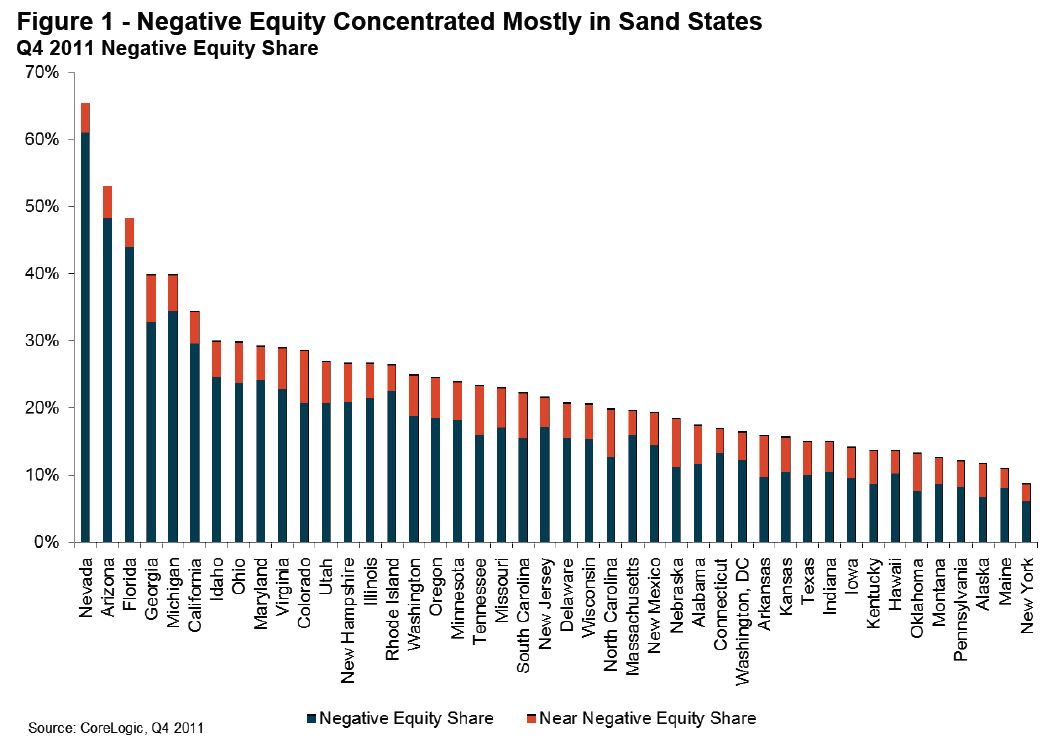
    CoreLogic, Negative Equity by StateClick on graph for larger image.

    This graph shows the break down of negative equity by state. Note: Data not available for some states. From CoreLogic:

    Nevada had the highest negative equity percentage with 61 percent of all of its mortgaged properties underwater, followed by Arizona (48 percent), Florida (44 percent), Michigan (35 percent) and Georgia (33 percent). This is the second consecutive quarter that Georgia was in the top five, surpassing California (29 percent) which previously had been in the top five since tracking began in 2009. The top five states combined have an average negative equity share of 44.3 percent, while the remaining states have a combined average negative equity share of 15.3 percent.”

    CoreLogic, Distribution of EquityThe second graph shows the distribution of equity by state- black is Loan-to-value (LTV) of less than 80%, blue is 80% to 100%, red is a LTV of greater than 100% (or negative equity). Note: This only includes homeowners with a mortgage – about 31% of homeowners nationwide do not have a mortgage.

    Some states – like New York – have a large percentage of borrowers with more than 20% equity, and Nevada, Arizona and Florida have the fewest borrowers with more than 20% equity.

    Some interesting data on borrowers with and without home equity loans from CoreLogic: “Of the 11.1 million upside-down borrowers, there are 6.7 million first liens without home equity loans. This group of borrowers has an average mortgage balance of $219,000 and is underwater by an average of $51,000 or an LTV ratio of 130 percent.

    The remaining 4.4 million upside-down borrowers had both first and second liens. Their average mortgage balance was $306,000 and they were upside down by an average of $84,000 or a combined LTV of 138 percent.”


  • America’s Credit and Housing Crisis: New State Bank Bills, Marketoracle.co.uk


    Seventeen states have now introduced bills for state-owned banks, and others are in the works.  Hawaii’s innovative state bank bill addresses the foreclosure mess.  County-owned banks are being proposed that would tackle the housing crisis by exercising the right of eminent domain on abandoned and foreclosed properties.  Arizona has a bill that would do this for homeowners who are current in their payments but underwater, allowing them to refinance at fair market value.

    The long-awaited settlement between 49 state Attorneys General and the big five robo-signing banks is proving to be a majordisappointment before it has even been signed, sealed and court approved.  Critics maintain that the bankers responsible for the housing crisis and the jobs crisis will again be buying their way out of jail, and the curtain will again drop on the scene of the crime.

    We may not be able to beat the banks, but we don’t have to play their game.  We can take our marbles and go home.  The Move Your Money campaign has already prompted more than 600,000 consumers to move their funds out of Wall Street banks into local banks, and there are much larger pools that could be pulled out in the form of state revenues.  States generally deposit their revenues and invest their capital with large Wall Street banks, which use those hefty sums to speculate, invest abroad, and buy up the local banks that service our communities and local economies.  The states receive a modest interest, and Wall Street lends the money back at much higher interest.

    Rhode Island is a case in point.  In an article titled “Where Are R.I. Revenues Being Invested? Not Locally,” Kyle Hence wrote in ecoRI Newson January 26th:


    According to a December Treasury report, only 10 percent of Rhode Island’s short-term investments reside in truly local in-state banks, namely Washington Trust and BankRI. Meanwhile, 40 percent of these investments were placed with foreign-owned banks, including a British-government owned bank under investigation by the European Union.

    Further, millions have been invested by Rhode Island in a fund created by a global buyout firm . . . . From 2008 to mid-2010, the fund lost 10 percent of its value — more than $2 million. . . . Three of four of Rhode Island’s representatives in Washington, D.C., count [this fund] amongst their top 25 political campaign donors . . . .

    Hence asks:

    Are Rhode Islanders and the state economy being served well here? Is it not time for the state to more fully invest directly in Rhode Island, either through local banks more deeply rooted in the community or through the creation of a new state-owned bank?

    Hence observes that state-owned banks are “[o]ne emerging solution being widely considered nationwide  . . . . Since the onset of the economic collapse about five years ago, 16 states have studied or explored creating state-owned banks, according to a recent Associated Press report.”

    2012 Additions to the Public Bank Movement

    Make that 17 states, including three joining the list of states introducing state bank bills in 2012: Idaho (a bill for a feasibility study), New Hampshire (a bill for a bank), and Vermont (introducing THREE bills—one for a state bank study, one for a state currency, and one for a state voucher/warrant system).  With North Dakota, which has had its own bank for nearly a century, that makes 18 states that have introduced bills in one form or another—36% of U.S. states.  For states and text of bills, see here.

    Other recent state bank developments were in Virginia, Hawaii, Washington State, and California, all of which have upgraded from bills to study the feasibility of a state-owned bank to bills to actually establish a bank.  The most recent, California’s new bill, was introduced on Friday, February 24th.

    All of these bills point to the Bank of North Dakota as their model.  Kyle Hence notes that North Dakota has maintained a thriving economy throughout the current recession:

    One of the reasons, some say, is the Bank of North Dakota, which was formed in 1919 and is the only state-owned or public bank in the United States. All state revenues flow into the Bank of North Dakota and back out into the state in the form of loans.

    Since 2008, while servicing student, agricultural and energy— including wind — sector loans within North Dakota, every dollar of profit by the bank, which has added up to tens of millions, flows back into state coffers and directly supports the needs of the state in ways private banks do not.

    Publicly-owned Banks and the Housing Crisis

    A novel approach is taken in the new Hawaii bill:  it proposes a program to deal with the housing crisis and the widespread problem of breaks in the chain of title due to robo-signing, faulty assignments, and MERS.  (For more on this problem, see here.)  According to a February 10th report on the bill from the Hawaii House Committees on Economic Revitalization and Business & Housing:

    The purpose of this measure is to establish the bank of the State of Hawaii in order to develop a program to acquire residential property in situations where the mortgagor is an owner-occupant who has defaulted on a mortgage or been denied a mortgage loan modification and the mortgagee is a securitized trust that cannot adequately demonstrate that it is a holder in due course.

    The bill provides that in cases of foreclosure in which the mortgagee cannot prove its right to foreclose or to collect on the mortgage, foreclosure shall be stayed and the bank of the State of Hawaii may offer to buy the property from the owner-occupant for a sum not exceeding 75% of the principal balance due on the mortgage loan.  The bank of the State of Hawaii can then rent or sell the property back to the owner-occupant at a fair price on reasonable terms.

    Arizona Senate Bill 1451, which just passed the Senate Banking Committee 6 to 0, would do something similar for homeowners who are current on their payments but whose mortgages are underwater (exceeding the property’s current fair market value).  Martin Andelman callsthe bill a “revolutionary approach to revitalizing the state’s increasingly water-logged housing market, which has left over 500,000 ofArizona’s homeowners in a hopelessly immobile state.”

    The bill would establish an Arizona Housing Finance Reform Authority to refinance the mortgages of Arizona homeowners who owe more than their homes are currently worth.  The existing mortgage would be replaced with a new mortgage from AHFRA in an amount up to 125% of the home’s current fair market value. The existing lender would get paid 101% of the home’s fair market value, and would get a non-interest-bearing note called a “loss recapture certificate” covering a portion of any underwater amounts, to be paid over time.  The capital to refinance the mortgages would come from floating revenue bonds, and payment on the bonds would come solely from monies paid by the homeowner-borrowers. An Arizona Home Insurance Fund would create a cash reserve of up to 20 percent of the bond and would be used to insure against losses. The bill would thus cost the state nothing.

    Critics of the Arizona bill maintain that it shifts losses from collapsed property values onto banks and investors, violating the law of contracts; and critics of the Hawaii bill maintain that the state bank could wind up having paid more than market value for a slew of underwater homes. An option that would avoid both of these objections is one suggested by Michael Sauvante of the Commonwealth Group, discussed earlierhere: the state or county could exercise its right of eminent domain on blighted, foreclosed and abandoned properties.  It could offer to pay fair market value to anyone who could prove title (something that with today’s defective title records normally can’t be done), then dispose of the property through a publicly-owned land bank as equity and fairness dictates.  If a bank or trust could prove title, the claimant would get fair market value, which would be no less than it would have gotten at an auction; and if it could not prove title, it legally would have no claim to the property.  Investors who could prove actual monetary damages would still have an unsecured claim in equity against the mortgagors for any sums owed.


    Rhode Island Next?

    As the housing crisis lingers on with little sign of relief from the Feds, innovative state and local solutions like these are gaining adherents in other states; and one of them is Rhode Island, which is in serious need of relief.  According to The Pew Center on the States, “The country’s smallest state . . . was one of the first states to fall into the recession because of the housing crisis and may be one of the last to emerge.”

    Rhode Islanders are proud of having been first in a number of more positive achievements, including being the first of the 13 original colonies to declare independence from British rule.  A state bank presentation was made to the president of the Rhode Island Senate and other key leaders earlier this month that was reportedly well received.  Proponents have ambitions of making Rhode Island the first state in this century to move its money out of Wall Street into its own state bank, one owned and operated by the people for the people.

    Ellen Brown is an attorney and president of the Public Banking Institute, http://PublicBankingInstitute.org.  In Web of Debt, her latest of eleven books, she shows how a private cartel has usurped the power to create money from the people themselves, and how we the people can get it back.  Her websites are http://WebofDebt.com and http://EllenBrown.com

    Ellen Brown is a frequent contributor to Global Research.  Global Research Articles by Ellen Brown

    © Copyright Ellen Brown 2012

    Disclaimer: The views expressed in this article are the sole responsibility of the author and do not necessarily reflect those of the Centre for Research on Globalization. The contents of this article are of sole responsibility of the author(s). The Centre for Research on Globalization will not be responsible or liable for any inaccurate or incorrect statements contained in this article.

    http://www.marketoracle.co.uk/Article33365.html

  • Financial Force Majeure


    Financial Force Majeure: The Virtual World Taylored to Our Real World

    If any of you have ever played the virtual reality game, Sim City or any similar, you will probably appreciate the point to be made more immediately than those unfamiliar. For the unfamiliar, this is a game in which you are the master of the land, tasked with taking what amounts to any empty field and building, expanding, and developing yourself a thriving metropolis.

    This entails tapping into the natural resources that are available within your splotch of land, thereby harnessing those resources to grow your community. As master of your domain, you have to the politician, the banker, the shopkeeper too, making wise decisions with your electronic currency inasmuch as budgeting and investment are concerned. You have to provide the infrastructure, exploiting what resources you have to attract more Sims (the inhabitants of your city) to further grow your town.

    You zone the land for residential, commercial, and industrial zones and providing for greenbelt, park, and recreational zones. You build schools, banks, retail and shopping centers, single-family and multi-family residential, industrial, and hospitals. As in the real world, this is done through various types of investment deals in the both the private and public sectors, involving commercial and investment banks, private investors and businesses. Your metropolis’ success depends on good investment strategies.

    Mother Nature is an ever present threat, just as in the real world, throwing a natural disaster your way now and again. Of course, disaster strikes when least expected, testing the validity of your decisions, most of all your infrastructure. It is than you discover if value engineering the levy walls was such a good idea. Should news of cutting corners for costs leaks out, it costs your city, as restitution to flood victims is yours to bear.

    Of course, the entirety is based on a designed program consisting of a language, codes, and locks. As with any program there savvy programmers, some might say hackers, having the learned knowledge to manipulate codes, language, and changing locks or even to remove locks. Purposes in hacking games might be to expand the games capabilities or to be able to be able to skip ahead to more advanced levels without having to play through the levels not desired.

    Virtual reality games are rooted in fantasy, even if based on real situations, there is no tangible result. Emotional personal satisfaction or perhaps of monetary award if in some sort of competition is the best reward one can hope for. You can’t physically walk the streets of your city, go to one of its schools, or benefit from the investment dividends in terms of attaining real dollars.

    For the developers, the tangible aspects are realized by sales which return in real dollars to the owners of the rights to the game. The developers might not necessarily be the owners either, depending on whether the developers retain rights or assigned them away to another.

    The point to take away from this little piece is more of a question. What if, with highly sophisticated programming, it was possible to design investment strategies, for instance and than somehow apply them to the real world? What if it has already been done…..What if our whole entire economy has been modeled in the virtual world, brought forth into the real world?

    Sound ridiculous? ………think again…….


    INFORMATION PROCESSING SYSTEM FOR SEAMLESS VIRTUAL TO REAL WORLD OPERATIONS      

    US Patent Pub. No.: US 2002/0188760 Al


    SECURING CONTRACTS IN A VIRTUAL WORLD    

    US Patent Pub. No.: US 2007/0117615


    WEB DEPENDENT CONSUMER FINANCING AND VIRTUAL RESELLING METHOD      

    US Patent Pub. No.: US 2001/0056399 A1


    TRANSACTIONS IN VIRTUAL PROPERTY      

    US Patent Pub. No.: US 2005/0021472 Al


    VIRTUAL FINANCE/INSURANCE COMPANY       

    US Patent Pub. No.: US 2003/0187768 A1


  • MERS


    What we need to do is take a survey, the population being made up of mortgage borrowers between the years 2002-2008. Why these years would become apparent with the results, which can be predicted before ever tallying the results. It would be a one question survey:

    “Upon loan origination, was it required, in addition to completing a loan 1003 loan application, that you also provide specific documents for verification and loan qualification purposes, or did you simply have to complete a loan 1003 loan application?”

    My bet would be that most everyone who was in receipt of a loan prior to September 2005 was required to submit documents to a human person which were used to verify loan qualification. Most nearly everyone subsequent that date was not required to submit anything by way of supporting documents.

    This gives us two separately defined groups:

    GROUP A: borrowers whose loans were humanly underwritten and verified

    GROUP B: borrowers whose loans were underwritten entirely by automation

    We can argue about the underlying reasons for economic collapse all day long, as there are certainly many, but one fact remains as being integral. This is acknowledging that there were borrowers that never, ever should have been approved for a loan, yet were. It was this very small subset of borrowers in Group B however, those that defaulted nearly immediately, that is within the first through third months out of the gate. It was these ‘early payment defaults (EPD’s ) that spread throughout the investment community causing fear, bringing into question the quality of all loan originations, thereby freezing the credit markets in August 2007, a year later the entire economy collapsed.

    Of course, it is much more complex than that, but the crucial piece that provided the catalyst was these EPD’s. It was the quality of the borrowers from these EPD’s that became the model by which was used to stigmatize all borrowers. What was needed was a fall guy, to first lessen the anger towards the bailouts in providing a scapegoat, and second to divert attention away from the facts underlying the lending standards the failed and/or intentionally purposeful failure of the automation. From my research, it was with purposeful intent come hell or high water is my mission in life to bring forth into the public light.

    Putting intent aside for the moment and just focusing on the EPD’s and the domino effect they caused which resulted in millions of borrowers, from both Groups A and B, to lose their homes or struggling to hold on. How could one small group of failed borrowers affect millions of other borrowers, especially those who were qualified through the traditional methods of underwriting?

    The answer is an obvious one, coming down to the one common element that is the structuring of the loan products, that as it relates to the reset. Anyone whose reset occurred just prior and certainly after the economic collapse was as the saying goes…..Screwed. It is within is this, that the Grand Illusion lay intentionally concealed and hidden. It is within the automation wherein all the evidence clearly points to the fact that a mortgage is not a mortgage but rather a basket of securities….Not just any securities, but debt defaultable securities. In other words, it was largely planned to intentionally give loans to those whom were known to result in default.

    But, even without understanding any of the issues as to the ‘basket of securities” there is one obvious point that looms, hiding in plain sight, which I believe should be completely exploited. This as it directly relates to our mortal enemy, that which takes the name of MERS. I know there are those that disseminate the structure of Mortgage Electronic Registration Systems, Inc and Merscorp as it relates to the MIN number and want to pick it apart, and all this is well and good. However, they miss the larger and more obvious point that clearly gives some definition.

    There is one particular that every one of those millions upon millions of borrowers, those in both Group A and Group B along with the small subset of Group B, all have in common. ……MERS. MERS was integrated into every set of loan documents, slide past the borrowers without explanation without proper representation in concealing the implied contracts behind the trade and service mark of MERS.

    MERS does not discriminate between a good or a bad loan, a loan is a loan as far it is concerned, whether it was fraudulently underwritten or perfectly underwritten. If it is registered with MERS the good, the bad, the ugly all go down, and therein lays an issue that is pertinent to discussion.

    MERS was written into all Fannie and Freddie Uniform Security Instrument, not by happenstance, rather mandated by Fannie and Freddie. It was they who crafted verbiage and placement within the document. Fannie and Freddie are of course agency loans, however nearly 100% of non-agency lenders utilized the same Fannie and Freddie forms. Put into context, MERS covers both agency and non-agency, and not surprisingly members of MERS as well. Talk about fixing the game!!

    It would seem logical, considering we, the American Taxpayer own Fannie Mae, that we should be entitled some answers to some very basic questions……The primary question: If Fannie Mae and Freddie Mac mandated that MERS play the role that it does, why than were there no quality control measures in place, and should they not have been responsible for putting in some safety measures in place?

    The question is a logical one; any other business would have buried in litigation had a product it sponsored or mandated, as the case may be here, resulted in complete failure. From the standpoint of public policy, MERS was a tremendous failure. Why? The answer derives itself from the facts as laid out above regarding the underwriting processes and the division of borrowers: Group A and B.

    This becomes a pertinent taking into account Fannie Mae on record in its recorded patents.

    US PATENT #7,881,994 B1– Filed April 1, 2004, Assignee: Fannie Mae

     ‘It is well known that low doc loans bear additional risk. It is also true that these loans are

    charged higher rates in order to compensate for the increased risk.’


    System and method for processing a loan

    US PATENT # 7,653,592– Filed December 30, 2005, Assignee: Fannie Mae

    The following from the Summary section states:

    ‘An exemplary embodiment relates to a computer-implemented mortgage loan application data processing system comprising user interface logic and a workflow engine. The user interface logic is accessible by a borrower and is configured to receive mortgage loan application data for a mortgage loan application from the borrower. The workflow engine has stored therein a list representing tasks that need to be performed in connection with a mortgage loan application for a mortgage loan for the borrower. The tasks include tasks for fulfillment of underwriting conditions generated by an automated underwriting engine. The workflow engine is configured to cooperate with the user interface logic to prompt the borrower to perform the tasks represented in the list including the tasks for the fulfillment of the underwriting conditions. The system is configured to provide the borrower with a fully-verified approval for the mortgage loan application. The fully-verified approval indicates that the mortgage loan application data received from the borrower has already been verified as accurate using information from trusted sources. The fully-verified approval is provided in a form that allows the mortgage loan application to be provided to different lenders with the different lenders being able to authenticate the fully-verified approval status of the mortgage loan application’

    Computerized systems and methods for facilitating the flow of capital

    through the housing finance industry

    US PATENT # 7,765,151– Filed July 21, 2006, Assignee: Fannie Mae

    The following passages taken from patent documents reads:

    ‘The prospect or other loan originator preferably displays generic interest rates (together with an assumptive rate sheet, i.e., current mortgage rates) on its Internet web site or the like to entice online mortgage shoppers to access the web site (step 50). The generic interest rates (“enticement rates”) displayed are not intended to be borrower specific, but are calculated by pricing engine 22 and provided to the loan originator as representative, for example, of interest rates that a “typical” borrower may expect to receive, or rates that a fictitious highly qualified borrower may expect to receive, as described in greater detail hereinafter. FIG. 2b depicts an example of a computer Internet interface screen displaying enticement rates.’

     ’If the potential borrower enters a combination of factors that is ineligible, the borrower is notified immediately of the ineligibility and is prompted to either change the selection or call a help center for assistance (action 116). It should be understood that this allows the potential borrower to change the response to a previous question and then continue on with the probable qualification process. If the potential borrower passes the eligibility screening, the borrower then is permitted to continue on with the probable qualification assessment.’

    ‘Underwriting engine 24 also determines, for each approved product, the minimum amount of verification documentation (e.g., minimum assets to verify, minimum income to verify), selected loan underwriting parameters, assuming no other data changes, (e.g., maximum loan amount for approval, maximum loan amount for aggregating closing costs with the loan principal, and minimum refinance amount), as well as the maximums and minimums used to tailor the interest rate quote (maximum schedule interest rate and maximum number of points) and maximum interest rate approved for float up to a preselected increase over a current approved rate. It should be appreciated that this allows the potential borrower to provide only that information that is necessary for an approval decision, rather than all potentially relevant financial and other borrower information. This also reduces the processing burden on system.’

    The two patents above was Fannie Mae’s means of responding to its competition, that being the non-agency who had surpassed the agencies in sales volume (those stats I will have to dig up and repost as they are not handy at the moment), as the non-agencies had dropped all standards back in and around September 2005.

    The point being though, Fannie Mae and Freddie Mad were the caretakers of MERS, so to speak, inasmuch as mandating MERS upon the borrowers. Had there been safety measures in place that caught the fact that the loans that were dumping out quickly, that is the EPD’s, there might have been a stoppage in place, thereby preventing MERS from executing foreclosures upon every successive mortgage.

    I know that this is all BS though, because it is a cover up, a massive one that cuts into the heart of the United States government. This is perhaps one avenue by which to get there, as the questions asked are easily understood, as opposed to digging into the automation processes which people apparently are not ready to accept as of yet.

  • Mass Court May Rule on Retroactivity of some Foreclosures Tied to ‘Naked Mortgages’, by Jann Swanson Mortgagenewsdaily.com


    Another next major marker in the convoluted foreclosure landscape will probably come in the next few weeks when the Massachusetts Supreme Judicial Court (SJC) is expected to rule on Eaton v. Federal National Mortgage Association (Fannie Mae).  This is another in a series of cases challenging the right of various lenders and nominees to foreclose on delinquent mortgages based on assertions that those parties do not own or at least cannot prove they own the enabling legal documents.

    Eaton raises an additional point that has excited interest – whether or not that foreclosure can be challenged and compensation enforced on a retroactive basis or whether such retroactivity exacts too high a cost or permanently clouds title.

    The details of the case are fairly standard, involving a note given by Henrietta Eaton to BankUnited and a contemporaneous mortgage to Mortgage Electronic Registration Systems (MERS).  The mortgage was later assigned by MERS to Green Tree servicing and the assignment did not reference the note.  The Eaton Home was subsequently foreclosed upon by Green Tree which assigned its rights under the foreclosure to Fannie Mae which sought to evict Eaton.  Eaton sued, charging that the loan servicer did not hold the note proving that Eaton was obliged to pay the mortgage.

    The Massachusetts Superior Court relied on a January, 2011 ruling in U.S. Bank V. Ibanez in which the court held that the assignment of a mortgage must be effective before the foreclosure in order to be valid and that as holder of the note separated from the mortgage due to a lack of effective assignment, the Plaintiffs had only a beneficial interest in the mortgage note and the power of sale statute granted foreclosure authority to the mortgagee, not to the owner of the beneficial interest.

    In Eaton the lower court said it was “cognizant of sound reason that would have historically supported the common law rule requiring the unification of the promissory note and the mortgage note in the foreclosing entity prior to foreclosure. Allowing foreclosure by a mortgagee not in possession of the mortgage note is potentially unfair to the mortgagor. A holder in due course of the promissory note could seek to recover against the mortgagor, thus exposing her to double liability.”

    In its brief to the Supreme Judicial Court, Fannie Mae contests the lower court ruling on the grounds that:

    1.  Requiring unity of the note and mortgage to foreclose would create a cloud on the Title and result in adverse consequence for Massachusetts homeowners.

    2.  A ruling requiring unity of the note and mortgage to conduct a valid foreclosure should be limited to prospective application only (because)

    A.  Such a ruling was not clearly foreshadowed and

    B.  Retroactive application could result in hardship and injustice.

    The case has been the impetus for filings of nearly a dozen amicus briefs from groups such as the Land Title Association, Real Estate Bar Association, and foreclosure law firms, most in response to a SJC request for comment on whether any ruling should be applied retroactively and if so what the impact would be on the title of some 40,000 homes foreclosed in the last few years.

    Of particular interest is a brief filed by the Federal Housing Finance Agency, conservator of both Fannie Mae and Freddie Mac which some observers said might be the first time the agency had intervened in a particular foreclosure case.

    FHFA asked the court to apply any decision to uphold the lower court decision prospectively rather than retrospectively.  It’s argument:  applying a ruling retroactively would be “a direct threat to orderly operation of the mortgage market.”   FHFA also said “Retroactive application of a decision requiring unity of the note and the mortgage for a valid foreclosure would impose costs on U.S. Taxpayers and would frustrate the statutory objectives of Conservatorship.”

    “There presently is no mechanism or requirement under Massachusetts law to record the identity of the person entitled to enforce the note at the time of foreclosure,” FHFA said.  “Therefore, a retroactive rule requiring unity of the note and mortgage for a valid foreclosure would potentially call into question the title of any property with a foreclosure in its chain of title within at least the last twenty years.”

    contrary opinion was advanced in a brief filed by Georgetown University Law School Professor Adam Levitin who called the ruling that a party cannot foreclose on a “naked mortgage” (one separated from the note) merely a restatement of commercial law and “to the extent that the mortgage industry has disregarded a legal principle so commonsensical and uncontroversial that it has been encapsulated in a Restatement, it does so at its peril.”

    Levitin argues that it is impossible to know how widespread the problem of naked mortgages may be either in Massachusetts or nationwide so this should temper any evaluation of the impact of retroactivity.  He also states that there are several factors “that should assuage concerns about clouded title resulting from a retroactively applicable ruling requiring a unity of the note and mortgage.”  He points out that adverse possession, pleading standards, burdens of proof and equitable defenses such as laches all combine to make the likelihood of challenging past foreclosure unlikely and sharply limiting the retroactive effect of a ruling.

    Kathleen M. Howley and Thom Weidlich, writing for Bloomberg noted that a decision to uphold the lower court “could lead to a surge in claims from home owners seeking to overturn seizures.”

    According to Howley and Weidlich, the SJC ruled last year on two foreclosure cases that handed properties back to owners on naked mortgage grounds.  The Ibanez case, referenced above dealt with two single family houses, but in Bevilacqua v. Rodriguez the court handed an apartment building back to the previous owner five years after the foreclosure.  In the interim a developer had purchased the building and turned it into condos.  The condo owners lost their units without compensation and the building now stands vacant.

    The decision may be available before month’s end and as Massrealestateblog.com said, “For interested legal observers of the foreclosure crisis, it really doesn’t get any better than this”.

  • FRAUD – It is all in the technology


    We have to end this once and for all, and get to the bottom of this..for the sake of the borrowers which were lied to and than intentionally defamed of character by the people of this country……follow the technology and we find the crooks http://automated-destruction.com/

    Credit Risk Management Report (Jun 3, 1996)

    Brightware Inc. and Servicing Management Systems Inc. signed a partnership agreement to offer software systems to help mortgage servicers increase servicing-generated revenues, improve service levels and lower credit losses. Brightware entered into value-added reseller (VAR) agreement with CounselWare, LLC of New York. CounselWare will market embedded technology built with Brightware’s tools in a software framework that lets attorneys model and capture information in systems that assess legal risk and provide advice to their corporate clients.

    Brightware Inc. has received $3 million in new venture-capital funding from Norwest Venture Capital, a unit of the Minneapolis-based bank, and Venrock Associates, a venture capital firm. Brightware will use the funds to develop so-called knowledge deployment frameworks, which help automate decision-making processes in a variety of areas, including lending and investment. Brightware provides risk-management software to about 200 organizations.

    Chase Manhattan Corp. uses Brightware’s EZ Reader Internet software to analyze E-mail coming into its World Wide Web site on the Internet. The Federal National Mortgage Association policy analysts use Brightware software to create underwriting rules for Desktop Underwriter, Fannie Mae’s automated underwriting system. Brightware also provides Equifax Check Services with software used in consumer-check authorizations at the point of sale.

    Brightware BrightAdvisor and BrightResponse utilized by Security First Technologies for use in to help consumers apply for loans. BrightAdvisor holds an interactive dialogue with the customer to help them find products and services they might want to buy year. So is another new BrightResponse responds automatically to electronic mail messages sent to a Web

    Gerlach, Kara. Real Estate Finance Today14. 5 (Mar 3, 1997)

    American Finance and Investment Inc. (AFI) unveils CyberSmart Instant Mortgage Web site, a Web site that provides consumers with an interactive online environment where a mortgage loan can be approved in minutes. A project designed and supported by Brightware Inc.

    Brightware enabled programs at:

    Chase Manhattan Bank
    Equifax Check Services
    Fannie Mae
    MetLife
    amongst others

    Won awards at the annual Innovative Applications of Artificial Intelligence conferences.

    In the mortgage industry and Development Partners with Brightware:

    American Finance and Investment Inc.
    Amway Corp.
    Security First Technologies
    Swiss Bank Corp.
    Wells Fargo Bank

    Orenstein, Alison. Bank Systems & Technology34. 5 (May 1997)

    A subsidiary of Virginia First Savings Bank, which has nearly $1 billion in assets, Washington-based AFI has licensed BrightResponse and BrightAdvice software from Brightware, Novato, Calif., for use with its Cybersmart Instant Mortgage Web site. BrightResponse acts as an inbound telemarketing agent, automating responses to e-mail and Web inquiries generated by Internet consumers as they shop on-line for mortgages. BrightAdvisor works as an electronic “sales agent” on the Net, tracking a consumer’s actions and offering sales advice on-line. Cybersmart is an underwriting system that processes mortgage applications and is supported by customer service representatives 24 hours a day, seven days a week.

    Angus, Jeff. InformationWeek 629 (May 5, 1997):

    BrightResponse technology fields 70% to 80% of the thousands of questions we receive a week,” says Jack Rodgers, president of American Finance & Investment Inc., which is testing mortgages worth $1 billion over the Internet and by telephone last year.

    Kutler, Jeffrey. American Banker [New York, N.Y] 07 Aug 1997

    At least one bank, Wells Fargo, is preparing to use the system to deal with the rising volume of customer inquiries related to its home banking program. Other banks and financial service companies are likely to follow suit, given that Brightware has been doing 80% of its business with financial organizations ranging from the new (Security First Network Bank) to the established (American Express Co). Brightware 1.0, as the newly released software is known, is designed to automate customer service over the World Wide Web. As an “inbound marketing agent,” it responds to on-line inquiries and can refer them to bankers as would a telephone call center representative.

    Kutler, Jeffrey. American Banker [New York, N.Y] 17 Oct 1997

    $11.5 million venture financing in Brightware capital, Advanta Partners LP bought $5 million of Series B preferred stock in Brightware, company developing automated sales and marketing tools for the Internet.

    Hambrecht & Quist,
    Norwest Venture Capital
    TTC Ventures
    Venrock Associates
    Wilson Sonsini Goodrich & Rosati.

    Norwest Venture Capital and Venrock, which is affiliated with the Rockefeller family, were among the first investors in Brightware and remain the largest. TTC Ventures is owned by Thomson Corp., a Canadian publishing company whose holdings include American Banker. Wilson Sonsini is a prominent Silicon Valley law firm. and with revenues of $13 million in the fiscal year ended last June, is staking out a position in what it calls sales servers-automated agents that use inquiries from customers to develop sales leads. Wells Fargo & Co. was among the early buyers of Brightware 1.0, seeing it as a way to deal with the customer service demands in its fast-growing on-line banking program.

    NOVATO, Calif–(BUSINESS WIRE)–March 17, 1998

    Brightware, the market leader in customer-direct selling on the Net, today announced that its strategy of focusing on the financial service market in the first six months of shipping Brightware(R) has yielded significant momentum in retail banking and mortgage lending.

    “Brightware is focusing on key market segments to drive forward on its mission to make the Net the world’s best sales channel. We have leveraged our strength in financial services to successfully penetrate the retail banking and mortgage segments and now are making inroads into the securities and insurance sectors.”

    Chuck Williams, president and CEO of Brightware

    By March 1998, Brightware’s retail banking customer list, to mention a few, included:

    Bank of America
    Swiss Bank
    The Toronto-Dominion Bank
    Wells Fargo

    Brightware’s mortgage banking customers includes amongst:

    American Finance and Investment
    Countrywide
    Fannie Mae
    Finet
    HomeSide Lending
    Registered Australian Mortgage Securities.
    iQualify
    Access National Mortgage

    In the mortgage sector, Brightware helps companies improve their use of the Net to directly source more home loans. Consumers need guidance in finding the right mortgages and making a decision to close. Brightware helps companies automate routine questions and answers in the early part of the process, and then forward qualified leads to human loan officers for rapid closing.
    Brightware Forms Product Services Group

    The product services group offers specialized vertical service capabilities for retail banks and mortgage companies today. The group plans to add specialized vertical  services for securities and insurance companies in the near term.
    Brightware Bolsters its International Presence

    Brightware, Ltd. The UK-based operation runs all of Brightware’s international business outside North America, and contributed 15% of revenues in the recent quarter. In October, 1997, Brightware, Ltd. signed Term Software as a Brightware distributor for Australia and New Zealand. This new Pacific Rim presence has yielded Brightware’s first customer in the region, Registered Australian Mortgage Securities.
    Brightware Expands Partnerships

    In the first six months of shipping, Brightware has expanded its partnerships with key partners such as Lotus, Microsoft, and Netscape. Lotus selected Brightware as a finalist for its 1998 Lotus Beacon Award, based on a solution implemented at Chase Manhattan Bank. Microsoft named Brightware a Microsoft Certified Solution Provider Partner and awarded Brightware its Best Web Site Solution for the value it adds to American Finance and Investment’s (AFI’s) industry-leading Cybersmart Instant Mortgage Web site

    NOVATO, Calif.–(BUSINESS WIRE)–April 15, 1998

    Brightware Inc., the market leader in automated customer interaction on the Net, today announced an alliance with Rockwell Electronic Commerce, Wood Dale, Ill., the leading vendor of call center systems. The Brightware call center systems application automatically answers free-form, natural language questions that customers enter on a Web page or send via e-mail. It interprets each inquiry and takes action according to a company’s business policies and best practices. Brightware generates immediate, informative, and personalized answers. It also makes proactive, appropriate suggestions and offers, notifies relevant company employees of important situations or opportunities, and acts on requests or routes them for follow-up.

    NEW YORK–(BUSINESS WIRE)–May 4, 1998

    Brightware Inc., Novato, Calif., and The Chase Manhattan Bank Monday announced an agreement whereby Chase will use the Brightware(R) server application to automatically classify E-mail messages received from retail banking customers.

    NOVATO, Calif.–(BUSINESS WIRE)–June 5, 1998

    Brightware Inc., the market leader in automated customer interaction on the Net, today announced that its 1997 sales of the Brightware(R) Server(TM) made it the worldwide revenue leader in Web/E-mail response software. The IDC report puts Brightware’s share at 26% of worldwide revenues for the category in 1997, which included revenues from 10 named vendors as well as revenues from other unnamed sources. The report also lists Brightware as the market leader for Europe, based upon 1997 revenues.

    NOVATO, Calif.–(BUSINESS WIRE)–June 29, 1998

    Version 2 of Brightware(R) Includes New Advice Agent and Enhanced Answer Agent to Conduct Automated Sales and Service Dialogs with Customers On the Net.  Brightware Advice(TM) Agent (new in version 2): Provides automatic real-time advice to customers by conducting interactive dialogs to determine their needs and present a company’s relevant product and service solutions. Brightware Answer(TM) Agent (enhanced in version 2):  Automatically answers customers’ Web and E-mail inquiries. The Brightware Server automates the approximately 80 percent of customer interactions that are straightforward and intelligently routes the 20 percent of complex or high-value customer interactions to employees for final resolution.

    American Finance and Investment (AFI) is adding the Brightware Advice Agent to its existing Brightware Server. Since September, 1997, the Brightware Answer Agent has been automatically answering 60 percent of incoming questions on AFI’s Web site. The new Brightware Advice Agent is a complete turnkey application for interacting with customers, organizing and accessing relevant content and guiding customers to execute the sales or service transactions that best meet their needs. Brightware delivers all of the key components for successfully automating real time Web dialog in a single integrated package:

    Brightware conducts real-time question and answer Dialog engine sessions with customers. Iterative customer profile creation: Brightware learns a customer’s needs and situation and updates their profile throughout a single dialog and across multiple dialogs

    Dynamic content assembly and page generation: Brightware automatically composes pages of content that provide the information and advice relevant to a customer’s current needs Fuzzy matching: Brightware automatically combines a customer’s answers to its questions with existing knowledge about a customer to determine which questions to ask next in the dialog, as well as which advice and cross-sell and up-sell offers to present at each point in the dialog.

    Business rules: Brightware applies a company’s unique policies and criteria to refine the Brightware dialog so that it implements sales and services best practices consistently.
    Business editors: Brightware makes it easy to enter and maintain knowledge with graphical editors designed for use by business professionals

    Enterprise integration: Brightware integrates existing product and customer databases seamlessly and provides an API for integration with enterprise applications and electronic commerce Servers.

    By packaging these elements into a single application, Brightware helps organizations avoid the risks and costs of coding applications from scratch. Its open architecture also lets organizations leverage existing investments in Web site content authoring, tracking and personalization tools.

    A Java servlet manages communications between Web servers and Brightware servers. The Brightware Java servlet supports Microsoft Internet Information Server, Netscape FastTrack and Enterprise Servers, Lotus Domino Go Web Server, Apache Server and any server that supports the Java servlet API. Brightware uses native APIs to integrate with the leading E-mail servers, MAPI for Microsoft Exchange and Lotus API for Lotus Notes. Brightware integrates with other mail servers using its open API. Brightware runs on Microsoft Windows NT and integrates with Oracle, Microsoft SQL Server, Sybase, DB2 and databases that support ODBC. Brightware also includes an open API for easy integration with other applications and modules. Brightware Is Priced for Aggressive Web Businesses.

    Brightware is targeted to Fortune 1000 companies who are using the Net as their newest customer channel, and the new generation of enterprises whose businesses are based on the Net. Brightware license fees start at $95,000 annually or $190,000 for a perpetual license. This price includes a choice of either the Brightware Answer Agent or the Brightware Advice Agent. If a second agent is purchased at the same time, license fees for this agent start at $47,500 annually or $95,000 for a perpetual license.

    NOVATO, Calif.–(BUSINESS WIRE)–July, 1998

    Chase Manhattan Bank has licensed Novato, Calif.-based Brightware’s customer service and sales software, which automatically reads and answers email queries, routing inquiries to appropriate personnel for prompt handling. The Brightware application, slated to go live at the $366 billion bank in six to 12 months, replaces a custom-built system that Brightware had built for Chase in a consulting engagement.

    Chase Manhattan Bank has licensed Novato, Calif.-based Brightware’s customer service and sales software, which automatically reads and answers email queries, routing inquiries to appropriate personnel for prompt handling. The Brightware application, slated to go live at the $366 billion bank in six to 12 months, replaces a custom-built system that Brightware had built for Chase in a consulting engagement.

    NOVATO, Calif.–(BUSINESS WIRE)—Sept. 17, 1998

    Brightware Inc., a provider of software that automates customer service tasks, such as responding to e-mail messages, reported an increase of 140% in sales for the fiscal year ended June 30, compared with the previous fiscal year prior.

    “Brightware’s record sales resulted from many companies looking

    for leading-edge e-commerce solutions and realizing that interactivity

    is a key ingredient to on-line success. Our intelligent, automated solutions

    give companies an opportunity to provide a high-tech approach to on-line

    selling, marketing and customer service, while also limiting human involvement

    in these efforts, thereby reducing costs.”

    Chuck Williams, CEO and president of Brightware

    Brightware licensed clients by March 1999, amongst others included:

    Access National Mortgage
    Advanta
    Amway
    Bank of America
    Bank of Ireland
    Chase Manhattan
    Countrywide
    Coverdell
    Egghead.com
    Fannie Mae Desktop Underwriter
    Freddie Mac Terms of Business
    HomeSide Lending
    Intuit Australia
    Loanshop.com
    MediaOne
    Peterson’s
    Rockwell
    Swiss Bank
    TD Bank
    Waterhouse Securities
    Wells Fargo

    Brightware is a registered trademark of Brightware, Inc., its product list as of March 1999 includes:

    Brightware Contact Center
    Brightware Server
    Brightware Answer
    Brightware Client Desktop
    Brightware Supervisor Desktop

    NOVATO, Calif.–(BUSINESS WIRE)–March 23, 1999

    Brightware, Inc., the leading supplier of customer assistance software for the Internet, today announced a strategic partnership with The Vantive Corporation whereby Brightware(R) 3 will integrate with the Vantive Enterprise and Vantive Web solutions to meet the needs of the e-customer.

    Business Editors & High Tech Writers. Business Wire [New York] 12 July 1999

    Brightware has raised the bar for email management applications by providing the first in a series of industry-focused solutions,” said Chris Erickson, president and chief executive officer of Brightware. “Brightware’s Knowledge Packs leverage our deep industry experience to provide financial service institutions with tailored email workflow and automation solutions that deliver unparalleled ROI and an exceptional e Customer experience. Our customers also benefit from our new integrator partnerships with Bowne Internet Solutions and SRA International, both of whom can help financial institutions design and implement eCustomer Assistance strategies that incorporate our products.”

    Brightware’s New Partners

    Bowne & Co – Bowne Internet Solutions is a consulting and development services company that partners with clients in the financial services industry to manage every stage in the evolution of their online business. Bowne brings long-term value to its relationships by combining practical application of Internet technology, in-depth knowledge in the financial services industry and the stability and resources of a worldwide company with a long history of superior customer service. Part of Bowne & Co., the world’s largest financial printer, Bowne Internet Solutions can manage, repurpose and distribute a client’s information to any audience, through any medium, in any language, anywhere in the world.
    SRA International, Inc. offers consulting and systems integration services, as well as products and business solutions, to clients in business and government. SRA provides comprehensive solutions for Internet customer relationship management projects, including customer email management and compliance integrating Brightware’s award-winning email assistance solution with Assentor (R), SRA’s market-leading email message screening and archiving software that helps securities firms utilize email in compliance with Securities and Exchange Commission (SEC) monitoring guidelines. With the Assentor-Brightware combination, securities firms can facilitate email communication with clients while applying technology to the compliance review process.

    Brightware’s Knowledge Packs are developed for retail banking, mortgage banking and securities firms. Each Knowledge Pack has the same structure, with content tailored to the products, language

    Brightware has closed over a dozen new financial institutions, July 1999, including:

    CIBC
    Cariplo of Italy
    Cendant Mortgage
    Creditland
    New Century
    Paytrust
    Upland Mortgage
    Valley National Bank
    Westpac Banking Corp. of Australia
    as well as other major banks and brokerage houses in the US, UK and Ireland

    In addition to new business successes, Brightware secured add-on licenses from existing customers including:

    Mortgage.com
    Countrywide
    HomeSide Lending
    Toronto-Dominion Bank

    Brightware’s roster of financial service customers now spans over 30 institutions across seven countries.

    American Banker [New York, N.Y] 21 Sep 1999:

    American Business Financial Services is revamping its mortgage loan origination site, http://www.UplandMortgage.com, using technology from Brightware Inc. and Qwest Internet Solutions. The site, to be launched in early 2000, will use Answer Agent software from Brightware for automatic loan approval and automatic e- mail messaging between consumers and a 24-hour support staff. It will also use Brightware’s Advice Agent automated reasoning system for interactive dialogues. The system will enable borrowers to track the progress of their loan applications.

    NOVATO, Calif.–(BUSINESS WIRE)–Sept. 28, 1999

    Brightware Becomes Siebel Premier Software Partner for Email Management Software. Brightware, Inc., the leading supplier of eCustomer Assistance software for the Internet today announced it has formed a partnership with Siebel Systems, Inc. as a Premier Software Partner in the Siebel Alliance Program. As part of its alliance with Siebel, Brightware will integrate its category-dominating Web and email assistance applications with Siebel Systems’ market-leading, Web-based front office application suite. With this best-of-breed solution, corporations will be able to manage and automate eCustomer interactions while consistently delivering across all channels.

    BALA CYNWYD, Pa., Oct. 12, 1999 /PRNewswire

    American Business Financial Services, Inc. (Nasdaq: ABFI) today announced that on October 1st, it implemented Brightware, Inc.’s Answer Agent, an advanced, automated e-mail system, along with its proprietary Rapid Credit Approval Process, on its http://www.UplandMortgage.com web site. In addition to activating Answer Agent, the launch of online Rapid Credit Approval is a significant enhancement towards online mortgage approval.

    BALA CYNWYD, Pa.–(BUSINESS WIRE)–Feb. 7, 2000

    EasyLoan Advisor to Replicate Interaction with Loan Officers American Business Financial Services, Inc. (Nasdaq: ABFI) today announced that it has introduced EasyLoan Advisor, a proprietary system which provides personalized services and solutions to customers through interactive web dialog, on its http://www.UplandMortgage.com web site.

    “In essence a VIRTUAL LOAN OFFICER. Very simply, EasyLoan Advisor

    enables us to replicate much of the interaction our loan officers have with

    prospects by providing them with education,guidance and assistance

    regarding their personal financial situation and our product offerings.

    By using this highly sophisticated and advanced online communication process,

    borrowers will determine the loan that can best meet their needs.”

    Anthony Santilli, Chairman and Chief Executive Officer of ABFI

    NASHVILLE, Tenn., April 14, 2000 /PRNewswire

    Petra Capital Partners, a private capital management firm, today announced its participation in the management-led buyout of MindBox, Inc. from Brightware, Inc. The financing has enabled the former custom solutions division of Brightware to start operating autonomously as MindBox. In a leveraged buyout, a new entity MindBox has been spun off from Brightware, a supplier of eCustomer Assistance software for the Internet. The former Brightware custom solutions division will focus on developing and providing software and services to financial services organizations.

    “Brightware was comprised of two distinct business units:

    eCustomer Assistance Internet applications
    Customer Solutions

    “By selling the customer solutions division to MindBox, we made the strategic

    decision that each business unit would be stronger if run as independent companies.”

    Chris Erickson, CEO of Brightware.

    Brightware will focus solely on: eCustomer Assistance market Providing applications that helps eBusinesses service sell and create strong relationships with their eCustomers
    GREENBRAE, Calif.–(BUSINESS WIRE)–June 19, 2000

    Hitting the market in full stride only a month after its spin-off from Brightware(TM), MindBox, Inc., the worldwide leader in providing artificial intelligence applications to automate complex business and operations processes for the financial services industry, today announced an impressive client roster consisting of many of the top lenders and financial institutions in the country.

    Customers include industry leaders such as:

    Countrywide Home Loans
    Fannie Mae
    Freddie Mac
    HomeSide Lending
    Mortgage.com
    GE Capital Corporation
    Upland Mortgage.
    Chase Manhattan
    Citigroup

    MindBox in Financial Services

    Countrywide Home Loans: Countrywide Credit Industries, Inc. provides consumer and business-to-business financial services in domestic and international markets.
    Fannie Mae: Fannie Mae is the country’s third largest corporation, in terms of assets, and the nation’s largest

    provider of funds for home mortgages.

    Freddie Mac: Freddie Mac is a stockholder-owned corporation chartered by Congress to increase the supply of funds that mortgage lenders can make available to homebuyers and multifamily investors.
    HomeSide Lending: HomeSide Lending is one of the largest full-service residential mortgage banking companies in the United States. Headquartered in Jacksonville, Florida, HomeSide services over $145 billion in home loans representing over 1.6 million homeowners.
    Mortgage.com: Mortgage.com (NSDQ: MDCM), is a pioneer in online mortgage banking, dedicated to reducing to reducing the cost of mortgage origination and funding by supplying financial institutions, realtors and homebuilders with point-of-sale and Internet technology, business management, loan processing, call center and mortgage funding capabilities.
    GE Capital Corporation: GE Capital (NYSE: GE) offers a wide range of value-added financial products and services through a network of 28 specialized businesses in five core niches:
    Equipment Management
    Customer Services
    Specialized Financing
    Mid-Market Financing and Specialty Insurance.
    Upland Mortgage: Upland Mortgage is a retail mortgage lender offering the most flexible and convenient loan programs available in the market today

    Utilizing MindBox’s artificial intelligence applications, lenders are able to automate

    and streamline complex business and operations processes within the following areas:

    Mortgage lending origination and underwriting
    insurance underwriting
    Sales assistance
    Credit grading
    Compliance verification
    Terms of business
    Portfolio management
    Personalize pricing
    Deal structuring
    cross-selling
    Best execution.

    GREENBRAE, Calif.–(BUSINESS WIRE)–Sept. 11, 2000

    Building on its success in working with global customers, MindBox(TM), Inc. today announced the formation of its International MindBox User Group. Founding Board Members of the group include:

    Ernst & Young
    American Express
    Countrywide Home Loans
    Ford Motor Credit
    MindBox

    The International MindBox User Group will become the premier forum for companies to share technology innovations and product feedback related to ART*Enterprise(R), MindBox’s award-winning artificial intelligence development platform that is running in over 200 deployments worldwide.

    The first meeting of the International MindBox User Group was held in Denver, Colorado. The user group Board — consisting of top-name international companies — outlined its mission and strategies for culling user feedback and needs assessments, and building relationships and mechanisms between customers and MindBox to influence company and product direction in response to these needs. The Board also discussed ways to build bridges to Universities in order to cultivate new research and engineering talent in the artificial intelligence (A.I.) field.

    GREENBRAE, Calif.–(BUSINESS WIRE)–Sept. 11, 2000

    MindBox(TM), Inc. – officially launched as an independent company. MindBox is a technology company that helps financial services companies gain a competitive edge by intelligently automating their complex business and decision processes. The company develops and markets artificial intelligence software and consulting solutions that leverage industry and internal best practices to deliver automated decisioning systems designed to optimize customer interactions – over multiple channels such as the Web, phone, in-person, e-mail and kiosks.

    MindBox, Inc. was formed in a leveraged buyout of a former division of Brightware. The company already has 200 customers documenting positive return on their investment in automated decisioning systems built with ART*Enterprise(R). From auto loans to online mortgages to corporate tax services, companies have successfully incorporated MindBox artificial intelligence applications into their business models ……..generating new revenue streams by using MindBox technology to automate cross-selling and up-selling of products and services, thus simultaneously addressing customer needs better with personalized product choices, as well as capturing a larger share-of-wallet.

    The system is built in a component-based development environment, ART* Enterprise. This lets users create a series of process-related applications, including grading, product selection, deal structuring, processing, underwriting, and closing. The system is designed to be built on a variety of hardware platforms, including Microsoft Windows NT, or Unix running on Solaris or HP-UX systems.

    Mindbox says its decision support technology offers more than nearly instant and consistent decisions, it also allows an organization to capture “knowledge base” of top performers, gain access to and integrate extensive distributed information from multiple sources and unstructured documents, and allow business managers to define the system rules in a natural language without any code.

    GREENBRAE, Calif.–(BUSINESS WIRE)–Oct. 30, 2000

    MindBox(TM), Inc., today announced its new series of components designed to automate many critical steps that are common across the lending process built upon MindBox’s award-winning intelligent software development system, ART*Enterprise technology.

    ART*Credit
    ART*Explain
    ART*Animate
    ART*Exclude
    ART*Stipulate
    ART*Price
    ART*Optimize

    The programs are domain components created specifically for the financial services industry and provides a framework into which company-specific knowledge, best practices and parameters can be integrated for each step of the lending process, from the initial credit evaluation to pricing the chosen product. This ensures that institutions optimize their client relationships throughout the lending process–across all client contact channels–by interactively delivering customized offerings to each individual client. By creating components for steps in the lending process, MindBox has provided its customers with the ability to deploy powerful decisioning systems for the entire lending operation all at once or in a phased approach.

    GREENBRAE, Calif.–(BUSINESS WIRE)–Nov. 6, 2000

    MindBox(TM), Inc., the worldwide leader in providing intelligent technology that automates complex business and decision processes, today announced that it has joined the Oracle(R) (Nasdaq: ORCL) Partner Program. The Oracle Partner Program is a global business network of more than 17,000 companies who deliver innovative e-business solutions based on Oracle software.

    As a member of the Oracle Partner Program, MindBox will gain exposure to Oracle customers via Oracle’s Partner Solutions Catalogue, a comprehensive listing of products and services from Oracle’s partner community. Focusing on the Financial Services industry will allow both companies the opportunity to reach more clients facing the need for decisioning technology in their applications in order to better service their customers.

    Mortgage Banking, April 2001 v61 i7 p107

    GREENBRAE, CALIFORNIA-BASED MINDBOX[TM], Inc. signed Jacksonville, Florida-based Alliance Mortgage Co. Alliance will deploy ArtPrice[TM], a product component that provides automated pricing of products or deals for a specific customer or borrower. By evaluating the information provided by the borrower and the guidelines of the institution, the component creates pricing tailored to a given individual and situation.

    American Banker, May 29, 2001 v166 i102 p24
    MindBox it will build an automated underwriting system for GMAC Mortgage Corp. The system, called EnGenious by GMAC Mortgage, will automate the underwriting, product qualification, and pricing of the company’s products. GMAC’s mortgage operations more efficient and permit it to handle larger and more complex deal structures.

    MindBox recently added American Business Financial Services Inc. subsidiary Upland Mortgage to its customer list. According to Mr. Barfus, one of the things Upland was interested in was creating an environment for originating loans on the Web without interference. Upland also wanted to be able to apply their sales strategies to not only find the product that made sense for the prospect, but also that made sense for Upland, that maximized or “optimized” the relationship with this customer.

    “How do you manipulate the various variables in qualifying for a loan such that this individual qualifies for a loan? What do you have to lend to this particular individual customer, what debts do they have to retire, can they take money out of savings to retire it – what are the various things that need to be done in order to reach an acceptable solution for all of the parties? All that stuff is automated.”

    Richard Barfus, CEO Mindbox

    Murray, Michael. Real Estate Finance Today18. 21 (May 28, 2001)

    GMAC Mortgage Corporation will be building an end-to-end automated underwriting system to handle complex deal structures using MindBox technology. The system, called EnGenious by GMAC Mortgage, will automate underwriting, product qualification, pricing and credit evaluation. The services will be accessible through a set of customizable and configurable components built from MindBox’s ARTEnterprise system.

    ARTEnterprise includes an extensible markup language (XML) interface that provides content in a readable form by tagging items and defining them in a document-type definition (DTD). It will use the XML interface to read its rules into the EnGenious system and allows GMAC to enter its rules in XML syntax. EnGenious will also implement ARTExplain to provide GMAC with the ability to explain the reasoning behind a given loan decision, such as stipulations or product exclusion decisions. ARTAnimate provides GMAC with the ability to manage and track process flows within the system.  GMAC Mortgage Corporation, one of the nation’s largest mortgage lenders headquartered in Horsham, PA, originates first and second lien residential mortgage loans through a nationwide network of retail offices, direct lending centers, correspondents, brokers, internet sites under the brands gmacmortgage.com and ditech.com, and GM Family First, a custom homeownership services program offered to GM employees, retirees, and dealers.

    GREENBRAE, Calif.–(BUSINESS WIRE)–Oct. 1, 2001

    MindBox(TM), the worldwide leader in providing intelligent software to automate complex business and decision processes, and ABC Virtual, the developer of ECLoanPro, today announced that they have formed a partnership that will enable both companies to offer a sophisticated loan automation solution to a broader mortgage market. The union will eliminate the cost barrier-of-entry for small to medium sized lending institutions, empowering them to remain competitive in the wholesale and retail online lending environment. ABC Virtual Communications is a leading internet software product and e-Business consulting services company. ABC Virtual specializes in revitalizing enterprise applications and extending their reach through the use of Web-centric technology.
    GREENBRAE, Calif.–(BUSINESS WIRE)–Oct. 8, 2001

    Wells Fargo Home Mortgage’s website will use MindBox’s ARTOptimize(TM) software to implement new website functionalities. ARTOptimize is a sophisticated deal-structuring software product that allows for complete personalization of every step in the loan origination and underwriting process.
    GREENBRAE, Calif.–(BUSINESS WIRE)–Oct. 29, 2001

    MindBox(TM) and CapitalStream (www.CapitalStream.com), a Seattle-based provider of commercial finance automation technology for banks, financial institutions and manufacturers, announce forming a partnership that will enable both companies to jointly offer loan automation solutions to the small business and leasing market. The partnership will provide customers with the ability to integrate the two companies’ products to create an automated lending and leasing system focused on providing highly-personalized loan and lease options to customers

    Seattle-based CapitalStream automates and streamlines commercial finance processes for banks, finance companies, and manufacturers. CapitalStream — FinanceCenter(TM), a patent pending technology, reduces processing time, lowers costs, and enables companies to cost effectively take advantage of new business opportunities by automating manual processes for leases, loans, lines of credit, and credit cards. CapitalStream, an established industry leader for more than five years with deep knowledge about the inner workings of the financing world, has helped hundreds of financial organizations increase their competitiveness, customer service and profitability.
    GREENBRAE, Calif.–(BUSINESS WIRE)–Jan. 8, 2002

    MindBox(TM) has completed development of a state-of-the-art mortgage lending system for GMAC Mortgage, an industry leader. The lending system called EnGenious(sm), uses MindBox’s sophisticated ARTEnterprise(TM) technology to fully automate underwriting, product qualification, product pricing and exception handling for all of GMAC Mortgage’s products. When the system is fully implemented, GMAC Mortgage will be able to offer its customers a more individually-tailored mortgage lending experience. For example, with EnGenious, a customer will be able to receive personalized responses during the mortgage lending application procedure that will not only offer customer-specific assistance and responses, but also accelerate the entire process.

    GREENBRAE, Calif.–(BUSINESS WIRE)–Oct. 21, 2002

    MindBox(TM), Inc., the worldwide leader in providing intelligent technology that automates complex business and decision processes, announced today that it is working with Ocwen Financial Corp. (NYSE:OCN) to provide case-based reasoning and artificial intelligence to enhance Ocwen’s Customer Relations Platform. The system, which is called the Customer Relations Expert, or CRE, will assist Ocwen’s Customer Relations Agents in diagnosing and resolving complex issues for Ocwen’s mortgage servicing customers. Ocwen Financial Corp. is a financial services company headquartered in West Palm Beach, Fla. The Company’s primary business is the servicing and special servicing of nonconforming, subperforming and nonperforming residential and commercial mortgage loans. Ocwen also specializes in the development of related loan servicing technology and software for the mortgage and real estate industries. Additional information about Ocwen Financial Corp. is available at http://www.ocwen.com.

    June 16, 2003 .–(BUSINESS WIRE) Copyright 2003 Thomson Media Inc

    , Calif –MindBox, LLC, the leading provider of software to automate complex business decisions, today announced Linux platform support and a secure sockets upgrade as part of ARTEnterprise(TM) 10, the latest version of its flagship inferencing engine for the financial services industry. . The addition of Linux OS support was in response to customer requests, and allows MindBox to sell ARTEnterprise to a rapidly growing segment of the IT market. ARTEnterprise for Linux runs on Red Hat 9, using GCC 3.2.2. The secure sockets enhancement enables communication of encrypted data transfer into and out of any application running on top of ARTEnterprise, enabling the system to work in all HTTPS environments.
    GREENBRAE, Calif.–(BUSINESS WIRE)–Aug. 13, 2003

    MindBox, a leading provider of intelligent automation software for the mortgage lending process, announced today it has reached an agreement with Aegis Mortgage Corporation’s lending subsidiary, Aegis Lending Corporation, to build the company’s multi channel automated mortgage lending system using MindBox’s ARTOptimize software.

    Initially, the Aegis system will help loan originators ask borrowers questions about their loan needs, and then analyze the responses against a given set of business and industry policies to provide the consumer with a selection of products and services available to fulfill their stated objectives. In the second phase, the system will provide an interactive forum that allows the consumer to express their needs and then adjust their requirements multiple times until the system returns the most appropriate loan solution for that borrower

    Once the desired product is selected, the system will help the borrower apply for the loan and will complete the underwriting process.

    The ARTOptimize Solution can automatically perform all of the typical steps involved in originating, underwriting and structuring a loan:

    Leverages loan application data provided by internal sources or directly from the retail customer
    Determines the qualified products and associated price for the customer.
    Provides recommendations and counter offers for applications that are not approved
    For those loans that are not “approved” as is, allows users to modify the request and re-submit
    Creates an audit log of activities
    During the sales process, assists the consumers in structuring deals that meet their needs
    Prices the final product, providing an optimized offer for the specific customer.

    Mortgage Servicing News, Nov 2003 v7 i9 p14

    MindBox, Greenbrae, Calif., has released Interactive Customer Account Manager. The intelligent system is designed for corporate call centers and servicing centers, and consists of software and services frameworks that are used to deploy a call center application utilizing intelligent scripting and proactive problem diagnosis and resolution. Known within Ocwen as the Customer Relations Expert (CRE), the system uses MindBox’s patented case-based reasoning engine to help Ocwen’s customer relations agents both diagnose and resolve customer issues, and also to proactively identify and resolve other potential problems with a customer’s account. The tool automatically generates scripts and instructions for call-center agents.

    American Banker, Dec 3, 2003 v168 i231 p12

    MindBox has released Interactive Customer Account Manager. The intelligent system is designed for corporate call centers and servicing centers, and consists of software and services frameworks that are used to deploy a call center application utilizing intelligent scripting and proactive problem diagnosis and resolution. The software automatically analyzes customer accounts in real time, and provides call-center agents with dynamically generated scripts and question prompts, the company said. The scripting information is available before the support call conversation begins and is further refined based on the conversation.
    Mortgage Technology, Jan-Feb 2004 v11 i1 p4

    MindBox LLC announced that Countrywide Home Loans had bought a more extensive annual license of technology used in the lender’s Clues automated underwriting system. MindBox’s ARTEnterprise software now can be used in every Countrywide mortgage underwriting decision regardless of the application’s origination channel.

    Wells Fargo & Co.
    J.P. Morgan Chase & Co.
    General Motors Corp.
    Principal Financial Group Inc.

    GREENBRAE, CA, Mar. 22, 2004 MARKET WIRE via COMTEX

    MindBox(TM), LLC, the worldwide leader in technology for automating complex business and decision processes, announced the addition of several new mid-market banking customers including: HomeBanc, First Preference Mortgage Corporation and ACT Mortgage Capital. Bank Systems + Technology, June 2004 v41 i6 p46

    Countrywide extends its automated underwriting system

    lender gives third-party originators access to automated platform.

    Countrywide Home Loans Inc., a subsidiary of Countrywide Financial Corp. (Calabasas, Calif.; $97.9 billion in total assets), has reaped the benefits of the recent mortgage explosion, processing more than 150,000 loans monthly. Last year it handled $434 billion in new mortgages.

    “The mortgage industry has seen a huge couple of years, due to the [refinancing] market, Countrywide has more than doubled

    the volume of its mortgage originations in the past two years.”

    Scott Berry Executive Vice President of Artificial Intelligence

    “Without the technology, there is no way we would have been able to do the

    amount of business that we did and continue to do.”

    DUBLIN, CA, Mar 28, 2005 (MARKET WIRE via COMTEX)

    Ellie Mae(R) Inc., an award-winning provider of innovative software and services for the mortgage industry, announced a strategic alliance with MindBox(R), LLC, the leading provider of sophisticated decisioning systems and award-winning rules engine and case-based reasoning software, to integrate Ellie Mae’s ePASS(R) network into all MindBox products.

    MindBox(R) is a technology company focused on financial services organizations. MindBox provides software and consulting services that leverage company and industry best practices in order to automate common lending practices such as underwriting, pricing, product best fit, deal structuring, debt reparation and cross sell across multiple origination channels. The company’s products and services have a proven track record of reducing cost and increasing revenue by automating knowledge-intensive business processes using sophisticated decisioning systems and award-winning rule and case-based reasoning software.

    Ellie Mae, Inc. is an award-winning provider of software and services for the mortgage industry, which has been recognized in each of the past three years as one of the fastest growing companies in the California Bay Area, and most recently has been named to the Inc. 500 list of America’s fastest growing private companies. Ellie Mae provides a comprehensive line of products and services including the company’s flagship Encompass(R) mortgage management system, Contour(TM) and Genesis2000(R) loan origination software, Executive Websites(TM) for mortgage brokers, and Ellie Mae Docs(TM) services for document processing. Ellie Mae’s ePASS(R) Network is the mortgage industry’s online transaction platform enabling 40,000+ mortgage companies in the United States to easily do business online with hundreds of leading lenders and nearly 100,000 settlement service providers. Ellie Mae is based in Dublin, California

    TCG and MindBox Form Strategic Partnership, Delivering Rules
    Management and Decision Support to Government

    WASHINGTON, DC AND GREENBRAE, CA, Mar 28, 2005 (MARKET WIRE via COMTEX)

    (Turner Consulting Group) TCG and MindBox(R), LLC announced today that they have formed a strategic partnership to deliver industry-leading decision support and rules-based reasoning tools to the government using TCG’s GSA Schedule contract vehicle. TCG is a leading provider of IT and management consulting solutions to the Federal government and MindBox is the premier provider of advanced rule- and case-based reasoning technology to government agencies.

    The use of decision support and artificial intelligence software can significantly accelerate information processing in many government systems, including grants management, bio-informatics, financial management, scientific research, and information management. TCG (Turner Consulting Group, http://www.tcg.com), a Washington, DC-based company, specializes in delivering grants management solutions to the Federal government, and is responsible for pioneering integration work with Grants.gov, the government’s grants applications portal.

    TCG focuses on helping government agencies use the power of the Internet and the Web to better interact with the public, and to generate internal cost savings and efficiencies.  Today the system serves the invention and patent reporting requirements of 22 Federal agencies. TCG was one of the fastest growing privately held companies in the United States in 2001, as ranked by Inc. magazine.

    “The government processes massive amounts of information according to incredibly complicated policies and rules,” said David G. Cassidy, Vice President at TCG. “Through our agreement with MindBox, TCG will deliver cutting-edge tools that help manage and overcome this growing need, and give other integrators GSA Schedule access to the industry’s best rules- and case-based reasoning software.”

    Mortgage Technology, July 2005 v12 i5 p33

    Aegis Funding Corporation and MindBox(R), LLC today announced the availability of the Aegis Broker Loan Enabler (ABLE). The ABLE web-based portal offers mortgage brokers a way to electronically upload or manually enter loan submission data online, then receive back true, instantaneous underwriting decisions — complete with conditions, stipulations and detailed pricing.

    ABLE is built on MindBox’s ARTEnterprise(TM) Product Suite, which automates every decision step in the mortgage lending process using patented rules decisioning technology. ABLE can also provide brokers with repair strategies and alternative loan options drawn from across the entire spectrum of Aegis Funding Corporations products and programs — ensuring brokers can give their customers the best possible deal.

    Aegis chose MindBox for the development of its ABLE portal based on MindBox’s ability to address several key business needs, most notably its simplified user maintenance. MindBox’s ARTOptimize(TM) and MindBox Power Editor Products are being used to:

    Automate the structuring of a deal tailored to an individual borrower’s specific requirements, based on credit scoring, pricing parameters and company strategies.
    Enable line-of-business users to manage and maintain the software rules and guidelines that govern loan policies and approval criteria, instead of relying upon IT staff.
    Be able to automate cross sell of a variety of products, as well as automating product qualification and underwriting.

    Aegis Mortgage Corp. has four lending subsidiaries:

    Aegis Lending Corp., headquartered in Baton Rouge, La.
    Aegis Wholesale Corp.
    Aegis Funding Corp. (which also uses the trade name Aegis Home Equity)
    Aegis Correspondent Corp., located in Houston

    ARTOptimize is a powerful product that automates the process of creating an individually tailored financial package for a given customer, resulting in automated, complete personalization of every step in the loan origination and underwriting process. Specifically, ARTOptimize leverages an institution’s data and sophisticated decision technology to complete the following steps:

    Integrates credit data from multiple sources
    Analyzes and acts upon that credit data according to specific company policy
    Provides explanations of credit decisions made and why subsequent actions were taken
    Prices the final product, providing the best possible offer for the specific customer
    Provides a list of conditions that must be met in order for the loan to be granted
    Provides a suggested list of debt consolidation strategies the borrower might take in order to lower costs and create a better debt portfolio
    As part of this debt consolidation scenario, lays the foundation for the cross selling of other products, specifically, HELOCs and line of credit products.

    Mindbox provides the MindBox Power Editor with each of the components. The MindBox Power Editor is a multi-level editing application that allows business users to modify or update automated business policies. It also allows the business user to define the hierarchy and organization of rules in the system, ensuring that the system follows the business practices required.

    Mortgage Technology, Oct 2005 v12 i7 p34 – GREENBRAE, CA,

    MindBox(R) LLC announced today that Saxon Capital, Inc. (“Saxon”) (NYSE: SAX), a residential mortgage lending and servicing real estate investment trust (REIT), has implemented a new automated loan underwriting and loan pricing system built with MindBox’s ARTOptimize software. Saxon’s new rules-driven underwriting system, called i-Deals(TM), allows consumers to apply for mortgages online and receive loan approval decisions, qualifying conditions, ‘best-fit’ alternative loan suggestions and even reasons for loan denial — all instantly and automatically.

    Saxon used MindBox’s industry-proven ARTOptimize suite of software components to build the i-Deals underwriting and pricing system, and is also using the MindBox Power Editor to manage the corporate-wide underwriting rules and pricing policies that define what loan programs and interest rates to offer on any given day.

    “The business advantage of having a rules-driven system is being able to instantly respond to market conditions and competitive situations, and with the MindBox Power Editor, Saxon’s loan officers can change the actual loan terms in the system without disturbing the core underwriting policies, and without having to ask for help from their IT department.”

    Rich Barfus, President and CEO of MindBox, LLC

    News provided by Comtex Oct 24, 2005 (MARKET WIRE via COMTEX) GREENBRAE, CA,

    MindBox, LLC, a leading provider of rules-based software products for automating loan origination decisions, deal structuring, and underwriting, announced today the launch of the MindBox Loan Decisioning Platform, a complete framework of automated templates and components for deploying web-based loan origination portals for mortgage brokers and loan officers. It allows mortgage lenders to quickly implement a portal where brokers or loan officers can submit loan applications online and get instant loan underwriting, product selection, deal structuring and pricing decisions. The new decisioning platform announced today has already been successfully deployed in pioneering broker portals at Aegis Mortgage Corporation, ACT Mortgage Capital and Ownit Mortgage Solutions

    Copyright 2005 MindBox, LLC. ARTEnterprise(TM)

    MindBox(R), LLC, a leading provider of rules-based software products for automating loan origination decisions, deal structuring, product eligibility, pricing and underwriting, announced today an alliance with MSI Services. The companies plan to integrate MindBox’s ARTEnterprise(TM) product family into MSI Services’ CallCenterExpress — an advanced contact center solution designed specifically for financial services companies, that allows intelligent routing of calls according to loan type, real-time access to account history and customer profile, and preview dialing. The resulting integrated solution will enable CallCenterExpress to predict and diagnose possible issues, suggest and approve cross sell products and deals, and automate the underwriting of additional loans.

    According to the terms of the partnership, MSI Services will offer the integrated solution to financial services companies of all sizes as an effective tool to transform call centers into profit-generating contact centers. MindBox will also be able to offer the combined solution to its customers.

    Comtex. , Jan. 3, 2006 (Canada NewsWire via COMTEX)- RICHMOND, BC

    MacDonald, Dettwiler and Associates Ltd. (MDA:TSX) announced today a significant strategic expansion in the Financial Services market. The Company has acquired privately held MindBox, LLC. MindBox(R) is a leading provider of advanced decisioning solutions to the U.S. mortgage lending community.

    MindBox(R) will become part of MDA’s Financial Services business in the U.S., and will continue its operations as a separate business unit under the leadership of Richard Barfus, President and CEO. In order to maximize synergies, MDA is proceeding concurrent with this transaction to bring all of its U.S. Financial Services business (i.e., Marshall & Swift/Boeckh (MSB), DataQuick and MindBox(R)) together under a single unified leadership team.

    Jan. 10, 2006 /PRNewswire/- BELLEVUE, Wash.

    Corum Group is proud to announce the acquisition of its client, MindBox, LLC. by MacDonald, Dettwiler and Associates Ltd. (MDA). MindBox is one of the leading providers of software for mortgage lenders that automates knowledge-intensive business processes using sophisticated decisioning systems and award-winning rule and case-based reasoning. “There are great synergies between these two companies and the acquisition provides significant benefits to both parties. It enables MindBox to leverage the resources and presence of MDA in current and future markets. MDA can leverage MindBox’s powerful products and prestigious client base as an important addition to its lending services business in the U.S. MDA can also adapt MindBox’s solutions for its insurance services business,” explains Ward Carter, Corum President.

    MDA provides advanced information solutions that capture and process vast amounts of data, produce essential information, and improve the decision making and operational performance of business and government organizations worldwide. MDA employs more than 2,500 people in locations across the United States, the United Kingdom, and Canada. The Company’s common shares trade on the Toronto Stock Exchange under the symbol TSX: MDA (see http://www.mdacorporation.com/).

    Corum Group Ltd. is the premier provider of M&A services to software and information technology companies worldwide. With ten offices globally, Corum has completed over $5 billion in transactions in 14 countries in its 20-year history, and publishes the software industry’s most widely distributed M&A research. Corum is built and staffed by highly experienced former CEOs, who are supported by the industry’s leading researchers, writers and valuators. The company has spent more than $20 million to build the world’s largest IT database of software companies worldwide (with over 70,000 contacts) to help ensure unparalleled success in client engagements. For more information visit http://www.corumgroup.com/.

    Mar 06, 2006 (MARKET WIRE via COMTEX) GREENBRAE, CA, — MindBox(R) (TSX: MDA)

    a leader in solutions for automating complex business and decision processes, today announced that Option One/H&R Block Mortgage Corporation has selected MindBox’s ARTOptimize product suite to build its DealMaker System for automating real time structuring of mortgage loans based on customer preferences. DealMaker will automatically evaluate and respond to all loan requests processed through their point-of-sale (POS) system by retail loan officers.

    Option One’s new DealMaker system also allows loan officers to play “what if” scenarios to help arrive at the best loan solution. Using various levels of borrower information, the DealMaker system generates valid, fully priced proposals. These loan proposals take into account customer objectives such as rate reduction, cash out, debt consolidation, down payments and closing costs. DealMaker also contains a debt management service which allows the loan officer to plan the best credit scenario for their borrower. The DealMaker system is currently being used by retail channel loan officers and was recently expanded to the internet for use by H&R Block customers and tax professionals.

    Mar 29, 2006 (MARKET WIRE via COMTEX) SAN DIEGO, CA, — MBA NATIONAL CONFERENCE

    MDA MindBox(R) Inc., a leader in information solutions for automating complex business and decision processes, today announced that it will offer its award-winning ARTOptimize loan automation software as a hosted service available for a monthly subscription.

    May 08, 2006 (MARKET WIRE via COMTEX)  News provided by Comtex  CHICAGO, IL,

    MBA National Secondary Market Conference — MDA MindBox(R) Inc, a leader in information solutions for automating complex business and decision processes, announced today that its ARTEnterprise decisioning technology is powering the industry’s first 100 percent automated risk analysis system — the Walzak Risk Analysis Process Score (WRAPS).

    The WRAPS predictive scoring model can be used by lenders and investors to replace manual quality control reviews and due diligence for evaluation and pricing of loans within a portfolio — reducing to 45 hours what used to take up to 45 days. The patent-pending risk model was built entirely within MindBox’s award-winning ARTEnterprise decisioning software system by MindBox’s software engineers.

    MindBox’s ARTEnterprise technology integrates numerous outside data providers and various rules-based processing into one streamlined, efficient system that calculates a standardized investment risk score. Each loan in a portfolio is automatically analyzed against independent data to find potential fraudulent or inconsistent information in six areas: credit, appraised value, regulatory compliance, title, borrower income and general fraud. The system also checks calculations and other variations from policy and procedure requirements.

    Jul 17, 2006 (MARKET WIRE via COMTEX) News -GREENBRAE, CA,

    MindBox(R), a leader in information solutions for automating complex business and decision processes, today released ARTEnterprise 10.1.1. The updated version of ARTEnterprise includes cutting-edge technology to speed the time it takes to match borrower loan requests against available lender loan packages when applying for online mortgage approval. In addition, MindBox has included a new Web service to give lenders new options for integrating ARTEnterprise with their existing applications.

    Jul 24, 2006 (MARKET WIRE via COMTEX) – GREENBRAE, CA, — MindBox(R)

    a leader in information solutions for automating complex business and decision processes, today introduced the MindBox Power Portal, a customizable web site technology for e-commerce transactions that allows lending institutions to quickly launch private branded, comprehensive web sites for automating the underwriting and approval of mortgage loan applications.

    With MindBox Power Portal, brokers, loan officers and other originators are able to submit specific borrower and loan information to a web site for automatic analysis by MindBox’s ARTEnterprise Decisioning Engines, including ARTOptimize, ARTQualify and ARTPrice. For every loan submitted, multiple loan scenarios are automatically generated by MindBox’s deal structuring capabilities and displayed by the Power Portal.

    The MindBox Power Portal is unique in that it is a single source for all of these underwriting and approval services. Before now, financial institutions had to rely on multiple vendors for each of these individual applications.

    “In the competitive world of mortgage lending, providing instant and

    automated loan prequalifications and loan approvals available over

    the Web at the point of sale has become a necessity in order to attract the

    best brokers and loan agents, and convert more loan shoppers to borrowers”

    MindBox Power Portal supports multiple channels of business — including wholesale, correspondent, retail and affinity — and can be implemented as a stand-alone e-commerce site or integrated into an existing web site to provide a comprehensive business offering.

    Among the functionalities of MindBox Power Portal are user authentication for secure, authorized transactions; pipeline management that allows users to view the status of their loans; “Quick Quote” data entry that allows for streamlined loan shopping; comprehensive credit interface and analysis for real-time, accurate scoring; electronic integration into the lender’s back office; and the ability to view loan status, underwriting stipulations and conditions in order to reduce the number of calls to the support desk.

    2006 SourceMedia, Inc.  (c) 2006 Origination News and SourceMedia, Inc

    United Mortgage Lenders: MindBox Hit the Bulls-Eye with Its AI System. BOCA RATON, FL — Citing artificial intelligence as the differentiator, United Mortgage Lenders, Boca Raton, Fla., has chosen MindBox’s ARTOptimize product suite for its Bulls-Eye point-of-sale decisioning system

    LandAmerica(R) and MindBox(R) Form Partnership

    MindBox LLC, a leading provider of rules-based software products for automating loan origination decisions, deal structuring, product eligibility, pricing and underwriting, today announced a strategic partnership with LandAmerica Financial Group, Inc. (NYSE: LFG), a leading provider of real estate transaction services. The partnership was formed to integrate LandAmerica Credit Services technology into all MindBox software products.

    LandAmerica Credit Services is one of the nation’s largest credit reporting companies providing mortgage brokers and lenders with a full slate of credit reporting products (including tri-bureau merges), fraud products, tax return verification reports, and a broad range of real estate solutions. According to the terms of the partnership agreement with MindBox, LandAmerica will provide MindBox customers access to its credit services directly through MindBox’s suite of loan origination and automated loan decisioning products.

    LandAmerica Lender Services provides mortgage originators and servicers a broad range of solutions including title, escrow/closing, credit reporting, appraisals, flood hazard certification, mortgage processing and tax services, as well as foreclosure and bankruptcy services. All LandAmerica services can be accessed, quoted, and packaged on-demand through LandAmerica’s LenderXtraOrderTM interface.

    MindBox Simplifies Process for Ameritrust Brokers Comtex Nov 06, 2006 GREENBRAE, CA

    Ameritrust Mortgage Co. LLC, a nationally recognized mortgage lender based in Charlotte, NC, has deployed MindBox Power Portal and an ASAP system from MindBox(R), a leader in information solutions for automating complex business and decision processes, the company announced today. With the MindBox solution, Ameritrust is able to automate the loan pre-approval, data gathering and underwriting processes within a Web-based broker portal, allowing the lender to reduce operating costs while increasing the volume of loans processed and approved.

    Additionally, the simple-to-use, point-and-click functionality allows Ameritrust’s sales staff to quickly import 1003 loan application data, pull credit information from dozens of vendors, and obtain loan approvals and pricing. The entire MindBox solution was deployed and operational with a full set of Ameritrust product guidelines in less than 90 days. MindBox has released Interactive Customer Account Manager. The intelligent system is designed for corporate call centers and servicing centers, and consists of software and services frameworks that are used to deploy a call center application utilizing intelligent scripting and proactive problem diagnosis and resolution.

    ICAM is designed to save operational costs within company call centers by automating complex, error-prone and time-consuming customer support responses. The software automatically analyzes customer accounts in real time, and provides call-center agents with dynamically generated scripts and question prompts, the company said. The scripting information is available before the support call conversation begins and is further refined based on the conversation

    Business Wire [New York] 15 Nov 2007

    MindBox, the industry leader in automated decisioning for mortgage lending and a Mortgage Technology Top-25 vendor, announces the launch of a new Management Consulting Group (MCG). The MCG will be technology independent, and will advise mortgage lending executives and managers looking to evaluate their operations and processes through strategic resource allocation and improved enterprise decisioning. The MindBox Management Consulting Group will link clients with our industry experts who have years of hands-on experience working with many of the elite residential mortgage lenders, investors, credit reporting agencies, and mortgage insurance companies. The MCG will offer a wide range of consulting services including:

    Detailed Analysis of Origination Systems and Costs
    Enterprise Decision Management
    Business Process Modeling and Process Optimization
    Technology Utilization Analysis
    Needs Assessment and Business Case Development
    Project Risk Assessment and Benefit-Cost Analyses
    Loss Mitigation Risk Assessment

    Business Wire [New York] 21 July 2008

    MacDonald, Dettwiler and Associates Ltd. (TSX:MDA) is pleased to introduce MDA Lending Solutions, Inc. in the U.S. This organization, previously known as TransUnion Settlement Solutions, is part of the continued strategic expansion of MDA’s Information Products business in the U.S. MDA Lending Solutions provides advanced information solutions that improve the decision making and operational performance of financial services customers by driving time, cost and risk out of real estate transactions. The company offers a comprehensive set of services for lenders originating, servicing and securitizing real estate loans, including collateral valuation, title and property information, flood compliance, residential credit and loan closing/settlement products

    MDA’s Information Products business in the U.S. market until now has included DataQuick, a premier provider of real estate information solutions, and MindBox, a provider of advanced decisioning technologies for the mortgage industry. With the addition of MDA Lending Solutions, these MDA owned businesses will begin a collaborative effort to develop information solutions that leverage their combined capabilities and experience across the financial services industry.

    Marketing Business Weekly (Sep 7, 2008):

    MacDonald, Dettwiler and Associates Ltd. (MDA), is announcing the integration of two of its U.S. businesses into the MDA Lending Solutions organization. MDA companies DataQuick(R) and MindBox(R) will now be part of a combined organization that delivers advanced information solutions to financial services institutions in the U.S. The consolidated organization brings together extensive property data, state of the art analytics resources and the full range of traditional real estate products all under one organization. Since acquiring the Lending Solutions business in May 2008, MDA companies DataQuick(R) and MindBox(R) have already joined forces to enhance MDA’s ePolicy(TM) automated decisioning platform and have recently begun collaboration on several joint offerings that leverage MDA’s core competencies of property data, analytics and technology. MacDonald, Dettwiler and Associates, LTD (MDA) provides advanced information solutions that capture and process vast amounts of data, produce essential information, and improve the decision making and operational performance of business and government organizations worldwide.

    Business Wire [New York] 16 Oct 2008

    MDA Lending Solutions, a provider of advanced information solutions to the real estate lending industry, announced the introduction of MDA DataQuick’s Collateral Validation. The most recent addition to MDA Lending Solution’s Collateral Risk Management platform, Collateral Validation automates the valuation reconciliation process, enabling users to more accurately review individual loans and make better informed decisions regarding default or acquisition strategy. Collateral Valuation, a more comprehensive approach to collateral reconciliation brings all of the data needed to make decisions on individual loans together in an accurate, easy-to-use and configurable solution. Collateral Validation enables servicers and lenders to manage the rising volume of default collateral with historical data to support the valuation.

    Collateral Valuation also includes a forecast, which provides servicers with the projected market value of the property for the next 30, 60 or 90 days. The tool utilizes MDA DataQuick’s proprietary Neighborhood Level Housing Price Index (HPI), which collects complete real estate and sales data from across the country. The HPI drills the data down to the ZIP+1 or 2, providing lenders with trends and forecasts at the most local level, compared to the industry standard of County-level data. A full Collateral Valuation report includes market value, HPI trending and other supporting property information to help automate the valuation review and reconciliation process. By incorporating industry best practices with MDA DataQuick’s property data, lenders can quickly evaluate individual loans and better prioritize and execute their default strategies.

    MDA Lending Solutions Enhances, Renames Automated Valuation Model Business Wire [New York] 20 Oct 2008

    MDA Lending Solutions, a provider of advanced information solutions to the mortgage industry, announced today at the Mortgage Bankers Association’s 95th Annual Conference and Expo the upgrade of MDA DataQuick’s automated valuation model (AVM), which has been renamed as ValueSmart. The enhanced AVM generates accurate property values by automatically selecting and using the most appropriate valuation methodologies. ValueSmart increases valuation accuracy and helps lenders better manage risk by creating values from five modeling methods and geo-spatial techniques. The enhanced AVM updates its data daily with sales data, removing the need to wait weeks or months for out-of-date transaction reports. As a result, lenders can improve the quality and speed of their valuations.

    MDA Releases HVCC-compliant Portal for Mortgage Brokers Business Wire [New York] 30 Dec 2008

    MDA Lending Solutions, a provider of advanced information solutions to the real estate lending industry, has developed its Managed Appraisal Platform, an electronic portal specifically for mortgage lenders seeking a way to achieve appraisal independence and regulatory compliance in their third party originations channel. The portal enables lenders and brokers to easily order appraisals from approved, third party sources without complicated technical integrations or high transaction fees. The portal is designed to provide compliance with the anticipated changes in appraisal regulation.

    The new Home Value Code of Conduct (HVCC) regulations are designed to take conflicts of interest out of the home valuation process. MDA Lending Solutions’ Managed Appraisal Platform enables appraiser independence and incorporates wholesale lenders’ quality standards to deliver objective and accurate values in support of real estate loans.

    MDA DataQuick Offers Solution to State Regulations Implementing Stricter Title Inducement Rules

    Business Wire [New York] 11 Feb 2009 – MDA DataQuick, a division of MDA Lending Solutions that provides property and real estate data, announced today updates to its services to ensure compliance with regulatory changes in various states concerning the services title companies can provide to clients, including non-public real estate information. The restructured product offerings and launch of a new website, http://www.DataQuickDirect.com, ensure that realtors and mortgage brokers have complete access to the real estate information they need to conduct business.

    MDA DataQuick has created DataQuick Direct, which offers the Realtor Direct and Mortgage Broker Direct packages. These special packages for realtors and mortgage brokers provide affordable access to the vital real estate data needed for their business. Title companies using PropertyFinder have access to public record profiles of a subject property.

    Residential Realtors(R) will have access to MDA DataQuick’s GoTitle, which provides presentation-ready property profiles and property history reports. Commercial Realtors will have access to PropertyFinder for complete reports and property details. Mortgage brokers will have access to ProspectFinder, a marketing leads and demographic data tool, in addition to the full functionality of PropertyFinder. The Realtor Direct and Mortgage Broker Direct packages also include the optional service, ForeclosureFinder, MDA DataQuick’s new web-based foreclosure tracking tool.

    MDA Lending Solutions Introduces Automated Portfolio Review Tool Business Wire [New York] 19 Feb 2009

    MDA Lending Solutions, a provider of advanced information solutions to the mortgage industry, announced today the launch of ARTAdvisor(TM) from MDA MindBox. The platform provides risk management from early risk detection through loss mitigation by automating the review, analysis and management of any size portfolio.

    ARTAdvisor(TM) combines comprehensive credit analysis with sophisticated collateral analysis to identify risky loans and to propose optimal resolutions ranging from government sponsored programs such as FHA Hope for Homeowners to lender-specific loan modifications. The platform uses a customizable rules engine to review any number of loans based on the organization’s own standards for quality and performance. This risk management intelligence enables the organization to know how individual loans and entire portfolios are performing at any given time, increasing efficiency and maintaining profitability.

    ARTAdvisor identifies unseen or emerging points of risk, analyzes data from multiple sources to show trends in performance, identifies secondary market opportunities and accelerates loss mitigation strategies at the individual loan level and the portfolio level. It can also be implemented at the point-of-sale, pre-qualification or loan application stage to identify risk upfront, enhancing pricing and decisioning. ARTAdvisor can be licensed as an in-house operation, or provided as a secure on-demand Web service.