Never Miss an Event – View Our Calendar

Blog

  • Good News for Unemployed Mortgage Holders, from Personalfinancebulletin.com


    Fannie Mae says that lenders must start helping unemployed borrowers now. In a letter to lending service providers Fannie Mae said that service providers must start working with Housing Finance Agencies (HFAs) immediately to make use of Hardest-Hit Fund Programs developed to provide temporary help to unemployed home owners.

    The government has set aside $7.6 billion in an effort to help home owners avoid foreclosure and strengthen markets where housing has been particularly hard hit.

    The HFAs will determine which borrows meet the requirements of the program. If the borrower is already under another Fannie Mae program to reduce or defer payments they will not be eligible unless the former program is canceled. In other words, consumers can’t double dip. This includes borrowers who are under a HAMP trial.  HAMP modifies the terms and amounts of loans so that borrowers are better able to make payments. This may include principle reduction or loan duration changes. HAMP beneficiaries begin with a probationary, trial period for a few months where they establish that they can meet the modified payments. After the trial they may be eligible to make the new loan terms permanent.

    In some cases HFA’s may forestall foreclosures that are scheduled but have not been executed.

    The HHF Reinstatement Program may be applied to help a borrower catch up on payments that are delinquent.

    HHF programs are temporary in nature. If the beneficiary is still unemployed at the end of the program, service providers may look into other Fannie Mae options like forbearance.

  • Christopher Whalen: Freddie and Fannie Helped to Create Epidemic of Mortgage Fraud, by Zerohedge.com


    Chris Whalen (co-founder of Institutional Risk Analytics [1]) knows a thing or two about banking and mortgages. Whalen has been hailed by Nouriel Roubini as one of the leading independent analysts of the U.S. banking system, and there are few people who know more about mortgage fraud.

    Whalen points out [2] in a must-read article that Fannie and Freddie helped create the epidemic of mortgage fraud:

    By summer of 2007 most of the bulk GSE pools underwritten by the MIs [mortgage insurers] started to experience extremely high levels of delinquencies. But rather than curtail MI operations and shore up underwriting, the MIs made a big push and increased subpirme production insuring large amounts of subprime product (lots of 220s) all the way into first quarter 2008.

    The MIs tripled down and did so in hopes of making enough fee income to (1) meet plan and (2) shore up capital that had started to bleed. This push, which was not always reported honestly to share and bond holders, signed the respective death warrants for Fannie and Freddie. But the zombie dance party rocks on.

    So today the MIs are still operating, though they are not providing insurance because they can’t. Observers in the operational trenches tell The IRA that virtually no MI claims are being paid – even if the claim is legitimate. The MIs are very undercapitalized and still bleeding heavily. But they get continued business because the GSEs demand MI on high LTV loans. Lenders are forced to use the MIs and consumers are made to pay the premium. Thus the auditors of the GSE continue to respect the cover from the MIs, even though the entire industry is arguably insolvent.

    Thus we go back to the low-income borrower, who is forced by the GSEs to pay for private mortgage insurance that will never pay out. The relationship between the GSEs and the MIs is identical to the “side letter” insurance transactions between AIG andGen Re, and come to think of it, the AIG credit default swaps trades with Goldman Sachs (GS) and various other Wall Street dealers. In each case the substance of the transaction is to falsify the financial statements of the participants. And in each case, the acts are arguably criminal fraud.

    Whalen blasts the cowards in Washington for failing to unwind the mortgage fraud:

    The invidious cowards who inhabit Washington are unwilling to restructure the largest banks and GSEs. The reluctance comes partly from what truths restructuring will reveal. As a result, these same large zombie banks and the U.S. economy will continue to shrink under the weight of bad debt, public and private. Remember that the Dodd-Frank legislation was not so much about financial reform as protecting the housing GSEs.

    Because President Barack Obama and the leaders of both political parties are unwilling to address the housing crisis and the wasting effects on the largest banks, there will be no growth and no net job creation in the U.S. for the next several years. And because the Obama White House is content to ignore the crisis facing millions of American homeowners, who are deep underwater and will eventually default on their loans, the efforts by the Fed to reflate the U.S. economy and particularly consumer spending will be futile. As Alan Meltzer noted to Tom Keene on Bloomberg Radio earlier this year: “This is not a monetary problem.”

    ***

    The policy of the Fed and Treasury with respect to the large banks is state socialism writ large, without even the pretense of a greater public good.

    ***

    The fraud and obfuscation now underway in Washinton to protect the TBTF banks and GSEs totals into the trillions of dollars and rises to the level of treason.

    ***

    And in the case of the zombie banks, the GSEs and the MIs, the fraud is being actively concealed by Congress, the White House and agencies of the U.S. government led by the Federal Reserve Board. Is this not tyranny?

  • GMAC Foreclosures Included Treehouses, Forts, Crystalair.com


    HORSHAM, Penn. (CAP) – Internal memos and other documents covertly obtained by CAP News show that mortgage company GMAC‘s questionable foreclosure practices included not only the so-called “robo-signing” of tens of thousands of foreclosures on single family dwellings, but also children’s treehouses, public outhouses and in one case, an 8-year-old German Shepherd‘s dog house.

    “We’ve only audited less than one percent of GMAC’s September filings and already we’ve found so much fraudulent activity it would make Bernie Madoff roll over in his grave,” said Penn. State Attorney General Tom Corbett. “You know, if he were dead.”

    Corbett said his office uncovered one situation where a Philadelphia girl was told by her mother to go clean up her Barbies before dinner but upon arriving in the living room found the front door to her Barbie Pink World 3-Story Dream Townhouse locked and all the furniture strewn across the living room floor. “And to make matters worse, her Ken had run off with her best friend’s Barbie,” added Corbett.

    Other scenarios played out similarly. A Scranton man who asked not to be identified said his son came running into the house crying one Saturday because he tried to climb into his treehouse only to find that another boy he didn’t know was playing Matchbox cars there. Numerous attempts to bribe the boy with candy failed to get him to emerge from the treehouse.

    “And now my kid’s inside just sitting on the couch watching TV,” said the father. “If he becomes lazy and obese because of this, I’m gonna sue.”

    GMAC isn’t alone. Both Citigroup and Bank Of America have also come under fire for signing documents without fully reviewing them, which somehow extended beyond foreclosures to include other loan approvals, faked autographs on sports memorabilia, and a permission slip for one office worker’s child’s school field trip to Fred’s Museum Of Science.

    “Totally fraudulent – that science museum has been closed for months,” said Mass. Attorney General Martha Coakley. “And I’m pursuing a case against Super Duper Foreclosures, Inc. too. Something’s just not right about that.”

    Other state attorneys general are joining the fight with Corbett and vowing to put an end to the unscrupulous foreclosures, “if it’s the last thing we do” – which for many of the Democratic incumbents seeking re-election this fall, it may be.

    “What we need is a hard-target foreclosure check of every gas station, residence, warehouse, farmhouse, henhouse, outhouse and doghouse in the area,” said Iowa Attorney General Tom Miller. “Every duplicitous foreclosure means one less vote for me. Go get ’em!”

    Pundits note that President Obama has been noticeably absent from any of the foreclosure brouhaha, but administration sources say he’s still dealing with the long-term fallout from when the White House was foreclosed on President Bush in 2007. He also has reportedly stationed secret service agents inside the fort on Sasha and Malia’s play structure to ensure the first family “doesn’t fall victim to a middle-class problem.”

    “Who knew when we bailed out those people who couldn’t afford their mortgages a year and a half ago that they’d all end up in foreclosure now,” said Obama. “Not me, that’s for sure. Funny how it worked out like that.”

  • Signs Hyperinflation Is Arriving, by Gonzalo Lira


    This post is gonna be short and sweet—and scary:

    Back in late August, I argued that hyperinflation would be triggered by a run on Treasury bonds. I described how such a run might happen, and argued that if Treasuries were no longer considered safe, then commodities would become the store of value.


    Such a run on commodities, I further argued, would inevitably lead to price increases and a rise in the Consumer Price Index, which would initially be interpreted by the Federal Reserve, the Federal government, as well as the commentariat, as a good thing: A sign that “the economy is recovering”, a sign that “normalcy” was returning.
    I argued that—far from being “a sign of recovery”—rising CPI would be the sign that things were about to get ugly.
    I concluded that, like the stagflation of ‘79, inflation would rise to the double digits relatively quickly. However, unlike in 1980, when Paul Volcker raised interest rates severely in order to halt inflation, in today’s weakened macro-economic environment, that remedy is simply not available to Ben Bernanke.

    Therefore, I predicted that inflation would spiral out of control, and turn into hyperinflation of the U.S. dollar.

    A lot of people claimed I was on drugs when I wrote this.

    Now? Not so much.

    In my initial argument, I was sure that there would come a moment when Treasury bond holders would realize that they are the New & Improved Toxic Asset—as everyone knows, there is no way the U.S. Federal government can pay the outstanding debt it has: It’s simply too big.

    So I assumed that, when the market collectively realized this, there would be a panic in Treasuries. This panic, of course, would lead to the spike in commodities.

    However, I am no longer certain if there will ever be such a panic in Treasuries. Backstop Benny has been so adroit at propping up Treasuries and keeping their yields low, the Stealth Monetization has been so effective, the TBTF banks’ arbitrage trade between the Fed’s liquidity windows and Treasury bond yields has been so lucrative, and the bond market itself is so aware that Bernanke will do anything to protect and backstop Treasuries, that I no longer think that there will necessarily be such a panic.
    But that doesn’t mean that the second part of my thesis—commodities rising, which will trigger inflation, which will devolve into hyperinflation—will not occur.
    In fact, it is occurring.

    The two key commodities that have been rising as of late are oil and grains, specifically wheat, corn and livestock feed. The BLS report on Producer Price Index of commodities is here.

    Grains as a class have risen over 33% year-over-year. Refined oil products have risen just shy of 13%, with home heating oil rising 18% year-over-year. In other words: Food, gasoline and heating oil have risen by double digits since 2009. And the 2010-‘11 winter in the northern hemisphere is approaching.

    A friend of mine, SB, a commodities trader, pointed out to me that big producers are hedged against rising commodities prices. As he put it to me in a private e-mail, “We sometimes forget that the commodity markets aren’tsolely speculative. Most futures contracts are bought by companies whouse those commodities in their products, and are thus hedging their costs to produce those products.”

    Very true: But SB also pointed out that, hedged or not, the lag time between agricultural commodities and the markets is about six-to-nine months, on average. So he thought that the rise in grains, which really took off in June–July, would hit the supermarket shelves in January–March.

    He also pointed out that, with higher commodity costs and lower consumption, companies are going to be between the Devil and the deep blue sea. My own take is, if you can’t get more customers, then you’re just gonna have to charge more from the ones you got.

    Coupled to these price increases is the ongoing Currency War: The U.S.—contrary to Secretary Timothy Geithner’s statements—is trying to debase the dollar, so as to make U.S. exports more attractive to foreign consumers. This has created strains with China, Europe and the emerging markets.

    A beggar-thy-neighbor monetary policy works for small countries getting out of a hole of their own making: It doesn’t work for the world’s largest single economy with the world’s reserve currency, in the middle of a Global Depression.

    On the contrary, it creates a backlash; the ongoing tiff over rare-earth minerals with China is just the beginning. This could easily be exacerbated by clumsy politicking, and turn into a full-on trade war.

    What’s so bad with a trade war, you ask? Why nothing, not a thing—if you want to pay through the nose for imported goods. If you enjoy paying 10, 20, 30% more for imported goods—then hey, let’s just stick it to them China-men! They’re still Commies, after all!

    Furthermore, as regards the Federal Reserve policy, the upcoming Quantitative Easing 2, and the actions of its chairman, Ben Bernanke: There is an increasing sense in the financial markets that Backstop Benny and his Lollipop Gang don’t have the foggiest clue about what they’re doing.

    Consider:

    Bruce Krasting just yesterday wrote a very on-the-money précis of the trial balloons the Fed is floating, as regards to QE2: Basically, Bernanke through his WSJ mouthpiece said that the Fed was going to go for a cautious, incrementalist approach, vis-à-vis QE2: “A couple of hundred billion at a time”. You know: “Just the tip—just to see how it feels.”

    But then on the other hand, also just yesterday, Tyler Durden at Zero Hedge had a justifiable freak-out over the NY Fed asking Primary Dealers for their thoughts on the size of QE2. According to Bloomberg, the NY Fed was asking the dealers how big they thought QE2 would be, and how big they thought itought be: $250 billion? $500 billion? A trillion? A trillion every six months? (Or as Tyler pointed out, $2 trillion for 2011.)

    That’s like asking a bunch of junkies how much smack they want for the upcoming year—half a kilo? A full kilo? Two kilos?

    What the hell you think the junkies are gonna say?

    Between BK’s clear reading of the tea leaves coming from the Wall Street Journal, and TD’s also very clear reading of the tea leaves by way of Bloomberg, you’re getting a seriously contradictory message: The Fed is going to lightly tap-tap-tap liquidity into the markets—just a little—just a few hundred billion dollars at a time—

    —while at the same time, the Fed is saying to the Primary Dealers, “We’re gonna make you guys happy-happy-happy with a righteously sized QE2!”

    The contradictory messages don’t pacify the financial markets—on the contrary, they make the markets simultaneously contemptuous of Bernanke and the Fed, while very frightened as to what they will ultimately do.

    What happens when the financial markets don’t really know what the central bank is going to do, and suspect that the central bankers themselves aren’t too clear either?

    Guess.

    So to sum up, we have:

    • Rising commodity prices, the effects of which (because of hedging) will be felt most severely in the period January–March of 2011.

    • A beggar-thy-neighbor race-to-the-bottom Currency War, that might well devolve into a Trade War, which would force up prices on imported goods.

    • A Federal Reserve that does not seem to know what it is doing, as regards another round of Quantitative Easing, which is making the financial markets very nervous—nervous about the Fed’s ultimate responsibility, which is safeguarding the U.S. dollar.

    • A U.S. economy that is weak to the point of collapse, where not even 0.25% interest rates are sparking investment and growth—and which therefore prohibits the Fed from raising interest rates, if need be.

    • A U.S. fiscal deficit which is close to 10% of GDP annually, and which is therefore unsustainable—especially considering that the total U.S. fiscal debt is well over 100% of GDP.

    These factors all point to one and the same thing:

    An imminent currency collapse.

    Therefore, I am confident in predicting the following sequence of events:

    • By March of 2011, once higher commodity prices reach the marketplace, monthly CPI will be at an annualized rate of not less than 5%.

    • By July of 2011, annualized CPI will be no less than 8% annualized.

    • By October of 2011, annualized CPI will have crossed 10%.

    • By March of 2012, annualized CPI will cross the hyperinflationary tipping point of 15%.

    After that, CPI will rapidly increase, much like it did in 1980.

    What the mainstream commentariat will make of all this will be really something: When CPI reaches 5% by the winter of 2011, pundits and economists and the Fed and the Obama administration will all say the same thing: “Happy days are here again! People are spending! The economy is back on track!”

    However, by the late spring, early summer of 2011, people will realize what’s going on—and the Federal Reserve will initially be unwilling to drastically raise interest rates so as to quell inflation.

    Actually, the Fed won’t be able to raise rates, at least not like Volcker did back in 1980: The U.S. economy will be too weak, and the Federal government’s balance sheet will be too distressed, with it’s $1.5 trillion deficit. So at first, the Fed will have to let the rising inflation rate slide, and keep trying hard to explain it away as “a sign of a recovering economy”.

    Once the Fed realizes that the rising CPI is not a sign of a reignited economy, but rather a sign of the collapsing dollar, they will pursue a puerile “inflation fighting” scheme of incremental interest rate hikes—much like G. William Miller, the Chairman of the Fed from January of ‘78 to August of ‘79, pursued so unsuccessfully.

    2012 will be the bad year: I predict that hyperinflation’s tipping point will be no later than the first quarter of 2012. From there, it will accelerate. By the end of 2012, I would not be surprised if the CPI for the year averaged 30%.

    By that point, the rest of the economy—unemployment, GDP, all the rest of it—will be in the toilet. By that point, the rest of the economy will no longer matter: The collapsing dollar will make 2012 the really really bad year of our Global Depression—which is actually kind of funny.

    It’s funny because, as you know, I am a conservative Catholic: I of course put absolutely no stock in the ridiculous notion that “The Mayans predicted our civilization’s collapse in 2012!”—that’s all rubbish, as far as I’m concerned.

    It’s just one of those cosmic jokes that 2012 will turn out to be the year the dollar collapses, and the larger world economies go down the tubes.

    As cosmic jokes go, all I’ve got to say is this:

    Good one, God.

    Gonzalo Lira’s  Blog
    http://gonzalolira.blogspot.com


  • The Obama Foreclosure Relief Package What it Contains and How to Determine If You Qualify, Expertforeclosurehelper.com


    Official presidential portrait of Barack Obama...
    Image via Wikipedia
    On Wednesday, February 18, President Obama unveiled his administration’s latest attempt to stabilize prices in the housing market and help stop the rising tide of foreclosures. Will this plan be any better than the half-dozen that the Bush administration passed? With a $275 billion price tag, we should expect the foreclosure problem to be resolved, but this latest bailout act seems to be just another way to avoid helping homeowners.
    As with the FHA Hope for Homeowners Act, Obama’s newest plan is simply out of the financial reach of many homeowners. The requirements are quite strict, which should have been no surprise when the president announced a longer list of people who would not be helped by the plan than who would receive assistance. But taking hundreds of billions of dollars away from homeowners, employers, and everyone else to avoid helping people will not promote economic recovery.
    As the government spreads pain and misery around the economy, redistributing poverty from the banks to the rest of us, homeowners may not want to put too much hope in this latest plan. But for those interested in having another government-sponsored program to stop foreclosure, the following is a list some of the requirements to qualify for the plan.
    To qualify for a foreclosure refinance loan from the government at a fixed rate of around 4-5% for 15-30 years fixed, all of the following requirements must be met:
    • The loan must be a conforming loan under Fannie Mae and Freddie mac guidelines.
    • The mortgage must be owned by either of the Government Sponsored Enterprises, Fannie Mae or Freddie Mac.
    • Alternatively, the loan may have been sold by Fannie Mae or Freddie Mac in a mortgage security.
    • The homeowners are not currently behind on payments or have a history of on-time payments.
    • The homeowners must continue to pay any second mortgage on the property even after the refinance.
    • The first mortgage on the house must not be more than 5% of the fair market value of the property, or it must be written down to that amount. For example, if the house is worth $100,000, the first mortgage may not be more than $105,000.
    Looking at this list of requirements, it will become apparent that many, many homeowners will not qualify for this program with current housing market declines. Borrowers with 80/20 loans whose home values have fallen under the amount due on the first mortgage will have to keep paying on the second mortgage, as well as either pay down the first or have the bank agree to reduce the balance due.
    And this program is voluntary for banks who have not received federal bailout money from the Troubled Assets Relief Program (TARP). While most of the big banks have received funds, many smaller regional banks have not — and these banks may not be willing to write down the value of their loans by 10-20%. Writing down the value of bad mortgage securities is what has caused so many paper losses on bank balance sheets already; it is inconceivable that many struggling banks will want to admit to even more.
    There is also a second part of the bailout plan that may allow homeowners to qualify for a government-guaranteed mortgage modification program. This involves the bank modifying the loan to be within 38% of the borrowers’ gross income and the government stepping in with money to help reduce the payment to 31%. The requirements for this part of the plan are the following:
    • The mortgage must be conforming under Fannie and Freddie guidelines — jumbo loans are not permitted.
    • This program must be done on a principal residence — investment homes, second homes, or vacation properties do not qualify.
    • The homeowners must be in danger of default on the loan or have already defaulted. In danger of default can be a mortgage where the payment is more than 31% of the borrowers’ gross (before tax) income.
    • The lender must be willing to modify the mortgage to reduce the homeowners’ monthly payment to 38% of their gross income or less.
    While the new bailout program gives banks more incentives to negotiate with borrowers, it may not give enough to convince banks to change their normal business practices and dedicate more resources to helping homeowners. As mentioned above, participation is voluntary, except for banks that have received TARP money and Fannie Mae and Freddie Mac, which are under government conservatorship.
    Does the plan go too far? Some critics point out that using taxpayer money to bail out failing banks or failing individual borrowers will only create more moral hazard in the future. Once debts are paid back or discharged and banks loosen up lending, there will be a strong incentive to reinflate a housing bubble, especially in the presence of low interest rate targets set by the government. A new bubble and collapse will send all of the same players back for more government bailouts.
    Or does the plan not go far enough? Other critics point out that this is not nearly enough money that the government is taking away from taxpayers to bail out the housing market. Property values fall for everyone in areas hard hit by foreclosure, so it is in everyone’s best interest to do whatever it takes to prevent more foreclosures, or so the argument goes.
    In either case, the full details of the plan will be released on March 4th, which gives all of us a week to contemplate how the government’s latest bailout plan will save the housing market. Unfortunately, previous plans have failed to assist many borrowers, and this plan seems to offer little in the way of really novel proposals. For most homeowners facing foreclosure, it will probably be best to keep looking at other options, in addition to considering receiving mortgage assistance from the federal government.
    The ForeclosureFish website has been created to provide homeowners in danger of losing their properties with relevant and importantforeclosure help and advice. The site describes various methods that may be used to save a home, such as foreclosure loans, mortgage modification, filing bankruptcy (Chapter 7 or 13), and more. Visit the site to read more about how to save a home, what options may be applicable in your situation, and how to recover afterwards:http://www.foreclosurefish.com/
  • Fha Loan Limits Get More Flexible, Thetruthaboutmortgage.com


    Logo of the Federal Housing Administration.
    Image via Wikipedia

    A FHA loan requirement that the sum of all liens not exceed the maximum geographical loan limit has been eliminated, according to a Mortgagee Letter from HUD.

    Previously, the sum of all liens (first and second mortgages) could not exceed the geographical maximum mortgage limit for both purchase and refinance transactions.

    In other words, even if the first mortgage was below the maximum loan limit, an associated second mortgage could push it beyond the limit and disqualify the loan from FHA financing.

    For example, in Los Angeles county the maximum loan amount for a FHA loan is $729,750, meaning a loan of that size wouldn’t qualify for FHA financing if it had a second mortgage behind it.

    Going forward, only the FHA-insured first lien is subject to this maximum loan limit.

    However, FHA still requires that the combined loan amount of the FHA-insured first mortgage and any subordinate lien(s) not exceed the applicable FHA loan-to-value (LTV) ratio, which is generally 96.5 percent.

    The FHA has made a number of changes recently to improve its balance sheet, including the introduction of a minimum credit score requirement and higher mortgage insurance premiums.

    FHA loans accounted for a staggering 37 percent of all first mortgages in 2009, up from 26 percent in 2008 and just seven percent in 2007.

  • Bernanke Leaps into a Liquidity Trap, by John P. Hussman, Ph.D., Hussmanfunds.com


    “There is the possibility… that after the rate of interest has fallen to a certain level, liquidity preference is virtually absolute in the sense that almost everyone prefers cash to holding a debt at so low a rate of interest. In this event, the monetary authority would have lost effective control.”

    John Maynard Keynes, The General Theory

    One of the many controversies regarding Keynesian economic theory centers around the idea of a “liquidity trap.” Apart from suggesting the potential risk, Keynes himself did not focus much of his analysis on the idea, so much of what passes for debate is based on the ideas of economists other than Keynes, particularly Keynes’ contemporary John Hicks. In the Hicksian interpretation of the liquidity trap, monetary policy transmits its effect on the real economy by way of interest rates. In that view, the loss of monetary control occurs because at some point, a further reduction of interest rates fails to stimulate additional demand for capital investment.

    Alternatively, monetary policy might transmit its effect on the real economy by directly altering the quantity of funds available to lend. In that view, a liquidity trap would be characterized by the failure of real investment and output to expand in response to increases in the monetary base (currency and reserves).

    In either case, the hallmark of a liquidity trap is that holdings of money become “infinitely elastic.” As the monetary base is increased, banks, corporations and individuals simply choose to hold onto those additional money balances, with no effect on the real economy. The typical Econ 101 chart of this is drawn in terms of “liquidity preference,” that is, desired cash holdings, plotted against interest rates. When interest rates are high, people choose to hold less cash because cash doesn’t earn interest. As interest rates decline toward zero (and especially if the Fed chooses to pay banks interest on cash reserves, which is presently the case), there is no effective difference between holding riskless debt securities (say, Treasury bills) and riskless cash balances, so additional cash balances are simply kept idle.
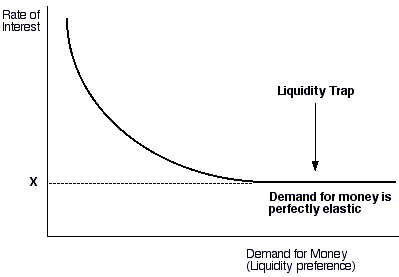


    Velocity

    A related way to think about a liquidity trap is in terms of monetary velocity: nominal GDP divided by the monetary base. (The identity, which is true by definition, is M * V = P * Y. The monetary base times velocity is equal to the price level times real output).

    Velocity is just the dollar value of GDP that the economy produces per dollar of monetary base. You can also think of velocity as the number of times that one dollar “turns over” each year to purchase goods and services in the economy. Rising velocity implies that money is “turning over” more rapidly, so that nominal GDP is increasing faster than the stock of money. If velocity rises, holding the quantity of money constant, you’ll observe either growth in real output or inflation. Falling velocity implies that a given stock of money is being hoarded, so that nominal GDP is growing slower than the stock of money. If velocity falls, holding the quantity of money constant, you’ll observe either a decline in real GDP or deflation.

    The belief that an increase in the money supply will result in an increase in GDP relies on the assumption that velocity will not decline in proportion to the increase in money. Unfortunately for the proponents of “quantitative easing,” this assumption fails spectacularly in the data – both in the U.S. and internationally –particularly at zero interest rates.

    How to spot a liquidity trap

    The chart below plots the velocity of the U.S. monetary base against interest rates since 1947. Since high money holdings correspond to low velocity, the graph is simply the mirror image of the theoretical chart above.

    Few theoretical relationships in economics hold quite this well. Recall that a Keynesian liquidity trap occurs at the point when interest rates become so low that cash balances are passively held regardless of their size. The relationship between interest rates and velocity therefore goes flat at low interest rates, since increases in the money stock simply produce a proportional decline in velocity, without requiring any further decline in yields. Notice the cluster of observations where interest rates are zero? Those are the most recent data points.

    One might argue that while short-term interest rates are essentially zero, long-term interest rates are not, which might leave some room for a “Hicksian” effect from QE – that is, a boost to investment and economic activity in response to a further decline in long-term interest rates. The problem here is that longer-term interest rates, in an expectations sense, are already essentially at zero. The remaining yield on longer-term bonds is a risk premium that is commensurate with U.S. interest rate volatility (Japanese risk premiums are lower, but they also have nearly zero interest rate variability). So QE at this point represents little but an effort to drive risk premiums to levels that are inadequate to compensate investors for risk. This is unlikely to go well. Moreover, as noted below, the precise level of long-term interest rates is not the main constraint on borrowing here. The key issues are the rational desire to reduce debt loads, and the inadequacy of profitable investment opportunities in an economy flooded with excess capacity.

    One of the most fascinating aspects of the current debate about monetary policy is the belief that changes in the money stock are tightly related either to GDP growth or inflation at all. Look at the historical data, and you will find no evidence of it. Over the years, I’ve repeatedly emphasized that inflation is primarily a reflection of fiscal policy – specifically, growth in the outstanding quantity of government liabilities, regardless of their form, in order to finance unproductive spending. Look at the experience of the 1970’s (which followed large expansions in transfer payments), as well as every historical hyperinflation, and you’ll find massive increases in government spending that were made without regard to productivity (Germany’s hyperinflation, for instance, was provoked by continuous wage payments to striking workers).

    Likewise, real economic growth has no observable correlation with growth in the monetary base (the correlation is actually slightly negative but insignificant). Rather, economic growth is the result of hundreds of millions of individual decision-makers, each acting in their best interests to shift their consumption plans, saving, and investment in response to desirable opportunities that they face. Their behavior cannot simply be induced by changes in the money supply or in interest rates, absent those desirable opportunities.

    You can see why monetary base manipulations have so little effect on GDP by examining U.S. data since 1947. Expand the quantity of base money, and it turns out that velocity falls in nearly direct proportion. The cluster of points at the bottom right reflect the most recent data.

    [Geek’s Note: The slope of the relationship plotted above is approximately -1, while the Y intercept is just over 6%, which makes sense, and reflects the long-term growth of nominal GDP, virtually independent of variations in the monetary base. For example, 6% growth in nominal GDP is consistent with 0% M and 6% V, 5% M and 1% V, 10% M and -4% V, etc. There is somewhat more scatter in 3-year, 2-year and 1-year charts, but it is random scatter. If expansions in base money were correlated with predictably higher GDP growth, and contractions in base money were correlated with predictably lower GDP growth, the slope of the line would be flatter and the fit would still be reasonably good. We don’t observe this.]

    Just to drive the point home, the chart below presents the same historical relationship inJapanese data over the past two decades. One wonders why anyone expects quantitative easing in the U.S. to be any less futile than it was in Japan.

    Simply put, monetary policy is far less effective in affecting real (or even nominal) economic activity than investors seem to believe. The main effect of a change in the monetary base is to change monetary velocity and short term interest rates. Once short term interest rates drop to zero, further expansions in base money simply induce a proportional collapse in velocity.

    I should emphasize that the Federal Reserve does have an essential role in providing liquidity during periods of crisis, such as bank runs, when people are rapidly converting bank deposits into currency. Undoubtedly, we would have preferred the Fed to have provided that liquidity in recent years through open market operations using Treasury securities, rather than outright purchases of the debt securities of insolvent financial institutions, which the public is now on the hook to make whole. The Fed should not be in the insolvency bailout game. Outside of open market operations using Treasuries, Fed loans during a crisis should be exactly that, loans – and preferably following Bagehot’s Rule (“lend freely but at a high rate of interest”). Moreover, those loans must be senior to any obligation to bank bondholders – the public’s claim should precede private claims. In any event, when liquidity constraints are truly binding, the Fed has an essential function in the economy.

    At present, however, the governors of the Fed are creating massive distortions in the financial markets with little hope of improving real economic growth or employment. There is no question that the Fed has the ability to affect the supply of base money, and can affect the level of long-term interest rates given a sufficient volume of intervention. The real issue is that neither of these factors are currently imposing a binding constraint on economic growth, so there is no benefit in relaxing them further. The Fed is pushing on a string.

    Toy blocks

    Certain economic equations and regularities make it tempting to assume that there are simple cause-effect relationships that would allow a policy maker to directly manipulate prices and output. While the Fed can control the monetary base, the behavior of prices and output is based on a whole range of factors outside of the Fed’s control. Except at the shortest maturities, interest rates are also a function of factors well beyond monetary policy.

    Analysts and even policy makers often ignore equilibrium, preferring to think only in terms of demand, or only in terms of supply. For example, it is widely believed that lower real interest rates will result in higher economic growth. But in fact, the historical correlation between real interest rates and GDP growth has been positive – on balance, higher real interest rates are associated with higher economic growth over the following year. This is because higher rates reflect strong demand for loans and an abundance of desirable investment projects. Of course, nobody would propose a policy of raising real interest rates to stimulate economic activity, because they would recognize that higher real interest rates were an effect of strong loan demand, and could not be used to cause it. Yet despite the fact that loan demand is weak at present, due to the lack of desirable investment projects and the desire to reduce debt loads (which has in turn contributed to keeping interest rates low), the Fed seems to believe that it can eliminate these problems simply by depressing interest rates further. Memo to Ben Bernanke: Loan demand is inelastic here, and for good reason. Whatever happened to thinking in terms of equilibrium?

    Neither economic growth nor the demand for loans are a simple function of interest rates. If consumers wish to reduce their debt, and companies do not have a desirable menu of potential investments, there is little benefit in reducing interest rates by another percentage point, because the precise cost of borrowing is not the issue. The current thinking by the FOMC seems to treat individual economic actors as little unthinking toy blocks that can be moved into the desired position at will. Instead, our policy makers should be carefully examining the constraints and interests that are important to people and act in a way that responsibly addresses those constraints.

    A good example of this “toy block” thinking is the notion of forcing individuals to spend more and save less by increasing people’s expectations about inflation (which would drive real interest rates to negative levels). As I noted last week, if one examines economic history, one quickly discovers that just as lower nominal interest rates are associated with lower monetaryvelocity, negative real interest rates are associated with lower velocity of commodities(hoarding). Look at the price of gold since 1975. When real interest rates have been negative (even simply measured as the 3-month Treasury bill yield minus trailing annual CPI inflation), gold prices have appreciated at a 20.7% annual rate. In contrast, when real interest rates have been positive, gold has appreciated at just 2.1% annually. The tendency toward commodity hoarding is particularly strong when economic conditions are very weak and desirable options for real investment are not available. When real interest rates have been negative and the Purchasing Managers Index has been below 50, the XAU gold index has appreciated at an 85.7% annual rate, compared with a rate of just 0.1% when neither has been true. Despite these tendencies, investors should be aware that the volatility of gold stocks can often be intolerable, so finer methods of analysis are also essential.

    Quantitative easing promises to have little effect except to provoke commodity hoarding, a decline in bond yields to levels that reflect nothing but risk premiums for maturity risk, and an expansion in stock valuations to levels that have rarely been sustained for long (the current Shiller P/E of 22 for the S&P 500 has typically been followed by 5-10 year total returns below 5% annually). The Fed is not helping the economy – it is encouraging a bubble in risky assets, and an increasingly unstable one at that. The Fed has now placed itself in the position where small changes in its announced policy could have disastrous effects on a whole range of financial markets. This is not sound economic thinking but misguided tinkering with the stability of the economy.

    Implications for Policy

    In 1978, MIT economist Nathaniel Mass developed a framework for the liquidity trap based on microeconomic theory – rational decisions made at the level of individual consumers and firms. The economic dynamics resulting from the model he suggested seem strikingly familiar in the context of the recent economic downturn. They offer a useful way to think about the current economic environment, and appropriate policy responses that might be taken.

    “The theory revolves around a set of forces that for a period of time promote cumulative expansion of capital formation, but eventually lead to overexpansion of capital production capacity and then into a situation where excess capacity strongly counteracts expansionary monetary policies.

    “The capital boom followed by depression runs much longer than the usual short-term business cycle, and is powerfully driven by capital investment interactions. The weak impact of monetary stimulus on real activity arises because additional money has little force in stimulating additional capital investment during a period of general overcapacity. Instead, money is withheld in idle balances when profitable investment opportunities are scarce.”

    In one illustration of the model, Mass introduces a monetary stimulus much like what Alan Greenspan engineered following the 2000-2002 recession (which was also preceded by an unusually large buildup of excess capacity, leading to an investment-led downturn). Though Greenspan’s easy-money policy didn’t prompt a great deal of business investment, it did help to fuel the expansion in another form of investment, specifically housing. Mass describes the resulting economic dynamics:

    “Following the monetary intervention, relatively easy money provides a greater incentive to order capital… But now the overcapacity that characterizes the peak in the production of capital goods reaches an even higher level than without the stimulus. This overcapacity eventually makes further investment even less attractive and causes the decline in capital output to proceed from a higher peak and at a faster pace. Due to persistent excess capital which cannot be reduced as fast as labor can be cut back to alleviate excess production, unemployment actually remains higher on the average following the drop in production.”

    In what reads today as a further warning against Bernanke-style quantitative easing, Mass observed:

    “Even aggressive monetary intervention can do little to correct excess capital.. Once excess capacity develops, the forces that previously led to aggressive expansion are almost played out. Efforts to prolong high investment can produce even more excess capital and lead to a more pronounced readjustment later.”

    Mass concluded his 1978 paper with an observation from economist Robert Gordon:

    “Why was the recovery of the 1930’s so slow and halting in the United States, and why did it stop so far short of full employment? We have seen that the trouble lay primarily in the lack of inducement to invest. Even with abnormally low interest rates, the economy was unable to generate a volume of investment high enough to raise aggregate demand to the full employment level.”

    I’ve generally been critical of Keynes’ willingness to advocate government spending regardless of its quality, which focused too little on the long-term effects of diverting private resources to potentially unproductive uses. His remark that “In the long-run we are all dead” was a reflection of this indifference. Still, I do believe that fiscal responses can be useful in a protracted economic downturn, and can include projects such as public infrastructure, incentives for research and development, and investment incentives in sectors that are not burdened with overcapacity. Additional deficit spending is harmful when it fails to produce a stream of future output sufficient to service the debt, so the expected productivity of these projects is the essential consideration. Given present economic conditions, it appears clear that Keynes was right about the dangers of easy monetary policy when an economic downturn results from overcapacity. As I noted last week in The Recklessness of Quantitative Easing, better options are available on the fiscal menu.

    Market Climate

    As of last week, the Market Climate for stocks remained characterized by an overvalued, overbought, overbullish condition. This has been historically associated with a poor return-risk profile and “negative skew” – a tendency for the market to establish a string of marginal new highs, and for occasional 2-3 day pullbacks to be followed by sharp recoveries. The pattern is for little overall progress, but repeated slight highs, terminating with a steep, abrupt decline that can wipe out weeks or months of gains in a matter of days. In statistical terms, the mode of the distribution is positive, the mean is negative, and the skew is downright wicked.

    The Strategic Growth Fund remains fully hedged, with our put strikes raised close to the current market to tighten our downside protection, at a cost of just over 1% of assets in additional time premium. The Strategic International Equity Fund remains largely but not fully hedged against international equity fluctuations. Currency fluctuations typically account for only a small fraction the variability in international returns, so our primary risk is covered by equity hedges, but the Fund also has nearly one-third of its currency risk hedged as well. The Strategic Total Return Fund moved to a fairly defensive stance last week, with an average duration of less than 1.5 years, and only about 3% of assets in precious metals shares, 1% in foreign currencies, and 2% in utility shares. Though we sharply cut our precious metals exposure over the past few weeks on overbought price conditions and other factors, I expect that we’ll continue to vary our exposure opportunistically. The Fed’s insistence on bad policy will probably continue to support commodity hoarding behavior, but commodity market conditions threaten to become very tenuous if economic conditions strengthen. Presently, I remain concerned about additional weakness in employment, housing, and the broad economy, but we’ll take our evidence as it comes.


    One might argue that while short-term interest rates are essentially zero, long-term interest rates are not, which might leave some room for a “Hicksian” effect from QE – that is, a boost to investment and economic activity in response to a further decline in long-term interest rates. The problem here is that longer-term interest rates, in an expectations sense, are already essentially at zero. The remaining yield on longer-term bonds is a risk premium that is commensurate with U.S. interest rate volatility (Japanese risk premiums are lower, but they also have nearly zero interest rate variability). So QE at this point represents little but an effort to drive risk premiums to levels that are inadequate to compensate investors for risk. This is unlikely to go well. Moreover, as noted below, the precise level of long-term interest rates is not the main constraint on borrowing here. The key issues are the rational desire to reduce debt loads, and the inadequacy of profitable investment opportunities in an economy flooded with excess capacity.

    One of the most fascinating aspects of the current debate about monetary policy is the belief that changes in the money stock are tightly related either to GDP growth or inflation at all. Look at the historical data, and you will find no evidence of it. Over the years, I’ve repeatedly emphasized that inflation is primarily a reflection of fiscal policy – specifically, growth in the outstanding quantity of government liabilities, regardless of their form, in order to finance unproductive spending. Look at the experience of the 1970’s (which followed large expansions in transfer payments), as well as every historical hyperinflation, and you’ll find massive increases in government spending that were made without regard to productivity (Germany’s hyperinflation, for instance, was provoked by continuous wage payments to striking workers).

    Likewise, real economic growth has no observable correlation with growth in the monetary base (the correlation is actually slightly negative but insignificant). Rather, economic growth is the result of hundreds of millions of individual decision-makers, each acting in their best interests to shift their consumption plans, saving, and investment in response to desirable opportunities that they face. Their behavior cannot simply be induced by changes in the money supply or in interest rates, absent those desirable opportunities.

    You can see why monetary base manipulations have so little effect on GDP by examining U.S. data since 1947. Expand the quantity of base money, and it turns out that velocity falls in nearly direct proportion. The cluster of points at the bottom right reflect the most recent data.


    Hussmand Funds
    http://www.hussmanfunds.com


  • Sales of U.S. New Homes Increased Again in September, by Bob Willis, Bloomberg.com


    Sales of new homes rose in September for a second month to a pace that signals the industry is struggling to overcome the effects of a jobless rate hovering near 10 percent.

    Purchases increased 6.6 percent to a 307,000 annual rate that exceeded the median forecast of economists surveyed by Bloomberg News, figures from the Commerce Department showed today in Washington. Demand is hovering near the record-low 282,000 reached in May.

    A lack of jobs is preventing Americans from gaining the confidence needed to buy, overshadowing declines in borrowing costs and prices that are making houses more affordable. At the same time, foreclosure moratoria at some banks, including JPMorgan Chase & Co., signal the industry will redouble efforts to tighten lending rules, which may depress housing even more.

    “These are still very low levels,” said Jim O’Sullivan, global chief economist at MF Global Ltd. in New York. “Ultimately, a significant recovery in housing will depend on a clear pickup in employment.”

    Another Commerce Department report today showed orders for non-military capital equipment excluding airplanes dropped in September, indicating gains in business investment will cool.

    Capital Goods Demand

    Bookings for such goods, including computers and machinery meant to last at least three years, fell 0.6 percent after a 4.8 percent gain in August that was smaller than previously estimated. Total orders climbed 3.3 percent last month, led by a doubling in aircraft demand.

    Stocks fell, snapping a five-day gain for the Standard & Poor’s 500 Index, on the durable goods report and investor speculation that steps taken by the Federal Reserve to shore up the economy will be gradual. The S&P 500 fell 0.5 percent to 1,179.8 at 10:14 a.m. in New York.

    Economists forecast new home sales would increase to a 300,000 annual pace from a 288,000 rate in August, according to the median of 73 survey projections. Estimates ranged from 270,000 to 330,000.

    The median price increased 3.3 percent from September 2009 to $223,800.

    Purchases rose in three of four regions, led by a 61 percent jump in the Midwest. Purchases dropped 9.9 percent in the West.

    Less Supply

    The supply of homes at the current sales rate fell to 8 months’ worth, down from 8.6 months in August. There were 204,000 new houses on the market at the end of September, the fewest since July 1968.

    Reports earlier this month showed the housing market is hovering at recession levels. Housing starts increased in September to an annual rate of 610,000, the highest since April, while building permits fell to the lowest level in more than a year, signaling construction will probably cool.

    Sales of existing homes, which now make up more than 90 percent of the market, increased by 10 percent to a 4.53 million rate in September, the National Association of Realtors said yesterday. The pace was still the third-lowest on record going back a decade.

    Home resales are tabulated when a contract is closed, while new-home sales are counted at the time an agreement is signed, making them a leading indicator of demand.

    Moratoria’s Influence

    Economists are debating the likely effect on new-home sales from the foreclosure moratoria and regulators’ probes into faulty paperwork. Most agree the moratoria pose a risk to housing sales as a whole.

    Michelle Meyer, a senior economist at Bank of America Merrill Lynch Global Research in New York, is among those who say the moratoria, by limiting the supply of existing homes, may lift demand for newly built houses in coming months.

    “There is a possibility there will be a shift in demand for new construction, at least in the short term,” she said.

    The U.S. central bank and other regulators are “intensively” examining financial firms’ home-foreclosure practices and expect preliminary findings next month, Fed Chairman Ben S. Bernanke said this week at a housing conference in Arlington, Virginia.

    Fed officials have signaled they may start another round of unconventional monetary easing at their next meeting Nov. 2-3 to try to spur the economic recovery.

    Homebuilders say labor-market conditions will be the biggest factor in spurring or delaying a recovery.

    “The U.S. economy needs to improve, and we’ve got to see some improvement in job creation,” Larry Sorsby , chief financial officer at Hovnanian Enterprises Inc., the largest homebuilder in New Jersey, said during an Oct. 7 conference call.

    To contact the reporter on this story: Bob Willis in Washington at bwillis@bloomberg.net

    To contact the editor responsible for this story: Christopher Wellisz at cwellisz@bloomberg.net

  • Goldman: The Fed Needs To Print $4 Trillion In New Money, Zerohedge.com


    With just over a week left to the QE2 announcement, discussion over the amount, implications and effectiveness of QE2 are almost as prevalent (and moot) as those over the imminent collapse of the MBS system. Although whereas the latter is exclusively the provenance of legal interpretation of various contractual terms, and as such most who opine either way will soon be proven wrong to quite wrong, as in America contracts no longer are enforced (did nobody learn anything from the GM/Chrysler fiasco for pete’s sake), when it comes to printing money the ultimate outcome will certainly have an impact. And the more the printing, the better. One of the amusing debates on the topic has been how much debt will the Fed print. Those who continue to refuse to acknowledge that the economy is in a near-comatose state, of course, hold on to the hope that the amount will be negligible: something like $500 billion (there was a time when half a trillion was a lot of money). A month ago we stated that the full amount will be much larger, and that the Fed will be a marginal buyer of up to $3 trillion. Turns out, even we were optimistic. A brand new analysis by Jan Hatzius, which performs a top down look at how much monetary stimulus is needed to fill the estimated 300 bps hole between the -7% Taylor Implied Funds Rate (of which, Hatzius believes, various other Federal interventions have already filled roughly 400 bps of differential) and the existing 0.2% FF rate. Using some back of the envelope math, the Goldman strategist concludes that every $1 trillion in new LSAP (large scale asset purchases) is the equivalent of a 75 bps rate cut (much less than comparable estimates by Dudley, 100-150bps, and Rudebusch, 130bps). In other words: the Fed will need to print $4 trillion in new money to close the Taylor gap. And here we were thinking the economy is in shambles. Incidentally, $4 trillion in crisp new dollar bills (stored in bank excess reserve vaults) will create just a tad of buying interest in commodities such as gold and oil…

    Here is the math.

    First, Goldman calculates that the gap to close to a Taylor implied funds rate is 7%.


    Our starting point is Chairman Bernanke?s speech on October 15, which defined the dual mandate as an inflation rate of ?two percent or a bit below? and unemployment equal to the committee?s estimate of the long-term sustainable rate. The Fed?’s job is then to provide just enough stimulus or restraint to put the forecast for inflation and unemployment on a ?glide path? to the dual mandate over some reasonable period of time. Indeed, Fed officials have implicitly pursued just such a policy since at least the late 1980s.

    To quantify the Fed?s approach, we have estimated a forward-looking Taylor-style rule that relates the target federal funds rate to the FOMC?s forecasts for core PCE inflation and the unemployment gap (difference between actual and structural unemployment). At present, this rule points to a desired federal funds rate of -6.8%, as shown in Exhibit 1.3 Since the actual federal funds rate is +0.2%, our rule implies on its face that the existence of the zero lower bound on nominal interest rates  has kept the federal funds rate 700 basis points (bp) ?too high.?

    It is important to be clear about the meaning of this ?policy gap.? It does not mean?as is sometimes alleged?that policy is tight in an absolute sense, much less that it will necessarily push the economy back into recession. In fact, policy as measured by  the real federal funds rate of -1% is very easy. However, our policy rule implies that under current circumstances?with the Fed missing to the downside on both the inflation and employment part of the dual mandate (and by a large margin in the  latter case) ?a very easy policy is not good enough. Instead, policy should be massively easy to facilitate growth and job creation, fill in the output gap, and ultimately raise inflation to a mandate-consistent level.

    Next, Goldman calculates how much existing monetary, and fiscal policy levers have narrowed the Taylor gap by:


    The 700bp policy gap clearly overstates the extent of the policy miss because it ignores (1) the expansionary stance of fiscal policy, (2) the LSAPs that have already occurred and (3) the FOMC?s ?extended period? commitment to a low funds rate. We attempt to incorporate the implications of these for the policy gap in two steps.

    First, we obtain an estimate of how much the existing unconventional Fed policies have eased financial conditions. In previous work we showed that the first round of easing pushed down short- and long-term interest rates, boosted equity prices and led to depreciation of the dollar. Although our estimates are subject to a considerable margin of error, they suggest that ?QE1? has boosted financial conditions?as measured by our GSFCI ?by around 80bp per $1 trillion (trn) of purchases. Moreover, our estimates suggest that the ?extended period? language has provided an additional 30bp boost to financial conditions. A number of studies undertaken at the Fed similarly point to sizable effects on financial conditions. A New York Fed study, for example, finds that QE1 has pushed down long-term yields by 38-82bp. A paper by the St. Louis Fed also finds a sizable boost to financial conditions more generally, including equity prices and the exchange rate.

    Second, we translate this boost to financial conditions?as well as the expansionary fiscal stance?into funds rate units. To do so, we attempt to quantify the relative impact of changes in the federal funds rate, fiscal policy and the GSFCI on real GDP. As such estimates are subject to considerable uncertainty we take the average effect across a number of existing studies (see Exhibit 2). With regard to monetary policy, the studies we consider suggest that a 100bp easing in the funds rate, on  average, boosts the level of real GDP by 1.6% after two years. A fiscal expansion worth 1% of GDP, on average, raises the level of GDP by 1.1% two years later. Using existing studies to gauge the effects of an easing in our GSFCI on output is more difficult as other researchers construct their financial conditions indices in different ways. Taking the average across studies that report effects for the components of their indices?thus allowing us to re-weight the effects for our GSFCI? and our own estimate suggests that a 100bp easing in financial conditions increases the level of GDP by around 1.5% after two years.

    What does this mean for the real impact on the implied fund rate from every incremental dollar of purchases?


    Combining these two steps suggests that $1trn of asset purchases is equivalent to a 75bp cut in the funds rate (calculated as the effect of LSAPs on financial conditions (80bp), multiplied by the effect of financial conditions on GDP (1.5%), divided by the effect of the funds rate on GDP (1.6%)). This estimate reinforces the view that QE1 helped to substitute for conventional policy. Our estimate, however, is less optimistic than the 100-150bp range cited by New York Fed President Dudley, or the 130bp implied by Glenn Rudebusch of the San Francisco Fed.

    In terms of the other policy levers, our analysis implies that the ?extended period? language is worth around 30bp cut in the funds rate and a fiscal stimulus of 1% of GDP is equivalent to around 70bp of fed funds rate easing.

    So how much more work should the FOMC do? Exhibit 3 shows that consideration of policy levers other than the funds rate cuts the estimated policy gap by more than half, from 700bp to 300bp. Of this 400bp reduction, the easy stance of fiscal policy is worth 240bp; QE1 is worth 130bp; and the existing commitment language is worth another 30bp.

    And the kicker, which shows just how naive we were:

    We can then express the remaining policy gap in terms of the required additional LSAPs. Using our estimate that $1trn in LSAPs is worth an estimated 75bp cut in the federal funds rate and assuming that all other policy levers stay where they are at present, Fed officials would need to buy an additional $4trn to close the remaining policy gap of 300bp.

    Now, for the amusing part: what does $4 trillion in purchases means for inflation. Or, a better question, when will $4 trillion be priced in…

    In reality, the FOMC is unlikely to authorize additional LSAPs of as much as $4trn, unless the economy performs much worse than we are forecasting. The committee perceives LSAPs as considerably more costly than an equivalent amount of conventional monetary stimulus, and is therefore not likely to use the two interchangeably. Many Fed officials believe that there are significant ?tail risks? associated with LSAPs and the associated increase in the Fed?s aggregate balance sheet. These  risks include the possibility of substantial mark-to-market losses on the Fed?s investment, which might prove embarrassing in the Fed?s dealings with Congress and could, in theory, undermine its independence. They also include the possibility that the  associated sharp increase in the monetary base will lead households and firms to expect much higher inflation at some point in the future.

    Unfortunately, it is extremely difficult to put a number on the perceived or actual cost of an extra $1trn in LSAPs in terms of these tail risks. However, we have some information on how the FOMC has behaved to date that might reveal Fed? officials? perception of these costs.

    Oddly, nobody ever talks about the impact of “unconvential” printing of trillions on commodities such as oil and gold. They will soon.

    Our analysis is therefore consistent with additional asset purchases of around $2trn if the FOMC?s forecasts converge to our own. It is unlikely, however, that the FOMC will announce asset purchases of this size in the very near term. Rather, our analysis suggests that the timing of the announcements should depend on whether, and how quickly, the FOMC?s forecasts converge to ours.

    Hatzius pretty much says it all- suddenly the market will be “forced” to price in up to 4 times as much in additional monetary loosening from the “convention wisdom accepted” $1 trillion. We have just one thing do add. If Goldman has underestimated the impact of existing fiscal and monetary intervention, and instead of closing 4% of the Taylor gap, the actual impact has been far less negligible (and if Ferguson is right in assuming that all this excess money has in fact gone to chasing emerging market and commodity bubbles), it means that, assuming 75bps of impact per trillion, the Fed will not stop until it prints nearly ten trillion in incremental money beginning on November 3. That’s almost more than M1 and M2 combined.

    Is the case for $10,000 gold becoming clearer?

  • Bernanke Asset Purchases Risk Unleashing 1970s Inflation Genie, by Craig Torres, Bloomberg.com


    Official portrait of Federal Reserve Chairman ...
    Image via Wikipedia

    For the second time since he became chairman in 2006, Ben S. Bernanke is leading the Federal Reserve into uncharted monetary territory.

    Bernanke next week is likely to preside over a decision to launch another round of large-scale asset purchases after deploying $1.7 trillion to pull the economy out of the financial crisis, comments from policy makers over the past week indicate. This time, with interest rates already near zero, the Fed will be aiming to increase the rate of inflation and reduce the cost of borrowing in real terms. The goal is to unlock consumer spending and jump-start an economy that’s growing too slowly to push unemployment lower.

    Estimates for the ultimate size of the asset-purchase program range from $1 trillion at Bank of America-Merrill Lynch Global Research to $2 trillion at Goldman Sachs Group Inc., with economists at both firms agreeing the Fed will likely start by announcing $500 billion after the Nov. 2-3 meeting. The danger is that once the Fed kindles price increases, inflation will be difficult to control.

    “By reducing real interest rates and trying to break the psychology of ‘Why spend today when I can buy goods cheaper tomorrow,’ they are hoping to drive growth that would be more commensurate with a pickup in employment,” said Dan Greenhaus, chief economic strategist at Miller Tabak & Co. in New York. “The risk is a late 1970s type of scenario where the inflation genie gets out of the bottle.”

    The U.S. Treasury Department yesterday sold $10 billion of five-year Treasury Inflation Protected Securities at a negative yield for the first time at a U.S. debt auction as investors bet the Fed will be successful in sparking inflation. The securities drew a yield of negative 0.55 percent.

    ‘Unacceptable’ Inflation

    William Dudley, president of the New York Fed and vice chairman of the Federal Open Market Committee, yesterday repeated that current levels of inflation and a 9.6 percent unemployment rate are “unacceptable” and said the Fed needs to take action, even though expanding the balance sheet isn’t a “perfect tool.”

    “To the extent that we can do things to improve the economic environment, we certainly owe it to the millions of people who are unemployed to do so,” Dudley said in response to audience questions after a speech in Ithaca, New York. Policy makers haven’t yet decided whether to buy additional assets, he said.

    A second jolt of monetary stimulus would expand the Fed’s $2.3 trillion balance sheet to a record and likely work through the exchange rate as well as interest rates, said former Fed governor Lyle Gramley. A weaker dollar would boost U.S. exports and push prices higher as the cost of imported goods rises.

    Competitive Exports

    “It is a channel that works not only from the standpoint of encouraging more growth and making exports more competitive, but if you’re worried about inflation getting too low, this tends to put a little upward pressure” on it, said Gramley, a senior adviser at Potomac Research Group in Washington.

    An index of the dollar versus six major currencies is down 5.2 percent since Sept. 20, the day before Fed officials concluded their last meeting by saying inflation measures were “somewhat below those the Committee judges most consistent, over the longer run, with its mandate to promote maximum employment and price stability.” The Standard and Poor’s 500 Index is up 3.8 percent since then.

    A 10 percent decline in the dollar in the first six months of next year would push the economy above estimates of trend growth, moving indicators on inflation and employment more rapidly toward the Fed’s policy goals, according to a simulation run by Macroeconomic Advisers LLC on their model of the U.S. economy.

    Effect on GDP

    Gross domestic product would rise 1.1 percentage points more than the St. Louis-based firm’s baseline forecast for next year, to 4.8 percent. In 2012, growth of 5.7 percent would exceed the baseline forecast by 1.3 percentage points.

    Unemployment would fall to 7 percent by the end of 2012, 1.4 points lower than the firm’s baseline forecast. The consumer price index, minus food and energy, would rise 0.4 percent and 0.7 percent more each year.

    A continuing rally in stocks could also provide an added lift to growth, the firm’s simulation showed.

    The firm, co-founded by former Fed governor Laurence Meyer, predicts the Wilshire 5000 stock index will jump 14 percent next year and 16 percent in 2012. The index tracks the impact of rising asset prices on household net worth. An additional 10 percent gain in the stock index in the first half of 2011 boosts growth by 0.1 percentage point and 0.3 percentage point more than the firm’s baseline forecast.

    ‘Transmission Mechanism’

    “The transmission mechanisms are risk assets and a lower dollar,” said Steven Einhorn, who helps manage $5 billion at hedge fund Omega Advisors Inc. in New York. “Exports will respond over the next six to 12 months, and a further lift in risk assets will have benefits in more consumer spending as it lifts households’ net worth.”

    A weaker dollar won’t be welcomed by U.S. trading partners concerned about the danger of competitive devaluations as nations seek to boost exports and growth.

    Bernanke received “criticism” at a meeting of Group of 20 central bankers and finance ministers in South Korea last weekend, said German Economy Minister Rainer Bruederle.

    “It’s the wrong way to try to prevent or solve problems by adding more liquidity,” Bruederle told reporters. “Excessive, permanent money creation in my opinion is an indirect manipulation of an exchange rate.”

    $500 Billion

    Economists Jan Hatzius at Goldman Sachs and Ethan Harris at Bank of America predict the Fed will spread an initial $500 billion in asset purchases over six months. That is the figure mentioned in the Oct. 1 speech by Dudley, who said $500 billion in purchases could have the same effect as cutting the benchmark federal funds rate by as much as a 0.75 percentage point.

    The FOMC’s meeting next week could be contentious, with regional bank presidents such as Charles Plosser of Philadelphia and Richard Fisher of Dallas expressing concern in public remarks about a second round of asset purchases. Neither is a voting member of the FOMC this year.

    Plosser told reporters Oct. 20 that high unemployment may not be “amenable to monetary-policy solutions” and added that he was “less inclined to want to follow a policy that is highly concentrated on raising inflation and raising inflation expectations.”

    Fisher said central bank officials must be mindful of the effect their actions are having on the dollar.

    Dollar Impact

    “We need to be aware of the impact whatever we do has on other variables, and one of the variables is the dollar, the value of the dollar against other currencies,” Fisher said in an Oct. 22 interview in New York.

    The prospect of an easier policy for a long period could prompt foreign investors to use Fed purchases as an opportunity to unload longer-term Treasuries, said Vincent Reinhart, former director of the Fed Board’s Division of Monetary Affairs.

    “This might put more pressure on the exchange value of the dollar than the Fed is willing to tolerate,” said Reinhart, a resident scholar at the American Enterprise Institute in Washington.

    Some commodity prices have already started to move up in anticipation of further Fed stimulus. Gold futures traded on the Comex in New York have risen 22 percent this year to $1,338.90 an ounce, while silver is up 40 percent.

    “The Fed would like to talk up as many asset classes as it can,” said Scott Minerd, the Santa Monica-based chief investment officer at Guggenheim Partners LLC, who helps oversee $76 billion.

    Asset Bubbles

    “The history of the Fed, over the last 20 years, is one of bubble to bubble: one bubble deflates to create another bubble,” Minerd said. “We are certainly heading into the mother of all bubbles with commodities and gold.”

    Another danger for the Fed is that its policy fails to have the intended effect, damaging the central bank’s credibility, Reinhart said.

    “What happens if they bulk up the portfolio by another $500 billion in the next six months and there is no material change in markets or the outlook,” he said. “Presumably, the Fed will double-down and buy some more, but at some point, people will ask, ‘Is that all there is?’”

    U.S. central bankers cut the benchmark lending rate to zero in December 2008. Seeking more stimulus, they launched a $1.7 trillion program to buy mortgage-backed securities, housing agency debt and U.S. Treasuries. The purchases ended in March.

    Jackson Hole

    Bernanke told central bankers in Jackson Hole, Wyoming, in August that those purchases “pushed investors into holding other assets with similar characteristics,” lowering interest rates on a broad range of debt.

    While a second round of Treasury purchases would also lower nominal rates, the FOMC has been explicit about the need to lower real interest rates through higher inflation, minutes of its Sept. 21 meeting show.

    The personal consumption expenditures price index, minus food and energy, rose at a 1.4 percent annual rate in August. That’s below the Fed’s long-run preference range of 1.7 percent to 2 percent. The year-over-year increase in consumer prices jumped as high as 14.8 percent in 1980 during the administration of Jimmy Carter.

    Even moderate rates of inflation can shift wealth through the economy. Companies can make more money because their prices rise faster than wages. Households can also benefit as incomes eventually rise while costs on fixed-rate debt stay the same.

    Chipotle Mexican Grill Inc. chief financial officer John Hartung told Bloomberg Television Oct. 22 that he expects inflation to be in the low-single to mid-single digits next year. “We would welcome modest inflation along with the continued pickup in consumer demand,” Hartung said.

    To contact the reporters on this story: Craig Torres in Washingtont ; or Scott Lanman in Washington at slanman@bloomberg.net.

    To contact the editor responsible for this story: Christopher Wellisz at cwellisz@bloomberg.net

  • New York Grants Right to Claim Attorney Fees to Prevailing Homeowners in Foreclosures


    Going against state bankers, New York Gov. David A. Paterson has signed into law a measure that will allow prevailing homeowners in many foreclosure actions to claim attorney fees from lenders.
    The Access to Justice in Lending Act, A1239/S2614, will put defendants in foreclosure proceedings on the same footing as lenders, who often include in mortgage documents the right to recoup reasonable attorney fees if they bring a successful action.
    Supporters of the new requirement say that it will encourage attorneys to volunteer their services to homeowners facing foreclosure, many of them who cannot afford to hire their own lawyers. At the same time, they say the measure will give the homeowners leverage to negotiate concessions from lenders seeking to avoid the potential costs of litigation.
    “At a time when not-for-profits and counselors are flooded with these cases, this is an important step in bringing parity for homeowners,” the governor’s office said in an e-mailed statement.
    The new law, Real Property Law §282, provides that all mortgage agreements giving prevailing lenders the right to attorney fees, must be read to grant that right to borrowers as well. Although it goes into effect 60 days after its signing, it applies to all mortgages in effect on or after Oct. 20 and all proceedings begun on or after that date.
    Assemblyman Rory Lancman, D-Queens — who sponsored the bill with Senator Jeffrey Klein, D-Bronx — said in an interview that it will help “restore integrity and fairness” to a foreclosure process shadowed by revelations that many banks and their attorneys have resorted to procedural shortcuts that deny homeowners their right to due process. The measure was signed on the same day Chief Judge Jonathan Lippman ordered lender attorneys to submit affirmations in all foreclosures attesting that they have made reasonable efforts to verify the facts in the documents they submit.
    The law was opposed by the state Bankers Association in a memorandum to the governor drafted by Wilson, Elser, Moskowitz, Edelman & Dicker (NYLJ, July 9). The memo argued the bill was unconstitutional in its application to existing mortgages. It contended that the two most common laws used by homeowners to fight foreclosure, the federal Truth in Lending Act, 15 USC §1640, and the federal Fair Debt Collection Practices Act, 15 USC §1692k, already allowed the recovery of attorney’s fees. And it complained that the bill’s “broadly drafted” language could open up the possibility of homeowners being awarded attorney’s fees to which they had no right.
    Roberta Kotkin, general counsel and chief operating officer of the association, said in an interview after the governor signed the law that the organization stood by its criticisms. Moreover, she said the new requirement could increase the cost of mortgages to account for lenders’ added risk.
    “Now it’s signed into law. Obviously we’re going to honor it and work with it,” she said.
    But organizations representing homeowners have been enthusiastic about the bill.
    “I do think the biggest benefit is the leverage [the new law] gives the homeowner in getting out of foreclosure with an affordable modification,” said Meghan Faux, director of the foreclosure prevention project for South Brooklyn Legal Services, which is a part of Legal Services NYC.
    There were 77,815 foreclosures pending in New York courts as of Oct. 12, a 50 percent increase from the beginning of the year. Legal Services NYC, in a memo to the governor supporting the law, said the demand for its services had mounted, and “because of our limited resources, we are able to represent only a fraction of low-income homeowners, even though many of them have meritorious claims and defenses to foreclosure.”
    The group argued that the proposal would allow a greater number of borrowers to obtain legal representation and create an incentive for lenders to resolve more cases early in the process.
    And attorneys are becoming increasingly creative in challenging foreclosures as the process comes under more scrutiny. For example, they are questioning the ownership of mortgage notes that were shuffled from entity to entity during the securitization boom.
    “With so many issues of standing being questioned, it seems both the availability and the range of potential defenses is much larger today than even a couple of weeks ago,” said Michael Hickey, executive director of the Center for New York City Neighborhoods.
    Lancman, an attorney, said the fees to homeowners’ lawyers would likely be low in most cases — ranging from a few thousand dollars to “low five figures” — because skilled attorneys could determine problems with the lender’s case early on. He said attorneys would not make a fortune from foreclosure cases, but the profits would be enough to justify picking up the most meritorious cases.
    The new program is modeled after Real Property Law §234, a 1966 law that gave prevailing tenants the right to recoup attorney’s fees whenever landlords include a fee provision in the lease. A 1995 Court of Appeals decision upheld the application of the law to leases signed before it became effective. Duell v. Condon, 84 NY 2d 773.
    That ruling describes the purpose of the earlier fees provision as “to level the playing field between landlords and residential tenants, creating a mutual obligation that provides an incentive to resolve disputes quickly and without undue expense.”
    Moreover, it said that the law tended to discourage landlords from engaging in frivolous litigation aimed at harassing tenants.

  • How $257 can halt a home purchase


    My company frequently works with customers to “clean up” their credit so that they can qualify for a home loan. This process typically takes about 6 months, maybe longer depending on the severity of the problem and the resources available to pay off delinquent accounts. We don’t charge anything for this because: a) it’s illegal, and b) it’s part of serving our clients and ensuring they get a loan they can live with.

    We have been working with one couple on this process for about 8 months, and we were able to get them approved to buy a home. We all know that corrections/updates to credit tradelines can take somewhere between 30-90 days to be reflected on your credit report. However, this isn’t always the case. Sometimes the delinquent items continue to reported inaccurately for years. In my experience, in no instance is this more true than with government judgments and tax liens.

    We’ve all heard horror stories about government inefficiencies from every department in every level of government. Whether it’s the DMV or the USPS, it’s a big undertaking and people are, after all, only human. There will be mistakes. However, the lack of accountability is an area in which I think the public sector excels.

    When we re-pulled the credit to get the loan going, the client’s FICO score was just fine. However, a $257 judgment from Multnomah County, OR was still reporting as delinquent. A couple of years ago, the county instituted a temporary income tax called the ITAX, and many people wound up owing hundreds, sometimes thousands of dollars when the tax expired. Our clients were some of those people.

    The client had paid a settlement with the county a couple years ago, and believed that this amount was included. Even if it wasn’t, $257 isn’t a huge deal for anyone to worry about. Until you start adding penalties and 9% interest, that is.

    We decided that we would submit the loan file anyway, and given underwriting turntimes, we would be able to collect proof before every other piece of documentation had been signed off by our underwriter. What follows is the story of how that happened.

    I called the county circuit court, where the judgment had been filed and processed. I was given another number to call. The person at that number couldn’t help me, because it was a “small claims” matter. She gave me the number for small claims. The nice man at small claims told me that he could accept a payment for the judgment, but has no way of knowing what the payoff amount would be. I played along hoping he could give me the number of someone who would know more about the issue. He directed me to yet another phone number, which was the “helpline” for the ITAX. I called this number. It was out of service, as it expired THE SAME YEAR THE ITAX EXPIRED, which was a few years ago. A pre-recorded message directed me to yet another number. The person I talked to at that number told me that the account had been sent to collections, and gave me the number of the collection agency they contract with.

    OK, now I’m getting somewhere. I skeptically call the collection agency, and a very helpful lady answered the phone and told me what I already suspected:

    They would never sue someone over $257 because it costs $100 to file the suit.

    This is where her very nice qualities shined through. She took down my information, and said she would call the county courthouse to find out what was going on and get back to me. I thought to myself, “why the heck would she take the time to do all that for something she has no prayer of receiving payment on?”. However, I thanked her and moved on.

    I called the county back, explaining yet another person what I had just been through, and she directed me to the one man who still deals with ITAX payment issues. She also asked to remain on the line to verify that this would be the correct way to deal with any other future ITAX related issues so that people like me would not have to waste what had become a 45 minute telephonic wild goose chase. I thanked her profusely.

    The “ITAX man” picked up the phone and was very courteous and professional. However, he told me something after looking up the client in his system that absolutely floored me. He said that the client’s judgment amount was for $833! I told him they had another tax lien from a previous year that had already been paid off, as indicated on my credit report. He said he didn’t have any record of that, but that he would take my word for it because that’s what the credit report said. He said that the client would need to send his department a check for the $257, and he would send the check and the paperwork to the attorney’s office. The attorney would clear the item, then send the check in to be processed. Once the check had cleared, I would get an email with the proof of payment on county letterhead. I hesitantly asked him how long he thought this process would take. He said 5 or 6 business days.

    I knew the client would pay the $257 just to get it over and done with, and feeling like I had accomplished a small victory, we called him. He told us that he had just made 5 phone calls to various county departments and that they told him that their records indicated that he didn’t owe anything, which is what we suspected all along. However, he would need to get a letter from the law firm he settled with indicating as such so that we could prove to the lender that everything was all clear. That is where we are in the process.

    Now, everyone I talked to during this entire process was courteous and helpful. But here’s what I want to know:

    How can a society function when it takes roughly 23 phone calls to clear up a $257 judgment that NOBODY can even determine is still active?

    It would be a shame if something like this caused this client to miss out on the opportunity to buy the house of their dreams at a record low interest rate. Surely, we can do better.

    Jason Hillard

    http://www.homeloanninjas.com

  • Apartment Rents Rise in U.S. West as Foreclosures Boost Apartment Demand, by Danielle Kucera, Bloomberg.com


    Apartment rents rose across the U.S. West and South for the third straight quarter as record foreclosures boosted demand for rental housing, RealFacts said.

    The average asking rent climbed to $958 a month from $950 in the second quarter, according to a report released today by the Novato, California-based research company. It declined 0.7 percent from a year earlier. Rents reached a record $1,002 in the third quarter of 2008.

    “We’re getting to be much more of a culture that puts a premium on rental housing,” Sarah Bridge, owner of RealFacts, said in an interview. “People are disillusioned with the housing market. They don’t want to spend their money that way if they’re going to be foreclosed on.”

    Sales of properties in the foreclosure process accounted for almost a third of U.S. transactions in September and surpassed 100,000 for the first time, RealtyTrac Inc. said on Oct. 14. The data provider’s figures go back to 2005.

    Apartment rents rose fastest in the Denver area, with rates increasing 2.4 percent from the second quarter to $883 a month, followed by the Austin, Texas, region, with a 2.3 gain to $837 a month, RealFacts said. In the Atlanta area, rents rose 2.2 percent to $834, and in the San Jose, California, region they increased 1.9 percent to $1,587.

    The San Jose area, which encompasses Sunnyvale and Santa Clara, was the priciest region in RealFacts’ database in the third quarter.

    Apartments were 92.8 percent occupied, up from 92 percent in the second quarter and 91.7 percent a year earlier, according to RealFacts.

    “It seems the apartment sector is outperforming the economy in general,” Bridge said.

    The survey covers 3.29 million rental units in states including California, Florida, Indiana,Arizona, Texas, Colorado and Nevada. Closely held RealFacts surveys apartment owners quarterly.

    To contact the reporter on this story: Danielle Kucera in New York at dkucera6@bloomberg.net.

    To contact the editor responsible for this story: Kara Wetzel at kwetzel@bloomberg.net.

  • Timothy Geithner forecloses on the moratorium debate, Dean Baker, Guardian


    Official portrait of United States Secretary o...
    Image via Wikipedia

    Treasury Secretary Timothy Geithner is good at telling fairy tales. Geithner first became known to the general public in September of 2008. Back then, he was head of the New York Federal Reserve Board. He was part of the triumvirate, along with Federal Reserve Board chairman Ben Bernanke and then Treasury secretary Henry Paulson, who told congress that it had to pass the Tarp or the economy would collapse.

    This was an effective fairytale, since congress quickly handed over $700bn to lend to the banks with few questions asked. Of course, the economy was not about to collapse, just the major Wall Street banks. To prevent the collapse of the banks, congress could have given the money – but with the sort of conditions that would ensure the financial sector would never be the same. Alternatively, it could have allowed the collapse, and then rushed in with the liquidity to bring the financial system back to life.

    But the Geithner fairytale did the trick. Terrified members of congress tripped over each other to make sure that they got the money to the banks as quickly as possible.

    Now, Geithner has a new fairytale. This time, it is that if the government imposes a foreclosure moratorium, it will lead to chaos in the housing market and jeopardise the health of the recovery.

    For the gullible, which includes most of the Washington policy elite, this assertion is probably sufficient to quash any interest in a foreclosure moratorium. But those capable of thinking for themselves may ask how Geithner could have reached this conclusion.

    The point of a foreclosure moratorium would be to ensure that proper procedures are being followed. We know that this is not the case at present. There have been several outstanding stories in the media about law firms that specialise in filing documents for short-order foreclosures. They hire anyone they can find to sign legal documents assuring that the papers have been properly reviewed and are in order.

    In some cases, this has led to the wrong house being foreclosed. People who are current on their mortgage – or who, in one case, did not even have a mortgage – have been foreclosed by this process. The more common problem would be the assignment of improper fees and penalties to mortgage holders. Or, in many cases, foreclosures have probably occurred where the servicer did not actually possess the necessary legal documents.

    A moratorium would give regulators the time needed to review servicers’ processes and ensure that they have a system in place that follows the law and will not be subject to abuse. This is the same logic as the Obama administration used when it imposed a moratorium on deepsea drilling following the BP oil spill.

    No one can seriously dispute that there is a real problem. Three of the largest servicers, Bank of America, JP Morgan and Ally Financial have already imposed their own moratorium to get their procedures in order. This is just a question of whether we should have regulators oversee the process or “trust the banks”.

    If the argument for a moratorium is straightforward, it is difficult to see any basis for Geithner’s disaster fairytale. If there were a moratorium in place for two to four months, then banks would stop adding to their inventory of foreclosed properties.

    But most banks already have a huge inventory of unsold properties. Presumably, they would just sell homes out of this inventory. This “shadow inventory” of foreclosed homes that were being held off the market has been widely talked about by real estate analysts for at least two years. It is difficult to see the harm if it stops growing for a period of time.

    Of course, it actually was Obama administration policy to try to slow the process of foreclosure. This has repeatedly been given as a main purpose of its Hamp programme, the idea being that this would give the housing market more time to settle down. Now, we have Geithner issuing warnings of Armageddon if a foreclosure moratorium slows down the foreclosure process.

    It doesn’t make sense to both push a policy intended to slow the foreclosure process and then oppose a policy precisely because it would slow the process. While this is clearly inconsistent, there has been a consistent pattern to Geithner’s positions throughout this crisis.

    Support for the Tarp, support for Hamp and opposition to a foreclosure moratorium are all positions that benefit the Wall Street banks. I’m just saying.


    http://www.guardian.co.uk/commentisfree/cifamerica/2010/oct/18/mortgage-arrears-banking

  • Freddie Mac To Increase Counterparty Net-Worth Requirements, by Mortgageorb.com


    Freddie Mac
    Image via Wikipedia


    Freddie Mac has announced it is increasing its net worth requirements for several counterparties, including seller/servicers.

    Entities that already were approved as seller/servicers prior to Oct. 15 must maintain an acceptable net worth of $2 million. Starting June 30, 2012, those companies will have to maintain an acceptable net worth of $2.5 million, plus a dollar amount equal to 0.25% of their representation and warranty unpaid principal balance.

    The $2.5 million net-worth requirement is already in effect for seller/servicers approved on or after Oct. 15. Those firms will also have until June 30, 2012, to add a dollar amount equal to 0.25% of their representation and warranty unpaid principal balance.

    “We are making these changes to help ensure the stability of the mortgage market by working with counterparties that have the financial strength and operational capacity to handle the risks and contractual obligations associated with market variations,” Freddie Mac says in Bulletin 2010-23.

    Document custodians for Freddie Mac seller/servicers will not be excluded from the wave of new requirements. Starting last Friday, entities that apply to be document custodians or that enter into new relationships with Freddie Mac seller/servicers must have an acceptable net worth of $1 million and an investment-grade rating by a nationally recognized statistical rating organization or an acceptable net worth of $500 million.

    Prior to the change, document custodians doing business with Freddie Mac seller/servicers only needed to maintain an acceptable net-worth of $1 million. Custodians approved prior to Oct. 15 will have to comply with the new investment-grade rating requirement by June 30, 2011.

  • Foreclosure Crisis Triggers Debate on Role of Mortgage Registry, by Thom Weidlich, Bloomberg.com


    On July 1, a federal judge took away Robert Bellistri’s house in Arnold, Missouri.

    Bellistri, who bought the house as an investment after it was seized for non-payment of taxes, failed to notify Mortgage Electronic Registration Systems Inc. of his purchase, the judge said. A state appeals court last year had ruled otherwise, finding Bellistri didn’t need to tell MERS, a company that lets banks electronically register their sales of home loans so they can avoid trudging down to the county land-records office.

    The case highlights a debate raging in courts on the role MERS has, if any, in home foreclosures. How it’s resolved will determine whether MERS’s involvement produced a defective process and clouded millions of property titles. A definitive ruling against MERS might slow any future bundling of mortgages into securities since the company played a role in that process.

    “MERS is the central device by which the banks have tried to opt out of the legal system and the real-property record system,” U.S. Representative Alan Grayson of Florida said in an interview. “They have taken it upon themselves, with the supposed consent of the borrowers, to violate a system of property record-keeping that we’ve had going back centuries.”

    Attorneys general of all 50 states opened a joint investigation into home foreclosures Oct. 13, saying they will seek an immediate halt to any improper practices at banks and mortgage companies. The announcement came after several banks, including Bank of America Corp., halted foreclosures in either all states or the 23 with judicial supervision of foreclosures.

    More Rounds

    MERS, whose parent company is Merscorp Inc., bills itself as a provider of “support services to the mortgage industry,” specifically tracking the servicing rights and ownership interests in mortgage loans on its electronic registry.

    Merscorp, based in Reston, Virginia, was created by industry leaders in 1995 to improve servicing after county offices couldn’t deal with the flood of mortgage assignments, Karmela Lejarde, a spokeswoman for MERS, said in an interview.

    “That bottleneck got mitigated,” she said. The company’s tagline is “Process Loans, Not Paperwork.”

    According to its Website, MERS is owned by the largest lenders in the country including Bank of America, Citigroup Inc., JPMorgan Chase & Co. and Wells Fargo & Co., in addition to Fannie Mae and Freddie Mac, which own or guarantee more than half of the $11 trillion U.S. mortgage market.

    The company’s net operating revenue last year was $32 million, she said.

    Nominee

    Under the MERS system, a borrower who takes out a loan agrees to allow the company to act as the lender’s nominee, or agent, on the mortgage or deed of trust securing the property. That means MERS holds the lien, according to the company.

    MERS continues to be the mortgagee of record as long as the note promising the borrower’s repayment is owned by a MERS member. If it’s sold to an outside entity, the assignment is recorded with the appropriate county.

    About 60 percent of newly originated loans are on the MERS system, Lejarde said. Since its inception in 1995, it has carried 66 million loans and currently has between 23 million and 25 million active loans, she said.

    “The problem with MERS is it takes a public function and puts it into a private entity that doesn’t seem to have any clear accountability,” said Alan White, a law professor at Valparaiso University in Indiana. “And it does it on legal grounds that seem tenuous.”

    Securitization

    MERS played a key role in the bundling of mortgages into securities that reached a frenzy before the economic decline of 2008, critics including Grayson of Florida said. It allowed banks to sell and resell home loans faster, easier and cheaper, he said.

    “MERS was a facilitator of securitization,” said Grayson, a Democratic member of the House Financial Services Committee.

    MERS disagrees. It was created to provide clarity and transparency and not “to enable faster securitization,” it said in an Oct. 9 statement.

    “MERS probably served a necessary purpose given the volume of securitization that went on,”Talcott Franklin, a lawyer in Dallas who represents investors in mortgage-backed securities, said in a phone interview. “But for MERS, do you know how overwhelmed the county recorder offices would have been by the volume of assignments that had to go through there?”

    Fees

    A big selling point for the company is its cost savings. It charges $6.95 for every loan registered, Lejarde said. With an average cost of about $40 for filing a mortgage assignment with local counties, MERS has saved the industry about $2.4 billion, Merscorp Chief Executive Officer R.K. Arnold said in a September 2009 deposition in an Alabama suit.

    The company is accused in two whistleblower suits filed this year of cheating California and Nevada counties out of millions of dollars in recording fees. In 2006, New York State’s highest court told one county it had to record MERS mortgages against its wishes. The county said MERS cost it $1 million a year.

    Several courts have expressed confusion that MERS positions itself as both mortgage owner and representative of a mortgage owner. That stems from its use of mortgage language that typically states it is both the mortgagee and “acting solely as nominee for Lender and Lender’s successors and assigns.”

    Agent and Principal

    “It is axiomatic the same entity cannot simultaneously be both an agent and a principal with respect to the same property right,” Christopher Peterson, a law professor at the University of Utah in Salt Lake City, wrote in a law-review article about MERS this year.

    Peterson wrote that courts should look to the actual economics of the transaction, which some have done, finding that MERS has no standing in proceedings to seize delinquent borrowers’ homes.

    In a March 2009 ruling, U.S. Bankruptcy Judge Linda B. Riegle in Las Vegas decided MERS wasn’t a true beneficiary under a trust deed.

    “If it doesn’t walk like a duck, talk like a duck and quack like a duck, then it’s not a duck,” she wrote.

    Consumer advocates and bankruptcy attorneys who criticize MERS say it has no right to foreclose when it doesn’t hold both the promissory note and the security instrument — the mortgage or trust deed. The U.S. Supreme Court ruled in 1872 that a mortgage has no separate existence from the note, Peterson wrote.

    Legal Right

    “It appears that on a widespread and probably pervasive basis, they did not take the steps necessary to own the note,” Grayson said in a Sept. 30 video he recorded about MERS, “which means that in 45 out of the 50 states they lack the legal right to foreclose.”

    MERS says it has the right to foreclose because the borrower grants the company legal title to the mortgage and it forecloses as agent for the promissory-note holder. “Courts around the country have repeatedly upheld and recognized this right,” MERS said in an Oct. 4 e-mailed statement.

    Since March 2009, supreme courts in Arkansas, Kansas and Maine have found that MERS had no standing in foreclosure proceedings under their states’ laws. The company lends no money and suffers no injury, the panels said.

    MERS’s relationship to the bank that owned a loan in question was “more akin to that of a straw man than to a party possessing all the rights given a buyer,” the Kansas Supreme Court wrote. “What stake in the outcome of an independent action for foreclosure could MERS have?”

    Minnesota Victory

    MERS won a high-court victory last year when the Minnesota Supreme Court declared the company doesn’t have to record the sale of a promissory note, as opposed to a mortgage, at the county office before a foreclosure can begin.

    Citing a 2004 state law it called “the MERS statute,” the Minnesota court said “the legislature appears to have given approval to MERS’s operating system for purposes of recording.” A MERS lawyer helped draft the law, Arnold, the company CEO, said in the deposition last year.

    In response to the Kansas decision, the state legislature there changed court-procedure rules this year to require a “nominee of record” to be made part of such lawsuits.

    Eventually high courts in states with judicial oversight of foreclosures will have to review MERS’s role, Patrick A. Randolph, a professor at the University of Missouri-Kansas City specializing in real-estate law, said in an interview.

    “It’s a question of state law,” Randolph said. “The problem is simply confusion about a word the courts are not used to seeing in this context — the word ‘nominee.’”

    Lien Holder

    Under its contracts, MERS is the mortgage owner’s agent and has the right to foreclose, said Randolph, who is also affiliated with a St. Louis law firm, Husch Blackwell LLP, which works for MERS, though he doesn’t handle those cases he said.

    Complicating matters, MERS doesn’t handle foreclosures itself. Home-loan owners, including trustees of mortgage-backed entities, do so in its name. MERS Inc., which holds the liens, has no employees, and MERSCORP, the parent, has only about 50, Lejarde said.

    MERS has also come under fire for allowing members to appoint their employees as MERS certifying officers — as assistant secretaries or vice presidents of MERS — to sign documents, including assignments. MERS has deputized “thousands” of such certifying officers, Arnold said.

    Vexed

    New York Supreme Court Justice Arthur M. Schack, a trial- level judge in Brooklyn, is particularly vexed by the practice and has tossed foreclosure actions in part because of it.

    He has pointed out what he sees as a potentially serious conflict: The same person, as an “employee” of MERS — with duties owed to the entity selling a mortgage — assigns that mortgage to a bank at presumably market value, and then the same person, as the bank’s employee, swears an affidavit in the foreclosure case.

    Schack has demanded that two-hat-wearing signers provide him with their employment histories.

    Lejarde, the MERS spokeswoman, said the certifying officers are employees of the lenders, not MERS, and must follow both companies’ policies.

    MERS’s certifying officers represent for the company’s critics what they see as its role in muddying mortgage titles, to the point borrowers don’t know who owns their loans — a charge MERS strongly denies.

    Previous Lender

    In his case, Bellistri had notified BNC Mortgage Inc., the previous homeowner’s lender, that he bought the house in Arnold, about 18 miles southwest of St. Louis. He didn’t notify MERS, which was listed as BNC’s nominee on the trust deed.

    By that time, BNC had conveyed the note to Deutsche Bank AG, as trustee of a mortgage-backed investment vehicle, though Bellistri had no way of knowing that. MERS continued to hold “legal title to the beneficial interests in the deed of trust on behalf of Deutsche Bank,” according to the federal judge’s ruling.

    In the proceeding Bellistri initiated, a Missouri state court and the Missouri Court of Appeals in St. Louis named him the property’s rightful owner. Deutsche Bank had hired Ocwen Financial Corp. as servicer. MERS assigned the deed to Ocwen and said the note went with it.

    The appeals court disagreed, saying MERS had no right to grant Ocwen the note because records showed it was still owned by BNC. So Ocwen lacked standing to contest Bellistri’s deed, it said. Under Missouri law, the note and deed go together, and therefore Bellistri keeps the house, the appeals court said.

    Federal Suit

    MERS filed a federal suit at U.S. District Court for the Eastern District of Missouri, where judgeCharles A. Shaw ruled the other way. Shaw said that Bellistri failed to properly notify MERS of its redemption rights and that the state-court decision threatened MERS’s “overall business model — at least in Missouri.”

    Lawsuits elsewhere attack that business model. In Delaware federal court, homeowners accuse MERS of forcing them to pay inflated fees related to their foreclosures.

    MERS and its members have been sued this year for racketeering in New York, Florida and Kentucky federal courts, accused of conspiring to falsely foreclose on loans and “to undermine and eventually eviscerate long-standing principles of real-property law.”

    Dozens of lawsuits claiming MERS itself is a fraud have been consolidated for pretrial proceedings in federal court in Phoenix. The homeowners haven’t fared well there. In September 2009, U.S. District Judge James Teilborg threw out an earlier case with similar accusations. On Sept. 30, he tossed six proposed class-action, or group, lawsuits.

    Defaulting Owners

    Teilborg found the defaulting homeowners failed to sufficiently allege that MERS and its members conspired to commit fraud because it’s not a true beneficiary under the trust deed. They also fail to explain how MERS, as a “’sham’ beneficiary,” diminishes their need to pay back the money they borrowed, the judge said.

    “At most, plaintiffs find the MERS system to be disagreeable and inconvenient to them as consumers,” Teilborg wrote.

    The Bellistri case is Mortgage Electronic Registration Systems Inc. v. Bellistri, 09-cv-731, U.S. District Court, Eastern District of Missouri (St. Louis) and Bellistri v. Ocwen Loan Servicing LLC, ED91369, Missouri Court of Appeals, Eastern District (St. Louis).

    To contact the reporter on this story: Thom Weidlich in Brooklyn, New York, federal court attweidlich@bloomberg.net.

    To contact the editor responsible for this story: David E. Rovella at drovella@bloomberg.net.


  • Nightmare on Every Street, by Alex J. Pollock, Reason Magazine


    The Colonial Revival headquarters of Fannie Ma...
    Image via Wikipedia


    Fannie Mae and Freddie Mac are broke. The two government-sponsored enterprises (GSEs) that togetherfinance more than $5 trillion in mortgages are insolvent, if you don’t count the $150 billion already injected into them by the federal government. The common shares of these state-corporate hybrids have lost more than 99 percent of their value, both have been delisted from the New York Stock Exchange, and since September 2008 they have been official wards of the state. The largest owner of their obligations is now the United States Federal Reserve.

    Housing finance inflation was at the center of the financial crisis, and the GSEs were at the center of housing finance inflation. Any meaningful reform of the mortgage system, and therefore the financial problems underlying the recession, must deal directly with Fannie and Freddie. But last summer our elected representatives instead passed a 2,300-page financial “reform” act that purposefully avoided addressing this central issue.

    Discussions of how to reform Fannie and Freddie have now belatedly begun on Capitol Hill and in the Obama administration. The process will be complicated and controversial. But if we are to avoid future distortions and government-inflated bubbles in the housing market, Fannie and Freddie can and should be dismantled.

    Divided and Conquered

    The core problem with GSEs isn’t hard to understand. You can be a private company disciplined by the market, or you can be a government entity disciplined by the government. If you try to be both, you can avoid both disciplines.

    To fix that, the first step is to put the GSEs into receivership (as opposed to the current conservatorship), so that the small remaining value of the common shares and all their governance rights are wiped out. Then the restructuring can proceed, Julius Caesar style: divide them into three parts.

    The first of those parts, unfortunately, must be a “bad bank,” a liquidating trust that will bear Fannie and Freddie’s deadweight losses–the $150 billion spent by the Treasury so far, plus the additional losses that are embedded in the GSEs’ portfolios and will be realized over time. According to various estimates by the CBO and private analysts, it will cost in the range of $200 billion to $400 billion to make whole the foreign and domestic creditors of Fannie and Freddie. That cost will unjustly, but at this point unavoidably, be borne by taxpayers.

    All the current debt and mortgage-based securities obligations that bear the Treasury’s implicit but very real guarantee should be placed in these trusts to run off over time, with all the current mortgage assets of the GSEs dedicated to servicing them. These trusts will be responsible for liquidating the old GSEs. They can be modeled on the structure used in the 1996 act that privatized another GSE: Sallie Mae, the federal student loan company.

    The second of the three parts should be formed by privatizing Fannie and Freddie’s prime mortgage loan securitization and investing businesses. All their intellectual property, systems, human capital, and business relationships should be put into truly private companies, sold to private investors, and sent out into the world to compete, flourish, or fail like anybody else. As fully private enterprises, they will be free to do anything they think will create a successful business–except trade on the taxpayers’ credit card.

    When there is a robust private secondary market for the largest segment of Fannie and Freddie’s business–high-quality prime mortgage loans to the middle and upper middle classes–private investors can then put private capital at risk, taking their own losses and reaping their own gains. In this mortgage sector, the risks are manageable, and no taxpayer subsidies or taxpayer risk exposures are necessary.

    Decades ago, there may have been an argument for GSEs to guarantee the credit risk of prime mortgage loans in order to overcome the geographic barriers to mortgage funding, barriers that were themselves largely created by government regulation. More recently, there may have been a case for using GSEs to get through the financial crisis that they themselves had done so much to exacerbate. But as we move into the future mortgage finance system, the prime mortgage market can and should stand on its own, just like the corporate bond market.

    A private secondary market for prime mortgages should have developed naturally a long time ago. It didn’t because no private entity could compete with the GSEs’ government-granted advantages. Bond salesmen, pushing trillions of dollars of GSE debt and mortgage-backed securities to investors all over the world, basically told them this: “You can’t go wrong buying this bond, because it is really a U.S. government credit, but it pays you a higher yield. So you get more profit with no credit risk.” Although there was, and still is, no formal government guarantee of Fannie and Freddie’s obligations, what the bond salesmen told the investors was nonetheless true, as events have fully confirmed. The Treasury has made it clear that its financial support of Fannie and Freddie is unlimited.

    There can be no private prime middle class mortgage loan market as long as Fannie and Freddie use their government advantages both to make private competition impossible and to extract duopoly profits from private parties. The duopoly element of the old housing finance system should not be allowed to survive.

    The third part to be carved from Fannie and Freddie should consist of intrinsically governmental activities, such as housing subsidies and nonmarket financing of risky loans. These should move explicitly to the government, where they will be fully subject to the discipline of congressional approval and appropriation of funds. This would be in sharp contrast to past practice, in which the GSEs received huge subsidies and used some of the money to win political favor, all concealed off budget. Instead, the funding for these activities would have to be appropriated by Congress in a transparent way, subject to the disciplines of democracy. These functions of Fannie and Freddie should be merged into the structure of the Department of Housing and Urban Development, along with the government mortgage programs of the Federal Housing Administration and Ginnie Mae.

    Ending Freddie and Fannie, SlowlybIt is unrealistic to expect to achieve all this at once, but by clarifying where we should arrive, we can start the journey. That process has become somewhat easier because Fannie and Freddie are basically government housing banks

    now, overwhelmingly owned and entirely controlled by the government.

    Fair and transparent accounting demands that the GSEs not receive the political benefits of off-balance-sheet accounting. The Accurate Accounting of Fannie Mae and Freddie Mac Act (H.R. 4653), proposed by Rep. Scott Garrett (R-N.J.), would require Fannie and Freddie to be part of the federal budget, a change recommended by the Congressional Budget Office. Honest, on-budget accounting would give Congress a strong incentive to junk the GSE model and restructure Fannie and Freddie on the principle of “one or the other, but not both.”

    Congress should also take up a proposal from Rep. Jeb Hensarling (R-Texas), the GSE Bailout Elimination and Taxpayer Protection Act (H.R. 4889), which lays out a transition to a world with no GSEs. Hensarling’s bill would increase Fannie and Freddie’s capital requirements, reduce their role in the mortgage market, and establish a sunset on the GSE charters.

    The ongoing, unlimited bailout of the GSEs will hit the taxpayers for much more than the $150 billion cost of the notorious savings and loan collapse of the 1980s. It is obviously difficult for Fannie and Freddie’s longtime political supporters to admit that the GSEs were a massive blunder. But that is now undeniable. The failure of Fannie and Freddie creates a perfect opportunity to restructure these hybrids, leaving no government-sponsored enterprise behind.

    Alex J. Pollock is a resident fellow at AEI.

    http://www.aei.org/article/102663

  • Wintrust Mortgage Corp – Wholesale – Wholesale – Agency, FHA/VA


    Brokers today received an announcement via email that Schaumburg, IL based Wintrust Mortgage Corporation would be closing its Wholesale Lending Division effective immediately:

    “Effective today, October 15, 2010, Wintrust Mortgage Corporation is exiting the Wholesale business after many years of service to the mortgage brokerage community. This is a business decision based on our need to better focus our assets and attention to the continued growth of our Retail and Correspondent Channels.”

    One insider we spoke with told us all of the Wholesale Account Executives were let go earlier today. That amounted to 6 people aligned with the Schaumburg, IL corporate office and another 7 people out of the Overland Park, KS wholesale office (based on the contact lists posted on their web site). We’re told underwriters and an untold number of support staff will remain until sometime in December to close out the pipeline. Our source didn’t have details on the wholesale division’s production, but the company overall averaged more than $302 million per month in 2009.