Never Miss an Event – View Our Calendar

Blog

  • Land Sales Contract Solution: Down Payment Installment


    SG_Logo_150x150


    What is most attractive about Land Sales Contracts or seller financing in general is the buyer and the seller can develop agreements that will fit each others needs. Recently a buyer and seller came to an agreement on the selling price of a home. The buyer had very little for a down payment. The seller proposed that the buyer make down payment installments during the term of the agreement. In this case the buyer and seller had to agree on a couple things. First they had to agree how much the down payment would be. Second they had to agree on how many installment payments the buyer could make. In this case, the contract for for 60 months and the seller and buyer agreed on a 48 month down payment installment plan.

    The Deal:

    Sales Price………$250,000
    Down Payment…….10% ($25,000)
    Buyer will pay 50% ($12,500) at closing and will pay the rest of down payment over 48 months at $260.42 per month.
    Interest Rate…….7%
    Payment………….$1496.93
    Payments Amortised over 30 years
    Buyer to pay Property Taxes ($1953 per year) and Insurance ($258) during term of contract.
    Contract Term…….60 Months (Balloon payment of balance due month 61)

    Monthly Payment Break Down

    Contract……….$1468
    Down Payment..$260.42
    Taxes…………..$162.75
    Insurance………$21.50
    Total……………$1912.92

    If the seller and buyer had agreed that the buyer was to make interest only payments instead of a 30 year amortization then the payment would be a little smaller.

  • Portland Development Commission Announces Home Buyer Workshops


    The Portland Development Commission announced 11 home buyer workshops in 2009. They’ll cover below market rate loans, home buyer tax credit programs and down payment assistance loans. They targeting moderate income buyers who need help reducing the cash they need to close the purchase or lower their payment. For more information, call 503-823-3400. Here’s a list of the workshops. All sessions start at 6 p.m.

    Jan. 13, 2009 – Kenton Firehouse, 8105 N Brandon
    Feb. 5, 2009 – Lents Baptist Church, 5921 SE 88th
    March 5, 2009 – Portland Development Commission, 222 NW 5th
    April 9, 2009 – Kaiser Town Hall, 3704 N Interstate
    May 14, 2009 – Lents Baptist Church, 5921 SE 88th
    June 11, 2009 – Portland Development Commission, 222 NW 5th
    July 9, 2009 – Kaiser Town Hall, 3704 N Interstate
    August 13, 2009 – Lents Baptist Church, 5921 SE 88th
    Sept. 10, 2009 – Portland Development Commission, 222 NW 5th
    Oct. 8, 2009 – Kaiser Town Hall, 3704 N Interstate
    Nov. 12, 2009 – Lents Baptist Church, 5921 SE 88th

    For More Information Portland Development Commission Neighborhood Housing Program
    http://www.pdc.us/housing_services/home_buyer/default.asp

  • Portland home price decline hits double digits, Ryan Frank, Front Porch Blog


    Posted by Ryan Frank, The Oregonian December 30, 2008

    Portland-area home values continued to reach new depths in October when prices dropped 10.1 percent compared to the same month in 2007, according to an index published today.

    The Standard & Poor’s Case-Shiller index, one of the most closely watched housing measures, reported the first such double-digit decline in Portland since prices began to fall in the summer of 2007. Prices have now fallen back to their January 2006 levels.

    Portland, along with Seattle and Charlotte, ranked among the top three markets in the index early in 2008. But their position has fallen as the housing crisis that began in the Sun Belt and Rust Belt states rolls through the Northwest. Portland and Seattle now rank No. 7 and No. 8, respectively, for the smallest year-over-year declines. Seattle and Atlanta also dipped to double-digit declines for the first time in October. (Check out Portland’s index since 1987 and an October 2008 ranking by city.)

    “While not yet experiencing as severe a contraction as in the Sun Belt, it seems the Pacific Northwest and Mid-Atlantic South is not immune to the overall demise in the housing market,” David M. Blitzer, chairman of the Standard & Poor’s index committee said in a statement.

    Beyond the northwest, the worst of the pain continued to be concentrated in California, Arizona, Nevada and Florida where speculators, growth and loose lending combined to drive prices far beyond sustainable limits. Phoenix, Las Vegas and San Francisco all fell more than 30 percent in October compared to a year earlier. The 10-city and 20-city composites also hit new lows at 19.1 percent and 18 percent, respectively.

    The New York Times’ home page, for now, has a very cool chart for that shows each of the 20 markets rise and fall in the housing boom and bust.

    http://blog.oregonlive.com/frontporch/

  • Pay Option ARMs – The Implosion Is Still Coming Despite Low Rates: Mr. Mortgage


    There is some serious Pay Option ARM (POA) misinformation going around. Everywhere you look there are stories about how the low index value on the LIBOR will automatically ‘fix’ Pay Option ARMs and drop borrower’s payments to almost nothing. Sorry folks, no cigar.  It is shotgun stories by the major media and television personality analysts that set the market and consumer up to for disappointment every time.  Over the past year and a half this is my forth story on why a particular bailout or market event will not help the POA’s.

    Like the failed mortgage modification efforts and foreclosure moratoria you read about almost daily, this will be a non-starter for most.  It is truly a shame how badly constructed these loans really are and how many home owner and bank balance sheets they have destroyed. These loans are much more toxic than Subprime ever was – at least with Subprime the principal balance doesn’t grow each month!  They are in a class of their own and ultimately will need a bailout of their own I am sorry to say.

    The POA was a favorite across all borrower types especially the middle to upper-end home owner in the bubble states. The broad failure of this loan type will have severe consequences on already depressed CA real estate and on the middle to upper-end home owners in particular.

    Monthly Payments / Neg-Am Set-up / Recasts / Qualifying / Negative-Equity

    Pay Option ARMs have four or five monthly payment choices. The majority pay the minimum monthly fixed payment rate, known as the ‘teaser’ rate.The percentage of borrowers who opt for the lowest payment has increased as values have fallen. The minimum monthly payment increases 7.5% per year regardless of what happens to the underlying index value. Therefore, this recent drop in rates means nothing for most POA home owner’s monthly mortgage-related outgo.

    With the low underlying index values borrowers won’t accrue as much negative amortization but at the end of the first 5-years, most will still see their payment jump sharply. If the underlying indices stay low for years into the future it will make for lower adjustments upward several years from now on subsequent resets, which may be helpful for some.

    But this drop in rates does little for those who have had their loan for a few years in the near-term. These borrowers accrued large amounts of negative-amortization as the indices soared from mid-2004 to 2007 and this has to be factored into the first reset.

    Past Underwriting Indiscretions — for much of the time that POA’s were in existence many banks qualified the borrowers at the minimum monthly payment rate or based upon interest only payments. Additionally, over 80% were stated or limited income documentation loans. Both of these factors make knowing how the borrower will react to even the standard 5-year hard recast nearly impossible to forecast given they were never underwritten to take into consideration a reset of any type.

    What also must be taken into consideration is that a large percentage of underwater, over-leveraged Subprime, Alt-A and POA borrowers are defaulting even prior to their reset date due to the epidemic amount of negative equity. POA’s were mostly originated at higher LTV/CLTV’s in the hardest hit states meaning they are significantly underwater even without the compounding effects of negative amortization.  In CA, a heavy POA state, 60% of all mortgage holders are either underwater or within 5% of being underwater unable to sell or refinance.

    Pay Options Have a Floor Rate That Always Results in a Payment Spike

    The margins (lender profit) were very high on these loans during the ‘POA mania’ portion of the great bubble.  I have seen as high as 5% but the average for Prime MTA-based POA’s is probably around 3.25% to 3.5%.  The rates below from a large-named lender still in existence today show margins as high as 4%. The margin rate will always have to be paid regardless if the underlying index value falls to zero, which is not possible. The 1HPP (one year hard pre-payment penalty) loan below was the most popular carrying a margin from 3.025% to 4.000% followed closely by the 3-year prepayment penalty loan.

    The program and rates below are from July 2006, which was the peak of ‘POA mania’.  It is based upon the MTA index, as 80% of all POA’s were and 80% of all Pay Option owners pay the minimum monthly payment.

    Reference key for program below: Start Rate = fully amortized ‘payment’ rate. This increases 7.5% per year.  Points = broker rebate (yield spread premium. This is the percentage of the loan amount paid by the lender to deliver that rate and margin). NPP Margin = No Prepayment Penalty.  1HPP = 1 year Hard Prepayment Penalty.  3HPP = 3 year Hard Prepayment Penalty.

    After 5-years, most POAs (other than Wachovia’s 10-year) will hard recast to pay off the remaining balance in 25-years. When the loan is recast, the payment required to fully amortize the loan over the remaining term becomes the new minimum payment, and the previous payment cap does not apply.

    Standard 5-Year Recast vs. Negative Amortization Limit Recast

    The 1st Standard 5-Year Recast occurs when the 61st payment is due. Standard 5-Year Recasts occur each 60 months thereafter.

    A new minimum payment is calculated for the payment due on the 61st month based on the fully indexed rate at that time, the remaining term of the loan and the loan balance at that time. There are no other payment options for this (61st) month. This new recast payment becomes the new minimum payment for the upcoming 12 months subject to a 7.5% (or whatever your payment cap is) increase the following 12 months and subject to a full recast 5 years from this payment recast, i.e. when the 121st payment is due.

    The 1st Negative Amortization Limit Recast occurs when (or if) the negative amortization cap is reached. Most Pay Options have a neg-am cap of 110% to 115%.  Wachovia has one of the highest at 125%. At this point, the loan is automatically recast for the remaining portion of the standard recast term (5 years) and then subject to recast at the normal scheduled (5 year) recast period.

    For example, if the loan reaches the negative amortization cap on month 59, the loan goes through a Negative Amortization Limit Recast. At the end of the 5th year, on the 61st month, the loan goes through a scheduled Standard 5-Year Recast.

    Most Pay Options Based Upon MTA Not LIBOR

    Roughly 80%+ of all Option ARMs were based upon the MTA, which is still over 2%. The remainder is based upon the COFI, COSI and LIBOR…probably in that order as well. Very few loans outstanding are true ARM loans of any kind are based upon a short-term LIBOR index.

    The MTA, also known as the 12-Month Moving Average Treasury index is the 12-month average of the monthly average yields of U.S. Treasury securities adjusted to a constant maturity of one year.  It is calculated by averaging the previous 12 monthly values of the 1-Year CMT (Constant Maturity Treasuries) Index.

    There is more…

    The CMT is a set of “theoretical” securities based on the most recently auctioned “real” securities: 1-, 3-, 6-month bills, 2-, 3-, 5-, 10-, 30-year notes, and also the ‘off-the-runs’ in the 7- to 20-year maturity range. The Constant Maturity Treasury rates are also known as “Treasury Yield Curve Rates”.  The CMT indexes are volatile and move with the market but more quickly than the COFI Index or the MTA Index (see historical graph below).

    Therefore, it would be something else if the CMT followed short-rates down to zero. I think if this happened there would be other things to worry about than a few hundred billion in Pay Options blowing up.

    **Please note in the chart above that even though the MTA is down to 2% now, it was as high as 5.25% in 2006 and 2007 forcing large amounts of negative-amortization on most all POA’s originated from 2004 until 2007.  When payment rates are so low and margins so high, many are sitting right up against their respective 110% or 115% maximum negative amortization limit which forces a hard reset prior to the 5-year scheduled reset.

    Actual Pay Option ARM Payment Choices and 6-Year Payment Schedule

    Below are the five payment choices available of which the majority chose the ‘Minimum Monthly Payment’, option 1). Each year the minimum monthly payment rate increases 7.5% regardless of what happens to the underlying indices.

    Also below are the annual payment rates for the first 5-years up until month 61 and the hard recast. The loan scenario uses a $300k loan amount, 1.25% payment rate, 7.5% annual payment cap, 3.5% margin and is based upon the MTA taken out to the 61st month and first recast. With a 2.03% MTA and 3.5% margin the fully indexed rate is 5.53%.

    It is very important to note when evaluating the following schedules that:

    a) for much of the time that POA’s were in existence many banks qualified the borrowers at the minimum monthly payment rate or based upon interest only payments. Additionally, over 80% were stated or limited income documentation loans. Both of these factors make knowing how the borrower will react to the standard 5-year hard recast nearly impossible to forecast given they were never underwritten to take into consideration a reset of any type .

    b) the schedules below are for new loans originated today and not take in account many who have had their loans for a few years when the underlying index values soared. All of the previously accrued negative amortization has to be re-calculated into the payment upon hard recast at 5-years or at the maximum allowable negative amortization amount of 110% to 125%.

    POA Monthly Payment OPTIONS with MTA at Current 2.03% (Fully-Indexed Rate 5.53%)


    • 1) Minimum Monthly Payment: $999.76 (Deferred Interest/Neg-Am = $388.49)
    • 2) Interest Only Payment: $1388.25
    • 3) Fully Amortizing 30-year Payment: $1713.26
    • 4) Fully Amortizing 15-year Payment: $2459.70
    • 5) Fully Amortizing 40-year Payment: $1558.14


    POA Monthly Payment OPTIONS if MTA Falls to 1.03% in 12-Mo’s (Fully-Indexed Rate 4.53%)


    • 1) Minimum Monthly Payment: $999.76 (Deferred Interest/Neg-Am = $138.45)
    • 2) Interest Only Payment: $1138.25
    • 3) Fully Amortizing 30-year Payment: $1529.52
    • 4) Fully Amortizing 15-year Payment: $2303.11
    • 5) Fully Amortizing 40-year Payment: $1358.93

    Actual Year 1 through Year 6 – Monthly Payment Increase Schedule

    • 1) Year 1: $999.76 = Choice 1 – Minimum Monthly Payment (80% of cases)
    • 2) Year 2: $1074.74 = ($999.76 + 7.5% mandatory annual payment increase)
    • 3) Year 3: $1155.35 = ($1074.74 + 7.5% mandatory annual payment increase)
    • 4) Year 4: $1242.00 = ($1155.35 + 7.5% mandatory annual payment increase)
    • 5) Year 5: $1335.15 = ($1242.00 + 7.5% mandatory annual payment increase)
    • 6) *Month 61: = $1952.29 (Hard Recast to pay off loan in remaining 25-years)

    IF the MTA drops to 1.03% from its present 2.03% over the next 12-months (no change monthly until month 61):

    • 1) Year 1: $999.76 = Choice 1 – Minimum Monthly Payment (80% of cases)
    • 2) Year 2: $1074.74 = ($999.76 + 7.5% mandatory annual payment increase)
    • 3) Year 3: $1155.35 = ($1074.74 + 7.5% mandatory annual payment increase)
    • 4) Year 4: $1242.00 = ($1155.35 + 7.5% mandatory annual payment increase)
    • 5) Year 5: $1335.15 = ($1242.00 + 7.5% mandatory annual payment increase)
    • 6) *Month 61: = $1,707.59 (Hard Recast to pay off loan in remaining 25-years)


    In summary, while low interest rates are good overall, the effects that lower rates will have on the now ‘infamous’ Pay Option ARM will be muted for many reasons.  The broad failure of this loan type will have severe consequences on already depressed real estate values in the bubble states.

    The only way to ‘fix’ POA’s is to re-underwrite and aggressively modify like I talk about in my recent report Mr Mortgage: My Case FOR Mortgage Principal Reductions .

    **For those of you looking for another take on the Pay Option crisis with the same outcome, please check out my good buddy Dr Housing Bubble’s recent report entitled: Option ARMs For Dummies – Why 4.5% Rates Will Do Absolutely Nothing For These Toxic Assets.

    http://mrmortgage.ml-implode.com/

  • In Foreclosure? Say No To Fakes and Frauds


    It is amazing that just as we move out of an era of fraudulent loan officers, fake “Mortgage Planners” and Financial Trusted Advisers we are now being over run by a hoard of “Foreclosure Experts”.   Could these people be one in the same.  Just the times and the opportunities are different?

    When in foreclosure there are experts out there that can help you develop a plan of action.  These people are beholden in one way or another to the state of Oregon as in they have an ACTIVE Real Estate license, Mortgage Certificate or member of the Oregon Bar.  Bottom line, if they rip you off they it is harder for them to hide.   Your legal representatives and the state of Oregon can track them down and hold them accountable.

    It is never good to be in foreclosure.  But remember you only make the situation worse by not seeking the information you need to develop a plan of action.   Maybe you can not keep your home.  Maybe you should sell and buy another home on seller contract or lease option.  Maybe you can work something out with the lenders.  You have to treat foreclosure as an problem that can be solved and not the end of the world.

    Information is power and with right power anything and everything is possible.   Do rot sit in place, do not allow shame to prevent you from doing what you can to resolve the problem for you and your family.

    Lastly, do not listen to anyone that does not hold an Oregon License, Mortgage Certificate or member of the bar that promises to save your home or help you make your payments.  Those people have nothing to lose and everything to gain by gaining your trust.   If it sounds to good to be true….it is.  If it sounds like it is not legal….there is a good chance is it not legal.   If that little voice in the back of your head says hang up the phone…..hang up.   Use your common sence and reach out to people that can help provide you with real solutions.

    Well that is enough ranting.  Keep an eye on this blog.  Will be posting possible solutions to the problems you are facing.   If they work for you….great.  If they won’t help you in your situation, feel free to send me an email or post the question on this message board. 


    Fred Stewart
    President
    Stewart Group Realty Inc.

  • Oregon Home Prices OFHEO DATA: Oregon Economics Blog


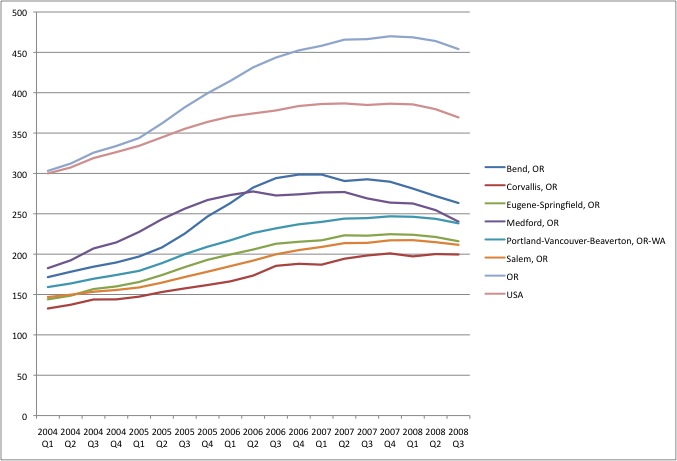
    The OFHEO has come out with its latest house price data. Remember that these cover much more of the US than the 20 cities of the Case-Shiller report, but are based home sales only with conventional mortgages. Anyway, we can see the data for Oregon cities, Oregon and the USA.

    Here (a bit messy) is the raw data since Q1 of 2004:

    Here (even more messy) is the quarter to quarter % change in home values:

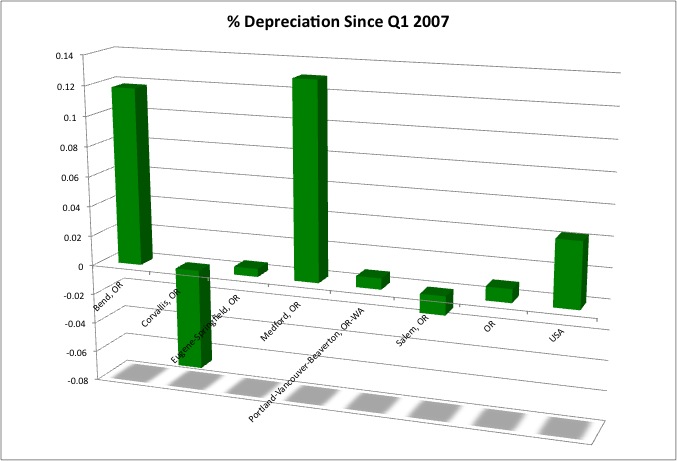
    Here is the overall depreciation (so positive numbers are bad in the sense that they represent loss of value) since Q1 of 2007 when the market in Oregon really turned:

    Overall, it is bad, especially for Bend and Medford which are seeing collapses of California proportions, but overall the state is not doing too badly in relative terms.

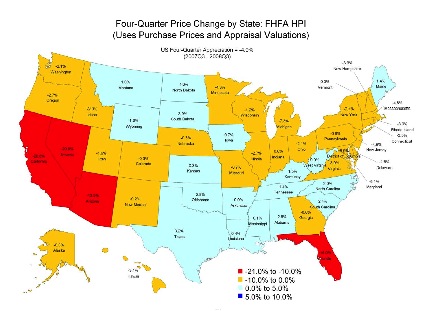
    Here is a nice picture from their summary report that shows the national picture. Oregon is the 35th best state in terms of home value appreciation (or limited depreciation):

  • Save Homes from Foreclosure, Here’s How – Please Share With Others: Daily Kos


    by War on Error

    This info has helped others.  Please pass this to anyone facing foreclosure with Mortgage Electronic Systems Registration on their foreclosure papers.

    HELP PEOPLE SAVE THEIR HOMES.

    To learn how the Ownership Society Scam was choreographed.  Read this website:
    http://loanworkout.org/…

    Read this diary for history, details, and some of people who put together what may be the biggest White Collar Crime in history
    http://www.dailykos.com/…

    MORTGAGE ELECTRONIC REGISTRATION SYSTEMS  (MERS) – Go to your newspaper’s foreclosure listing and look for MERS on the postings.  50,000,000 mortgages list MERS as the Trustee.  But MERS doesn’t have any promissory notes.  You have to read all this to understand.  But do give it to anyone facing foreclosure.

    Without MERS, the huge volume of Mortgage Backed Securities and CDOs could not have been created.  

    HERE IS THE SCARY possibility:  Countries, retirement funds, states, counties, etc. invested in these bundled products, based on ratings from the likes of Standard & Poors, Fitch, and Moody’s only to find, when they opened up the bundles, that they were filled with JUNK instead of GOLD. So they lost all of the money they invested. You can watch PBS NOW to learn how junk became traded as gold:

    http://www.pbs.org/…

    Is it possible that the real money, given to Hedge Funds to purchase MSBs and CDOs, by banks and pension funds throughout the world, left the banks and pension funds virtually empty?  Could this explain the rush to Capital Hill for huge infusions of Bailout Money?  Did banks and pension funds lose everything on their bad bets?  If you watch the PBS NOW program referenced above, it seems that is a strong possibility.  They lost their money gambling on products said to be gold that were, in fact, junk.  Good grief!

    The bundles of MBSs and CDOs couldn’t have been so quickly created without the electronic power of MERS.

    ….What many people refuse to admit is that because of the so-called MERS paperless “system” many of the so-called mortgage backed security trusts do not actually hold the promissory notes which evidence the debts that are supposed to be backing the bonds purchased by these investors.

    The situation is reminiscent of the great Great Olive Oil Scandal in the late 1800’s when banks were duped into investing millions of dollars into Olive Oil only to later discover that the tanks which were supposed to be holding millions of gallons of olive oil backing their investments were mostly empty.

    This problem with the missing trust assets/promissory notes manifests itself each time MERS and/or the trustees for the bondholders brings a legal action to collect on a debt through foreclosure.  Because neither MERS nor the bondholders trustees are holding the notes, they lack proof of standing to maintain their legal actions and the actions are subject to dismissal.

    Many foreclosure actions have been dismissed based upon lack of standing. This a problem that it is a direct result of MERS “system”….

    THERE IS HOPE HERE.  PASS THIS TO ANYONE FACING FORECLOSURE with MERS on their paperwork, PLEASE.  

    The details are found in the two sites listed in the INTRO.

    Together we may be able to help families avoid so much suffering.

    …….One informed lawyer who represents homeowners in Florida, April Charney, had foreclosure proceedings against 300 clients dismissed or postponed in 2007 for lack of standing. She is quoted as saying that “80 percent of them involved lost-note affidavits”. . .

    They raise the issue of whether the trusts own the loans at all,” Charney said. “Lost-note affidavits are pattern and practice in the industry. They are not exceptions. They are the rule.” Ms. Charney, started challenging MERS and it members lost note affidavits after becoming skeptical of the a lender could possibly lose hundreds of promissory notes.

    At least two Florida judges shared Ms. Charney’s skepticism regarding the copious amounts of MERS lost note affidavits and they issued show cause orders, sua sponte, challenging MERS to show proof that it held and/or lost notes in numerous actions. After evidentiary hearings these two alert judges dismissed twenty nine (29) MERS actions to foreclose for lack of standing. One judge struck MERS pleadings as being sham.

    A South Carolina court dismissed a MERS action to foreclose for lack of standing even though MERS filed an affidavit wherein a person claiming to be an officer of MERS claimed that MERS was holding a promissory note. The South Carolina court vetted the MERS affidavit claim that it was the holder of the note after being apprised of the fact that MERS had previously told the Nebraska Court of Appeals that it never held promissory notes.

    In late 2007 three Federal Court Judges in Ohio dismissed over fifty law suits brought by trustees of mortgage backed trusts where they could not produce the original promissory notes.

    Following these decisions the Bankruptcy Court in Los Angelas, California adopted a rule of practice which requires all foreclosing trustees or other plaintiffs to produce the original promissory note when bring an action to foreclose a debt or face sanctions for not doing so. Several court in New York have been routinely dismissing foreclosure actions brought by MERS or its memebers because they continually fail to produce promisssory notes.

    Here is a possible way to fight MERS or any foreclosure if they don’t have the proper, original documentation:

    ……To make matters worse many of the debts evidenced by these undelivered promissory notes were supposed to be secured by mortgage liens. However in place of mortgages being executed in favor of the original lender many of these mortgages were executed in favor of MERS. Because MERS never holds these notes or owns a debt it is not a creditor. MERS has no legal standing to enforce a debt, or so it told the Nebraska Court of Appeals in 2005. However this lack of standing defense must be raised by property owners who are sued.

    The most effective economic way to raise this lack of standing defense is by bringing a motion to dismiss in response to the complaint to foreclose. In many states and in federal court this is called a Rule 12 motion. This motion is brought in place of answering the complaint. An honest attorney in most areas of the country should be willing to prepare and bring such a motion for $500.00 to $1,500.00 for a distressed homeowner. Or you might be able to find a lawyer to do it for you pro bono and perhaps a legal aid attorney. At least five judges around the country have dismissed these actions for lack of standing sua sponte, which means they did it on their own volititia. Perhaps more judges will feel the duty to do the same thing in the future.

    http://loanworkout.org/…

    Lastly, what might be disconcerting.  Who at Fannie and Freddie Mac played along?  Democrats?  Republicans?  Both?  If both, now what?

    Or did the likes of CountryWide play Fannie and Freddie?  Playing within the rules?  Could they have succeeded without inside help?

    ADDITIONAL WEBSITES OF INTEREST:

    1999 MERS plans for future foreclosures, in place at launch.
    http://www.mersinc.org/…

    MERS list of Shareholders or a list of people getting bailout money:
    http://www.mersinc.org/…

    How to buy a foreclosed home from HUD for $1.00, yes One Dollar:
    http://www.hud.gov/…

    A very informative website sharing the methods used to steal homes from HOMEOWNERS:
    http://www.msfraud.org/

    In conclusion, defenders of MERS says it is just an easy way to pass paper.  Fine.  However, when MERS took a Trustee position on deeds filed with Registry of Deeds, the problems escalate.  Imagine, in the old days, listing your fax number as the Trustee on a deed, just because that is how the paper work was forwarded.  How can a homeowner, facing foreclosure, work out a deal with a fax machine or its fax number?

    For fun, here is Bush launching the Housing Crisis:


    http://www.dailykos.com/story/2008/11/24/114621/44/351/665802

  • Oregon jobless like 1981; new help for homeowners? by Ryan Frank, The Oregonian November


    Oregon jobs: Oregon lost 14,100 seasonally adjusted jobs between September and October, the biggest decline since February 1981. That’s no typo. Since 1981. Rich Read has the story.

    Food stamp requests rising in Medford/Bend: The two housing markets powered by Californian transplants during the housing boom now see big jumps in food stamp requests. “I’ve been here 16 years and this is more than I’ve ever seen,” said Lisa Lewis, the state’s self-sufficiency program manager for the Medford area. Many of the people asking the state for help have never been in a welfare office before. They are “blue-collar professionals,” Lewis said. “They’re dry-wallers, electricians, plumbers.”

    St. Helens mill shutdown: Boise says it will layoff 300 people from its St. Helens paper and pulp mill, a major Columbia County employer.

    Homeowner help?: Lawmakers are again pushing financial officials to send help directly to homeowners to help them avoid foreclosure.

    Hotel forecast, um, not good:
    Hotel occupancies are forecasted to fall to 58.6 percent in 2009, the lowest rate since 1971. “The deteriorating outlook for the economy is impacting travel habits and spending, and hotels are expected to experience reduced occupancy levels, and to a lesser degree, some room rate erosion through 2009,” said Scott Berman, principal and U.S. Leader of PricewaterhouseCoopers’ Hospitality and Leisure practice.

    Anybody got some upbeat news?


    http://blog.oregonlive.com/frontporch/

  • Make more on the sale of your home


    Stephanie Stricklen, for KGW.com


    It’s a buyer’s market! When it comes to the housing market — how many times have we heard that lately?

    Well, sellers, this morning’s stretching your dollar is for you. In part two of our series on stretching that home dollar– we have tips for sellers from smartmoney.com.


    At #5: picking the wrong buyer. Watch out for people with preapproval letters that are more than 4 to 6 weeks old and people who want to attach all kinds of caveats on buying your house– for example– selling theirs first.


    #4: paying for a home stager; someone you pay to ready your place for tours. Smartmoney.com says unless you live in a million dollar mansion, save your cash and use common sense instead.


    “You want to make sure that when people have four houses that are similar that they’re going into that yours is going to look the best,” says Mary Low with Iron Gate Realty Group.


    Your yard should look healthy and weed free. The inside of your home should be clean, bright, and free of clutter, extra furniture, and knick knacks.


    Mistake #3: failing to respond to all offers. If someone lowballs you– see if they’re willing to negotiate rather than rejecting them outright.


    “If you’re not motivated to really sell, this is not a market to put your house on,” says Mary.


    On a similar vein mistake #2 is: questioning the first offer. Smartmoney.com says too many sellers reject thier first offer thinking if they hold out more money will come– a strategy that rarely works.


    And the number one mistake home sellers make? Asking too much.


    “You really have to price your home at the competition or a little under in order to really be competitive,” says Mary.


    Look around at what’s currently selling in your neighborhood– that’ll tell you if you’re way off the mark.


    For additional information:

  • Oregon Land Sales Contract A Seller Financing Web Site


    Announcing the Oregonlandsalescontract.com (http://oregonlandsalescontract.com) web site. The OLSC web site is for the listing of homes in which the seller is offering Owner Carry, Lease Option or Rent to Own terms. The credit crunch has made it hard to impossible for many good buyers to obtain financing. In today’s market sellers have to consider offering terms so they do not miss out on an opportunity to sell their property to qualified buyers. This might seem like the sellers are compromising their position to some. For others, this is an opportunity for sellers to realize the interest income lenders have enjoyed for years.

    Please share this link with anyone you feel might consider selling their residential or commercial property with terms or are looking for real estate to buy on terms.

    Oregon Land Sales Contract
    http://www.oregonlandsalescontract.com

  • Portland realtors ranks may slim with economic downturn, KGW.com


    By ERIC ADAMS, kgw.com Staff


    PORTLAND — Area realtors are adjusting to new economic realities and cutting costs.

    The Metropolitan Association of Realtors announced its cutting marketing and other costs as it anticipates that as many as 1,100 of its 7,800 members may not renew their licenses.

    Realtors received their renewal notices earlier this month and have until Jan. 1 to pay their bill, which amounts to about $400 and includes local, state and national fees.

    Kathy Querin, the association’s chief executive officer, said there is no way to know until New Years Day just how many agents will not renew their memberships.

    She said sales have slowed, though, and that realtors may decide they can’t make a living selling houses in the metro area.

    “What we do know is the market has seen decline,” she said.

    Through September, 15,389 houses have been sold in the Portland area, a 32 percent drop from 2007, according to the association.

    The state reports a 3.5 percent drop in real estate licensing since 2005, which many consider was the high-mark year for home sales.

    Jim Homolka, president of Re/Max Equity Group, said he expects the number of realtors in the region to shrink by about 10 percent.

    Re/Max recently closed its Bend office, where 55 people were employed. Offices that have closed around the Portland Metro area include Tualatin, Raleigh Hills and Vancouver Salmon Creek.

    Most of those realtors have shifted to nearby branches, Homolka said.


    http://www.kgw.com/business/stories/kgw_111108_business_realtors_out_of_business.1a1bbfd4f.html


  • Land Sales Contract


    20 years ago when I first entered real estate money was tight…especially for people that wanted to buy homes in Inner North and Northeast Portland.  No reason to rehash why as what is more important right now is to visit how people adapted and moved forward. 

    Land Sales Contracts are agreements between the buyer and the seller that allow the transfer of equity interest in real property.  This tool allows greater flexibility in the terms used to carry properties.  Selling price, down payment or payments, payment schedules and other terms can fit the uniquness of the transaction. 

    You might be thinking why a seller would consider contract terms over cash out terms?  There are several reasons why a seller would consider this avenue.  Some are motivated by nessity and others have more calculted reasons.   I hope to discuss those easons on this blog over the coming weeks.  I will leave you with one interesting situation why someone would consider using a land sales contract to sell property. 

    One of the first clients I had when I entered real estate was a school teacher.  He and his wife were planning on retiring and over the years they had aquired several rental properties and their family home.  Their plan was to sell all of the properties on land sales contract at an interest rate of at least 10%.   The payments they would recive from the contracts in addition to their other investments would mean they would have a comfortable retirement.  With the exception of the home they lived in which was in Alemeda, all of their properties were located in close in Northeast Portland/Albina.  The buyers put down downpayments that ranged in 10-15% and the interest rates ranged between 10% and 12% .  Non of the buyers could have obtained a loan at the time.  Either because they or the home they purchased would have conformed to lending standards of the time. 

    Looking back, I can see the benifits to the buyer, the seller and the community at large.  Contract sales allow the market to move at a time when lending resources were limited.  It allowed families and invidvidulas to invest in the community they lived in and take ownership of their lifestyle.  Bottom line, it was a win, win, win situation for most.  

    The challanging times we live in is a good reminder that cash is not always king.  That there is always another way to obtain our goals.   For some selling or buying property on a land sales contract is the right opprotunity and for some the only one.

  • Beware home equity credit freezesBy WAYNE HAVRELLY, kgw.com


    PORTLAND, Ore. — It wasn’t long ago when people were tapping the equity in their homes to pay bills.

    Now many of those home equity loans are being frozen by lenders because home values are dropping.

    It happened to Debbie Inguagiato who runs a massage therapy business out of her home. She says after 15 years of never missing a loan payment and creating a very high credit rating, shes about to lose her house.

    “I don’t think i have ever been this scared in my entire life”, said Inguagiato.

    She said a mortgage broker gave her some terrible advice as she was going blind from an eye disease.

    Inguagioto said, “I was advised by someone who said she was living off equity of her home for 25 years. She told me she knew what she was doing and she led me through this process of getting a home equity loan.”

    Inguagioto used the loan to help pay her first mortgage and start her massage business which has been very slow.

    Then, late this summer that home equity loan was frozen because her lender claimed her home plunged in value.

    Mortgage companies based in other parts of the country are not always fair when they freeze home equity loans in the Northwest according to realtor and attorney Holly Hummel.

    “Your dealing with someone in another part of the country pulling up data on a desktop appaisal that may not take into consideration that you have a brand new kitchen,” said Hummel.

    She says while real estate values have certainly dropped in suburban communities like happy valley homes in much of Portland have held up well. Debbie’s home is in one of North Portland’s hottest neighborhoods.

    Her home was appraised at $430,000 when she took out the equity loan 2 years ago. However, she says her lender told her the value had dropped to just $262,000, so they froze her loan.

    Debbie doesn’t buy it and nor do Portland real estate experts who say the best thing homeowners in this situation can do is immediately contact their lenders.

    Hummel said, “I have seen people renegotiate with their lender and have their lender come around to their way of thinking, that in fact their house has not dropped to that level.”

    Ronald Stroble, Vice President of Oregon based Umpqua banks mortgage division, said lenders are now working closely with homeowners looking to avoid foreclosure.

    Stroble said, “In the old days people thought they cant call lenders because they didn’t want them to know they were having financial trouble. The message to everyone in this financial meltdown is please, call your lender. Find out what options you have.”

    Debbie has sent her lender comparable sales in her neighborhood and a new appraisal showing her home is still worth about $420,000.

    She’s still waiting to hear back from her lender, Popular Mortgage Servicing Inc.

    The New Jersey based company did not return calls from Newschannel 8.

    Inguagiato said, “I’ve never been homeless, I plan not to be, but the reality is I don’t know how long a legally blind person would make it out there on the street and I don’t want to learn.”

    The mortgage crisis is close to claiming another victim, but Inguagiato is not giving in without exploring every possible option.

    If you find yourself in the same home equity loan is frozen and your lender won’t renegotiate, another viable option is to approach local banks and credit unions.

    Most local financial institutions had light sub-prime loan exposure and still have plenty of money to loan if you qualify.


    http://www.kgw.com/business/money/stories/kgw_110708_special_report_home_equity.18e3d6f85.html

  • Mortgage Implode: Time to Get Your Bailout…The ‘Gimme Mine Coalition’


    2% Interest Only 5-year loans available again?!? Yes, but beware.

    -Home Owners and Mortgage professionals, this one is for you.

    I am a big advocate of mortgage modifications that include a fully documented re-underwrite and re-qualification of every borrower in America allowing a maximum of 28/36 debt to income ratios with market-rate 30-year fixed mortgages.

    Yesterday, the video camera was calling my name so I decided to go into more color on mortgage modifications.  Pass this video around to friends and family. Take matters into your own hands because it is obvious nobody will be riding to the rescue anytime soon.

    That being said, I do believe a large scale home owner bailout will come, but it will likely involve giving up present and future equity in your home.  Right now you do not need to do that.  You can even negotiate into the modification a better reporting of this event to the credit reporting agencies with some banks.

    In recent weeks I have seen banks get very aggressive including reducing principal balances to lower than the present home values and giving borrowers 2% interest only loans for five years.  Wachovia offered to buy down a friends mortgage to 2% on a 30-year fixed, however, they had to refi through FHA and carry a silent second for the principal balance reduction needed to get them to the FHA limit for the area.  This sounds great but I do not advocate a super low interest only rate without a principal balance reduction. Getting 2% today with no principal reduction just kicks the can down the road and will cause major troubles then.  Without a principal reduction you are still stuck unable to move or refi.

    I truly believe that there is a small window in time that exists right now where banks can’t handle any more foreclosures and you hold all the cards. The last thing the bank wants is another foreclosure and 65% write down.  If you play your cards right you can win and the bank can have a long-term customer paying her mortgage payment each and every month who will some day own the home. That is what it is all about.

    I also went into great detail on mortgage modifications on July 4th and I urge you re-read the posts. There is information in here you must know BEFORE taking on this task. You have to know what to ask for because banks are a ‘for profit’ business, which means decisions are not going to be in your best interest. – Best, Mr Mortgage

  • Can Home Buyers Get Help When Still Making Their Payments?


    Must a Borrower Stop Paying in Order to Get Help?

    by Jack M. Guttentag

    Inman News


    “Is it true that mortgage servicers will not help borrowers who are in trouble until they stop making their payments? I am a home retention counselor, and I keep hearing from people referred to me that they have received no response from their servicer because they have not yet missed a payment. I would hate to advise people that they have to stop paying if they expect to get any help if it is not true.”

    There is certainly much truth to this because I have heard the same story from numerous people I have counseled, whose stories I have no reason to doubt. The most common thing I hear is that they were told by the servicer to come back when they were two payments behind.

    There are understandable reasons why borrowers who are delinquent on their payments receive more prompt consideration than those who are current. To the degree that servicers are faced with more requests for help than they can handle at one time, they have to set priorities. The number of borrowers in trouble has ballooned over the past year, outstripping the efforts of servicers to expand their capacity to deal with them.

    Setting Priorities

    A plausible way to set priorities is in terms of the degree of urgency of the problem. A borrower 60 days behind in his payment is closer to foreclosure, and if he is going to be saved, he needs faster action than a borrower who is current. So borrowers who are current get placed at the bottom of the list of borrowers requiring special treatment, if they are even placed on the list at all.

    This tendency is reinforced by the fear of free-riders. All borrowers would like to get a better deal on their mortgages, whether they have trouble making their current payments or not. If loans are being modified to help borrowers, some borrowers who are not in financial distress will try to take advantage of the situation by pretending that they are. But potential free-riders may not be willing to become delinquent because that would hurt their credit. By only considering modifications for borrowers who are already delinquent, the servicer reduces the number of potential free-riders.

    In addition, the practice of dealing only with borrowers who are delinquent keeps loans in good standing for longer periods. Consider the borrower who loses her job but has savings sufficient to cover the payments for some months. Investors would prefer that the borrower make the payment out of savings for as long as possible, since she might find another job during this period, avoiding the need for any modification of the mortgage.

    Moving Up on the List

    If I were a borrower with reduced income but with good prospects of recovery, I would make the payment out of savings, avoiding the hit to my credit. If I considered the prospects of recovery to be poor, however, I would stop paying and husband my savings. This would move me up on the servicer’s priority list for special treatment. While it also moves up the hit to my credit, that is something that would happen anyway as soon as my savings were exhausted.

    If I did not have a problem making the current payment but would have a problem dealing with an anticipated payment increase, I would handle it differently.

    First, I would determine exactly how large the payment increase would be. If the increase stemmed from an interest-only loan reaching the end of the interest-only period, the new payment could be found using any monthly payment calculator (including calculator 7a on my Web site) inputting a term equal to the remaining life of the loan. If the increase stemmed from an ARM (adjustable-rate mortgage) adjustment, the new payment wouldn’t be known exactly until a month or two before the adjustment, but an estimate based on the current value of the rate index would provide a good estimate.

    A Detailed Budget

    Step two is to develop a detailed budget which documents the point that the expected payment is not affordable. Use the form provided by Genworth to show your income, expenses, and assets.

    Submit your document to the servicer well in advance of the anticipated payment increase. There is no guarantee that it will lead to a contract modification before the payment increase materializes. However, it gives you a good shot to move up in the servicer’s queue by providing the concrete detailed information that servicers require. It also keeps you out of the hands of the modification hustlers who want to be paid upfront for doing what you can do yourself.


  • How Long Will it Be Before the Foreclosed Homeowner Feels Relief From the 700 Billion Dollar Bailout


    Not soon enough if ever. Let me explain.

    Bush announced that the first 250 billion dollar infusion is targeted for the banks. Which will take time to do and time to see if it works. Which will mean that the balance of the money will not be used (350 billion dollar) until the next president is inaugurated in January 2009.

    However, the Bush Administration has unveiled additional mortgage assistance for homeowners at risk of foreclosure. The HOPE for Homeowners program will refinance mortgages for borrowers who are having difficulty making their payments, but can afford a new loan insured by HUD’s Federal Housing Administration (FHA). There are a lot of issues to be dealt with, plus pre-qualifications needed by the homeowner, which means it will take time to be effective.

    So what is offered by both candidates and when will it start?

    Barack Obama proposed more immediate steps to heal the nation’s ailing economy, including a 90-day moratorium on home foreclosures at some banks. Obama proposed that banks participating in the federal bailout should temporarily postpone foreclosures for families making good-faith efforts to pay their mortgage.

    Sen. John McCain proposed a plan to help millions of people around the country facing foreclosure by ordering the Treasury secretary to purchase and renegotiate faulty home loans.

    The plan is aimed at homeowners who owe more than their houses are worth or who are otherwise in danger of foreclosure. The government would use Fannie Mae, Freddie Mac and private mortgage brokers to pay off the troubled loans and refinance the homeowners, making their payments more affordable.

    Again, this will take time and concerted effort by the powers to be to implement any program before relief is felt by the homeowner who is facing foreclosure or who is in foreclosure.

    The common thread above is TIME, no matter what you like or dislike about the government, the presidential candidates, or what is going on in Washington (D.C.).

    Bankers/ Lenders, realtors, real estate investors, and all scam artists want you to believe that you do not have enough time and, especially, they do not want you to know how the foreclosure process works.

    You are nothing more than a new profit center for them, and they only have their best interest at heart (not yours).

    I have a short video that will show you how scam artists work, and it may help you understand what not to do. Check it out: http://www.AvoidForeclosurePain.com/Now.htm

  • Help Us Save The Housing Industry


    Dear Reader,

     I wanted to make you aware of an important petition that is being circulated in support of a new plan to save the housing industry. It was developed by a mortgage industry insider and we, at the Originator Times, believe it’s the only current plan to restore faith in the housing market and create profitability within our industry once again.

    If you are sick of getting calls from potential customers you can’t help because they are upside down on their mortgages; tired of loan programs that are here today and gone tomorrow; frustrated with volatile rates and increasing credit score requirements; and angered by plans that bail out the wealthy and powerful and do nothing to fix the real problem then join mortgage industry veteran Scott Messina and the Originator Times in making our voices heard in Washington.  

    Now is the time to act!  Sign the petition to support Messina’s “Save the American Dream” plan – the only plan that solves the root of the housing problem and sets the wheels in motion for a 2009 refinance boom similar to 2003 levels. 

    Click here to sign the petition, or visit http://savetheamericandreamplan.com to read about the complete plan, or scroll down to read a summary, then forward this e-mail to everyone you know in the industry.


    Sincerely,

    Melissa Sike

    Editor  

    ***

    Save the American Dream Plan


    The banks on Wall Street got their bailout. Now, what about all of us in the housing industry and those who work on Main Street?   

    Were still hurting because the big Wall Street bailout did nothing to address the root cause of the housing crisis.   We need a real solution instead of a band-aid.  The Save the American Dream plan is the correct solution and it isn’t being heard in Washington because the people on Main Street – whom would be helped – aren’t donating millions of dollars to a particular political campaign, and therefore, have no economic representation in Washington.  For two reasons, it’s our responsibility as mortgage industry professionals to speak for those that have no voice and make Washington listen to the plan that will save struggling homeowners …and ourselves.  It’s our responsibility because we were a part of the problem (along with many others, including borrowers) and because we are the ones that have the industry knowledge and expertise to really do what needs to be done.  We are in a unique position here to really solve this crisis.  Click here to join us in support of the Save the American Dream plan .

    The Save the American Dream plan will empower those millions of Americans who because of foreclosure and financial chaos have been living out their worst nightmares and provide them with viable refinance options to wake up and restore their dream. 

    By providing millions of Americans with a refinance option as an alternative to foreclosure, we’ll in turn create a refinance boom within the industry. 

    The Save the American Dream plan will save Wall Street by lending Main Street a hand and will rescue the U.S. housing market in the process.

  • Betty Jung’s Blog: Market Update: Building Permits 2007 vs. 2008


    And, here are some more numbers:

    According to the Construction Monitor www.constructionmonitor.com and the Home Builders Association of Metropolitan Portland, here is the 2008 Year-to-Date Building Permit activity by county.  It is at its lowest since 1991.

    Many small builders haven’t built anything new in several months and in some cases more than a year.  If you read my recent post Market Update:  New Construction, you will see there is still a large inventory of new homes that builders need to unload.  Remodeling is also lagging.

    In addition, many of the local builders here have filed for bankruptcy protection as I reported in my “Top 50 Builders in Oregon” post.  This weekend, I happened to notice another one of our larger local builders, whom I won’t name, is selling some of his lot inventory.  Is he in trouble or is he just making sure he won’t be? 

    2008 Year-to-date Building Permit Activity by County

    2008

    2007

    Difference

    WASHINGTON COUNTY


    Single Family

    650

    1,681

    -1,031

    Duplexes/Twin Homes

    0

    0

    0

    Other Residential Structures

    23

    96

    -73

    Residential Remodels

    291

    442

    -151

    MULTNOMAH COUNTY


    Single Family

    643

    1,249

    -606

    Duplexes/Twin Homes

    23

    84

    -56

    Other Residential Structures

    29

    66

    -37

    Residential Remodels

    1,004

    1,312

    -308

    CLACKAMAS COUNTY


    Single Family

    619

    1,361

    -743

    Duplexes/Twin Homes

    4

    9

    -5

    Other Residential Structures

    91

    209

    -118

    Residential Remodels

    417

    606

    -189

    YAMHILL COUNTY


    Single Family

    256

    370

    -114

    Duplexes/Twin Homes

    30

    13

    +17

    Other Residential Structures

    32

    154

    -122

    Residential Remodels

    91

    95

    -4

    Source:  Construction Monitor (www.constructionmonitor.com) and David Nielsen, Home Builders Association of Metropolitan Portland.

    Copyright ©Betty Jung 2008.  All Rights Reserved.

    Disclaimer: All information in this post is subject to change without notice. Subject matter is an opinion, is not guaranteed, may be time sensitive, and may be based on information collected from several sources which may or may not be reliable at the time of sourcing.  

    (For more local and national real estate news, click on my monthly newsletter – JUNG’S JOURNAL – on my website www.bettyjung.com).
    Betty Jung
    Broker
    RE/MAX equity group, inc.
    503-495-5220 or email:bettyjung@remax.net
  • Portland Tribune: Mortgage losses mounting, Steve Law


    More area homeowners at risk as foreclosure proceedings double


    Uncle Sam is bailing out Wall Street wheeler-dealers who invested in home loans, but there’s no relief in sight for the homeowners on Main Street.

    On Southeast Main east of 144th Avenue, stretching from outer Southeast Portland into Gresham, 14 homeowners have been hit with foreclosure filings in the past year, plus scores more in nearby blocks.

    • Judy Myer pawned her wedding ring and stopped taking prescribed medicines in a futile bid to save her Southeast Main Street home of 18 years, after husband Mark Myer lost his job and his unemployment benefits expired.

    • Judy’s son, Steve, who lives down the street, got socked with foreclosure after his 7-year-old daughter required heart surgery. Steve took out a second mortgage to cover the medical bills, then fell behind on house payments after suffering an on-the-job injury.

    • Across the street from the Myers, Ron Zitzewitz just got a six-month notice to vacate his mother’s home – one month after she died. Zitzewitz, 51, isn’t old enough to assume his mother’s reversible mortgage, and can’t refinance the loan because he’s permanently disabled.

    Portland is no real-estate basket case like Las Vegas or Phoenix. But the national foreclosure crisis that initially spared Portland has arrived here in a big way, bringing more human suffering and dampening housing prices.


    Foreclosure forum

    Oregon’s presumed next attorney general, John Kroger, along with state lawmakers and community leaders, will host a town hall for people facing foreclosure or who think they were victimized by deceptive lending practices.

    The event, called There’s No Place Like Home, takes place 9 a.m. to 2 p.m. Saturday, Nov. 22, at Portland Community College’s Cascade campus, Moriarty Auditorium, at the corner of North Killingsworth Street and North Albina Avenue.


    The number of Multnomah County residents in jeopardy of losing their homes has nearly doubled in the last year, based on the number immersed in foreclosure proceedings. Over the spring and summer, 300 Multnomah County homeowners a month got slapped with foreclosure notices – topping the peak levels reached in the last recession of 2001-02.

    In August 2007, the Portland area had an enviable 332nd-highest foreclosure rating among the nation’s 383 metropolitan areas. But by August 2008, Portland jumped to 254th-highest, according to First American CoreLogic, which provides real estate data services.

    “There’s a shakeout right now, and we’re failing on all cylinders,” said Portland real estate economist Jerry Johnson.

    Portland took longer than most cities to emerge from the last recession and didn’t get as overbuilt as other markets, Johnson said.

    But Portland home prices kept rising during the last recession, he noted. If banks and besieged homeowners try to dump too many discounted properties, he said, “you could swamp the market and kill the guys who are OK.”

    Home prices are sliding in large swaths of the metro area, especially in overbuilt sectors such as Portland’s condo market and suburban Happy Valley. In early October, in the 97086 ZIP code that includes Happy Valley, there were 247 homeowners facing foreclosure on top of 95 homes seized by banks, according to VisionCore, a division of First American CoreLogic.

    Short sales drive down prices

    Many overburdened homeowners, anxious to avoid foreclosures that soil their credit ratings, are resorting to “short sales,” in which they sell quickly for less than their home loan if the lender agrees to accept the lower amount. Banks also are auctioning off seized homes to investors looking for sweet deals.

    Dumping all those distressed properties on the market, sometimes at fire-sale prices, is depressing home values for neighboring residences.

    In a half-block stretch of Liebe Street southeast of Holgate Boulevard and 118th Avenue, four homes went into foreclosure in recent months. Investor Mark Bordcosh snapped up one of them, a three-bedroom townhouse appraised at $217,000, and offered it in an auction, with a minimum bid of $137,500.

    “I’m basically getting the house at a discount and I’m selling it at a discount,” he said.

    All parts of the city are seeing some foreclosures, though they are less common on the west side and close-in east-side neighborhoods, according to VisionCore. Portland working-class neighborhoods, especially in North Portland and the outer east side, are getting more than their share, as residents lose jobs or get burned by escalating interest rates on subprime loans.

    Main Street doesn’t necessarily have the highest proportion of foreclosures. But it is representative of the outer east side – meaning it is seeing plenty of angst and misery.

    Adversity is magnified

    Southeast Main east of 144th Avenue, dotted with modest one-story homes and towering firs, has long been known as an affordable place to buy a home. But it’s no longer affordable to many longtime residents.

    Mark Myer, 57, who lost his computer tech job after his company was sold, doesn’t expect any of the $700 billion Wall Street bailout approved by Congress Oct. 3 will trickle down to his end of the food chain.

    “The people that are stomping on the individuals are the ones that got bailed out,” Myer said. “If they share and start helping out some people, fine. History shows they’ll just turn around and stomp on us again.”

    Myer landed part-time work, but said employers have been reluctant to hire him now that there’s a foreclosure on his record. That’s despite 22 years’ service in the Navy.

    Judy Myer stopped taking medicines a year ago for her anxiety attacks, high blood pressure and cholesterol. After two heart attacks, two back surgeries and anxiety problems, she’s not in good shape to work outside the home.

    “I don’t know what’s going to happen. It’s just scary,” she said. “We’ll never be able to go out and have dinner and a movie.”

    Her son, Steve, an automotive technician, was denied workers’ compensation benefits after his 2006 on-the-job injury. The injury was deemed connected to a pre-existing condition. He qualified for short-term disability payments, but that only covered 60 percent of his salary. It wasn’t enough to make full mortgage payments and pay his $10,000 hospital bill.

    When his home lender demanded full payments on his mortgage, Steve threw up his hands. “I pretty much said, ‘Come and get it, there’s nothing I can do.’ ” he said.

    The lender backed down and offered him a payment plan, Steve said. He was able to save the house for now, but said he’s still tapped financially.

    A few doors down from the Myers, Trinidad Monje’s former Main Street home sits vacant, months after going into foreclosure. Judy Myer said it’s been languishing on the market at least two years.

    Down Main Street near 148th Avenue, Maxsim “Max” Lysack said he was forced into foreclosure after his roommate died. He wound up doing a short sale – selling the home for less than his mortgage – in a deal worked out with the lender.

    “I buy it for $285,000, and I sell it for $250,000,” Lysack said.

    Ron Zitzewitz has lived on Main Street off and on since childhood. He doesn’t earn much from disability payments and income from a knife-sharpening business, and moved in with his mother.

    Under her reverse mortgage, the lender takes a greater stake in the home’s equity each month, in lieu of mortgage payments. Zitzewitz can’t qualify for a new loan to refinance the $160,000 his mother owed.

    The house should be worth about $225,000, he said. But Zitzewitz doubts he can sell it for anything close to that because the market is so sour.

    Zitzewitz got married a few months ago, but so far his wife has been unable to find work.

    “We’re going to have to find somewhere else to live.”

    stevelaw@portlandtribune.com

  • Making Capitalism More Creative


    By Bill Gates

    http://www.time.com/time/business/article/0,8599,1828069,00.html 

    Capitalism has improved the lives of billions of people – something that’s easy to forget at a time of great economic uncertainty. But it has left out billions more. They have great needs, but they can’t express those needs in ways that matter to markets. So they are stuck in poverty, suffer from preventable diseases and never have a chance to make the most of their lives. Governments and nonprofit groups have an irreplaceable role in helping them, but it will take too long if they try to do it alone. It is mainly corporations that have the skills to make technological innovations work for the poor. To make the most of those skills, we need a more creative capitalism: an attempt to stretch the reach of market forces so that more companies can benefit from doing work that makes more people better off. We need new ways to bring far more people into the system – capitalism – that has done so much good in the world.

    There’s much still to be done, but the good news is that creative capitalism is already with us. Some corporations have identified brand-new markets among the poor for life-changing technologies like cell phones. Others – sometimes with a nudge from activists – have seen how they can do good and do well at the same time. To take a real-world example, a few years ago I was sitting in a bar with Bono, and frankly, I thought he was a little nuts. It was late, we’d had a few drinks, and Bono was all fired up over a scheme to get companies to help tackle global poverty and disease. He kept dialing the private numbers of top executives and thrusting his cell phone at me to hear their sleepy yet enthusiastic replies. As crazy as it seemed that night, Bono’s persistence soon gave birth to the (RED) campaign. Today companies like Gap, Hallmark and Dell sell (RED)-branded products and donate a portion of their profits to fight AIDS. (Microsoft recently signed up too.) It’s a great thing: the companies make a difference while adding to their bottom line, consumers get to show their support for a good cause, and – most important – lives are saved. In the past year and a half, (RED) has generated $100 million for the Global Fund to Fight AIDS, Tuberculosis and Malaria, helping put nearly 80,000 people in poor countries on lifesaving drugs and helping more than 1.6 million get tested for HIV. That’s creative capitalism at work.

    Creative capitalism isn’t some big new economic theory. And it isn’t a knock on capitalism itself. It is a way to answer a vital question: How can we most effectively spread the benefits of capitalism and the huge improvements in quality of life it can provide to people who have been left out?

    The World Is Getting Better
    It might seem strange to talk about creative capitalism when we’re paying more than $4 for a gallon of gas and people are having trouble paying their mortgages. There’s no doubt that today’s economic troubles are real; people feel them deeply, and they deserve immediate attention. Creative capitalism isn’t an answer to the relatively short-term ups and downs of the economic cycle. It’s a response to the longer-term fact that too many people are missing out on a historic, century-long improvement in the quality of life. In many nations, life expectancy has grown dramatically in the past 100 years. More people vote in elections, express their views and enjoy economic freedom than ever before. Even with all the problems we face today, we are at a high point of human well-being. The world is getting a lot better.

    The problem is, it’s not getting better fast enough, and it’s not getting better for everyone. One billion people live on less than a dollar a day. They don’t have enough nutritious food, clean water or electricity. The amazing innovations that have made many lives so much better – like vaccines and microchips – have largely passed them by. This is where governments and nonprofits come in. As I see it, there are two great forces of human nature: self-interest and caring for others. Capitalism harnesses self-interest in a helpful and sustainable way but only on behalf of those who can pay. Government aid and philanthropy channel our caring for those who can’t pay. And the world will make lasting progress on the big inequities that remain – problems like AIDS, poverty and education – only if governments and nonprofits do their part by giving more aid and more effective aid. But the improvements will happen faster and last longer if we can channel market forces, including innovation that’s tailored to the needs of the poorest, to complement what governments and nonprofits do. We need a system that draws in innovators and businesses in a far better way than we do today.

    Naturally, if companies are going to get more involved, they need to earn some kind of return. This is the heart of creative capitalism. It’s not just about doing more corporate philanthropy or asking companies to be more virtuous. It’s about giving them a real incentive to apply their expertise in new ways, making it possible to earn a return while serving the people who have been left out. This can happen in two ways: companies can find these opportunities on their own, or governments and nonprofits can help create such opportunities where they presently don’t exist.

    What’s Been Missed
    As C.K. Prahalad shows in his book The Fortune at the Bottom of the Pyramid, there are markets all over the world that businesses have missed. One study found that the poorest two-thirds of the world’s population has some $5 trillion in purchasing power. A key reason market forces are slow to make an impact in developing countries is that we don’t spend enough time studying the needs of those markets. I should know: I saw it happen at Microsoft. For many years, Microsoft has used corporate philanthropy to bring technology to people who can’t get it otherwise, donating more than $3 billion in cash and software to try to bridge the digital divide. But our real expertise is in writing software that solves problems, and recently we’ve realized that we weren’t bringing enough of that expertise to problems in the developing world. So now we’re looking at inequity as a business problem as well as something to be addressed through philanthropy. We’re working on projects like a visual interface that will enable illiterate or semiliterate people to use a PC instantly, with minimal training. Another project of ours lets an entire classroom full of students use a single computer; we’ve developed software that lets each student use her own mouse to control a specially colored cursor so that as many as 50 kids can use one computer at the same time. This is a big advance for schools where there aren’t enough computers to go around, and it serves a market we hadn’t examined before.

    Cell phones are another example. They’re now a booming market in the developing world, but historically, companies vastly underestimated their potential. In 2000, when Vodafone bought a large stake in a Kenyan cell-phone company, it figured that the market in Kenya would max out at 400,000 users. Today that company, Safaricom, has more than 10 million. The company has done it by finding creative ways to serve low-income Kenyans. Its customers are charged by the second rather than by the minute, for example, which keeps down the cost. Safaricom is making a profit, and it’s making a difference. Farmers use their cell phones to find the best prices in nearby markets. A number of innovative uses for cell phones are emerging. Already many Kenyans use them to store cash (via a kind of electronic money) and transfer funds. If you have to carry money over long distances – say, from the market back to your home – this kind of innovation makes a huge difference. You’re less tempting to rob if you’re not holding any cash.

    This is how people can benefit when businesses find opportunities that have been missed. But since I started talking about creative capitalism earlier this year, I’ve heard from some skeptics who doubt that there are any new markets. They say, “If these opportunities really existed, someone would have found them by now.” I disagree. Their argument assumes that businesses have already studied every possible market for their products. Their attitude reminds me of the old joke about an economist who’s walking down the street with a friend. The economist steps over a $10 bill that’s lying on the ground. His friend asks him why he didn’t take the money. “It couldn’t possibly be there,” he explains. “If it were, somebody would’ve picked it up!” Some companies make the same mistake. They think all the $10 bills have already been picked up. It would be a shame if we missed such opportunities, and it would make a huge difference if, instead, researchers and strategists at corporations met regularly with experts on the needs of the poor and talked about new applications for their best ideas.

    Beyond finding new markets and developing new products, companies sometimes can benefit by providing the poor with heavily discounted access to products. Industries like software and pharmaceuticals, for example, have very low production costs, so you can come out ahead by selling your product for a bigger profit in rich markets and for a smaller profit, or at cost, in poor ones. Businesses in other industries can’t do this tiered pricing, but they can benefit from the public recognition and enhanced reputation that come from serving those who can’t pay. The companies involved in the (RED) campaign draw in new customers who want to be associated with a good cause. That might be the tipping point that leads people to pick one product over another.

    There’s another crucial benefit that accrues to businesses that do good work. They will find it easier to recruit and retain great employees. Young people today – all over the world – want to work for organizations that they can feel good about. Show them that a company is applying its expertise to help the poorest, and they will repay that commitment with their own dedication.

    Creating New Incentives
    Even so, no matter how hard businesses look or how creatively they think, there are some problems in the world that aren’t amenable to solution by existing market incentives. Malaria is a great example: the people who most need new drugs or a vaccine are the least able to pay, so the drugs and vaccines never get made. In these cases, governments and nonprofits can create the incentives. This is the second way in which creative capitalism can take wing. Incentives can be as straightforward as giving public praise to the companies that are doing work that serves the poor. This summer, a Dutch nonprofit called the Access to Medicine Foundation started publishing a report card that shows which pharmaceutical companies are doing the most to make sure that medicines are made for – and reach – people in developing countries. When I talk to executives from pharmaceutical companies, they tell me that they want to do more for neglected diseases – but they at least need to get credit for it. This report card does exactly that.

    Publicity is very valuable, but sometimes it’s still not enough to persuade companies to get involved. Even the best p.r. may not pay the bill for 10 years of research into a new drug. That’s why it’s so important for governments to create more financial incentives. Under a U.S. law enacted last year, for example, any drug company that develops a new treatment for a neglected disease like malaria can get a priority review from the Food and Drug Administration (FDA) for another product it has made. If you develop a new drug for malaria, your profitable cholesterol drug could go on the market as much as a year earlier. Such a priority review could be worth hundreds of millions of dollars. It’s a fantastic way for governments to go beyond the aid they already give and channel market forces so they improve even more lives.

    Of course, governments in developing countries have to do a lot to foster capitalism themselves. They must pass laws and make regulations that let markets flourish, bringing the benefits of economic growth to more people. In fact, that’s another argument I’ve heard against creative capitalism: “We don’t need to make capitalism more creative. We just need governments to stop interfering with it.” There is something to this. Many countries could spark more business investment – both within their borders and from the outside – if they did more to guarantee property rights, cut red tape and so on. But these changes come slowly. In the meantime, we can’t wait. As a businessman, I’ve seen that companies can tap new markets right now, even if conditions aren’t ideal. And as a philanthropist, I’ve found that our caring for others compels us to help people right now. The longer we wait, the more people suffer needlessly.

    The Next Step
    In june, I moved out of my day-to-day role at Microsoft to spend more time on the work of the Bill & Melinda Gates Foundation. I’ll be talking with political leaders about how their governments can increase aid for the poor, make it more effective and bring in new partners through creative capitalism. I’ll also talk with CEOs about what their companies can do. One idea is to dedicate a percentage of their top innovators’ time to issues that affect the people who have been left behind. This kind of contribution takes the brainpower that makes life better for the richest and dedicates some of it to improving the lives of everyone else. Some pharmaceutical companies, like Merck and GlaxoSmithKline, are already doing this. The Japanese company Sumitomo Chemical shared some of its technology with a Tanzanian textile company, helping it produce millions of bed nets, which are crucial tools in the fight to eradicate malaria. Other companies are doing the same in food, cell phones and banking.

    In other words, creative capitalism is already under way. But we can do much more. Governments can create more incentives like the FDA voucher. We can expand the report-card idea beyond the pharmaceutical industry and make sure the rankings get publicity so companies get credit for doing good work. Consumers can reward companies that do their part by buying their products. Employees can ask how their employers are contributing. If more companies follow the lead of the most creative organizations in their industry, they will make a huge impact on some of the world’s worst problems.

    More than 30 years ago, Paul Allen and I started Microsoft because we wanted to be part of a movement to put a computer on every desk and in every home. Ten years ago, Melinda and I started our foundation because we want to be part of a different movement – this time, to help create a world where no one has to live on a dollar a day or die from a disease we know how to prevent. Creative capitalism can help make it happen. I hope more people will join the cause.