Tag: Bank of America

  • The Problem In 2010 Is Underwriting, by The Mortgage Professor


    Borrowers today are paying for the excesses of yesterday. During the go-go years leading to the crisis, underwriting rules became incredibly lax, and now they have become excessively restrictive.

    My mailbox today is stuffed with letters from borrowers who are being barred from the conventional (non-FHA) market by mortgage underwriting rules that have become increasingly detailed and rigid. In many cases the rules leave no room for discretion by the loan originator, and where there is discretion, originators are often too frightened to use it because of the heightened risk of having to buy back the mortgage or incur other penalties.

    Fannie Mae and Freddie Mac are the major source of the problems, but the large wholesale lenders who acquire loans from thousands of small mortgage lenders and mortgage brokers have their own rules which in many cases are even more restrictive than those of the agencies. Before the financial crisis, compliance with underwriting rules was subject to casual spot checks. Today, every loan is carefully scrutinized, and those that don’t past muster must be repurchased by the seller. The loss on a buyback wipes out the profit on about 8 loans of the same size.

     The Affordability Requirement Is a Curse


    The most important of the underwriting problems involve income documentation. The abuses that arose during the go-go years before 2007 had such a major impact on the mindsets of lawmakers, regulators and Fannie/Freddie that an affordability requirement has become the law of the land; all loans must be demonstrably affordable to the borrower. I have already written about the absurdity of this requirement, which makes ineligible many perfectly good loans to good people – such as the lady with a lot of equity and perfect credit who wants to borrow the money she needs to stay in her home for a few years before she sells it.

    The affordability requirement imposes an especially heavy burden on self-employed borrowers, who face the greatest difficulty in proving that they have enough income to qualify. Prior to the crisis, a variety of alternatives to full documentation of income were available, including “stated income,” where the lender accepted the borrower’s statement subject to a reasonableness test and verification of employment.

    The Self-Employed Are Back to Square One 


    Stated income documentation was designed originally for self-employed borrowers, and it worked very well for years. Then, during the go-go period preceding the crisis, the option was abused. Instead of curbing the abuses we eliminated the option, which is akin to outlawing knives after an outbreak of hari kari. Rejection of loan applications by self-employed borrowers with high credit scores and ample equity are now commonplace. This letter is typical.

    “We were pre-approved, found a home for less than the amount approved, paid for appraisal, inspection, earnest money, title company, then a few days before closing the lender told us they cannot honor the approval because our business income was 40% lower in 2009 than 2008…can they do this?”

    In this case, I have not been able to determine whether there was a rule change — from using the average of the two years to using the lower of the two years — or whether it was the interpretation that changed, but the result is the same: rejection. Before the crisis, this home purchase would have been saved by using stated income documentation.

    Note that in this particular case, the cost of rejection to the buyer was raised by the incompetence of the lender. Allowing the buyer to proceed almost all the way to a closing before checking their tax statements is inexcusable. Any home buyer whose income is business-related should be sure to get their income approved before putting down earnest money and incurring other mortgage expenses.

     The Robotization of Underwriting


    Loan underwriting, the process of deciding whether a loan application should be approved or rejected, used to be a profession that demanded a high level of discretion and judgment. That is no longer the case, as illustrated by this letter.

    “My wife recently applied in her name only for a mortgage to purchase a single family home which will be our residence. She earns a $70,000 salary that is more than enough to cover the mortgage and has a credit score of 800. We have no debt.


    I work from home trading stocks. In the market crash 08/09 I sustained losses in my trading account of $90,000. We file our taxes jointly. Today my wife’s application was refused citing Fannie/Freddie guidelines that state that tax losses must be deducted from her income…We are stunned…”
    This case is typical of many that used to involve a judgment call by the underwriter. The issue is whether the husband’s capital loss actually indicated a potential threat to the ability of his wife to service the mortgage. If the husband had $400,000 in his trading account, for example, the plausible judgment would be that such a threat was remote and the loan should be approved. But in this case, the underwriter did not explore the circumstances — the rejection was automatic based on the rule. With no alternative types of documentation available, the loan was not made.

    Why didn’t the underwriter use the judgment for which he is presumably being paid? He acted like a robot instead of an underwriter because his employer had instructed him to stay within the letter of the rules. The risk from making a judgment call that turns out to be mistaken has become so high that lenders find it more prudent to avoid such calls altogether.

    The Lowest Rates Are Available to Few 


    In addition to curtailing unduly the number of potential borrowers who qualify for loans, the current policies of Fannie and Freddie have shrunk the number of acceptable borrowers who qualify for the best prices to a very small group. To get the lowest rate possible on a mortgage sold to Fannie Mae, the borrower must have a credit score of 740 and a ratio of loan to property value of no more than 60%. The property must be single family but not manufactured, and in an area not subject to an “adverse market delivery charge.” The mortgage cannot have an interest-only provision, and any second mortgage has to be included in the 60% limit noted above.

    Fannie and Freddie are working at cross purposes to the Federal Reserve. The Fed is trying to counter economic weakness by forcing down long-term interest rates, including those on prime mortgages, to all-time lows. Fannie and Freddie have made it increasingly difficult for potential borrowers to qualify, and cut the number who qualify for the very best rates to a trickle.

    Thanks to Jack Pritchard for helpful comments.
    http://www.mtgprofessor.com

  • Refinancing: Whom Can You Trust?, by M.P. MCQUEEN, Wsj.com


    From Conflicts of Interest to Simplistic Formulas, the Web Is Awash With Dubious Mortgage Information. Here’s What You Need to Know


    With mortgage rates falling to record lows this summer and the housing market showing signs of a pulse, refinancing activity is perking up.  It’s too bad that so many people are relying on oversimplified advice and bad numbers to decide when to pull the trigger.

    The refinancing equation has never been more complicated. While some borrowers are desperate to reduce their monthly payments, others are looking to build equity. Some are even treating their mortgage as an investment vehicle, sinking excess cash into their homes in order to secure a lower rate and cut future payments.

    Yet most personal-finance resources these days don’t account for situations like these. Even essential factors like tax rates and inflation expectations are often ignored in favor of simplistic calculations.

    Many popular Web resources, in fact, are financed by lenders, mortgage brokers or “lead generators” that connect borrowers with banks. At times, their advice can be downright harmful.

    That’s because of the risk involved. Refinancing generally costs 3% to as much as 6% of the outstanding principal of the loan, with banks levying fees on everything from application fees and title searches to appraisal costs and legal expenses. (Mortgage “points” can add to the total, though they typically help reduce the interest rate and lower overall costs.)

    Fees are often murky, too, making comparison shopping difficult. The best way to compare deals, says Melinda Opperman of Riverside, Calif.-based Springboard Nonprofit Consumer Credit Management Inc., is to consult with a housing-counseling agency approved by the U.S. Department of Housing and Urban Development.

    Given such costs, you don’t want to refinance often. Yet the advice coming from the mortgage world suggests you should be doing it regularly.

    One particularly dubious idea gaining prominence is the “1% rule,” which used to be the 2% rule when rates were higher. The gist: Refinance when you can knock a full percentage point off your rate.

    A lead-generation site called Supermortgages.com says the following in a piece called “When to Refinance a Mortgage”: “Are the current mortgage interest rates at least 1 point less than your existing mortgage interest? If so, refinancing your home mortgage might make sense.”

    Wells Fargo & Co.’s website goes further. In an advice article titled “Deciding to Refinance,” it writes: “If interest rates are 1/2% to 5/8% lower than your current interest rate, it may be a good time to consider a refinance.”

    Yet people who followed the one-point rule could have refinanced five or six times in the last 15 years, paying so much in fees that the savings would likely be wiped out.

    Supermortgage.com’s content largely comes from mortgage brokers, lenders and other industry sources, says Andy Shane, a spokesman for parent company SuperMedia Inc. In this case, he says, the author is a freelance writer with a law degree and a background in real estate who used a mortgage calculator and determined that a one- to two-point cut in rates “made a pretty significant difference in monthly payments” compared with closing costs.

    Wells Fargo spokesman Jason Menke says the bank’s website has a wide range of information available to help borrowers. “The rate difference cited is just a point where a borrower may want to consider looking into a refinance,” he says.

    The 1% rule could translate into big business if it catches on. About 71% of outstanding fixed-rate mortgages guaranteed by Fannie Mae or other government-sponsored entities are at least a point above current rates, according to Walter Schmidt, senior vice president at FTN Financial Capital Markets in Chicago.

    Bills.com is another lead-generation site that offers personal-finance advice. Its new refinance calculator is among the most basic around: It asks users for some data and their reason for wanting to refinance and then spits out a yes/no answer.

    The answer, however, is usually “yes.” And sometimes it comes with a suggestion for a risky interest-only loan. It also provides a way for users to sign up for a quote.

    Ethan Ewing, president of Bills.com, says the calculator’s simplicity and ease are virtues. Most users say they are looking for a fixed-rate loan or a lower monthly payment, he says. “If [users] can save more than $100 a month on the payment with a new mortgage, the calculator says ‘yes.’ ”

    Another flawed concept is the standard break-even test. Many mortgage sites suggest that borrowers should calculate how many months it would take to save enough on mortgage interest charges to break even on the closing costs, and then to pull the trigger when the payoff goes below three to five years.

    But such analyses often ignore important factors, such as how long the borrower plans to stay in the house or the borrower’s tax rate, which determines a loan’s after-tax cost.

    Consider LendingTree.com, a lead generator, broker and lender. In an article called “When Does It Pay to Refinance a Mortgage?” it warns: “There are other things to consider when you refinance, too, including taxes and private mortgage insurance. For a break-even estimate that takes many of these factors into account, use the LendingTree refinancing calculator.”

    The problem: The refinance calculator doesn’t take taxes into account. It merely calculates your break-even point based on your current payment, the hypothetical new-loan payment, and the closing costs. Right below the results is a button to “start request”—meaning it will start to hook you up with a lender.

    “This is a simple calculator that gives you a straightforward break-even equation,” says Nicole Hall, a spokeswoman for LendingTree. “You should speak to a loan officer to thoroughly evaluate your options…. Generally, if you can lower your interest rate by 1%, you are saving enough to justify the refinance if you are staying in the home a certain number of years.”

    Versions of the same calculator appear on the sites of mortgage brokers or lead generators such as Domania.com and Calculators4Mortgages.com.

    There are, to be sure, plenty of websites whose advice is unbiased and sound. The Federal Reserve, for example, offers a refinance resource page on its website that includes a better break-even calculator with tax-rate considerations.

    A more-sophisticated calculation of the merits of refinancing would include other factors: the borrower’s tax rate, inflation expectations, how long the borrower plans to live in the house, the opportunity cost of paying closing costs rather than investing in stocks or bonds, and so on.

    One obscure calculator comes close. Instead of plugging in today’s mortgage rates and determining how long it would take to pay back the closing costs, it uses “optimization theory” to conjure up a person’s ideal refinance rate regardless of where rates are now. If you can find a rate that is equal to that rate or lower, it’s time to refinance.

    The bad news: Its results tend to flash the green light much less often than other calculators.

    The calculator, posted on the National Bureau of Economic Research’s website athttp://zwicke.nber.org/refinance/index.py, is based on a 2008 paper by two economists at the Federal Reserve and one from Harvard University. Using stochastic calculus, they devised a formula based on the loan size, the homeowner’s marginal tax rate, the expected inflation rate over the life of a loan, how long the borrower plans to remain in the house and other factors.

    “These ideas are really old hat among economists; our contribution is deriving a simple formula that anyone can plug into their calculator or computer,” says Harvard professor David Laibson, one of the authors.

    The Optimal Refinance Calculator spits out tougher numbers than many other calculators in part because it factors in the benefit of waiting beyond the break-even for the chance that rates could fall further. Refinance now and you reduce your ability to refinance later.

    According to the calculator, a borrower in the 35% tax bracket who has 20 years left on a $400,000 mortgage at 5.88% isn’t advised to refinance until rates hit 3.92% (assuming low closing costs of 3%). By contrast, a three-year break-even analysis of those parameters would suggest that today’s 4.5% rate is the time to make a deal.

    “Some people mistakenly think [the break-even] is a recommendation to refinance,” Prof. Laibson says. “You want to wait until things get better than the break-even point. Refinancing is irreversible and really costly.”

    Another way to benefit from falling rates in the future is via an adjustable-rate mortgage, the norm in places such as the United Kingdom and Australia. People with a strong conviction that deflation will unfold over the next several years can take out an ARM now and refinance later if rates start to head upward, though the transaction costs could add up.

    Be warned: The Optimal Refinance Calculator doesn’t account for refinancing into shorter-term loans, such as 15- or 20-year mortgages. It also doesn’t work for “cash in” refinance deals, which investors increasingly are viewing as investments unto themselves. The bet: With stocks in a 10-year slump and bonds looking bubbly, the best investment they can make is to cut their future mortgage payments.

    A new cash-in mortgage refinance tool, launched on Aug. 25 at www.mtgprofessor.com, calculates the “internal rate of return” on the cash a borrower puts into an underwater home loan to pay off the balance and cover closing costs. The money saved each month and the balance reduction is treated as a return on the cash invested. Compare that with your expected returns on stocks or bonds to see if a refinance makes sense.

    Jon Krieger, 34 years old, and wife April, 32, of Blairsville, Ga., didn’t need to invest extra cash—they simply wanted to cut their mortgage payment. Mr. Krieger says he tried several times last year to refinance but couldn’t because bank lending standards were too tight.

    It’s a good thing they didn’t refinance last year. Rates have since fallen even lower—precisely the possibility the Optimal Refinance Calculator considers.

    In August the couple refinanced their $416,000, 6.75% loan they took out in May 2007 with a new loan at 4.75%. It lowered their monthly payment by more than $500. The total closing costs were about $5,500, says Mr. Krieger.

    The deal easily satisfies the 1% rule and the three-year break-even. It also survives the Optimal Refinance Calculator, which put the Kriegers’ ideal rate at 5.63% or below.

    “We just kept plugging away and finally this came along, and it worked out real well,” says Mr. Krieger. “I was very pleased.”

    Write to M.P. McQueen at mp.mcqueen@wsj.com

  • Bill sets 45-day deadline on lender short sale decisions, by Ken Curry, Reoi.com


    Real estate brokers who have long complained about the time it takes to complete a short sale now have two U.S. congressmen in their corner who are sponsoring a bill that would require lenders to respond to consumer short sale requests within 45 days.

    Real estate brokers — and homeowners – have long complained about the length of time it takes to get a short sale done.

    Lenders have been pushing more short sales as the industry recognizes them as a viable alternative to foreclosure. Short sales in the U.S. have tripled since 2008, according to data analyzer CoreLogic.

    At the government-sponsored enterprises (GSEs), short sale volume in the second quarter was up more than 150% from volume in 2Q09, according to the Federal Housing Finance Agency’s “Foreclosure Prevention & Refinance Report.”

    This summer, Bank of America began testing a new short sale program that targets 2,000 pre-screened homeowners to short sell their homes. The participants are borrowers who have been considered for a modification under the Home Affordable Modification Program (HAMP) and a short sale under the Home Affordable Foreclosure Alternatives (HAFA) program, but have fallen out of either program or failed to qualify.

    The National Association of Realtors (NAR) is supporting the bill, H.R. 6133, “Prompt Decision for Qualification of Short Sale Act of 2010.” It was filed Sept. 15 by U.S. Reps. Robert Andrews (D-N.J.) and Tom Rooney (R-Fla.). The bill was referred to the House Committee on Financial Services on Wednesday.

    Immediate comment was not available to the bill from the Mortgage Bankers Association.

    “The short sale, which requires lender approval, is an important instrument for homeowners who owe more than their home is worth,” said NAR President Vicki Cox Golder, owner of Vicki L. Cox & Associates in Tucson, Ariz., said in a news release. “While the lending community has worked to improve the size and training of their short sales staffs, they still have a long way to go on improving response times.”

    In the second quarter, Nevada, California, Florida and Arizona had significant shares of all properties on the market are potential short sales: 32%, 28%, 27% and 24%, respectively, according to NAR data.

    “Unfortunately, homeowners who need to execute a short sale are severely hampered because lenders (loan servicers) are unable to decide whether to approve a short sale within a reasonable amount of time,” she said. “Potential homebuyers are walking away from purchasing short sale property because the lender has taken many months and still not responded to their request for an approval of a proposed short sale price,” Golder said.

    REO Insider is currently running a survey asking readers about the longest time that it has taken to complete a short sale. So far, 81% of respondents have said it takes more than 91 days, with 44% of those saying it takes 91-180 days.

    Write to Kerry Curry.

  • INSIDE CHASE and the Perfect Foreclosure, by Mandelman Matters Blog


    JPMorgan CHASE is in the foreclosure business, not the modification business’.”  That, according to Jerad Bausch, who until quite recently was an employee of CHASE’s mortgage servicing division working in the foreclosure department in Rancho Bernardo, California.

    I was recently introduced to Jerad and he agreed to an interview.  (Christmas came early this year.)  His answers to my questions provided me with a window into how servicers think and operate.  And some of the things he said confirmed my fears about mortgage servicers… their interests and ours are anything but aligned.

    Today, Jerad Bausch is 25 years old, but with a wife and two young children, he communicates like someone ten years older.  He had been selling cars for about three and a half years and was just 22 years old when he applied for a job at JPMorgan CHASE.  He ended up working in the mega-bank’s mortgage servicing area… the foreclosure department, to be precise.  He had absolutely no prior experience with mortgages or in real estate, but then… why would that be important?

    “The car business is great in terms of bring home a good size paycheck, but to make the money you have to work all the time, 60-70 hours a week.  When our second child arrived, that schedule just wasn’t going to work.  I thought CHASE would be kind of a cushy office job that would offer some stability,” Jerad explained.

    That didn’t exactly turn out to be the case.  Eighteen months after CHASE hired Jared, with numerous investors having filed for bankruptcy protection as a result of the housing meltdown, he was laid off.  The “investors” in this case are the entities that own the loans that Chase services.  When an investor files bankruptcy the loan files go to CHASE’S bankruptcy department, presumably to be liquidated by the trustee in order to satisfy the claims of creditors.

    The interview process included a “panel” of CHASE executives asking Jared a variety of questions primarily in two areas.  They asked if he was the type of person that could handle working with people that were emotional and in foreclosure, and if his computer skills were up to snuff.  They asked him nothing about real estate or mortgages, or car sales for that matter.

    The training program at CHASE turned out to be almost exclusively about the critical importance of documenting the files that he would be pushing through the foreclosure process and ultimately to the REO department, where they would be put back on the market and hopefully sold.  Documenting the files with everything that transpired was the single most important aspect of Jared’s job at CHASE, in fact, it was what his bonus was based on, along with the pace at which the foreclosures he processed were completed.

    “A perfect foreclosure was supposed to take 120 days,” Jared explains, “and the closer you came to that benchmark, the better your numbers looked and higher your bonus would be.”

    CHASE started Jared at an annual salary of $30,000, but he very quickly became a “Tier One” employee, so he earned a monthly bonus of $1,000 because he documented everything accurately and because he always processed foreclosures at as close to a “perfect” pace as possible.

    “Bonuses were based on accurate and complete documentation, and on how quickly you were able to foreclosure on someone,” Jerad says.  “They rate you as Tier One, Two or Three… and if you’re Tier One, which is the top tier, then you’d get a thousand dollars a month bonus.  So, from $30,000 you went to $42,000.  Of course, if your documentation was off, or you took too long to foreclose, you wouldn’t get the bonus.”

    Day-to-day, Jerad’s job was primarily to contact paralegals at the law firms used by CHASE to file foreclosures, publish sale dates, and myriad other tasks required to effectuate a foreclosure in a given state.

    “It was our responsibility to stay on top of and when necessary push the lawyers to make sure things done in a timely fashion, so that foreclosures would move along in compliance with Fannie’s guidelines,” Jerad explained.  “And we documented what went on with each file so that if the investor came in to audit the files, everything would be accurate in terms of what had transpired and in what time frame.  It was all about being able to show that foreclosures were being processed as efficiently as possible.”

    When a homeowner applies for a loan modification, Jerad would receive an email from the modification team telling him to put a file on hold awaiting decision on modification.  This wouldn’t count against his bonus, because Fannie Mae guidelines allow for modifications to be considered, but investors would see what was done as related to the modification, so everything had to be thoroughly documented.

    “Seemed like more than 95% of the time, the instruction came back ‘proceed with foreclosure,’ according to Jerad.  “Files would be on hold pending modification, but still accruing fees and interest.  Any time a servicer does anything to a file, they’re charging people for it,” Jerad says.

    I was fascinated to learn that investors do actually visit servicers and audit files to make sure things are being handled properly and homes are being foreclosed on efficiently, or modified, should that be in their best interest.  As Jerad explained, “Investors know that Polling & Servicing Agreements (“PSAs”) don’t protect them, they protect servicers, so they want to come in and audit files themselves.”

    “Foreclosures are a no lose proposition for a servicer,” Jerad told me during the interview.  “The servicer gets paid more to service a delinquent loan, but they also get to tack on a whole bunch of extra fees and charges.  If the borrower reinstates the loan, which is rare, then the borrower pays those extra fees.  If the borrower loses the house, then the investor pays them.  Either way, the servicer gets their money.”

    Jerad went on to say: “Our attitude at CHASE was to process everything as quickly as possible, so we can foreclose and take the house to sale.  That’s how we made our money.”

    “Servicers want to show investors that they did their due diligence on a loan modification, but that in the end they just couldn’t find a way to modify.  They’re whole focus is to foreclose, not to modify.  They put the borrower through every hoop and obstacle they can, so that when something fails to get done on time, or whatever, they can deny it and proceed with the foreclosure.  Like, ‘Hey we tried, but the borrower didn’t get this one document in on time.’  That sure is what it seemed like to me, anyway.”

    According to Jerad, JPMorgan CHASE in Rancho Bernardo, services foreclosures in all 50 states.  During the 18 months that he worked there, his foreclosure department of 15 people would receive 30-40 borrower files a day just from California, so each person would get two to three foreclosure a day to process just from California alone.  He also said that in Rancho Bernardo, there were no more than 5-7 people in the loan modification department, but in loss mitigation there were 30 people who processed forbearances, short sales, and other alternatives to foreclosure.  The REO department was made up of fewer than five people.

    Jerad often took a smoke break with some of the guys handing loan modifications.  “They were always complaining that their supervisors weren’t approving modifications,” Jerad said.  “There was always something else they wanted that prevented the modification from being approved.  They got their bonus based on modifying loans, along with accurate documentation just like us, but it seemed like the supervisors got penalized for modifying loans, because they were all about finding a way to turn them down.”

    “There’s no question about it,” Jerad said in closing, “CHASE is in the foreclosure business, not the modification business.”

    Well, now… that certainly was satisfying for me.   Was it good for you too? I mean, since, as a taxpayer who bailed out CHASE and so many others, to know that they couldn’t care less about what it says in the HAMP guidelines, or what the President of the United States has said, or about our nation’s economy, or our communities… … or… well, about anything but “the perfect foreclosure,” I feel like I’ve been royally screwed, so it seemed like the appropriate question to ask.

    Now I understand why servicers want foreclosures.  It’s the extra fees they can charge either the borrower or the investor related to foreclosure… it’s sort of license to steal, isn’t it?  I mean, no one questions those fees and charges, so I’m sure they’re not designed to be low margin fees and charges.  They’re certainly not subject to the forces of competition.  I wonder if they’re even regulated in any way… in fact, I’d bet they’re not.

    And I also now understand why so many times it seems like they’re trying to come up with a reason to NOT modify, as opposed to modify and therefore stop a foreclosure. In fact, many of the modifications I’ve heard from homeowners about have requirements that sound like they’re straight off of “The Amazing Race” reality television show.

    “You have exactly 11 hours to sign this form, have it notarized, and then deliver three copies of the document by hand to this address in one of three major U.S. cities.  The catch is you can’t drive or take a cab to get there… you must arrive by elephant.  When you arrive a small Asian man wearing one red shoe will give you your next clue.  You have exactly $265 to complete this leg of THE AMAZING CHASE!”

    And, now we know why.  They’re not trying to figure out how to modify, they’re looking for a reason to foreclose and sell the house.

    But, although I’m just learning how all this works, Treasury Secretary Geithner had to have known in advance what would go on inside a mortgage servicer.  And so must FDIC Chair Sheila Bair have known.  And so must a whole lot of others in Washington D.C. too, right?  After all, Jerad is a bright young man, to be sure, but if he came to understand how things worked inside a servicver in just 18 months, then I have to believe that many thousands of others know these things as well.

    So, why do so many of our elected representatives continue to stand around looking surprised and even dumbfounded at HAMP not working as it was supposed to… as the president said it would?

    Oh, wait a minute… that’s right… they don’t actually do that, do they?  In fact, our elected representatives don’t look surprised at all, come to think of it.  They’re not surprised because they knew about the problems.  It’s not often “in the news,” because it’s not “news” to them.

    I think I’ve uncovered something, but really they already know, and they’re just having a little laugh at our collective expense… is that about right?  Is this funny to someone in Washington, or anyone anywhere for that matter?

    Well, at least we found out before the elections in November.  There’s still time to send more than a few incumbents home for at least the next couple of years.

    I’m not kidding about that.  Someone needs to be punished for this.  We need to send a message.

  • Home Prices Drop in 36 States; Beazer Warns on Orders; 8 Million Foreclosure-Bound Homes to Hit the Market; Prices to Stagnate for a Decade, by Mike Shedlock,


    The small upward correction in home prices from multiple tax credit offerings died in July. Worse yet, inventory of homes for sale as well as shadow inventory both soared. 8 million foreclosure-bound homes have yet to hit the market according to Morgan Stanley.

    Home Prices Drop in 36 States

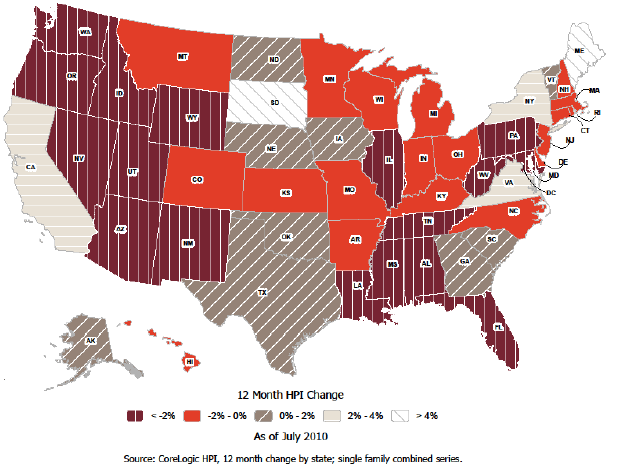
    CoreLogic reports Growing Number of Declining Markets Underscore Weakness in the Housing Market without Tax-Credit Support

    CoreLogic Home Price Index Remained Flat in July

    SANTA ANA, Calif., September 15, 2010 – CoreLogic (NYSE: CLGX), a leading provider of information, analytics and business services, today released its Home Price Index (HPI) that showed that home prices in the U.S. remained flat in July as transaction volumes continue to decline. This was the first time in five months that no year-over-year gains were reported. According to the CoreLogic HPI, national home prices, including distressed sales showed no change in July 2010 compared to July 2009. June 2010 HPI showed a 2.4 percent* year-over-year gain compared to June 2009.

    “Although home prices were flat nationally, the majority of states experienced price declines and price declines are spreading across more geographies relative to a few months ago. Home prices fell in 36 states in July, nearly twice the number in May and the highest since last November when national home prices were declining,” said Mark Fleming, chief economist for CoreLogic.

    Methodology

    The CoreLogic HPI incorporates more than 30 years worth of repeat sales transactions, representing more than 55 million observations sourced from CoreLogic industry-leading property information and its securities and servicing databases. The CoreLogic HPI provides a multi-tier market evaluation based on price, time between sales, property type, loan type (conforming vs. nonconforming), and distressed sales. The CoreLogic HPI is a repeat-sales index that tracks increases and decreases in sales prices for the same homes over time, which provides a more accurate “constant-quality” view of pricing trends than basing analysis on all home sales. The CoreLogic HPI provides the most comprehensive set of monthly home price indices and median sales prices available covering 6,208 ZIP codes (58 percent of total U.S. population), 572 Core Based Statistical Areas (85 percent of total U.S. population) and 1,027 counties (82 percent of total U.S. population) located in all 50 states and the District of Columbia.


    See the above article for additional charts

    Beazer Homes Warns on Orders

    The Wall Street Journal reports Beazer Homes Warns of Order Miss

    Beazer Homes USA Inc. said Wednesday it might miss order expectations for its fiscal-fourth quarter, as it also cut estimates for the year’s land and development spending, reflecting the sector’s weakness following the expiration of home-buyer tax credits.

    Last month, Beazer reported that its fiscal third-quarter loss was little changed because of a prior-year gain, while it reported a 73% surge in closings as buyers raced to qualify for the tax credit. Orders fell 33%.

    Inventory Soars

    Bloomberg reports U.S. Home Prices Face Three-Year Drop as Supply Gains

    The slide in U.S. home prices may have another three years to go as sellers add as many as 12 million more properties to the market.

    Shadow inventory — the supply of homes in default or foreclosure that may be offered for sale — is preventing prices from bottoming after a 28 percent plunge from 2006, according to analysts from Moody’s Analytics Inc., Fannie Mae, Morgan Stanley and Barclays Plc. Those properties are in addition to houses that are vacant or that may soon be put on the market by owners.

    “Whether it’s the sidelined, shadow or current inventory, the issue is there’s more supply than demand,” said Oliver Chang, a U.S. housing strategist with Morgan Stanley in San Francisco. “Once you reach a bottom, it will take three or four years for prices to begin to rise 1 or 2 percent a year.”

    Sales of new and existing homes fell to the lowest levels on record in July as a federal tax credit for buyers expired and U.S.

    Rising supply threatens to undermine government efforts to boost the housing market as homebuyers wait for better deals. Further price declines are necessary for a sustainable rebound as a stimulus-driven recovery falters, said Joshua Shapiro, chief U.S. economist of Maria Fiorini Ramirez Inc., a New York economic forecasting firm

    There were 4 million homes listed with brokers for sale as of July. It would take a record 12.5 months for those properties to be sold at that month’s sales pace, according to the Chicago-based Realtors group [National Association of Realtors].

    “The best thing that could happen is for prices to get to a level that clears the market,” said Shapiro, who predicts prices may fall another 10 percent to 15 percent. “Right now, buyers know it hasn’t hit bottom, so they’re sitting on the sidelines.”

    About 2 million houses will be seized by lenders by the end of next year, according to Mark Zandi, chief economist of Moody’s Analytics in West Chester, Pennsylvania. He estimates prices will drop 5 percent by 2013.

    Douglas Duncan, chief economist for Washington-based Fannie Mae, said in a Bloomberg Radio interview last week that 7 million U.S. homes are vacant or in the foreclosure process. Morgan Stanley’s Chang said the number of bank-owned and foreclosure-bound homes that have yet to hit the market is closer to 8 million.

    Defaulted mortgages as of July took an average 469 days to reach foreclosure, up from 319 days in January 2009. That’s an indication lenders — with the help of the government loan modification programs — are delaying resolutions and preventing the market from flooding with distressed properties, said Herb Blecher, senior vice president for analytics at LPS.“The efforts to date have been worthwhile,” Blecher said in a telephone interview from Denver. “They both helped borrowers stay in their homes and kept that supply of distressed properties on the market somewhat limited.”

    I disagree with Herb Blecher. I see little advantage stretching this mess out for a decade, and that is what the government seems hell-bent on doing. Everyone wants the government to “do something”. Unfortunately tax credits stimulated the production of new homes, ultimately adding to inventory. Prices need to fall to levels where there is genuine demand.

    The short-term rise in the Case-Shiller home price index and the CoreLogic HPI was a mirage that will soon vanish in the reality of an inventory of 8 million homes that must eventually hit the market.

    Lost Decade

    About 2 million houses will be seized by lenders by the end of next year, according to Mark Zandi, chief economist of Moody’s Analytics in West Chester, Pennsylvania. He estimates prices will drop 5 percent by 2013.

    After reaching bottom, prices will gain at the historic annual pace of 3 percent, requiring more than 10 years to return to their peak, he said.

    Home Price Pressures

    Last Bubble Not Reblown

    After the bottom is found, remember the axiom: the last bubble is not reblown for decades. Look at the Nasdaq, still off more than 50% from a decade ago.

    The odds home prices return to their peak in 10 years is close to zero. Houses in bubble areas may never return to peak levels in existing owner’s lifetimes. Zandi is way overoptimistic in his assessment of 3% annual appreciation after the bottom is found.

    Price Stagnation 

    I expect small nominal increases after housing bottoms, but negative appreciation in real terms as inflation picks up in the second half of the decade. Yes, deflation will eventually end. Alternatively the US goes in and out of deflation for a decade (depending on how much the Fed and Congress acts to prevent a much needed bottom). Either way, look for price stagnation in one form or another.

    Thus, if you have come to the conclusion there is no good reason to hold on to a deeply underwater home, nor any reason to rush into a home purchase at this time, you have reached the right conclusions.

    Hyperinflation? Please be serious.

    When Will Housing Bottom?

    Flashback October 25, 2007: When Will Housing Bottom?

    On the basis of mortgage rate resets and a consumer led recession I mentioned a possible bottom in the 2011-2012 timeframe. See Housing – The Worst Is Yet To Come for more details.

    Let’s take a look at housing from another perspective: new home sales historic averages and housing from 1963 to present.

    New Home Sales 1963 – Present

    New home sales reached a cyclical high in 2004-2005 approximately 50-60% higher than previous peaks.This happened in spite of a slowdown in population growth and household formation as compared to the 1960-1980 timeframe.

    From 1997-1998 and 2001-2002 to the recent peak, the average sales level was 1.1 million units, or 45-50% higher than the 40 year average. This translates to an average of 300,000-400,000 excess homes for nearly a decade, and arguably as many as 3-4 million excess homes.

    Such excess inventory may require as many as 5-7 years at recessionary average sales to absorb this inventory.

    Cycle Excesses Greatest In History

    The excesses of the current cycle have never been greater in history. The odds are strong that we have seen secular as opposed to cyclical peaks in housing starts and new single family home construction. With that in mind it is highly unlikely we merely return to the trend. If history repeats, and there is every reason it will, we are going to undercut those long term trendlines.

    There will be additional pressures a few years down the road when empty nesters and retired boomers start looking to downsize. Who will be buying those McMansions? Immigration also comes into play. If immigration policies and protectionism get excessively restrictive, that can also lengthen the decline.

    Finally, note that the current boom has lasted well over twice as long as any other. If the bust lasts twice as long as any other, 2012 just might be a rather optimist target for a bottom.

    When I wrote that in 2007, most thought I was off my rocker. Now, based on inventory, I may have been far too optimistic.

    Mike “Mish” Shedlock
    http://globaleconomicanalysis.blogspot.com See the above article for additional charts

    Beazer Homes Warns on Orders

    The Wall Street Journal reports Beazer Homes Warns of Order Miss

    Beazer Homes USA Inc. said Wednesday it might miss order expectations for its fiscal-fourth quarter, as it also cut estimates for the year’s land and development spending, reflecting the sector’s weakness following the expiration of home-buyer tax credits.

    Last month, Beazer reported that its fiscal third-quarter loss was little changed because of a prior-year gain, while it reported a 73% surge in closings as buyers raced to qualify for the tax credit. Orders fell 33%.

    Inventory Soars

    Bloomberg reports U.S. Home Prices Face Three-Year Drop as Supply Gains

    The slide in U.S. home prices may have another three years to go as sellers add as many as 12 million more properties to the market.

    Shadow inventory — the supply of homes in default or foreclosure that may be offered for sale — is preventing prices from bottoming after a 28 percent plunge from 2006, according to analysts from Moody’s Analytics Inc., Fannie Mae, Morgan Stanley and Barclays Plc. Those properties are in addition to houses that are vacant or that may soon be put on the market by owners.

    “Whether it’s the sidelined, shadow or current inventory, the issue is there’s more supply than demand,” said Oliver Chang, a U.S. housing strategist with Morgan Stanley in San Francisco. “Once you reach a bottom, it will take three or four years for prices to begin to rise 1 or 2 percent a year.”

    Sales of new and existing homes fell to the lowest levels on record in July as a federal tax credit for buyers expired and U.S.

    Rising supply threatens to undermine government efforts to boost the housing market as homebuyers wait for better deals. Further price declines are necessary for a sustainable rebound as a stimulus-driven recovery falters, said Joshua Shapiro, chief U.S. economist of Maria Fiorini Ramirez Inc., a New York economic forecasting firm

    There were 4 million homes listed with brokers for sale as of July. It would take a record 12.5 months for those properties to be sold at that month’s sales pace, according to the Chicago-based Realtors group [National Association of Realtors].

    “The best thing that could happen is for prices to get to a level that clears the market,” said Shapiro, who predicts prices may fall another 10 percent to 15 percent. “Right now, buyers know it hasn’t hit bottom, so they’re sitting on the sidelines.”

    About 2 million houses will be seized by lenders by the end of next year, according to Mark Zandi, chief economist of Moody’s Analytics in West Chester, Pennsylvania. He estimates prices will drop 5 percent by 2013.

    Douglas Duncan, chief economist for Washington-based Fannie Mae, said in a Bloomberg Radio interview last week that 7 million U.S. homes are vacant or in the foreclosure process. Morgan Stanley’s Chang said the number of bank-owned and foreclosure-bound homes that have yet to hit the market is closer to 8 million.

    Defaulted mortgages as of July took an average 469 days to reach foreclosure, up from 319 days in January 2009. That’s an indication lenders — with the help of the government loan modification programs — are delaying resolutions and preventing the market from flooding with distressed properties, said Herb Blecher, senior vice president for analytics at LPS.

    “The efforts to date have been worthwhile,” Blecher said in a telephone interview from Denver. “They both helped borrowers stay in their homes and kept that supply of distressed properties on the market somewhat limited.”

    I disagree with Herb Blecher. I see little advantage stretching this mess out for a decade, and that is what the government seems hell-bent on doing. Everyone wants the government to “do something”. Unfortunately tax credits stimulated the production of new homes, ultimately adding to inventory. Prices need to fall to levels where there is genuine demand.

    The short-term rise in the Case-Shiller home price index and the CoreLogic HPI was a mirage that will soon vanish in the reality of an inventory of 8 million homes that must eventually hit the market.

    Lost Decade

    About 2 million houses will be seized by lenders by the end of next year, according to Mark Zandi, chief economist of Moody’s Analytics in West Chester, Pennsylvania. He estimates prices will drop 5 percent by 2013.

    After reaching bottom, prices will gain at the historic annual pace of 3 percent, requiring more than 10 years to return to their peak, he said.

     Home Price Pressures

    Last Bubble Not Reblown

    After the bottom is found, remember the axiom: the last bubble is not reblown for decades. Look at the Nasdaq, still off more than 50% from a decade ago.

    The odds home prices return to their peak in 10 years is close to zero. Houses in bubble areas may never return to peak levels in existing owner’s lifetimes. Zandi is way overoptimistic in his assessment of 3% annual appreciation after the bottom is found.

    Price Stagnation 

    I expect small nominal increases after housing bottoms, but negative appreciation in real terms as inflation picks up in the second half of the decade. Yes, deflation will eventually end. Alternatively the US goes in and out of deflation for a decade (depending on how much the Fed and Congress acts to prevent a much needed bottom). Either way, look for price stagnation in one form or another.

    Thus, if you have come to the conclusion there is no good reason to hold on to a deeply underwater home, nor any reason to rush into a home purchase at this time, you have reached the right conclusions.

    Hyperinflation? Please be serious.

    When Will Housing Bottom?

    Flashback October 25, 2007: When Will Housing Bottom?

    On the basis of mortgage rate resets and a consumer led recession I mentioned a possible bottom in the 2011-2012 timeframe. See Housing – The Worst Is Yet To Come for more details.

    Let’s take a look at housing from another perspective: new home sales historic averages and housing from 1963 to present.

    New Home Sales 1963 – Present

    New home sales reached a cyclical high in 2004-2005 approximately 50-60% higher than previous peaks.This happened in spite of a slowdown in population growth and household formation as compared to the 1960-1980 timeframe.

    From 1997-1998 and 2001-2002 to the recent peak, the average sales level was 1.1 million units, or 45-50% higher than the 40 year average. This translates to an average of 300,000-400,000 excess homes for nearly a decade, and arguably as many as 3-4 million excess homes.

    Such excess inventory may require as many as 5-7 years at recessionary average sales to absorb this inventory.

    Cycle Excesses Greatest In History

    The excesses of the current cycle have never been greater in history. The odds are strong that we have seen secular as opposed to cyclical peaks in housing starts and new single family home construction. With that in mind it is highly unlikely we merely return to the trend. If history repeats, and there is every reason it will, we are going to undercut those long term trendlines.

    There will be additional pressures a few years down the road when empty nesters and retired boomers start looking to downsize. Who will be buying those McMansions? Immigration also comes into play. If immigration policies and protectionism get excessively restrictive, that can also lengthen the decline.

    Finally, note that the current boom has lasted well over twice as long as any other. If the bust lasts twice as long as any other, 2012 just might be a rather optimist target for a bottom.

    When I wrote that in 2007, most thought I was off my rocker. Now, based on inventory, I may have been far too optimistic.

    Mike “Mish” Shedlock
    http://globaleconomicanalysis.blogspot.com

  • Risks of walking away from mortgage debt, by Michele Lerner, Bankrate.com


    Some homeowners underwater on their home loan — meaning they owe more on the mortgage than the home’s current value — are turning to “strategic defaults” in which they simply walk away from mortgage debt.

    But financial experts warn the cost of skipping out on mortgage debt can be high.

    The American Bankers Association recently warned homeowners about the consequences of strategic default, including the possibility of the bank obtaining a judgment to pursue the homeowner’s assets, such as bank accounts, cars and investments.

    Wrecked credit

    A foreclosure — regardless of whether it is because of a strategic default or other circumstances — also has a negative impact on a consumer’s credit score.

    “A foreclosure is one of the stronger predictors of future credit risk,” says Craig Watts, public affairs director of FICO.

    Foreclosures remain on a credit report for seven years, with the impact gradually lessening over time.

    “For someone who has a foreclosure on (his or) her credit report, (his or) her FICO score can generally begin to recover after a couple of years, assuming the consumer stays current with (his or) her payments on all (his or) her other credit accounts,” Watts says.

    Watts says the impact of a foreclosure on a credit score depends on other factors in the borrower’s credit history. The ABA says a foreclosure drops a FICO score by 100 to 400 points.

    Difficulty getting new mortgage

    In addition, a voluntary foreclosure can impact a homeowner’s ability to qualify for a new mortgage for years to come.

    Peter Fredman, a Berkeley, Calif., consumer attorney, says Fannie Mae and Freddie Mac will not approve a mortgage within four years after foreclosure, while the ABA says it can take three to seven years to qualify for a new mortgage.

    In addition, mortgage giant Fannie Mae recently announced a tough new sanction on people who deliberately default on their mortgages. Such borrowers will be ineligible for a new Fannie-backed mortgage for seven years after the date of foreclosure.

    Other consequences

    Tax liability is another potential danger of defaulting. Although the Mortgage Forgiveness Debt Relief Act of 2007 (extended through 2012) offers widespread protection from federal taxes following a foreclosure, state taxes still may be due on unpaid debt.

    A lender can also pursue the remaining debt from an unpaid loan by obtaining a deficiency judgment against the delinquent borrower, or may work with a collection agency to recoup losses.

    And of course, ethical questions surround strategic defaults. A survey by Trulia.com and RealtyTrac found that 59 percent of homeowners would not consider defaulting no matter how much their mortgage was underwater, although another 41 percent of homeowners said they would consider a default.

    Less risky in some states

    Despite the potential negative consequences of a strategic default, the move is less risky in some states than others.

    “The first question for anyone considering a strategic default is whether the homeowners will be liable for the debt anyway,” says Fredman. “Each state has different rules.”

    Non-recourse laws protect homeowners in some states. When a borrower defaults in one of these states, the lender can take the home through a foreclosure but has no right to any other borrower assets. (Home equity loans are not eligible for this protection unless they were used as part of the home purchase.)

    According to research from the Federal Reserve Bank of Atlanta, 11 states are “non-recourse” states: Alaska, Arizona, California, Iowa, Minnesota, Montana, North Carolina, North Dakota, Oregon, Washington and Wisconsin.

    “In California, we have some of the best anti-deficiency rules around, so banks can foreclose on the home but cannot get any other judgment to claim additional assets,” Fredman says.

    In some areas, lenders are so overwhelmed with defaulting customers that homeowners can live in their homes for free for months or even a year or more before the foreclosure is complete.

    The average length of time from default to eviction is 400 days in California, Fredman says.

    Price of freedom

    The potential consequences of strategic default cannot deter some homeowners from taking the plunge, says Frank Pallotta, executive vice president and managing director of the Loan Value Group in Rumson, N.J.

    “While everyone understands the credit score impact of a strategic default, most borrowers don’t seem to care,” Pallotta says. “They think a 200-point hit on their credit score cannot offset the benefit of living for as long as 18 months rent- and mortgage-free. They see strategic default as a form of financial freedom, especially if they live in a non-recourse state and know someone who has done this.”

    Fredman — who developed the “Should I Pay or Should I Go” Web calculator to help consumers evaluate the wisdom of a strategic default — says homeowners considering a strategic default should research state regulations about loan defaults and tax laws. Even non-recourse states have various laws that can impact defaulting borrowers, he says.

    “I also think everyone should consult an attorney and probably an accountant, too, because the relative cost of these professionals is not nearly as high as the potential cost of making a mistake,” he says

  • What changes are coming for FHA lending?, by Charlene Crowell, NNPA Financial Writer


     When the Federal Housing Administration (FHA) was created in 1934, its main focus was to change the difficulty that people seeking mortgage loans faced during the Great Depression. By the end of World War II, many returning service men and women took advantage of FHA programs to help finance home purchases. Today, FHA insures 4.8 million single-family home mortgages.

    Now in 2010, the still-unfolding foreclosure tsunami that began in 2007 has forced FHA to alter how it can continue operating independent of taxpayer funds. Unlike many federal agencies, FHA’s only operating revenues are derived from fees paid for mortgage insurance. In mid-July FHA announced a number of policy changes that included an increase in mortgage insurance premiums. FHA is also considering other changes such as requiring new mortgage applicants to have higher down payments and/or higher credit scores.  

    For many policymakers, increasing required down payments and high credit scores are the opposite of what the country needs right now. Instead, these voices are urging FHA to preserve its traditional role of extending affordable access to homeownership. In their view, that access would be a valued complement to the many reforms sets forth and regulations yet to come from the Dodd-Frank Wall Street Reform Act.

    Among the organizations choosing to file comments on these changes and their likely effects was the Center for Responsible Lending (CRL), an affiliate of Self-Help. With 30 years of service as a community development financial institution operating a credit union and nonprofit loan fund, Self-Help has provided over $5.65 billion of financing to 64,000 low-wealth families, small businesses and nonprofit organizations in North Carolina and across America.  

    Like FHA, Self-Help has been a partner in expanding affordable and sustainable homeownership for many families that otherwise would have remained renters. As Self-Help’s research and policy arm, CRL has authored research reports and provided insightful analyses of nagging housing issues.  

    CRL also recently advised FHA in part, “The foreclosure crisis and the resulting economic crisis were caused by reckless and predatory lending practices and toxic financial products not by any policy goal aimed at increasing homeownership.”

    “The predatory lending practices and toxic products characteristic of the past decade,” continued CRL, “occurred for one reason and one reason only: For mortgage brokers, lenders and investors to make money. . .And communities of color were disproportionately targeted by non-bank subprime mortgage lenders who provided them with higher-cost, risk-layered, less sustainable loans than they qualify for.”

    Statistics from other independent organizations tracking African-American consumer trends support CRL’s own findings.  

    The 2010 annual survey published by the National Urban League, The State of Black America, determined that although nearly three quarters of white families own their own homes, less than half of African-American or Latino families are homeowners. Blacks and Latinos are also more than three times as likely to live in poverty as compared to Whites.

    Earlier this year, and as reported in this column, the Institute for Assets and Social Policy (IASP) at Brandeis University found that only one in four African-American middle-class families in America are financially secure.

    The 15th annual Buying Power of Black America report published by Target Market News determined that the $166.3 billion spent on housing each year is more than double and sometimes triple any other household cost. This fact suggests that housing affordability in the Black community remains a challenge. Moreover, on a range of services and products, Black households were found to spend more than their white counterparts.   

    These facts and other economic measures contributed to CRL’s call for a number of specific FHA reforms. Among them:

    An immediate ban on yield-spread premiums, the broker kickback paid by lenders for pushing high-cost loans onto buyers;

    Safeguards against abusive pricing and fees – including rigorous oversight and enforcement; and

    Stronger, more aggressive limits on points and fees identified in regulation that will complement those outlined in the Dodd-Frank bill.   

    Hopefully the regulations yet to be crafted by FHA will begin to close the affordability gap that now exists for many communities of color. Whatever rules go into effect, will become either the opportunity or an obstacle for people hoping to have their own American dream.

    This article was originally published in the September 13, 2010 print edition of The Louisiana Weekly newspaper

  • Could 62 Million Homes be Foreclosure Proof?, Fox News


    Homeowners’ Rebellion: Could 62 Million Homes Be Foreclosure-Proof?


    In fear of losing your home? Good news … there is a loophole in the system that could keep you right where you are! So what’s the secret? Watch Attorney Bob Massi’s solution below, and may we suggest a paper and pen to jot down all the details.

    Over 62 million mortgages are now held in the name of MERS, an electronic recording system devised by and for the convenience of the mortgage industry. A California bankruptcy court, following landmark cases in other jurisdictions, recently held that this electronic shortcut makes it impossible for banks to establish their ownership of property titles—and therefore to foreclose on mortgaged properties. The logical result could be 62 million homes that are foreclosure-proof.

    Mortgages bundled into securities were a favorite investment of speculators at the height of the financial bubble leading up to the crash of 2008. The securities changed hands frequently, and the companies profiting from mortgage payments were often not the same parties that negotiated the loans. At the heart of this disconnect was the Mortgage Electronic Registration System, or MERS, a company that serves as the mortgagee of record for lenders, allowing properties to change hands without the necessity of recording each transfer.

    MERS was convenient for the mortgage industry, but courts are now questioning the impact of all of this financial juggling when it comes to mortgage ownership. To foreclose on real property, the plaintiff must be able to establish the chain of title entitling it to relief. But MERS has acknowledged, and recent cases have held, that MERS is a mere “nominee”—an entity appointed by the true owner simply for the purpose of holding property in order to facilitate transactions. Recent court opinions stress that this defect is not just a procedural but is a substantive failure, one that is fatal to the plaintiff’s legal ability to foreclose.

    That means hordes of victims of predatory lending could end up owning their homes free and clear—while the financial industry could end up skewered on its own sword.

    California Precedent

    The latest of these court decisions came down in California on May 20, 2010, in a bankruptcy case called In re Walker, Case no. 10-21656-E–11. The court held that MERS could not foreclose because it was a mere nominee; and that as a result, plaintiff Citibank could not collect on its claim. The judge opined:

    Since no evidence of MERS’ ownership of the underlying note has been offered, and other courts have concluded that MERS does not own the underlying notes, this court is convinced that MERS had no interest it could transfer to Citibank. Since MERS did not own the underlying note, it could not transfer the beneficial interest of the Deed of Trust to another. Any attempt to transfer the beneficial interest of a trust deed without ownership of the underlying note is void under California law.

    In support, the judge cited In Re Vargas (California Bankruptcy Court); Landmark v. Kesler (Kansas Supreme Court); LaSalle Bank v. Lamy (a New York case); and In Re Foreclosure Cases (the “Boyko” decision from Ohio Federal Court). (For more on these earlier cases, see here, here and here.) The court concluded:

    Since the claimant, Citibank, has not established that it is the owner of the promissory note secured by the trust deed, Citibank is unable to assert a claim for payment in this case.

    The broad impact the case could have on California foreclosures is suggested by attorney Jeff Barnes, who writes:

    This opinion . . . serves as a legal basis to challenge any foreclosure in California based on a MERS assignment; to seek to void any MERS assignment of the Deed of Trust or the note to a third party for purposes of foreclosure; and should be sufficient for a borrower to not only obtain a TRO [temporary restraining order] against a Trustee’s Sale, but also a Preliminary Injunction barring any sale pending any litigation filed by the borrower challenging a foreclosure based on a MERS assignment.

    While not binding on courts in other jurisdictions, the ruling could serve as persuasive precedent there as well, because the court cited non-bankruptcy cases related to the lack of authority of MERS, and because the opinion is consistent with prior rulings in Idaho and Nevada Bankruptcy courts on the same issue.

    What Could This Mean for Homeowners?

    Earlier cases focused on the inability of MERS to produce a promissory note or assignment establishing that it was entitled to relief, but most courts have considered this a mere procedural defect and continue to look the other way on MERS’ technical lack of standing to sue. The more recent cases, however, are looking at something more serious. If MERS is not the title holder of properties held in its name, the chain of title has been broken, and no one may have standing to sue. In MERS v. Nebraska Department of Banking and Finance, MERS insisted that it had no actionable interest in title, and the court agreed.

    An August 2010 article in Mother Jones titled “Fannie and Freddie’s Foreclosure Barons” exposes a widespread practice of “foreclosure mills” in backdating assignments after foreclosures have been filed. Not only is this perjury, a prosecutable offense, but if MERS was never the title holder, there is nothing to assign. The defaulting homeowners could wind up with free and clear title.

    In Jacksonville, Florida, legal aid attorney April Charney has been using the missing-note argument ever since she first identified that weakness in the lenders’ case in 2004. Five years later, she says, some of the homeowners she’s helped are still in their homes. According to a Huffington Post article titled “‘Produce the Note’ Movement Helps Stall Foreclosures”:

    Because of the missing ownership documentation, Charney is now starting to file quiet title actions, hoping to get her homeowner clients full title to their homes (a quiet title action ‘quiets’ all other claims). Charney says she’s helped thousands of homeowners delay or prevent foreclosure, and trained thousands of lawyers across the country on how to protect homeowners and battle in court.

    Criminal Charges?

    Other suits go beyond merely challenging title to alleging criminal activity. On July 26, 2010, a class action was filed in Florida seeking relief against MERS and an associated legal firm for racketeering and mail fraud. It alleges that the defendants used “the artifice of MERS to sabotage the judicial process to the detriment of borrowers;” that “to perpetuate the scheme, MERS was and is used in a way so that the average consumer, or even legal professional, can never determine who or what was or is ultimately receiving the benefits of any mortgage payments;” that the scheme depended on “the MERS artifice and the ability to generate any necessary ‘assignment’ which flowed from it;” and that “by engaging in a pattern of racketeering activity, specifically ‘mail or wire fraud,’ the Defendants . . . participated in a criminal enterprise affecting interstate commerce.”

    Local governments deprived of filing fees may also be getting into the act, at least through representatives suing on their behalf. Qui tam actions allow for a private party or “whistle blower” to bring suit on behalf of the government for a past or present fraud on it. In State of California ex rel. Barrett R. Bates, filed May 10, 2010, the plaintiff qui tam sued on behalf of a long list of local governments in California against MERS and a number of lenders, including Bank of America, JPMorgan Chase and Wells Fargo, for “wrongfully bypass[ing] the counties’ recording requirements; divest[ing] the borrowers of the right to know who owned the promissory note . . .; and record[ing] false documents to initiate and pursue non-judicial foreclosures, and to otherwise decrease or avoid payment of fees to the Counties and the Cities where the real estate is located.” The complaint notes that “MERS claims to have ‘saved’ at least $2.4 billion dollars in recording costs,” meaning it has helped avoid billions of dollars in fees otherwise accruing to local governments. The plaintiff sues for treble damages for all recording fees not paid during the past ten years, and for civil penalties of between $5,000 and $10,000 for each unpaid or underpaid recording fee and each false document recorded during that period, potentially a hefty sum. Similar suits have been filed by the same plaintiff qui tam in Nevada and Tennessee.

    By Their Own Sword: MERS’ Role in the Financial Crisis

    MERS is, according to its website, “an innovative process that simplifies the way mortgage ownership and servicing rights are originated, sold and tracked. Created by the real estate finance industry, MERS eliminates the need to prepare and record assignments when trading residential and commercial mortgage loans.” Or as Karl Denninger puts it, “MERS’ own website claims that it exists for the purpose of circumventing assignments and documenting ownership!”

    MERS was developed in the early 1990s by a number of financial entities, including Bank of America, Countrywide, Fannie Mae, and Freddie Mac, allegedly to allow consumers to pay less for mortgage loans. That did not actually happen, but what MERS did allow was the securitization and shuffling around of mortgages behind a veil of anonymity. The result was not only to cheat local governments out of their recording fees but to defeat the purpose of the recording laws, which was to guarantee purchasers clean title. Worse, MERS facilitated an explosion of predatory lending in which lenders could not be held to account because they could not be identified, either by the preyed-upon borrowers or by the investors seduced into buying bundles of worthless mortgages. As alleged in a Nevada class action called Lopez vs. Executive Trustee Services, et al.:

    Before MERS, it would not have been possible for mortgages with no market value . . . to be sold at a profit or collateralized and sold as mortgage-backed securities. Before MERS, it would not have been possible for the Defendant banks and AIG to conceal from government regulators the extent of risk of financial losses those entities faced from the predatory origination of residential loans and the fraudulent re-sale and securitization of those otherwise non-marketable loans. Before MERS, the actual beneficiary of every Deed of Trust on every parcel in the United States and the State of Nevada could be readily ascertained by merely reviewing the public records at the local recorder’s office where documents reflecting any ownership interest in real property are kept….

    After MERS, . . . the servicing rights were transferred after the origination of the loan to an entity so large that communication with the servicer became difficult if not impossible …. The servicer was interested in only one thing – making a profit from the foreclosure of the borrower’s residence – so that the entire predatory cycle of fraudulent origination, resale, and securitization of yet another predatory loan could occur again. This is the legacy of MERS, and the entire scheme was predicated upon the fraudulent designation of MERS as the ‘beneficiary’ under millions of deeds of trust in Nevada and other states.

    Axing the Bankers’ Money Tree

    If courts overwhelmed with foreclosures decide to take up the cause, the result could be millions of struggling homeowners with the banks off their backs, and millions of homes no longer on the books of some too-big-to-fail banks. Without those assets, the banks could again be looking at bankruptcy. As was pointed out in a San Francisco Chronicle article by attorney Sean Olender following the October 2007 Boyko [pdf] decision:

    The ticking time bomb in the U.S. banking system is not resetting subprime mortgage rates. The real problem is the contractual ability of investors in mortgage bonds to require banks to buy back the loans at face value if there was fraud in the origination process.

    . . . The loans at issue dwarf the capital available at the largest U.S. banks combined, and investor lawsuits would raise stunning liability sufficient to cause even the largest U.S. banks to fail . . . .

    Nationalization of these giant banks might be the next logical step—a step that some commentators said should have been taken in the first place. When the banking system of Sweden collapsed following a housing bubble in the 1990s, nationalization of the banks worked out very well for that country.

    The Swedish banks were largely privatized again when they got back on their feet, but it might be a good idea to keep some banks as publicly-owned entities, on the model of the Commonwealth Bank of Australia. For most of the 20th century it served as a “people’s bank,” making low interest loans to consumers and businesses through branches all over the country.

    With the strengthened position of Wall Street following the 2008 bailout and the tepid 2010 banking reform bill, the U.S. is far from nationalizing its mega-banks now. But a committed homeowner movement to tear off the predatory mask called MERS could yet turn the tide. While courts are not likely to let 62 million homeowners off scot free, the defect in title created by MERS could give them significant new leverage at the bargaining table.

    Ellen Brown wrote this article for YES! Magazine, a national, nonprofit media organization that fuses powerful ideas with practical actions. Ellen developed her research skills as an attorney practicing civil litigation in Los Angeles. In Web of Debt, her latest of eleven books, she shows how the Federal Reserve and “the money trust” have usurped the power to create money from the people themselves, and how we the people can get it back. Her websites are webofdebt.com, ellenbrown.com, and public-banking.com.

  • Facing Foreclosure? What To Do Right Now, by Jerry DeMuth, HouseLogic.com


    If you’re facing foreclosure, don’t panic: Take steps right now to save your home or at least lessen the blow of its loss.

    A record high 2.8 million properties were hit with foreclosure notices (http://www.realtytrac.com/contentmanagement/pressrelease.aspx?channelid=9&accnt=0&itemid=8333) in 2009. That’s the bad news. The good news: About two-thirds of notices don’t result in actual foreclosures, says Doug Robinson of NeighborWorks, a nonprofit group that offers foreclosure counseling.

    Many homeowners find alternatives to foreclosure by negotiating with lenders, often with the help of foreclosure counselors. If you’re facing foreclosure, call your lender right now to determine your options, which can include loan modification, forbearance, or a short sale.

    Foreclosure process takes time

    The entire foreclosure process (http://portal.hud.gov/portal/page/portal/HUD/topics/avoiding_foreclosure/foreclosureprocess) can take anywhere from two to 12 months, depending on how fast your lender acts and where you live. Some states allow a nonjudicial process that’s speedier, while others require time-consuming judicial proceedings.

    Once you miss at least one mortgage payment, the steps leading up to an actual foreclosure sale can include demand letters, notices of default, a recorded notice of foreclosure, publication of the debt, and the scheduling of a foreclosure auction. Even when an auction is scheduled, however, it may never occur, or it may occur but a qualified buyer doesn’t materialize.

    Bottom line: Foreclosure can be a long slog, which gives you enough time to come up with an alternative. Meantime, if your goal is to salvage your home, think about keeping up with payments for homeowners insurance and property taxes. Otherwise, you could compound your problems by getting hit with an uncovered casualty loss or liability suit, or tax liens.

    Read the fine print

    Start by reviewing all correspondence you’ve received from your lender. The letters–and phone calls–probably began once you were 30 days past due. Also review your mortgage documents, which should outline what steps your lender can take. For instance, is there a “power of sale” clause that authorizes the sale of your home to pay off a mortgage after you miss payments?

    Determine the specific foreclosure laws (http://www.foreclosurelaw.org) for your state. What’s the timeline? Do you have “right of redemption,” essentially a grace period in which you can reverse a foreclosure? Are deficiency judgments that hold you responsible for the difference between what your home sells for and your loan’s outstanding balance allowed? Get answers.

    Pick up the phone

    Don’t give up because you missed a mortgage payment or two and received a notice of default. Foreclosure isn’t a foregone conclusion, but it’s heading in that direction if you don’t call your lender. Dial the number on your mortgage statement, and ask for the Loss Mitigation Department. You might stay on hold for a while, but don’t hang up. Once you do get someone on the line, take notes and record names.

    The next call should be to a foreclosure avoidance counselor (http://www.hud.gov/offices/hsg/sfh/hcc/fc/) approved by the U.S. Department of Housing and Urban Development. One of these counselors can, free of charge, explain your state’s foreclosure laws, discuss alternatives to foreclosure, help you organize financial documents, and even represent you in negotiations with your lender. Be wary of unsolicited offers of help, since foreclosure rescue scams (http://www.houselogic.com/articles/avoid-foreclosure-rescue-scams/) are common.

    Be sure to let your lender know that you’re working with a counselor. Not only does it demonstrate your resolve, but according to NeighborWorks, homeowners who receive foreclosure counseling are 1.6 times more likely to avoid losing their homes than those who don’t. Homeowners who receive loan modifications with the help of a counselor also reduce monthly mortgage payments (http://www.nw.org/newsroom/pressReleases/2009/netNews111809.asp) by $454 more than homeowners who receive a modification without the aid of a counselor.

    Lender alternatives to foreclosure

    Hope Now (http://www.hopenow.com), an alliance of mortgage companies and housing counselors, can aid homeowners facing foreclosure. A self-assessment tool will give you an idea whether you might be eligible for help from your lender, and there are direct links to HUD-approved counseling agencies and lenders’ foreclosure-prevention programs.

    There are alternatives to foreclosure that your lender might accept. The most attractive option that’ll allow you to keep your home is a loan modification that reduces your monthly payment. A modification can entail lowering the interest rate, changing a loan from an adjustable rate to a fixed rate, extending the term of a loan, or eliminating past-due balances. Another option, forbearance, can temporarily suspend payments, though the amount will likely be tacked on to the end of the loan.

    If you’re unable to make even reduced payments, and assuming a conventional sale isn’t possible, then it may be best to turn your home over to your lender before a foreclosure is completed. A completed foreclosure can decimate a credit score, which will make it hard not only to purchase another home someday, but also to rent a home in the immediate future.

    Your lender can approve a short sale, in which the proceeds are less than what’s still owed on your mortgage. A deed-in-lieu of foreclosure, which amounts to handing over your keys to your lender, is another possibility. The earlier you begin talks with your lender, the more likelihood of success.

    Explore government programs

    The federal government’s Making Home Affordable (http://www.makinghomeaffordable.gov/) program offers two options: loan modification (http://www.houselogic.com/articles/making-home-affordable-modification-option/) and refinancing (http://www.houselogic.com/articles/making-home-affordable-refinance-option/). A self-assessment will indicate which option might be right for you, but you need to apply for the program through your lender. A Making Home Affordable loan modification requires a three-month trial period before it can become permanent.

    Fannie Mae and Freddie Mac have their own foreclosure-prevention programs as well. Check to determine if either Fannie (http://www.fanniemae.com/loanlookup) or Freddie (http://www.freddiemac.com/mymortgage) owns your mortgage. Present this information to your lender and your counselor. Fannie and Freddie also have rental programs under which former owners can remain in recently foreclosed homes on a month-to-month basis.

    The federal Home Affordable Foreclosure Alternatives (https://www.hmpadmin.com/portal/programs/foreclosure_alternatives.html) program, which takes full effect in April 2010, offers lenders financial incentives to approve short sales and deeds-in-lieu of foreclosure. It also provides $3,000 in relocation assistance to borrowers. Again, talk to your lender and counselor.

  • Multnomahforeclosures.com: Bank Owned Property List Update for August 2010


    August REO list for bank owned property has been added to Multnomahforeclosures.com . REO lists for Clackamas, Multnomah and Washington County has been addd to the site. The homes listed in these files were deeded back or returned to the investor or lender due to the finalizing of the foreclosure process. Many of these homes may already be on the market or will soon will be. It would not be a bad idea to contact the new owner of these properties and find out what their plans are when it comes to their future ownership of the property.

    Multnomah County Foreclosures
    http://multnomahforeclosures.com

  • Is this the Right Time for the Fed to go Negative?, by Willem Buiter, Wsj.com


    Ben Bernanke, chairman of the Federal Reserve Bank, has a lot more tools for supporting U.S. economic activity through expansionary monetary policy than he discussed in his Jackson Hole speech, which alluded only to more quantitative easing and credit easing—increasing the size and changing the liquidity composition of the Fed’s balance sheet.

    Perhaps out of fear of resurrecting the moniker “Helicopter Ben,” Mr. Bernanke did not refer to the combined fiscal-monetary stimulus that (almost) always works: a fiat money-financed increase in public spending or tax cut. Treasury Secretary Tim Geithner can always send a sufficiently large check to each U.S. resident to ensure that household spending rises. By borrowing the funds from the Fed, there is no addition to the interest-bearing, redeemable debt of the state. As long as households are confident that these transfers will not be reversed later, “helicopter money drops” will, if pushed far enough, always boost consumption.

    However, stronger consumer expenditure, while appropriate from a cyclical perspective—any additional demand is welcome—is not what the U.S. needs for long-term sustainability and structural adjustment: to raise the national saving rate, boost fixed investment in plant, equipment and infrastructure, achieve a trade surplus and shift resources from the non-tradable to the tradable sectors.

    By way of illustration, an eight percentage point reduction in public and private consumption as a share of GDP could be compensated for by an increase in the trade surplus of five per cent of GDP and in non-housing U.S. fixed capital formation of three per cent of GDP. To achieve this, a much weaker real exchange rate and lower real interest rates are necessary. To pursue these objectives speedily a Federal Funds target rate of around minus three or minus four per cent may well be required right now, in our view. This brings monetary policy up against the zero lower bound (zlb) on nominal interest rates.

    The zlb results from the existence of currency (dollar bills and coins) with a zero nominal interest rate. Even allowing for “carry costs” of currency (storage, safekeeping, insurance etc.), this makes it impossible for competing assets like government bills, to offer interest rates much below zero. Stimulating demand in the U.S. economy, while rebalancing the composition of demand and production in the desired directions, requires a much lower Federal Funds target rate than is feasible with the zlb in place.

    To restore monetary policy effectiveness in a low interest rate environment when confronted with deflationary or contractionary shocks, it is necessary to get rid of the zlb completely. This can be done in three ways: abolishing currency, taxing currency and ending the fixed exchange rate between currency and bank reserves with the Fed. All three are unorthodox. The third is unorthodox and innovative. All three are conceptually simple. The first and third are administratively easy to implement.

    The first method does away with currency completely. This has the additional benefit of inconveniencing the main users of currency—operators in the grey, black and outright criminal economies. Adequate substitutes for the legitimate uses of currency, on which positive or negative interest could be paid, are available.

    The second approach, proposed by Gesell, is to tax currency by making it subject to an expiration date. Currency would have to be “stamped” periodically by the Fed to keep it current. When done so, interest (positive or negative) is received or paid.

    The third method ends the fixed exchange rate (set at one) between dollar deposits with the Fed (reserves) and dollar bills. There could be a currency reform first. All existing dollar bills and coin would be converted by a certain date and at a fixed exchange rate into a new currency called, say, the rallod. Reserves at the Fed would continue to be denominated in dollars. As long as the Federal Funds target rate is positive or zero, the Fed would maintain the fixed exchange rate between the dollar and the rallod.

    When the Fed wants to set the Federal Funds target rate at minus five per cent, say, it would set the forward exchange rate between the dollar and the rallod, the number of dollars that have to be paid today to receive one rallod tomorrow, at five per cent below the spot exchange rate—the number of dollars paid today for one rallod delivered today. That way, the rate of return, expressed in a common unit, on dollar reserves is the same as on rallod currency.

    For the dollar interest rate to remain the relevant one, the dollar has to remain the unit of account for setting prices and wages. This can be encouraged by the government continuing to denominate all of its contracts in dollars, including the invoicing and payment of taxes and benefits. Imposing the legal restriction that checkable deposits and other private means of payment cannot be denominated in rallod would help.

    In the other major industrial countries too (the euro area, Japan and the U.K.), monetary policy is constrained by the zlb. Conventional fiscal expansion with government debt-financed deficit increases would be ineffective or infeasible because of fiscal unsustainability. Like the Fed, the ECB, the Bank of Japan and the Bank of England therefore should lobby for the legislation necessary to eliminate the zlb. The euro area and Japan, which don’t suffer from deficient saving rates or undesirable current account deficits, could in addition stimulate consumption through helicopter drops of money—base money-financed fiscal stimuli.

    All three methods for eliminating the zlb, although administratively feasible and conceptually simple, are innovative and unorthodox. Central banks are conservative. The mere fact that something has not been done before often is sufficient grounds for not doing it now. The cost of rejecting institutional innovation to remove the zlb could, however, be high: a material risk of continued deficient aggregate demand, persistent deflation and, in the U.S. and the U.K., unnecessary conflict between short-term stabilization and long-term sustainability and rebalancing.

    —Willem Buiter is chief economist for Citi.

  • Executives With Criminal Records Slip Through FHA Crackdown, Documents Show, By Brian Grow, Publicintegrity.org


    A crackdown on reckless mortgage lenders by the Federal Housing Administration has failed to root out several executives with criminal records whose firms continue to do business with the agency in violation of federal law, according to government documents, court records and interviews.

    The get-tough campaign has also been hamstrung because, even when the FHA can ban mortgage companies for wrongdoing or an excessive default rate, the agency does not have the legal power to stop their executives from landing jobs at other lenders, or open new firms.

    After the collapse of the home loan market, the FHA launched an effort aimed at reducing losses on mortgages it insures by weeding reckless lenders out of the program.

    But documents and interviews reveal that more than 34,000 home loans have been issued over the past two years by a dozen FHA-approved lenders that have employed people who were convicted of felonies, banned from the securities industry or previously worked for firms barred by the agency.

    More than 3,000 of those loans, about 9 percent, were seriously delinquent or already a claim on the FHA insurance fund as of June 30. That’s nearly triple the rate for all loans made by FHA lenders over the past two years, about 3.4 million.

    Compared with other regulators, critics of the FHA say it rarely cracks down on company executives. “In the securities industry, you bar people for life. You don’t see that a lot with the FHA,” says Mark Calabria, director for financial regulation studies at the Cato Institute.

    Policing the cubicles and corner suites of FHA lenders is crucial because the agency, which encourages home ownership by insuring mortgages made by qualified lenders, has become a cornerstone of the U.S. housing market. Its portfolio of guaranteed loans has grown to $800 billion in March from $466 billion in fiscal 2008. The agency’s insurance program is financed by premiums paid by FHA borrowers, but taxpayers would be on the line if those funds are depleted.

    The agency has long struggled to stop companies from slipping risky loans under its protective umbrella. It has done this in part by barring lenders if too many of their borrowers default. 
    FHA Commissioner David Stevens has vigorously defended the agency’s bid to drop lenders with higher than average default rates or evidence of fraudulent loans. “No one can feign that we’re not all over fraud now, in this administration,” Stevens says. Since January, the agency has fined or withdrawn the approval of more than 1,100 lenders to issue federally-insured mortgages, according to records provided by the FHA.

    But he added, “By no means do I think are we are out of the woods, yet. …There are going to be some of these guys who slip through.”

    The internal watchdog at the Department of Housing and Urban Development, which oversees the FHA, says the agency has failed to systematically monitor the people making home loans. In recent Congressional testimony, he called for “a new mind-set at the FHA to know your participants and not just the entity.”

    Legislation passed by Congress last year bars any individual from working for an FHA lender in a range of positions if convicted of a felony that “involved an act of fraud, dishonesty, or a breach of trust, or money laundering.” The law, which broadly addressed foreclosure prevention efforts and housing policies, also rendered an FHA lender ineligible if it employs a person convicted of an offense “that reflects adversely” upon the company.

    According to HUD and FHA documents, court records and interviews, at least five convicted felons are now working for FHA lenders or worked for them in recent years.

    Gregg S. Marcus, for example, was co-owner of a mortgage company called Gettysburg Funding Corp. when he pled guilty in 1998 to federal tax evasion in New York following an investigation of false loan applications at that company, according to court records. Marcus was sentenced to five years probation and fined $50,000. His business partner at Gettysburg Funding pled guilty to bank fraud.

    Marcus went on to become executive director at another mortgage lender, Somerset Investors Corp. A HUD database shows Somerset remains an FHA-approved lender. The company’s status as an FHA lender did not change after a March 2010 audit by HUD’s Inspector General recommended Somerset return $2.8 million in insurance payments to the agency because of “significant underwriting deficiencies” in the firm’s loans. The government auditors, who had not set out to examine individual executives, didn’t identify Marcus as a convicted felon.

    HUD officials declined to comment on Gregg Marcus and his criminal conviction. In a statement, HUD said that the president of Somerset recently certified that none of company’s employees “were currently in, or had been involved in, an investigation that could result or has resulted in a criminal conviction. If the information was false, the certification would be inaccurate and may warrant administrative action by HUD.”

    Marcus and his wife, Randi, who is the president of Somerset, did not respond to certified letters requesting comment for this article. Phone calls and e-mails sent to Somerset were not returned.

    While HUD says it tries to keep felons out of the FHA program, housing officials say they cannot bar other individuals just because they had previously worked for a banned lender.

    “Termination of a lender does not specifically prohibit its principals and senior executives from seeking employment with approved lenders or forming a new company that may seek approval,” HUD said in a statement.

    HUD’s own inspector general, Kenneth Donohue, warned at a Senate subcommittee hearing in May that FHA suffers from a “systemic weakness” by allowing these individuals to continue doing business with the agency.

    “Without specific citations against individuals (FHA) could not link principals of a defunct company to those same individuals who would go on to form new entities,” Donohue said. “We see this type of maneuver too often and it makes the FHA program too easy a target for those intent on abusing the program.”

    At least four FHA lenders employ executives who previously worked at companies banned from doing business with the agency, according to documents and interviews.

    Lend America was banned by HUD last December after the Justice Department accused the company it of originating fraudulent loans insured by the FHA. Lend America’s chief business strategist, Michael Ashley, was barred from the FHA for life in March. But at least one of the firm’s other senior executives now works as a sales manager at a company currently approved to make FHA loans.

    In another instance, a former senior executive with BSM Financial, an FHA lender based in Allen, Texas, has worked for two other FHA lenders since that company was barred from the program in 2009. The executive is currently a top official at another FHA lender in Texas, according to documents and interviews.

    BSM had run into trouble in 2006 with auditors from HUD’s Office of Inspector General, who reported that “the lender approved mortgages on overvalued properties for borrowers that were less than creditworthy.” The auditors recommended BSM reimburse $2 million in losses on foreclosed homes, along with other penalties. In April 2009, BSM was banned from the FHA program because the firm never made the first payment required by a settlement agreement following the audit.

    In a statement responding to questions about why the executives have been able to move between various FHA lenders, HUD says, “misconduct or poor performance by a company does not necessarily extend to its officers or employees absent evidence that the officers or employees participated in, directed, knew about or had reason to know about specific violations or misconduct.”

    Stevens, the FHA commissioner, said his agency follows the principle of due process when deciding which individuals to bar.

    “You can’t just throw someone out because you don’t like them,” he said. “They have to violate a law; they have to commit a crime.”

    HUD officials acknowledge that most background checks on lender employees are generally limited to “principals” – individuals identified by FHA firms as senior executives or owners of the company.

    Because HUD allows lenders to identify their own principals, firms sometimes do not disclose the senior role played by convicted felons.

    According to the Justice Department lawsuit filed against Lend America, for example, its chief business strategist, Michael Ashley, had a 10-year history of state sanctions and a federal conviction related to a mortgage fraud scheme. The Justice Department alleged that he directly controlled sales at the firm. Yet Lend America never identified Ashley as one of its principals.

  • Home & Voices In This Corner FHA Chief Risk Officer expects better performance from newer mortgages, by Jon Prior, Housingwire.com


    Bob Ryan is the first chief risk officer of the Federal Housing Administration. He was hired in October 2009. A recent increase in the FHA insurance premiums is stirring some controversy in the market as to when the policy changes will help the insurance fund.

    Sheila Bair, chairman of theFederal Deposit Insurance Corp. said tighter, common-sense controls for mortgage lenders will help the housing market going forward.

    For this edition of In This Corner, Ryan says the models for the policy were built on the forecast that recent FHA mortgages will stay current longer.

    The FHA adjustments to its insurance premiums take effect Oct. 4. But is the increase in the monthly yield offset by the cuts in the upfront premiums?

    No I don’t think it is. There is a net incremental increase embedded in there. People may have a different view of what the expected life of the new loan is, just as every investor has a potential view of what the prepayments are going to be of a particular loan is when they make an investment decision.

    So there is some range of possibilities as far as how long that loan will go out. We use models to help us estimate. It’s a process we go through with the Office of Management and Budget (OMB) and its embedded in the budget process, so it’s pretty well vetted.

    It would take three years to make up unless the increase could go into effect on post-closed loans, which it can’t. But the issue is that we would expect, on average, those loans would last a good bit more than three years. In fact, it would be a little bit more than double, to the seven to eight-year range. So if you were to do the arithmetic on that you’d see it would more than offset the decline in the upfront fee.

    So, you’re expecting borrowers who receive mortgages written Oct. 4 and beyond to be paying premiums for at least seven years.

    These loans will be current longer. There’s a lot of things that play into that, such as the mortgage rate environment. This is all embedded in future forecasting of interest rates, but that the general conventional wisdom is that rates will be more likely to rise than to fall. I’m not making a prediction, I’m just saying that’s what’s embedded in the yield curve.

    And all these things conspire to mean that these loans will probably be out there for a long time.

    With the rise in insurance premiums, how long will it take to get the FHA insurance fund back to a healthy level?

    That’s an involved calculation. You would have to run through and make a bunch of other assumptions. This per rate increase has a large impact on accelerating the return to the 2% capital ratio.

    All the other credit policy changes that we’ve announced, some of which have started to go into effect, all of those enforcement actions, have made lenders more aggressive at how they monitor the credit risk and the underwriting processes that they go through. That means that we’re getting higher credit scores and better quality loans. Those activities in combination are also going to contribute to the return to the capital ratio of above 2%.

    The biggest contributor in the near term is going to be this premium increase.

    Some have said that the FHA’s greatest strength has been its larger upfront fee and the lower monthly premiums. With the latest adjustments, is the FHA moving away from that?

    There’s pros and cons to both the upfront and over-time fee. The biggest con to the over-time fee is right now we allow it to be financed into the balance of the loan. You’re taking that upfront premium, and you’re actually increasing the loan-to-value (LTV) ratio because you’re rolling it into the unpaid principal balance of the loan, and that defeats some of the purpose of it.

    So I think we get a double benefit from lowering that upfront and increasing it over time. It’s also a little bit more borrower friendly, in that they would have to come out of pocket for more cash if they had to pay the full upfront amount out of cash.


  • purchase apps rise as refinance demand falls, by Thetruthaboutmortgage.com


    Applications to purchase a home increased during the week ending September 3 as refinanceapps slid, according to the latest survey from the Mortgage Bankers Association.

    That bucked an ongoing trend seen over the past few months in which refinance apps were surging and purchase apps were falling flat.

    Overall, home loan demand decreased 1.5 percent from one week earlier, thanks to a 3.1 percent dip in refinance activity, offset by a 6.3 percent rise in purchase apps.

    “Purchase applications increased last week, reaching the highest level since the end of May.  However, purchase activity remains well below levels seen prior to the expiration of the homebuyer tax credit, and is almost 40 percent below the level recorded one year ago,” said Michael Fratantoni, MBA’s Vice President of Research and Economics, in a release.

    “On the other hand, refinance volume dropped last week for the first time in six weeks, but the level of applications to refinance remains close to recent highs, as historically low mortgage rates continue to draw borrowers into the market.”

    The refinance share of mortgage activity fell to 81.9 percent of total apps from 82.9 percent one week earlier as mortgage rates inched off record lows.

    The popular 30-year fixed averaged 4.50 percent, up from 4.43 percent, while the 15-year fixed rose to 4.00 percent from 3.88 percent.

    Finally, the one-year adjustable-rate mortgage ticked up to 7.00 percent from 6.95 percent, and remains quite unattractive.

  • Multnomahforeclosures.com: Updated Notice Of Default Lists and Books


    Multnomahforeclosures.com was updated with the largest list of Notice Defaults to date. With Notice of Default records dating back over 2 years. Multnomahforeclosures.com documents the fall of the great real estate bust of the 21st centry. The lists are of the raw data taken from county records.

    It is not a bad idea for investors and people that are seeking a home of their own to keep an eye on the Notice of Default lists. Many of the homes listed are on the market or will be.

    All listings are in PDF and Excel Spread Sheet format.

    Multnomah County Foreclosures

    http://multnomahforeclosures.com

  • Treasury Designs New Federal Program to Help Stimulate Economy, by Mandelman, Mandelman Matters


    This week, the federal government is said to be announcing a new federal program designed to keep our economy vacillating between deflationary collapse and contrived recovery.  The program, referred to as the Special TARP Underwriting Program to Impede Development, will first tackle the challenge of bringing the government’s most inane economic stability plans together under one larger, yet infinitely more purposeless program banner.

    Initial funding for the Special TARP Underwriting Program to Impede Development will come primarily from contributions made on a voluntary basis by the nation’s largest and most insolvent financial institutions, through the sporadic unannounced printing of twenty and fifty dollar bills, and from change found in the couches left behind in foreclosed homes.

    Names floated in the press for program director included initial frontrunner, Carrot Top, followed by Dan Quail and Paris Hilton, although confirmed reports say that Treasury Secretary Tim Geithner and White House economic advisor, Larry Summers, have thrown their considerable combined clout behind Elizabeth Warren.

    “I can’t think of anymore more qualified for this job than Liz,” the Treasury Secretary said while attending a Telethon for the Boatless in Miami Beach, sponsored by the magazine, Unbridled Avarice, and through a grant made by Goldman Sachs.  (In the spirit of full disclosure, Goldman did file papers with the SEC stating that the firm does plan to short that grant in an effort to remain vigilant about it’s risk profile.)

    The Special TARP Underwriting Program to Impede Development is known by the acronym, STUPID.  The program is projected to provide assistance to responsible American homeowners who have high credit scores, equity of $200,000 in a second home, and surnames that begin with “Gh” or “Pf,” assuming they did not file a tax return in 1992, and reside primarily in a state that ends in the letter “E”. Qualified homeowners can apply for assistance under the program by calling a toll-free number at HUD; area code 212-GET-STUPID.

    Secretary Geithner explained the program to reporters while waiting for his dessert soufflé to rise.  Those in attendance said that he told the group that the program would help homeowners and get the economy back on track by removing the key obstacle to the future profitability of financial institutions.  He also mentioned that the soufflé was dry.

    “So, now that you understand what STUPID is, let’s talk about what STUPID does,” Geithner told the group.  “I think you can see why Larry and I feel so strongly that Liz Warren be asked to run the new program.  I think that she, more than anyone else I can think of, is representative of what the program is all about.  I’m hoping that within a very short period of time, the entire country will associate the name Elizabeth Warren with STUPID.  I know Larry and I both do already.”

    The good news is that almost all of the HAMP participating servicers have already signed on to participate in the new program, so most homeowners are very likely to find that they have a STUPID Servicer handling their loan.

    http://mandelman.ml-implode.com/

  • Related News:Finance Real Estate U.S. Canada Homebuilders Revive Stalled U.S. Projects as Banks Unload Lots, By Prashant Gopal and John Gittelsohn, bloomberg.com


    Construction crews are returning to the Cascades of Groveland, a gated 55-and-older community west of Orlando, Florida, almost three years after its bankrupt developer left owners of the existing 238 houses surrounded by empty lots, partially built homes, and an unfinished clubhouse.

    Shea Homes, a builder based in Walnut, California, bought the remaining 761 lots from Bank of America Corp. in June and reopened the project Aug. 25 with a new sales office, lower prices and a changed name: “Trilogy.” Residents, who had taken over the guardhouse for mahjong, bingo and poker games, will get a 38,000-square-foot (3,530-square-meter) recreational center with indoor and outdoor pools, tennis courts and a card room.

    “For the people here, the activity of construction equipment is music to their ears,” said Eric Sorkin, 61, president of the homeowners association at the development, 35 miles northwest of Walt Disney World. “There’s a future.”

    Builders are buying lots at less than half their original prices from lenders eager to move distressed construction loans off their books. Developments are being resuscitated from Florida, California, and Las Vegas to Utah and the suburbs of Washington, D.C., according to Brad Hunter, chief economist for Metrostudy, a Houston-based housing researcher.

    “This is a natural progression of the cycle,” Hunter said. “Projects fail, the price of the asset drops until it reaches a point where it’s profitable for someone else to pick it up and remarket it. They reposition the project and then what was formerly infeasible, is feasible.”

    Mothballed Projects

    Builders, facing record low demand, are trying to boost margins and revenue by pulling unfinished projects out of mothballs. They’re benefiting from cheap land and falling construction costs as they seek to adapt floor plans to today’s market and lure buyers with prices that, in some neighborhoods, are little more than the cost of a foreclosed home. The 12 largest homebuilders by market value added 16,631 lots in their past two quarters, according to data compiled by Bloomberg.

    The revived projects could contribute to a delay in the U.S. housing recovery by adding to the supply of available homes, according to Hunter. At the same time, builders are being cautious about flooding the market by limiting the numbers of houses they are constructing without having buyers lined up, he said. Many homebuyers also aren’t interested in foreclosures, which may be damaged or in inferior locations, Hunter said.

    The next few months will show whether the revived projects will inflate supply, because many builders purchased lots around the same time, and will likely market them at about the same time, said Jill Lewis, homebuilder specialist for the Land Advisors Organization, a Scottsdale, Arizona-based land broker.

    Phoenix Communities

    In the Phoenix metro area, 48 communities have reopened with about 40 more coming in the next year, according to Land Advisors. About 6 percent of finished lots for production are owned by banks, down from 20 percent a year ago, the company said. On average, new homes in Phoenix are going for half of what they sold for four years ago, Land Advisors said.

    Picking up where another builder left off can be complicated by the passing of years. Without attention, weeds grow, swimming pools go green, government permits expire, and homeowners associations turn insolvent, said Taylor B. Grant, founding principal of California Real Estate Receiverships LLC in Newport Beach, California. Grant, who works as a court- appointed receiver for properties that have gone into default, is often asked by banks to prepare developments for sale.

    It can take nine to 12 months to ready a site and construct model homes, said Tom Dallape, principal at the Hoffman Company, a land brokerage advisory firm in Irvine, California.

    Knocking Down Homes

    Shea, which had some models in place, did it in a couple months. Soon after taking over the Cascades of Groveland, the closely held company began knocking down 16 partially built homes that “were sitting out there too long, and were not protected from the conditions,” said Jeff McQueen, executive vice president for Shea Homes Active Lifestyle Communities.

    Developers also are adapting projects to include smaller, more efficient designs that cost less to build, Dallape said.

    “They’re tailoring them to the market,” he said. “The average new house used to be 3,000 square feet. Today, it’s 2,100.”

    Publicly traded homebuilders such as D.R. Horton Inc., Lennar Corp., Meritage Homes Corp., KB Home, Standard Pacific Corp. and Toll Brothers Inc. started buying about a year ago as the market seemed to be strengthening, according to Tom Reimers, president of the California division of Land Advisors Organization. They deployed cash, which they amassed during the recession by selling land and taking advantage of a change in the tax code that provided them higher refunds, said Megan McGrath, homebuilding analyst with Barclays Plc in New York.

    Weaker Market

    The housing market weakened with the expiration of a homebuyer tax incentive in April, and builder land purchases could slow as a result, McGrath said.

    Sales so far in the restarted projects are relatively strong, Metrostudy’s Hunter said.

    Meritage, which builds in Texas, Nevada, Arizona, California, Colorado and Florida, has had a monthly pace of three sales per community in new projects compared with two for older developments, said Brent Anderson, vice president of investor relations. The Scottsdale, Arizona-based company bought 100 projects with 5,400 finished lots since the first quarter of last year and has reopened about half of them, he said.

    “If these lots weren’t available, it would be damn tough for builders to make a profit,” Anderson said.

    Plunging Sales

    New home sales slid 12 percent in July to a record-low annual pace, and existing-home sales tumbled 27 percent to the lowest level in a decade of recordkeeping, according to separate reports last month from the Commerce Department and the National Association of Realtors. Single-family housing starts fell 4.2 percent from June. Foreclosure filings increased almost 4 percent in July from the previous month, RealtyTrac Inc., an Irvine, California-based research company, said Aug. 12.

    In Phoenix, where more than half the homes sold are foreclosures, demand is weak. The number of newly built houses and condos sold in July in the metro area fell to 641, down 50 percent from June and 38 percent from a year earlier, San Diego- based MDA DataQuick reported Aug. 26.

    “All of us are going to sit back and evaluate the depth of the consumer market, and whether they are going to be chasing after the same buyer,” said Lewis of Land Advisors.

    Sales offices are only just starting to reopen. Newly acquired developments make up 20 percent or less of public builders’ closings, and may reach about 50 percent for some companies by the middle of next year, McGrath said.

    Less Than Foreclosures

    Candlelight Homes, a South Jordan, Utah, homebuilder that bought lots in 20 stalled projects, recently introduced a new slogan: “Quality new homes, less than foreclosures.”

    The company, which said most of its houses are cheaper than comparable foreclosed homes, has an average profit margin of 12 percent on the transactions, said Joe Salisbury, a partner at Candlelight. He purchases lots with power, sewer, and water lines and government approvals in place for 30 percent to 50 percent of what they sold for three years ago, he said.

    “We’re buying lots for less than the cost of the improvements,” Salisbury said. “If someone offered me raw land for free next door, I wouldn’t even want it because it would cost me more to build out the lots.”

    Builder Flexibility

    Development-ready lots give builders the flexibility to construct homes as customers sign contracts, and then ramp up quickly when the economy improves, said Robert Curran, a managing director for Fitch Ratings. Rather than paying for parcels upfront, builders often are acquiring the option to buy a minimum number of lots over a period of time, which gives them the freedom to walk away and simply lose their deposit.

    “The fact that you can take a lot in and quickly build on it means you’re not tying up capital for an extended period of time and get better returns,” New York-based Curran said.

    Private-equity firms are partnering with builders, big and small, to buy projects around the country and put them back on the market. Shea, for example, entered into a $15 million joint venture with Mountain Real Estate Group LLC to revive the Cascades project, the Charlotte, North Carolina-based property investment firm said in a statement. Levitt & Sons LLC, which pioneered the planned suburban community of Levittown, New York, abandoned the Cascades project after it filed for bankruptcy protection in November 2007.

    Toll Brothers

    Many public builders can finance projects on their own. Toll Brothers, the largest U.S. luxury-home builder, spent about $340 million on new land in the first nine months of its fiscal 2010, adding 4,100 lots, its first rise since 2006. The Horsham, Pennsylvania-based company has $1.64 billion in cash for more deals, Chief Executive Officer Douglas Yearley Jr. said.

    “This is an opportunity to be investing that capital back in the market,” Yearley said in an Aug. 11 interview. “We have opportunities now that we haven’t had for some time.”

    Toll Brothers paid $23 million in February to SunTrust Banks Inc. for Hasentree, a foreclosed golf course community in Wake Forest, North Carolina, that was once appraised for $78 million, said Tom Anhut, the builder’s group president in the state. Hasentree was built around an 18-hole course designed by Tom Fazio. It featured a completed community activity center, roads, about 400 acres of dedicated green space, 100 developed home sites, 218 raw sites, 18 new homes seeking buyers and 40 occupied houses at the time of the sale.

    Lower Prices

    Buyers have put deposits on four new Toll Brothers homes, with listing prices starting at $669,995 since Hasentree’s sales office reopened in July, Anhut said. The community’s original homes sold for an average $1.5 million.

    “This is really a special golf course and piece of property,” Anhut said. “But there’s a reason that we paid about one-third of the previous appraisal. Obviously, the market is different now.”

    Builders are competing for land with investment companies, some of which are buying expansive projects and selling chunks to homebuilders.

    Starwood Land Ventures of Bradenton, Florida, paid $81 million in February for 5,499 home sites in the state, most of which were finished, from bankrupt builder Tousa Inc. Miami- based Lennar has an option contract to buy about 1,500 of them across the state, said Mike Moser, east region president for Starwood Land Ventures, which is funded by Barry Sternlicht’s Starwood Capital Group LLC.

    Independence

    Among the newly opened Tousa projects is Independence, a master planned community in Orange County, Florida, with 500 finished lots, and room for 450 more, Moser said. Builders selling lots in the development include Lennar, Meritage, Ryland Group Inc. and closely held Ashton Woods Homes, he said.

    “This product is in a very good location,” Moser said. “There is still demand for housing, and builders are eager to build homes.”

    Residents of Trilogy, who have become close in the years since construction halted, are looking forward to having new neighbors, said Sorkin, the homeowners association president. The clubhouse, which Shea plans to complete in phases over the next two years, will be central Florida’s best, he said.

    “It will attract many buyers,” he said. “And of course, it will be a wonderful retreat for people who live here.”

    To contact the reporter on this story: Prashant Gopal in New York at Pgopal2@bloomberg.net; John Gittelsohn in New York at johngitt@bloomberg.net.

  • Credit score gaps narrow for FHA loans: Quality Mortgage Services, by Jason Philyaw, Housingwire.com


    The credit score gap for 2010 loans through the Federal Housing Administration fell 43 points from 2006 levels, according to Quality Mortgage Services.

    The mortgage quality-control services firm said its data show the average credit score of FHA loans ranked as excellent in 2006 was 665 whereas the average score of a loan ranked fair was 603 for a gap of 62 points. For FHA loans originated so far this year, the firm’s data show excellent loans have average credit scores of 707 while fair loans average scores are 688 for a difference of 19 points.

    “This is good news for investors because of the increase number of loans going for securitization where the borrower has a lower probability of a historical or future 90-day late credit scenario,” Quality Mortgage Services executive vice president Tommy Duncan said.

    The Franklin, Tenn.-based company performs post-closing quality-control audits and tracks trends of mortgages.

    “The decrease in the credit score gap shows that the FHA loan product is limiting itself to home buyers and reducing the number of applicants that would have normally qualified for a FHA loan in 2006,” Duncan said. “Also, this trend may make it more difficult to associate high-risk loans with certain credit score ranges and may place more focus on ratios. This data shows that underwriting templates have adjusted to a higher credit score standard to obtain a FHA loan and may be preventing the tradition first-time homebuyer, or low to moderate income earners, from obtaining a FHA loan.”

    Write to Jason Philyaw.

  • Fannie Mae tries to stimulate market for foreclosed homes, By Kenneth R. Harney, Latimes.com


    The mortgage giant quietly launches the HomePath program, which offers subprime-era terms for buyers: minimal down payments, no appraisals, no mortgage insurance and lower minimum credit scores.

    If you’re a buyer with little cash or a small-scale investor looking for a deal on a foreclosed house, a little-publicized national lending program could be just what you need this fall.

    Here’s what it offers:
    • Minimal down payments — 3% for buyers who plan to live in the house, 10% for investors. Most of your down payment can come from documented gifts from relatives or others with no direct connection to the transaction.
    • No requirement for an appraisal on the property unless you’re applying for additional money to renovate the house. This is crucial because lowball appraisals can be deal-killers, especially when the house needs cosmetic or other repairs.
    • Generous “seller contribution” limits of up to 6% of the price, effectively reducing the cash you’ll need to pay closing costs.
    • No requirement for mortgage insurance coverage, despite your high loan-to-value ratio at purchase.
    • A minimum credit score of 660 — significantly lower than the 700-plus scores many lenders now demand for conventional loans on favorable terms.
    • Maximum loan amounts tied to standard conventional loan limits: $729,750 in the highest cost markets, $625,500 in others, and $417,000 everywhere else.

    Who is offering such an unusual package of come-ons like this in an era of stringent underwriting requirements? It’s Fannie Mae, the mortgage investment giant that got into deep trouble when the housing bubble burst and is now bleeding red ink in prodigious quantities under federal conservatorship. As a result of its past problems, Fannie is saddled with a bulging portfolio of tens of thousands of foreclosed homes. It needs to sell those houses, is willing to finance their transfer to new owners and has come up with a program it calls HomePath to do so. In recent weeks, HomePath loans have been rolled out through mortgage brokers and a network of 50 lenders, so it’s probably available on houses in your area.

    The basics on HomePath: The program is restricted to Fannie Mae foreclosure holdings. The full lineup of listings can be viewed state by state at http://www.HomePath.com. Participating real estate brokers are listed on the same site; Fannie Mae will entertain only offers that come through those brokers, not directly from consumers. Most properties are open to bids from owner-occupant buyers and investors, but some designated “First Look” are reserved for bids from owner-occupants during the initial 15 days after listing.

    There are two main options with HomePath: mortgage financing to buy the house in its current “as is” condition and “renovation” financing, in which Fannie lends additional amounts needed for what it describes as “light to moderate” fix-ups, such as a roof repair or replacement of a heating, ventilation and air conditioning system. Standard HomePath listings are all in “move-in condition,” according to Fannie. That is, the company has inspected them, performed at least cosmetic repairs as needed, and determined them to be structurally sound with no code violations and all systems in working order. Listings eligible for renovation financing generally require some work to be funded through add-on amounts to the mortgage that are held in escrow by the lender after closing and disbursed as repairs are completed during the succeeding six months. The maximum rehab amount is $30,000 or 20% of the projected “as completed” value of the renovated house.

    Interest rates on both options are slightly higher than prevailing conventional or FHA-insured loan rates. For example, Peter Boutell, co-owner of Santa Cruz Home Finance in Santa Cruz, Calif., says that in mid-August, when 30-year fixed rates on owner-occupied home loans dropped to the 4 3/8% range, applicants making less than 20% down payments were required to pay mortgage insurance premiums that pushed their effective rate to about 4 7/8%. At the same time, HomePath loans with 5% down payments were available at 5 1/8%. “This is an amazing program” for people looking for a foreclosure at a low price who don’t have big down payment cash, Boutell said. “You cannot buy a fix-up with conventional financing anywhere. Lenders just won’t do them.”

    Are there potential downsides to HomePath? Absolutely. Although Fannie Mae says it owns foreclosed houses in a wide variety of neighborhoods, mortgage brokers say they are more likely to be found in lower- to moderate-priced areas that took deeper hits when the housing market unraveled. Buyers looking for pristine properties with zero defects might not find what they want on the HomePath listing board. But check it out. Fannie’s loan terms will be hard to beat.

  • Is Debt Really The Problem… or is it something else?, By Bill Westrom, Truthinequity.com


    Mainstream media, the Government and consumers themselves vilify debt as the root of the consumer’s financial plight and the root of a weakening country. Debt is not the problem; it’s the management of debt and the way debt is structured that is creating the problem not the debt itself. Unless you win the lottery, invent a cure for cancer or get adopted by Bill Gates or Warren Buffett, debt will be something you will have to face somewhere along the course of your adult life; it’s a natural component of our society.

    In today’s economic environment hard working American’s are experiencing a level of fear and financial uncertainty they have never been faced with. This is keeping them up at night wondering how they are going to sustain a life they have worked so hard to build. Americans are also wondering why those we have trusted for all these years; the banks, money managers and politicians, are thriving financially, but don’t seem to be contributing anything of real value to the public? Today, the predominant questions being asked by the American public as it relates to their financial future are; what am I going to do, what can I do, how am I going to do it? We all work way too hard to be faced with these questions. The answers to these frightening questions are right in front of us. The answers lie in the use of the financial resources we use every day. You just need to know how to use them to your advantage.

    The crux of the problem for consumers and the country alike lie with misaligned, improper or a shear lack of education on the use of the banking tools we use every day. The three banking tools that we use every day; checking accounts, credit cards and loans are simply being used improperly. The solution lies in educating consumers and institutions to use these tools in the proper sequence and function to manage debt properly, regain control of income and possess the authority to control the repayment of debt. It’s as simple as that. By exposing the failed business model of conventional banking and borrowing practices, realigning them into a model that actually helps consumers get more out of what they own and what they earn, we can once again grow individually, as a society and a nation.

    The Truth Is In The Proof.
    TruthInEquity.com