Tag: Clackamas County

  • Wells Fargo Curtailing Short Sale Extensions, by Kate Berry, Americanbanker.com


    In a move that will expedite some foreclosures, Wells Fargo & Co. has stopped granting extensions for certain distressed homeowners to complete short sales.

    The change last month preceded recent revelations of faulty documentation at two major mortgage servicers — JPMorgan Chase & Co. and Ally Financial Inc. — that suspended thousands of foreclosure actions to review their processes. Wells said it does not have the same problems as those servicers.

    The company said it changed its policy on short sales at the behest of investors for whom it services mortgages, including the government-sponsored enterprises.

    Early last month, Fannie Mae told its servicers to stop unnecessarily delaying foreclosures. The GSE said it would hold servicers responsible for unexplained delays to foreclosures with fines and on-site reviews.

    In a memo e-mailed to short sale vendors last month and obtained by American Banker, Wells said it will no longer postpone foreclosure sales for those who do not close short sales by the date in their approval letter from the company. Only extension letters dated Sept. 14 or earlier would be honored, Wells said.

    Mary Berg, a spokeswoman for Wells, confirmed that the memo was genuine. But she said it had “caused confusion,” and stressed that Wells still grants extensions on loans in its own portfolio (including those it acquired with Wachovia Corp.) and in cases where investors allow it. For those two categories, Berg said, Wells allows one foreclosure postponement, provided these conditions are met: a short sale has been approved by Wells, by junior lienholders and by mortgage insurers; the buyer has proof of funds or approved financing; and the short sale can close within 30 days of the scheduled foreclosure sale.

    Berg would not say how often Wells’ investors allow extensions.

    The new policy on short sales was put in place “over the past couple of months … in response to various investor changes,” Berg said. Those investors “would include the GSEs, HUD and those investing in private-label” mortgage-backed securities.

    In a short sale, a home is sold for less than the amount owed on the mortgage and the lender accepts a discounted payoff. The transactions are often less costly to the lender than seizing and liquidating the home.

    “As long as there is a short sale possibility, the loss will always be less,” said Rayman Mathoda, the president and chief executive of AssetPlan USA, a Long Beach, Calif., provider of short sale training and education. “Basically foreclosure sales should be delayed for any responsible homeowner that has a real buyer available.”

    Wells’ decision also follows efforts by the Obama administration to encourage short sales for borrowers who do not qualify for loan modifications.

    “It makes no business sense why they are doing this, since it’s wrong for the borrowers and for the government,” said Eli Tene, the CEO of IShortSale Inc., a Woodland Hills, Calif., firm that advises distressed borrowers.

    But experts on short sales said that in recent months servicers have been reluctant to approve the transactions out of concern that they will fall through, further prolonging the process.

    “There is also a growing issue with the new buyer and financing issues, either losing their jobs ahead of closing or the new lender not being ready to close, which then gives rise to the buyer running out of patience and walking,” said Jim Satterwhite, executive vice president and chief operating officer of Infusion Technologies LLC, a Jacksonville, Fla., provider of short sale services.

    Satterwhite said many servicers have reached the point where they know which borrowers do not qualify for a modification and are moving those borrowers through to foreclosure to deal with the backlog of inventory. “A lot of servicers are just falling in line with Fannie,” he said.

    Moreover, the expectation that housing prices will fall further is forcing servicers — and the GSEs — to push for a quicker resolution through foreclosure, since short sales can involve further delays. “Values are dropping faster and that also means the losses on short sales are going up,” Satterwhite said.

    Of course, the recent reports of “robo-signing” at Ally Financial’s GMAC Mortgage and at JPMorgan Chase could gum up the foreclosure works again. For example, on Friday, Connecticut Attorney General Richard Blumenthal asked state courts to freeze all home foreclosures for 60 days to “stop a foreclosure steamroller based on defective documents.” The day before, Acting Comptroller of the Currency John Walsh said he had told seven major servicers, including Wells, to review their foreclosure processes.

    Another Wells spokeswoman, Vickee J. Adams, said the company’s “policies, procedures and practices satisfy us that the affidavits we sign are accurate.”

  • Low FICOs Bar One-Third of Prospective Borrowers , Nationalmortgagenews.com


    Approximately one-third of Americans are unlikely to qualify for a mortgage because their credit scores are too low, an analysis of 25,000 loan quotes during the first half of September on Zillow Mortgage Marketplace found.

    The lead generation website found that those consumers with a credit score under 620 who entered data on the site were unlikely to have even one quote returned, even if they were willing to make a down payment in the 15% to 25% range.

    Zillow cited statistics from MyFICO.com that found over 29% of Americans have a score under 620.

    The study also found that for every 20-point increase in one’s credit score, the average low annual percentage rate offered to these consumers fell by 0.12%.

    Those consumers who had a credit score over 720 had an average low APR of 4.3% on a conventional 30-year fixed-rate mortgage. For borrowers whose score was between 620 and 639, the average low APR was 4.9%.

    Zillow chief economist Stan Humphries said homes are more affordable than in years, plus mortgage interest rates are at record lows. “But the irony here is that so many Americans can’t qualify for these low rates, or can’t qualify for a mortgage at all.”

  • Low FICOs Bar One-Third of Prospective Borrowers , Nationalmortgagenews.com


    Approximately one-third of Americans are unlikely to qualify for a mortgage because their credit scores are too low, an analysis of 25,000 loan quotes during the first half of September on Zillow Mortgage Marketplace found.

    The lead generation website found that those consumers with a credit score under 620 who entered data on the site were unlikely to have even one quote returned, even if they were willing to make a down payment in the 15% to 25% range.

    Zillow cited statistics from MyFICO.com that found over 29% of Americans have a score under 620.

    The study also found that for every 20-point increase in one’s credit score, the average low annual percentage rate offered to these consumers fell by 0.12%.

    Those consumers who had a credit score over 720 had an average low APR of 4.3% on a conventional 30-year fixed-rate mortgage. For borrowers whose score was between 620 and 639, the average low APR was 4.9%.

    Zillow chief economist Stan Humphries said homes are more affordable than in years, plus mortgage interest rates are at record lows. “But the irony here is that so many Americans can’t qualify for these low rates, or can’t qualify for a mortgage at all.”

  • Wealthbridge Mortgage Corp. – Retail – Agency, FHA/VA


    The Portland Business Journalyesterday reported thatWealthbridge Mortgage Corp.(view snapshot) had let go of 16 workers and would “lay off the remainder of its 109-member staff” as of 2010-10-15 based on a recent filing with Oregon under the Worker Adjustment and Retraining Notification Act.

    “Wealthbridge Mortgage Corp. intends to close its business and permanently lay off employees due to unforeseen circumstances outside of the company’s control and its inability to obtain the necessary capital to remain in business,” President Scott Everett said in a letter to local and state officials.

    Based in Beaverton, OR, the company had changed its name to Wealthbridge Mortgage from Gateway Financial Services at the beginning of 2008. Information given to us at the time implied the company had been hit with a lot of repurchases due to first payment defaults, although we did not see any evidence to support the allegation. An inside source reported a large number of LO’s and telemarketing staff were let go in the early months of 2008 as a result of the alleged buybacks, along with a handful of managers.

    The company originated an average of $16.62 million per month in residential mortgage loans during 2008, down from the previous year’s average volume of nearly $20 million per month.

    Cited most recently as the reason for the company’s “collapse” was the failure by Delaware investment firm Venn Capital Group Holdings LLC to close a deal to purchase the company on 2010-09-20. Branch offices in MN and NV will also be closed.

    If you have additional information to add, please post your comments below or send us an email.

    http://www.bizjournals.com/portland/stories/2010/09/20/daily45.html

  • Refinance Boom or Bust: The Scoop from Melissa Stashin of Pacific Residential Mortgage LLC


    Melissa Stashin, Pacific Residential MortgageMelissa Stashing

    Pacific Residential Mortgage, LLC
    4949 Meadows Road, Suite 150
    Lake Oswego, OR  97035

    (503) 699-LOAN (5626)
    (503) 905-4999    Fax

    Over the last few months refinancing has seen what could be deemed a “boom” in our current lending climate; yet, according to the Bloomberg report, the refinance index decreased 3.1 % in the beginning of September, so why the recent slow? When I turn on the radio, open a paper or see a pop-up in my email, I am bombarded with phrases like; “Lowest Levels on Record! Historic Lows! Lower Your Payment! Rates as Low As.”  Mortgage companies are using confidence boosting words to create hype in their marketing strategies, and this is important, but more crucial is providing information and education to consumers so they understand their options.  In a time when we have some of the best rates in history, getting the word out about refinancing options is fundamental.

    One of the best things you can do is dig through your file cabinet, find your mortgage statement and check your current interest rate. If it’s anything over 4.5% it’s worth a phone call. Just like your mom said, “you won’t know until you ask” and really, there are a lot of options. Many consumers who refinanced two years ago may have an incentive to refinance again and this is a good thing. From a local perspective, when consumers seek a lower monthly payment it increases disposable income which creates consumer spending and helps Oregon’s economy as a whole.

    So here’s the scoop, there are programs that allow you to refinance without equity in your property or very little. There are options for large loan amounts and those for small. Each program has its own set of guidelines which we, the mortgage banker, will walk you through. Credit issues may not disqualify you if they can be resolved; it’s just a matter of looking at everything carefully. It’s our job to determine the best program for your situation and your ability to repay. The magic recipe for low rate bliss requires four basic ingredients from you: assets, income, credit and property. Although this may seem daunting, if you tell us what your situation is and we can verify it, you may be able to save a significant amount of money. The reality is that rates still are historically low and there is a lot of opportunity for consumers to improve their interest rates. Choosing a local company like Pacific Residential Mortgage helps make for a smart consumer because we have the skills and local expertise to educate our borrowers. In this new mortgage market, the difficulty isn’t in qualifying our consumers it’s simply a matter of gathering information, stirring the ingredients together, and you may be the one that takes the cake!

    ~ Melissa Stashin

    Sr. Mortgage Banker/Branch Manager

    NMLS# 40033

  • Refinancing Your Home : Has the time arrived?, by Chris Wagner, American Capital Mortgage Inc.


    Chris Wagner, CMPS
    American Capital Mortgage Corporation
    555 SE 99th Ave., Suite 101
    Portland, OR 97216
    503-674-5000 Office
    503-888-3372 Cell


    The mortgage industry has gone through more transitions in the past few years than Lady Gaga has had costume changes!  Since mid-2007, qualifying has gone from just being able to fog a mirror to having to document your high school transcripts before your loan gets funded!

    All joking aside, we are seeing some outstanding refinancing opportunities that simply did not exist a short while ago.  Despite the current economic adversity, chances are good that you can significantly improve your current mortgage, simply due to the fact that we are seeing rates that haven’t been around since the 1940’s!

    Here are just a few highlights

    For those with an existing FHA loan: a streamline refinance will allow you to lower your rate without an appraisal or income qualifications!   VA loans offer a similar program called IRRL (interest rate reduction loan)

    For those whose conventional loans are owned by Fannie Mae or Freddie Mac: A “refi-plus” or the Home Affordable Refinance Plan (HARP) allows you to refinance, often without an appraisal, and if an appraisal is required, they provide for lowered values without paying for mortgage insurance while often allowing for limited income documentation as well.

    Getting qualified is simple! Within a short 5 to 10 minute phone call, your mortgage professional should be able to learn everything they need to update your file and determine which program is the best fit.  Realistically, most of the information are top of mind items and should be enough to get the ball rolling without the completion of a formal application. This will allowyou to get a good idea if refinancing now is a good idea for you.

    Let’s get down to business……

    Once you get a feel for what can be done based on your current circumstances and loan type, you will have the information necessary to make a good decision to get the best results you can, but there is more to it than just APR.  Call it cultural training, but we have all been conditioned to pursue an interest rate like a raccoon runs after whatever is shiny.  In both cases, what you end up with is not always good.

    There are essentially four categories that when surveyed, the vast majority of clients will describe their satisfaction or dissatisfaction based on how the following transactional components were executed.  You may consider keeping this list in the back of your mind as a scorecard while you are considering the individuals and institutions you will or are working with.

    1. 1. Communication: This is the number one source of concern that clients describe as a source of anxiety and ill ease.  Our imaginations tend to work against us when we are left to our own and there are few things that are crueler than being ignored.  Your broker/banker’s job is to effectively quarterback all of the people involved with your transaction and to report the progress and timelines to you in a pre-described manner.  This is the only way that expectations can be set properly.  Much like a safari guide, every trip is a little different, but there are enough similarities that your professional should know what to look out for, what to do if it is encountered and how it will affect your outcome.  If you have trouble getting your calls or emails returned promptly when you are initially inquiring about a loan, you can only count on it getting worse down the road.

    1. 2. Honesty and Integrity: This should be obvious, but it is not.  We are not talking about premeditated deception here.  The level of disclosure required by all parties is geared towards virtually eliminating that.  What we are talking about is a mortgage provider who quotes rates and terms prior to gathering the details of your transaction, thus paving the way toward disappointment.  What would you think of a doctor who gave you a prescription without asking questions or examining you first?  This kind of malpractice is due to an urgency to get a commitment from you and may indicate a lack of experience on the part of the interviewer.  Internet advertisers often employ phone-room type data input clerks that often work from a script.  Ask your provider for a written closing cost guarantee prior to spending any money besides the charge for a credit report.  This will go a long way to indicate to you if the numbers are real.

    1. 3. Smooth and Complete Process: Perhaps you have already been, or know of someone who was the victim of the “Oh, just one more thing” series of phone calls requesting additional information that never seem to end once started.  Granted, there are circumstances that in fact do generate requests that could not be anticipated initially, however you should receive a list of items required that you need to begin gathering immediately once your application has been taken.  In addition, you should be given a timeline of the various milestones that will occur during your transaction.  Examples would be, when appraisal is ordered, received, underwriting timelines, and ultimately when you will be signing.  You might get a super low rate, but if it feels like you had to crawl over broken glass to get it and you have been working on it for 4 months, much of the shine will have worn off that apple by the time you actually close.
    1. 4. Rates, terms and fees: This also seems fairly straightforward, as it has to make economic sense to proceed.  In reality, you may initially consider this to be the most significant detail when considering a lender.  The fact is, the lenders and individuals who are still in business after the past few years had to be competitive, or they simply would not be around.  It is wise to determine what your real savings is after all costs are considered.  If it costs you $5000 to lower your rate and that saves you $100 per month, you want to be aware that it will take you 50 months before you reach the break even point of expenses versus savings.  That could be an excellent strategy based on other criteria, but each situation needs to be considered individually in order to be genuinely accurate.  In this case, one size does NOT fit all.

    Action step: Don’t Wait!

    Find out what can be done in your present situation.  Don’t make assumptions regarding employment, home values or credit.  You owe it to yourself to know for sure.  Don’t wait until rates start creeping up, because they most certainly will.  You are under no obligation to act once you do get qualified, and if you do nothing else, you can get an updated credit report from all three major credit bureaus.  You have a historic opportunity to impact you and your family’s financial future, don’t wait!

  • Multnomahforeclosures.com: Updated Notice of Default Lists and Books for the Week of September 17th, 2010


    Multnomahforeclosures.com was updated today with the largest list of Notice Defaults to date. With Notice of Default records dating back nearly 2 years. Multnomahforeclosures.com idocuments the fall of the great real estate bust of the 21st century.

    All listings are in PDF and Excel Spread Sheet format.

    Multnomah County Foreclosures
    http://multnomahforeclosures.com

  • Bill sets 45-day deadline on lender short sale decisions, by Ken Curry, Reoi.com


    Real estate brokers who have long complained about the time it takes to complete a short sale now have two U.S. congressmen in their corner who are sponsoring a bill that would require lenders to respond to consumer short sale requests within 45 days.

    Real estate brokers — and homeowners – have long complained about the length of time it takes to get a short sale done.

    Lenders have been pushing more short sales as the industry recognizes them as a viable alternative to foreclosure. Short sales in the U.S. have tripled since 2008, according to data analyzer CoreLogic.

    At the government-sponsored enterprises (GSEs), short sale volume in the second quarter was up more than 150% from volume in 2Q09, according to the Federal Housing Finance Agency’s “Foreclosure Prevention & Refinance Report.”

    This summer, Bank of America began testing a new short sale program that targets 2,000 pre-screened homeowners to short sell their homes. The participants are borrowers who have been considered for a modification under the Home Affordable Modification Program (HAMP) and a short sale under the Home Affordable Foreclosure Alternatives (HAFA) program, but have fallen out of either program or failed to qualify.

    The National Association of Realtors (NAR) is supporting the bill, H.R. 6133, “Prompt Decision for Qualification of Short Sale Act of 2010.” It was filed Sept. 15 by U.S. Reps. Robert Andrews (D-N.J.) and Tom Rooney (R-Fla.). The bill was referred to the House Committee on Financial Services on Wednesday.

    Immediate comment was not available to the bill from the Mortgage Bankers Association.

    “The short sale, which requires lender approval, is an important instrument for homeowners who owe more than their home is worth,” said NAR President Vicki Cox Golder, owner of Vicki L. Cox & Associates in Tucson, Ariz., said in a news release. “While the lending community has worked to improve the size and training of their short sales staffs, they still have a long way to go on improving response times.”

    In the second quarter, Nevada, California, Florida and Arizona had significant shares of all properties on the market are potential short sales: 32%, 28%, 27% and 24%, respectively, according to NAR data.

    “Unfortunately, homeowners who need to execute a short sale are severely hampered because lenders (loan servicers) are unable to decide whether to approve a short sale within a reasonable amount of time,” she said. “Potential homebuyers are walking away from purchasing short sale property because the lender has taken many months and still not responded to their request for an approval of a proposed short sale price,” Golder said.

    REO Insider is currently running a survey asking readers about the longest time that it has taken to complete a short sale. So far, 81% of respondents have said it takes more than 91 days, with 44% of those saying it takes 91-180 days.

    Write to Kerry Curry.

  • INSIDE CHASE and the Perfect Foreclosure, by Mandelman Matters Blog


    JPMorgan CHASE is in the foreclosure business, not the modification business’.”  That, according to Jerad Bausch, who until quite recently was an employee of CHASE’s mortgage servicing division working in the foreclosure department in Rancho Bernardo, California.

    I was recently introduced to Jerad and he agreed to an interview.  (Christmas came early this year.)  His answers to my questions provided me with a window into how servicers think and operate.  And some of the things he said confirmed my fears about mortgage servicers… their interests and ours are anything but aligned.

    Today, Jerad Bausch is 25 years old, but with a wife and two young children, he communicates like someone ten years older.  He had been selling cars for about three and a half years and was just 22 years old when he applied for a job at JPMorgan CHASE.  He ended up working in the mega-bank’s mortgage servicing area… the foreclosure department, to be precise.  He had absolutely no prior experience with mortgages or in real estate, but then… why would that be important?

    “The car business is great in terms of bring home a good size paycheck, but to make the money you have to work all the time, 60-70 hours a week.  When our second child arrived, that schedule just wasn’t going to work.  I thought CHASE would be kind of a cushy office job that would offer some stability,” Jerad explained.

    That didn’t exactly turn out to be the case.  Eighteen months after CHASE hired Jared, with numerous investors having filed for bankruptcy protection as a result of the housing meltdown, he was laid off.  The “investors” in this case are the entities that own the loans that Chase services.  When an investor files bankruptcy the loan files go to CHASE’S bankruptcy department, presumably to be liquidated by the trustee in order to satisfy the claims of creditors.

    The interview process included a “panel” of CHASE executives asking Jared a variety of questions primarily in two areas.  They asked if he was the type of person that could handle working with people that were emotional and in foreclosure, and if his computer skills were up to snuff.  They asked him nothing about real estate or mortgages, or car sales for that matter.

    The training program at CHASE turned out to be almost exclusively about the critical importance of documenting the files that he would be pushing through the foreclosure process and ultimately to the REO department, where they would be put back on the market and hopefully sold.  Documenting the files with everything that transpired was the single most important aspect of Jared’s job at CHASE, in fact, it was what his bonus was based on, along with the pace at which the foreclosures he processed were completed.

    “A perfect foreclosure was supposed to take 120 days,” Jared explains, “and the closer you came to that benchmark, the better your numbers looked and higher your bonus would be.”

    CHASE started Jared at an annual salary of $30,000, but he very quickly became a “Tier One” employee, so he earned a monthly bonus of $1,000 because he documented everything accurately and because he always processed foreclosures at as close to a “perfect” pace as possible.

    “Bonuses were based on accurate and complete documentation, and on how quickly you were able to foreclosure on someone,” Jerad says.  “They rate you as Tier One, Two or Three… and if you’re Tier One, which is the top tier, then you’d get a thousand dollars a month bonus.  So, from $30,000 you went to $42,000.  Of course, if your documentation was off, or you took too long to foreclose, you wouldn’t get the bonus.”

    Day-to-day, Jerad’s job was primarily to contact paralegals at the law firms used by CHASE to file foreclosures, publish sale dates, and myriad other tasks required to effectuate a foreclosure in a given state.

    “It was our responsibility to stay on top of and when necessary push the lawyers to make sure things done in a timely fashion, so that foreclosures would move along in compliance with Fannie’s guidelines,” Jerad explained.  “And we documented what went on with each file so that if the investor came in to audit the files, everything would be accurate in terms of what had transpired and in what time frame.  It was all about being able to show that foreclosures were being processed as efficiently as possible.”

    When a homeowner applies for a loan modification, Jerad would receive an email from the modification team telling him to put a file on hold awaiting decision on modification.  This wouldn’t count against his bonus, because Fannie Mae guidelines allow for modifications to be considered, but investors would see what was done as related to the modification, so everything had to be thoroughly documented.

    “Seemed like more than 95% of the time, the instruction came back ‘proceed with foreclosure,’ according to Jerad.  “Files would be on hold pending modification, but still accruing fees and interest.  Any time a servicer does anything to a file, they’re charging people for it,” Jerad says.

    I was fascinated to learn that investors do actually visit servicers and audit files to make sure things are being handled properly and homes are being foreclosed on efficiently, or modified, should that be in their best interest.  As Jerad explained, “Investors know that Polling & Servicing Agreements (“PSAs”) don’t protect them, they protect servicers, so they want to come in and audit files themselves.”

    “Foreclosures are a no lose proposition for a servicer,” Jerad told me during the interview.  “The servicer gets paid more to service a delinquent loan, but they also get to tack on a whole bunch of extra fees and charges.  If the borrower reinstates the loan, which is rare, then the borrower pays those extra fees.  If the borrower loses the house, then the investor pays them.  Either way, the servicer gets their money.”

    Jerad went on to say: “Our attitude at CHASE was to process everything as quickly as possible, so we can foreclose and take the house to sale.  That’s how we made our money.”

    “Servicers want to show investors that they did their due diligence on a loan modification, but that in the end they just couldn’t find a way to modify.  They’re whole focus is to foreclose, not to modify.  They put the borrower through every hoop and obstacle they can, so that when something fails to get done on time, or whatever, they can deny it and proceed with the foreclosure.  Like, ‘Hey we tried, but the borrower didn’t get this one document in on time.’  That sure is what it seemed like to me, anyway.”

    According to Jerad, JPMorgan CHASE in Rancho Bernardo, services foreclosures in all 50 states.  During the 18 months that he worked there, his foreclosure department of 15 people would receive 30-40 borrower files a day just from California, so each person would get two to three foreclosure a day to process just from California alone.  He also said that in Rancho Bernardo, there were no more than 5-7 people in the loan modification department, but in loss mitigation there were 30 people who processed forbearances, short sales, and other alternatives to foreclosure.  The REO department was made up of fewer than five people.

    Jerad often took a smoke break with some of the guys handing loan modifications.  “They were always complaining that their supervisors weren’t approving modifications,” Jerad said.  “There was always something else they wanted that prevented the modification from being approved.  They got their bonus based on modifying loans, along with accurate documentation just like us, but it seemed like the supervisors got penalized for modifying loans, because they were all about finding a way to turn them down.”

    “There’s no question about it,” Jerad said in closing, “CHASE is in the foreclosure business, not the modification business.”

    Well, now… that certainly was satisfying for me.   Was it good for you too? I mean, since, as a taxpayer who bailed out CHASE and so many others, to know that they couldn’t care less about what it says in the HAMP guidelines, or what the President of the United States has said, or about our nation’s economy, or our communities… … or… well, about anything but “the perfect foreclosure,” I feel like I’ve been royally screwed, so it seemed like the appropriate question to ask.

    Now I understand why servicers want foreclosures.  It’s the extra fees they can charge either the borrower or the investor related to foreclosure… it’s sort of license to steal, isn’t it?  I mean, no one questions those fees and charges, so I’m sure they’re not designed to be low margin fees and charges.  They’re certainly not subject to the forces of competition.  I wonder if they’re even regulated in any way… in fact, I’d bet they’re not.

    And I also now understand why so many times it seems like they’re trying to come up with a reason to NOT modify, as opposed to modify and therefore stop a foreclosure. In fact, many of the modifications I’ve heard from homeowners about have requirements that sound like they’re straight off of “The Amazing Race” reality television show.

    “You have exactly 11 hours to sign this form, have it notarized, and then deliver three copies of the document by hand to this address in one of three major U.S. cities.  The catch is you can’t drive or take a cab to get there… you must arrive by elephant.  When you arrive a small Asian man wearing one red shoe will give you your next clue.  You have exactly $265 to complete this leg of THE AMAZING CHASE!”

    And, now we know why.  They’re not trying to figure out how to modify, they’re looking for a reason to foreclose and sell the house.

    But, although I’m just learning how all this works, Treasury Secretary Geithner had to have known in advance what would go on inside a mortgage servicer.  And so must FDIC Chair Sheila Bair have known.  And so must a whole lot of others in Washington D.C. too, right?  After all, Jerad is a bright young man, to be sure, but if he came to understand how things worked inside a servicver in just 18 months, then I have to believe that many thousands of others know these things as well.

    So, why do so many of our elected representatives continue to stand around looking surprised and even dumbfounded at HAMP not working as it was supposed to… as the president said it would?

    Oh, wait a minute… that’s right… they don’t actually do that, do they?  In fact, our elected representatives don’t look surprised at all, come to think of it.  They’re not surprised because they knew about the problems.  It’s not often “in the news,” because it’s not “news” to them.

    I think I’ve uncovered something, but really they already know, and they’re just having a little laugh at our collective expense… is that about right?  Is this funny to someone in Washington, or anyone anywhere for that matter?

    Well, at least we found out before the elections in November.  There’s still time to send more than a few incumbents home for at least the next couple of years.

    I’m not kidding about that.  Someone needs to be punished for this.  We need to send a message.

  • Home Prices Drop in 36 States; Beazer Warns on Orders; 8 Million Foreclosure-Bound Homes to Hit the Market; Prices to Stagnate for a Decade, by Mike Shedlock,


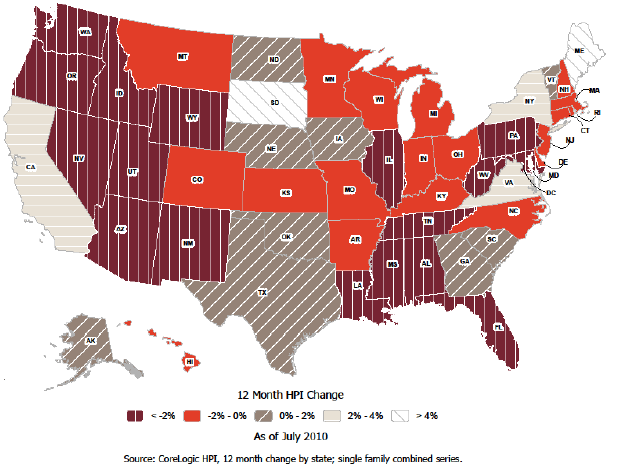
    The small upward correction in home prices from multiple tax credit offerings died in July. Worse yet, inventory of homes for sale as well as shadow inventory both soared. 8 million foreclosure-bound homes have yet to hit the market according to Morgan Stanley.

    Home Prices Drop in 36 States

    CoreLogic reports Growing Number of Declining Markets Underscore Weakness in the Housing Market without Tax-Credit Support

    CoreLogic Home Price Index Remained Flat in July

    SANTA ANA, Calif., September 15, 2010 – CoreLogic (NYSE: CLGX), a leading provider of information, analytics and business services, today released its Home Price Index (HPI) that showed that home prices in the U.S. remained flat in July as transaction volumes continue to decline. This was the first time in five months that no year-over-year gains were reported. According to the CoreLogic HPI, national home prices, including distressed sales showed no change in July 2010 compared to July 2009. June 2010 HPI showed a 2.4 percent* year-over-year gain compared to June 2009.

    “Although home prices were flat nationally, the majority of states experienced price declines and price declines are spreading across more geographies relative to a few months ago. Home prices fell in 36 states in July, nearly twice the number in May and the highest since last November when national home prices were declining,” said Mark Fleming, chief economist for CoreLogic.

    Methodology

    The CoreLogic HPI incorporates more than 30 years worth of repeat sales transactions, representing more than 55 million observations sourced from CoreLogic industry-leading property information and its securities and servicing databases. The CoreLogic HPI provides a multi-tier market evaluation based on price, time between sales, property type, loan type (conforming vs. nonconforming), and distressed sales. The CoreLogic HPI is a repeat-sales index that tracks increases and decreases in sales prices for the same homes over time, which provides a more accurate “constant-quality” view of pricing trends than basing analysis on all home sales. The CoreLogic HPI provides the most comprehensive set of monthly home price indices and median sales prices available covering 6,208 ZIP codes (58 percent of total U.S. population), 572 Core Based Statistical Areas (85 percent of total U.S. population) and 1,027 counties (82 percent of total U.S. population) located in all 50 states and the District of Columbia.


    See the above article for additional charts

    Beazer Homes Warns on Orders

    The Wall Street Journal reports Beazer Homes Warns of Order Miss

    Beazer Homes USA Inc. said Wednesday it might miss order expectations for its fiscal-fourth quarter, as it also cut estimates for the year’s land and development spending, reflecting the sector’s weakness following the expiration of home-buyer tax credits.

    Last month, Beazer reported that its fiscal third-quarter loss was little changed because of a prior-year gain, while it reported a 73% surge in closings as buyers raced to qualify for the tax credit. Orders fell 33%.

    Inventory Soars

    Bloomberg reports U.S. Home Prices Face Three-Year Drop as Supply Gains

    The slide in U.S. home prices may have another three years to go as sellers add as many as 12 million more properties to the market.

    Shadow inventory — the supply of homes in default or foreclosure that may be offered for sale — is preventing prices from bottoming after a 28 percent plunge from 2006, according to analysts from Moody’s Analytics Inc., Fannie Mae, Morgan Stanley and Barclays Plc. Those properties are in addition to houses that are vacant or that may soon be put on the market by owners.

    “Whether it’s the sidelined, shadow or current inventory, the issue is there’s more supply than demand,” said Oliver Chang, a U.S. housing strategist with Morgan Stanley in San Francisco. “Once you reach a bottom, it will take three or four years for prices to begin to rise 1 or 2 percent a year.”

    Sales of new and existing homes fell to the lowest levels on record in July as a federal tax credit for buyers expired and U.S.

    Rising supply threatens to undermine government efforts to boost the housing market as homebuyers wait for better deals. Further price declines are necessary for a sustainable rebound as a stimulus-driven recovery falters, said Joshua Shapiro, chief U.S. economist of Maria Fiorini Ramirez Inc., a New York economic forecasting firm

    There were 4 million homes listed with brokers for sale as of July. It would take a record 12.5 months for those properties to be sold at that month’s sales pace, according to the Chicago-based Realtors group [National Association of Realtors].

    “The best thing that could happen is for prices to get to a level that clears the market,” said Shapiro, who predicts prices may fall another 10 percent to 15 percent. “Right now, buyers know it hasn’t hit bottom, so they’re sitting on the sidelines.”

    About 2 million houses will be seized by lenders by the end of next year, according to Mark Zandi, chief economist of Moody’s Analytics in West Chester, Pennsylvania. He estimates prices will drop 5 percent by 2013.

    Douglas Duncan, chief economist for Washington-based Fannie Mae, said in a Bloomberg Radio interview last week that 7 million U.S. homes are vacant or in the foreclosure process. Morgan Stanley’s Chang said the number of bank-owned and foreclosure-bound homes that have yet to hit the market is closer to 8 million.

    Defaulted mortgages as of July took an average 469 days to reach foreclosure, up from 319 days in January 2009. That’s an indication lenders — with the help of the government loan modification programs — are delaying resolutions and preventing the market from flooding with distressed properties, said Herb Blecher, senior vice president for analytics at LPS.“The efforts to date have been worthwhile,” Blecher said in a telephone interview from Denver. “They both helped borrowers stay in their homes and kept that supply of distressed properties on the market somewhat limited.”

    I disagree with Herb Blecher. I see little advantage stretching this mess out for a decade, and that is what the government seems hell-bent on doing. Everyone wants the government to “do something”. Unfortunately tax credits stimulated the production of new homes, ultimately adding to inventory. Prices need to fall to levels where there is genuine demand.

    The short-term rise in the Case-Shiller home price index and the CoreLogic HPI was a mirage that will soon vanish in the reality of an inventory of 8 million homes that must eventually hit the market.

    Lost Decade

    About 2 million houses will be seized by lenders by the end of next year, according to Mark Zandi, chief economist of Moody’s Analytics in West Chester, Pennsylvania. He estimates prices will drop 5 percent by 2013.

    After reaching bottom, prices will gain at the historic annual pace of 3 percent, requiring more than 10 years to return to their peak, he said.

    Home Price Pressures

    Last Bubble Not Reblown

    After the bottom is found, remember the axiom: the last bubble is not reblown for decades. Look at the Nasdaq, still off more than 50% from a decade ago.

    The odds home prices return to their peak in 10 years is close to zero. Houses in bubble areas may never return to peak levels in existing owner’s lifetimes. Zandi is way overoptimistic in his assessment of 3% annual appreciation after the bottom is found.

    Price Stagnation 

    I expect small nominal increases after housing bottoms, but negative appreciation in real terms as inflation picks up in the second half of the decade. Yes, deflation will eventually end. Alternatively the US goes in and out of deflation for a decade (depending on how much the Fed and Congress acts to prevent a much needed bottom). Either way, look for price stagnation in one form or another.

    Thus, if you have come to the conclusion there is no good reason to hold on to a deeply underwater home, nor any reason to rush into a home purchase at this time, you have reached the right conclusions.

    Hyperinflation? Please be serious.

    When Will Housing Bottom?

    Flashback October 25, 2007: When Will Housing Bottom?

    On the basis of mortgage rate resets and a consumer led recession I mentioned a possible bottom in the 2011-2012 timeframe. See Housing – The Worst Is Yet To Come for more details.

    Let’s take a look at housing from another perspective: new home sales historic averages and housing from 1963 to present.

    New Home Sales 1963 – Present

    New home sales reached a cyclical high in 2004-2005 approximately 50-60% higher than previous peaks.This happened in spite of a slowdown in population growth and household formation as compared to the 1960-1980 timeframe.

    From 1997-1998 and 2001-2002 to the recent peak, the average sales level was 1.1 million units, or 45-50% higher than the 40 year average. This translates to an average of 300,000-400,000 excess homes for nearly a decade, and arguably as many as 3-4 million excess homes.

    Such excess inventory may require as many as 5-7 years at recessionary average sales to absorb this inventory.

    Cycle Excesses Greatest In History

    The excesses of the current cycle have never been greater in history. The odds are strong that we have seen secular as opposed to cyclical peaks in housing starts and new single family home construction. With that in mind it is highly unlikely we merely return to the trend. If history repeats, and there is every reason it will, we are going to undercut those long term trendlines.

    There will be additional pressures a few years down the road when empty nesters and retired boomers start looking to downsize. Who will be buying those McMansions? Immigration also comes into play. If immigration policies and protectionism get excessively restrictive, that can also lengthen the decline.

    Finally, note that the current boom has lasted well over twice as long as any other. If the bust lasts twice as long as any other, 2012 just might be a rather optimist target for a bottom.

    When I wrote that in 2007, most thought I was off my rocker. Now, based on inventory, I may have been far too optimistic.

    Mike “Mish” Shedlock
    http://globaleconomicanalysis.blogspot.com See the above article for additional charts

    Beazer Homes Warns on Orders

    The Wall Street Journal reports Beazer Homes Warns of Order Miss

    Beazer Homes USA Inc. said Wednesday it might miss order expectations for its fiscal-fourth quarter, as it also cut estimates for the year’s land and development spending, reflecting the sector’s weakness following the expiration of home-buyer tax credits.

    Last month, Beazer reported that its fiscal third-quarter loss was little changed because of a prior-year gain, while it reported a 73% surge in closings as buyers raced to qualify for the tax credit. Orders fell 33%.

    Inventory Soars

    Bloomberg reports U.S. Home Prices Face Three-Year Drop as Supply Gains

    The slide in U.S. home prices may have another three years to go as sellers add as many as 12 million more properties to the market.

    Shadow inventory — the supply of homes in default or foreclosure that may be offered for sale — is preventing prices from bottoming after a 28 percent plunge from 2006, according to analysts from Moody’s Analytics Inc., Fannie Mae, Morgan Stanley and Barclays Plc. Those properties are in addition to houses that are vacant or that may soon be put on the market by owners.

    “Whether it’s the sidelined, shadow or current inventory, the issue is there’s more supply than demand,” said Oliver Chang, a U.S. housing strategist with Morgan Stanley in San Francisco. “Once you reach a bottom, it will take three or four years for prices to begin to rise 1 or 2 percent a year.”

    Sales of new and existing homes fell to the lowest levels on record in July as a federal tax credit for buyers expired and U.S.

    Rising supply threatens to undermine government efforts to boost the housing market as homebuyers wait for better deals. Further price declines are necessary for a sustainable rebound as a stimulus-driven recovery falters, said Joshua Shapiro, chief U.S. economist of Maria Fiorini Ramirez Inc., a New York economic forecasting firm

    There were 4 million homes listed with brokers for sale as of July. It would take a record 12.5 months for those properties to be sold at that month’s sales pace, according to the Chicago-based Realtors group [National Association of Realtors].

    “The best thing that could happen is for prices to get to a level that clears the market,” said Shapiro, who predicts prices may fall another 10 percent to 15 percent. “Right now, buyers know it hasn’t hit bottom, so they’re sitting on the sidelines.”

    About 2 million houses will be seized by lenders by the end of next year, according to Mark Zandi, chief economist of Moody’s Analytics in West Chester, Pennsylvania. He estimates prices will drop 5 percent by 2013.

    Douglas Duncan, chief economist for Washington-based Fannie Mae, said in a Bloomberg Radio interview last week that 7 million U.S. homes are vacant or in the foreclosure process. Morgan Stanley’s Chang said the number of bank-owned and foreclosure-bound homes that have yet to hit the market is closer to 8 million.

    Defaulted mortgages as of July took an average 469 days to reach foreclosure, up from 319 days in January 2009. That’s an indication lenders — with the help of the government loan modification programs — are delaying resolutions and preventing the market from flooding with distressed properties, said Herb Blecher, senior vice president for analytics at LPS.

    “The efforts to date have been worthwhile,” Blecher said in a telephone interview from Denver. “They both helped borrowers stay in their homes and kept that supply of distressed properties on the market somewhat limited.”

    I disagree with Herb Blecher. I see little advantage stretching this mess out for a decade, and that is what the government seems hell-bent on doing. Everyone wants the government to “do something”. Unfortunately tax credits stimulated the production of new homes, ultimately adding to inventory. Prices need to fall to levels where there is genuine demand.

    The short-term rise in the Case-Shiller home price index and the CoreLogic HPI was a mirage that will soon vanish in the reality of an inventory of 8 million homes that must eventually hit the market.

    Lost Decade

    About 2 million houses will be seized by lenders by the end of next year, according to Mark Zandi, chief economist of Moody’s Analytics in West Chester, Pennsylvania. He estimates prices will drop 5 percent by 2013.

    After reaching bottom, prices will gain at the historic annual pace of 3 percent, requiring more than 10 years to return to their peak, he said.

     Home Price Pressures

    Last Bubble Not Reblown

    After the bottom is found, remember the axiom: the last bubble is not reblown for decades. Look at the Nasdaq, still off more than 50% from a decade ago.

    The odds home prices return to their peak in 10 years is close to zero. Houses in bubble areas may never return to peak levels in existing owner’s lifetimes. Zandi is way overoptimistic in his assessment of 3% annual appreciation after the bottom is found.

    Price Stagnation 

    I expect small nominal increases after housing bottoms, but negative appreciation in real terms as inflation picks up in the second half of the decade. Yes, deflation will eventually end. Alternatively the US goes in and out of deflation for a decade (depending on how much the Fed and Congress acts to prevent a much needed bottom). Either way, look for price stagnation in one form or another.

    Thus, if you have come to the conclusion there is no good reason to hold on to a deeply underwater home, nor any reason to rush into a home purchase at this time, you have reached the right conclusions.

    Hyperinflation? Please be serious.

    When Will Housing Bottom?

    Flashback October 25, 2007: When Will Housing Bottom?

    On the basis of mortgage rate resets and a consumer led recession I mentioned a possible bottom in the 2011-2012 timeframe. See Housing – The Worst Is Yet To Come for more details.

    Let’s take a look at housing from another perspective: new home sales historic averages and housing from 1963 to present.

    New Home Sales 1963 – Present

    New home sales reached a cyclical high in 2004-2005 approximately 50-60% higher than previous peaks.This happened in spite of a slowdown in population growth and household formation as compared to the 1960-1980 timeframe.

    From 1997-1998 and 2001-2002 to the recent peak, the average sales level was 1.1 million units, or 45-50% higher than the 40 year average. This translates to an average of 300,000-400,000 excess homes for nearly a decade, and arguably as many as 3-4 million excess homes.

    Such excess inventory may require as many as 5-7 years at recessionary average sales to absorb this inventory.

    Cycle Excesses Greatest In History

    The excesses of the current cycle have never been greater in history. The odds are strong that we have seen secular as opposed to cyclical peaks in housing starts and new single family home construction. With that in mind it is highly unlikely we merely return to the trend. If history repeats, and there is every reason it will, we are going to undercut those long term trendlines.

    There will be additional pressures a few years down the road when empty nesters and retired boomers start looking to downsize. Who will be buying those McMansions? Immigration also comes into play. If immigration policies and protectionism get excessively restrictive, that can also lengthen the decline.

    Finally, note that the current boom has lasted well over twice as long as any other. If the bust lasts twice as long as any other, 2012 just might be a rather optimist target for a bottom.

    When I wrote that in 2007, most thought I was off my rocker. Now, based on inventory, I may have been far too optimistic.

    Mike “Mish” Shedlock
    http://globaleconomicanalysis.blogspot.com

  • Multnomahforeclosures.com: Bank Owned Property List Update for August 2010


    August REO list for bank owned property has been added to Multnomahforeclosures.com . REO lists for Clackamas, Multnomah and Washington County has been addd to the site. The homes listed in these files were deeded back or returned to the investor or lender due to the finalizing of the foreclosure process. Many of these homes may already be on the market or will soon will be. It would not be a bad idea to contact the new owner of these properties and find out what their plans are when it comes to their future ownership of the property.

    Multnomah County Foreclosures
    http://multnomahforeclosures.com

  • Multnomahforeclosures.com: Updated Notice Of Default Lists and Books


    Multnomahforeclosures.com was updated with the largest list of Notice Defaults to date. With Notice of Default records dating back over 2 years. Multnomahforeclosures.com documents the fall of the great real estate bust of the 21st centry. The lists are of the raw data taken from county records.

    It is not a bad idea for investors and people that are seeking a home of their own to keep an eye on the Notice of Default lists. Many of the homes listed are on the market or will be.

    All listings are in PDF and Excel Spread Sheet format.

    Multnomah County Foreclosures

    http://multnomahforeclosures.com

  • Related News:Finance Real Estate U.S. Canada Homebuilders Revive Stalled U.S. Projects as Banks Unload Lots, By Prashant Gopal and John Gittelsohn, bloomberg.com


    Construction crews are returning to the Cascades of Groveland, a gated 55-and-older community west of Orlando, Florida, almost three years after its bankrupt developer left owners of the existing 238 houses surrounded by empty lots, partially built homes, and an unfinished clubhouse.

    Shea Homes, a builder based in Walnut, California, bought the remaining 761 lots from Bank of America Corp. in June and reopened the project Aug. 25 with a new sales office, lower prices and a changed name: “Trilogy.” Residents, who had taken over the guardhouse for mahjong, bingo and poker games, will get a 38,000-square-foot (3,530-square-meter) recreational center with indoor and outdoor pools, tennis courts and a card room.

    “For the people here, the activity of construction equipment is music to their ears,” said Eric Sorkin, 61, president of the homeowners association at the development, 35 miles northwest of Walt Disney World. “There’s a future.”

    Builders are buying lots at less than half their original prices from lenders eager to move distressed construction loans off their books. Developments are being resuscitated from Florida, California, and Las Vegas to Utah and the suburbs of Washington, D.C., according to Brad Hunter, chief economist for Metrostudy, a Houston-based housing researcher.

    “This is a natural progression of the cycle,” Hunter said. “Projects fail, the price of the asset drops until it reaches a point where it’s profitable for someone else to pick it up and remarket it. They reposition the project and then what was formerly infeasible, is feasible.”

    Mothballed Projects

    Builders, facing record low demand, are trying to boost margins and revenue by pulling unfinished projects out of mothballs. They’re benefiting from cheap land and falling construction costs as they seek to adapt floor plans to today’s market and lure buyers with prices that, in some neighborhoods, are little more than the cost of a foreclosed home. The 12 largest homebuilders by market value added 16,631 lots in their past two quarters, according to data compiled by Bloomberg.

    The revived projects could contribute to a delay in the U.S. housing recovery by adding to the supply of available homes, according to Hunter. At the same time, builders are being cautious about flooding the market by limiting the numbers of houses they are constructing without having buyers lined up, he said. Many homebuyers also aren’t interested in foreclosures, which may be damaged or in inferior locations, Hunter said.

    The next few months will show whether the revived projects will inflate supply, because many builders purchased lots around the same time, and will likely market them at about the same time, said Jill Lewis, homebuilder specialist for the Land Advisors Organization, a Scottsdale, Arizona-based land broker.

    Phoenix Communities

    In the Phoenix metro area, 48 communities have reopened with about 40 more coming in the next year, according to Land Advisors. About 6 percent of finished lots for production are owned by banks, down from 20 percent a year ago, the company said. On average, new homes in Phoenix are going for half of what they sold for four years ago, Land Advisors said.

    Picking up where another builder left off can be complicated by the passing of years. Without attention, weeds grow, swimming pools go green, government permits expire, and homeowners associations turn insolvent, said Taylor B. Grant, founding principal of California Real Estate Receiverships LLC in Newport Beach, California. Grant, who works as a court- appointed receiver for properties that have gone into default, is often asked by banks to prepare developments for sale.

    It can take nine to 12 months to ready a site and construct model homes, said Tom Dallape, principal at the Hoffman Company, a land brokerage advisory firm in Irvine, California.

    Knocking Down Homes

    Shea, which had some models in place, did it in a couple months. Soon after taking over the Cascades of Groveland, the closely held company began knocking down 16 partially built homes that “were sitting out there too long, and were not protected from the conditions,” said Jeff McQueen, executive vice president for Shea Homes Active Lifestyle Communities.

    Developers also are adapting projects to include smaller, more efficient designs that cost less to build, Dallape said.

    “They’re tailoring them to the market,” he said. “The average new house used to be 3,000 square feet. Today, it’s 2,100.”

    Publicly traded homebuilders such as D.R. Horton Inc., Lennar Corp., Meritage Homes Corp., KB Home, Standard Pacific Corp. and Toll Brothers Inc. started buying about a year ago as the market seemed to be strengthening, according to Tom Reimers, president of the California division of Land Advisors Organization. They deployed cash, which they amassed during the recession by selling land and taking advantage of a change in the tax code that provided them higher refunds, said Megan McGrath, homebuilding analyst with Barclays Plc in New York.

    Weaker Market

    The housing market weakened with the expiration of a homebuyer tax incentive in April, and builder land purchases could slow as a result, McGrath said.

    Sales so far in the restarted projects are relatively strong, Metrostudy’s Hunter said.

    Meritage, which builds in Texas, Nevada, Arizona, California, Colorado and Florida, has had a monthly pace of three sales per community in new projects compared with two for older developments, said Brent Anderson, vice president of investor relations. The Scottsdale, Arizona-based company bought 100 projects with 5,400 finished lots since the first quarter of last year and has reopened about half of them, he said.

    “If these lots weren’t available, it would be damn tough for builders to make a profit,” Anderson said.

    Plunging Sales

    New home sales slid 12 percent in July to a record-low annual pace, and existing-home sales tumbled 27 percent to the lowest level in a decade of recordkeeping, according to separate reports last month from the Commerce Department and the National Association of Realtors. Single-family housing starts fell 4.2 percent from June. Foreclosure filings increased almost 4 percent in July from the previous month, RealtyTrac Inc., an Irvine, California-based research company, said Aug. 12.

    In Phoenix, where more than half the homes sold are foreclosures, demand is weak. The number of newly built houses and condos sold in July in the metro area fell to 641, down 50 percent from June and 38 percent from a year earlier, San Diego- based MDA DataQuick reported Aug. 26.

    “All of us are going to sit back and evaluate the depth of the consumer market, and whether they are going to be chasing after the same buyer,” said Lewis of Land Advisors.

    Sales offices are only just starting to reopen. Newly acquired developments make up 20 percent or less of public builders’ closings, and may reach about 50 percent for some companies by the middle of next year, McGrath said.

    Less Than Foreclosures

    Candlelight Homes, a South Jordan, Utah, homebuilder that bought lots in 20 stalled projects, recently introduced a new slogan: “Quality new homes, less than foreclosures.”

    The company, which said most of its houses are cheaper than comparable foreclosed homes, has an average profit margin of 12 percent on the transactions, said Joe Salisbury, a partner at Candlelight. He purchases lots with power, sewer, and water lines and government approvals in place for 30 percent to 50 percent of what they sold for three years ago, he said.

    “We’re buying lots for less than the cost of the improvements,” Salisbury said. “If someone offered me raw land for free next door, I wouldn’t even want it because it would cost me more to build out the lots.”

    Builder Flexibility

    Development-ready lots give builders the flexibility to construct homes as customers sign contracts, and then ramp up quickly when the economy improves, said Robert Curran, a managing director for Fitch Ratings. Rather than paying for parcels upfront, builders often are acquiring the option to buy a minimum number of lots over a period of time, which gives them the freedom to walk away and simply lose their deposit.

    “The fact that you can take a lot in and quickly build on it means you’re not tying up capital for an extended period of time and get better returns,” New York-based Curran said.

    Private-equity firms are partnering with builders, big and small, to buy projects around the country and put them back on the market. Shea, for example, entered into a $15 million joint venture with Mountain Real Estate Group LLC to revive the Cascades project, the Charlotte, North Carolina-based property investment firm said in a statement. Levitt & Sons LLC, which pioneered the planned suburban community of Levittown, New York, abandoned the Cascades project after it filed for bankruptcy protection in November 2007.

    Toll Brothers

    Many public builders can finance projects on their own. Toll Brothers, the largest U.S. luxury-home builder, spent about $340 million on new land in the first nine months of its fiscal 2010, adding 4,100 lots, its first rise since 2006. The Horsham, Pennsylvania-based company has $1.64 billion in cash for more deals, Chief Executive Officer Douglas Yearley Jr. said.

    “This is an opportunity to be investing that capital back in the market,” Yearley said in an Aug. 11 interview. “We have opportunities now that we haven’t had for some time.”

    Toll Brothers paid $23 million in February to SunTrust Banks Inc. for Hasentree, a foreclosed golf course community in Wake Forest, North Carolina, that was once appraised for $78 million, said Tom Anhut, the builder’s group president in the state. Hasentree was built around an 18-hole course designed by Tom Fazio. It featured a completed community activity center, roads, about 400 acres of dedicated green space, 100 developed home sites, 218 raw sites, 18 new homes seeking buyers and 40 occupied houses at the time of the sale.

    Lower Prices

    Buyers have put deposits on four new Toll Brothers homes, with listing prices starting at $669,995 since Hasentree’s sales office reopened in July, Anhut said. The community’s original homes sold for an average $1.5 million.

    “This is really a special golf course and piece of property,” Anhut said. “But there’s a reason that we paid about one-third of the previous appraisal. Obviously, the market is different now.”

    Builders are competing for land with investment companies, some of which are buying expansive projects and selling chunks to homebuilders.

    Starwood Land Ventures of Bradenton, Florida, paid $81 million in February for 5,499 home sites in the state, most of which were finished, from bankrupt builder Tousa Inc. Miami- based Lennar has an option contract to buy about 1,500 of them across the state, said Mike Moser, east region president for Starwood Land Ventures, which is funded by Barry Sternlicht’s Starwood Capital Group LLC.

    Independence

    Among the newly opened Tousa projects is Independence, a master planned community in Orange County, Florida, with 500 finished lots, and room for 450 more, Moser said. Builders selling lots in the development include Lennar, Meritage, Ryland Group Inc. and closely held Ashton Woods Homes, he said.

    “This product is in a very good location,” Moser said. “There is still demand for housing, and builders are eager to build homes.”

    Residents of Trilogy, who have become close in the years since construction halted, are looking forward to having new neighbors, said Sorkin, the homeowners association president. The clubhouse, which Shea plans to complete in phases over the next two years, will be central Florida’s best, he said.

    “It will attract many buyers,” he said. “And of course, it will be a wonderful retreat for people who live here.”

    To contact the reporter on this story: Prashant Gopal in New York at Pgopal2@bloomberg.net; John Gittelsohn in New York at johngitt@bloomberg.net.

  • Is Debt Really The Problem… or is it something else?, By Bill Westrom, Truthinequity.com


    Mainstream media, the Government and consumers themselves vilify debt as the root of the consumer’s financial plight and the root of a weakening country. Debt is not the problem; it’s the management of debt and the way debt is structured that is creating the problem not the debt itself. Unless you win the lottery, invent a cure for cancer or get adopted by Bill Gates or Warren Buffett, debt will be something you will have to face somewhere along the course of your adult life; it’s a natural component of our society.

    In today’s economic environment hard working American’s are experiencing a level of fear and financial uncertainty they have never been faced with. This is keeping them up at night wondering how they are going to sustain a life they have worked so hard to build. Americans are also wondering why those we have trusted for all these years; the banks, money managers and politicians, are thriving financially, but don’t seem to be contributing anything of real value to the public? Today, the predominant questions being asked by the American public as it relates to their financial future are; what am I going to do, what can I do, how am I going to do it? We all work way too hard to be faced with these questions. The answers to these frightening questions are right in front of us. The answers lie in the use of the financial resources we use every day. You just need to know how to use them to your advantage.

    The crux of the problem for consumers and the country alike lie with misaligned, improper or a shear lack of education on the use of the banking tools we use every day. The three banking tools that we use every day; checking accounts, credit cards and loans are simply being used improperly. The solution lies in educating consumers and institutions to use these tools in the proper sequence and function to manage debt properly, regain control of income and possess the authority to control the repayment of debt. It’s as simple as that. By exposing the failed business model of conventional banking and borrowing practices, realigning them into a model that actually helps consumers get more out of what they own and what they earn, we can once again grow individually, as a society and a nation.

    The Truth Is In The Proof.
    TruthInEquity.com

  • New Program for Buyers, With No Money Down, John Leland, Nytimes.com


    MILWAUKEE — When the housing bubble burst, one of the culprits, economists agreed, was exotic mortgages, including those that required little or no money down.

    But on a recent evening, Matthew and Hannah Middlebrooke stood in their new $115,000 three-bedroom ranch house here, which Mr. Middlebrooke bought in June with just $1,000 down.

    Because he also received a grant to cover closing costs and insurance, the check he wrote at the closing was for 67 cents.

    “I thought I’d be stuck renting for years,” said Mr. Middlebrooke, 26, who earns $32,000 a year as a producer for a Christian television ministry.

    Although home foreclosures are again expected to top two million this year, Fannie Mae, the lending giant that required a government takeover, is creeping back into the market for mortgages with no down payment.

    Mr. Middlebrooke’s mortgage came from a new program called Affordable Advantage, available to first-time home buyers in four states and created in conjunction with the states’ housing finance agencies. The program is expected to stay small, said Janis Smith, a spokeswoman for Fannie Mae.

    Some experts are concerned about the revival of such mortgages.

    “Loans that have zero down payment perform worse than loans with down payments,” said Mathew Scire, a director of the Government Accountability Office’s financial markets and community investment team. “And loans with down payment assistance” — like Mr. Middlebrooke’s — “perform worse than those that do not.”

    But the surprise is the support these loans have received, even from critics of exotic mortgages, who say low down payments themselves were not the problem, except when combined with other risk factors like adjustable rates or lax underwriting.

    Moreover, they say, the housing market needs such nontraditional lending, as long as it is done prudently.

    “This is subprime lending done right,” said John Taylor, president of the National Community Reinvestment Coalition, an umbrella group for 600 community organizations, and a staunch critic of the lending industry. “If they had done subprime this way in the first place, we wouldn’t have these problems.”

    At Harvard’s Joint Center for Housing Studies, Eric Belsky, the director, said the loans might be the type of step necessary to restart the housing market, because down payment requirements are keeping first-time home buyers out.

    “If you look at where the market may get strength from, it may very well be from first-time buyers,” he said. “And a very significant constraint to first-time buyers is the wealth constraint.”

    The loans are the idea of state housing finance agencies, or H.F.A.’s, quasi-government entities created to help moderate-income people buy their first homes.

    Throughout the foreclosure crisis, the state agencies continued to make loans with low down payments, often to borrowers with tarnished credit, with much lower default rates than comparable mortgages from commercial lenders or the Federal Housing Administration. The reason: the agencies did not offer adjustable rates, and they continued to document buyers’ income and assets, which many commercial lenders did not do. In 2009, the agencies’ sources of revenue dried up, and they had to curtail most lending.

    Then they created Affordable Advantage. The loans are 30-year fixed mortgages, with mandatory homeownership counseling, available to people with credit scores of 680 and above (720 in Massachusetts). The buyers have to put in $1,000 and must live in the homes.

    All of these requirements ease the risk, said William Fitzpatrick, vice president and senior credit officer of Moody’s Investors Service. “These aren’t the loans that led us into the mortgage crisis,” he said.

    So far Idaho, Massachusetts, Minnesota and Wisconsin are offering the loans. The Wisconsin Housing and Economic Development Authority has issued 500 loans since March, making it the first state to act. After six months, there are no delinquencies so far, said Kate Venne, a spokeswoman for the agency.

    The agencies buy the loans from lenders, then sell them as securities to Fannie Mae. Because the government now owns 80 percent of Fannie Mae, taxpayers are on the hook if the loans go bad.

    The state agencies oversee the servicing of the loans and work with buyers if they fall behind — a mitigating factor, said Mr. Fitzpatrick of Moody’s.

    “They have a mission to put people in homes and keep them in homes,” not to foreclose unless other options are exhausted, he said. The loans have interest rates about one-half of a percentage point above comparable loans that require down payments.

    Ms. Smith, the spokeswoman for Fannie Mae, distinguished the program from loans of the boom years that “layered risk on top of risk.”

    With the new loans, she said, “income is fully documented, monthly payments are fixed, credit score requirements are generally higher, and borrowers must be thoroughly counseled on the home-buying process and managing their mortgage debt.”

    For Porfiria Gonzalez and her son, Eric, the loan allowed them to move out of a rental house in a neighborhood with a high crime rate to a quiet street where her neighbors are retirees and police officers.

    Ms. Gonzalez, 30, processes claims in the foreclosure unit at Wells Fargo Home Mortgage; she has seen the many ways a mortgage holder can fail.

    On a recent afternoon in her three-bedroom ranch house here, Ms. Gonzalez said she did not see herself as repeating the risks of the homeowners whose claims she processed.

    “I learned to stay away from ARM loans,” or adjustable rate mortgages, she said. “That’s the No. 1 thing. And always have some emergency money.”

    When she first started shopping, she looked at houses priced around $140,000. But the homeownership counselor said she should keep the purchase price closer to $100,000.

    “They explained to me that I don’t need a $1,200-a-month payment,” she said.

    The counselor worked with her real estate agent and attended her closing. On May 28, Ms. Gonzalez bought her home for $90,500, with monthly payments of $834. After moving expenses, she has kept her savings close to $5,000 to shield her from emergencies.

    “If I had to make a down payment, it would have wiped out my savings,” she said. “I would have started with nothing.”

    Now, she said, she is in a home she can afford in a neighborhood where her son can play in the yard. A neighbor brought her a metal pink flamingo with a welcome sign to place by her side door.

    “My favorite part is the big backyard,” said Eric, 10. “And that’s pretty much it.”

    “You don’t like it that it’s a quiet, safe neighborhood?” his mother asked.

    “Yeah, I do.”

    “He didn’t go out much with kids in the old neighborhood,” she said.

    “Because they were bad kids,” he said.

    Ms. Gonzalez said that owning a house was much more work than renting, and that when the basement flooded during a heavy rain, her heart sank.

    “But I look at it as an investment,” she said, adding that a similar house in the neighborhood was on the market for $120,000.

    Prentiss Cox, a professor at the University of Minnesota Law School who has been deeply critical of the mortgage industry, said the program met an important need and highlighted the track record of state housing agencies, which never engaged in exotic loans.

    “It’s not a story people want to hear, because it won’t bring back the big profits,” Mr. Cox said. “The H.F.A.’s have shown how the problems of the last 10 years were about having sound and prudent regulation of lending, not just whether the loans were prime or subprime.”

    He added, “One of the great and unsung tragedies of the whole crisis was the end of the subprime market.”

  • FHA puts floor on borrower credit eligibility, by CHRISTINE RICCIARDI, Housingwire.com


    Borrowers with credit scores less than 500 are not eligible for Federal Housing Administration-insured mortgage financing, according to the new credit score and loan-to-value (LTV) requirements released today by the U.S. Department of Housing and Urban Development.

    This is the first time the FHA has had a minimum score to determine borrower eligibility.

    Borrowers with a credit score between 500 and 579 can receive up to 90% LTV  from FHA for a single-family mortgage while any borrower with a score 580 or above is eligible for maximum funding. Non-traditional and insufficient credit is accepted provided that borrowers meet the underwriting guidelines.

    100% financing is available to borrowers using Mortgage Insurance for Disaster Victims with no downpayment, as long as their credit score is above 500.

    The FHA said it is providing a special, temporary allowance to permit higher LTV mortgage loans for borrowers with lower decision credit scores, so long as they involve a reduction of existing mortgage indebtedness pursuant to FHA program adjustments.

    The credit standards will take effect on Oct. 4.

  • Federal Housing Stimulus: How Much More?, Diana Olick, CNBC


    New reports are rolling around Wall Street and Washington today that the Obama Administration is considering yet another economic stimulus package; this round would be for small businesses. This comes just one week after increased chatter about more government stimulus for housing.

    Congress returns the week of September 13th, and as Democrats face an uncertain election this November, you know they’re going to be looking to make average Americans feel more secure about their finances.

    But how much has housing stimulus really helped?

    Through July 3, 2010, the IRS reports a bill of $23.5 for the home buyer tax credit, according to a letter dated yesterday (September 2nd) from the Government Accountability Office to Rep. John Lewis, Chairman of the House Ways and Means Committee’s Subcommittee on Oversight. $16.2 billion for the first time and move-up credits and $7.3 billion for interest-free loans which recipients will begin repaying in January.

    The Department of Housing and Urban Development has also already allocated nearly $6 billion for the Neighborhood Stabilization Program, which gives state and local governments and non-profit housing developers funds to acquire property, demolish or rehabilitate foreclosures and offer assistance to low- to middle-income homebuyers for down payments and closing costs. In the coming weeks it will add $1 billion to that. Just this week HUD Secretary Donovan gave NSP grantees a leg up over investors, by providing a first right of refusal for those grantees to buy foreclosed homes.

    The talk around Washington is for yet another home buyer tax credit, this time perhaps for short sale and foreclosure buyers. Unfortunately every time we get a short-term stimulus, we get an inevitable drop off in sales and prices, as we’re experiencing now. Yes, we saw a mini burst of buying from credits last fall and this spring, but the overall numbers are still way down, and inventories are still far too high.

    The one steady in gauging housing is confidence, and until we get that back, sales will remain weak for the foreseeable future.

    Government stimulus, arguably, sells houses, and we need that to bring down our currently record-high inventories.

    But Government stimulus is also temporary, and everyday buyers and sellers recognize that, which doesn’t add to their already faltering confidence.

    Questions?  Comments?  RealtyCheck@cnbc.com

  • Refinance Demand Up as Mortgage Interest Rates Maintain Low Levels, by Rosemary Rugnetta, Freerateupdate.com


    September 2, 2010 (FreeRateUpdate.com) – As mortgage interest rates continue to maintain low levels, refinance demand continues to increase across the nation. According to the Mortgage Banker’s Association, refinances have reached a 15 month high, the highest point since May of 2009. Rates are at the lowest point than any other time since Freddie Mac began keeping track in 1971. Mortgage applications rose for the fourth straight week with refinances accounting for the bulk of the demand. This is due to mortgage interest rates that continue to remain low with the 30 year fixed rate at 4.125% and the 15 years fixed rate at 3.625%.

    The current refinance demand is not surprising considering the record low mortgage rates that have continued for the past several weeks. After a slow start, these low mortgage rates are finally spurring home owner interest. Unfortunately, not all home owners can refinance with these historic rates. Those who are underwater due to the depressed housing market and those whose credit has been compromised will not be able to take advantage of the market’s record low interest rates. On the other hand, for others, especially those who have refinanced within the past two years, it is a great time to do it again. In addition, those home owners who currently have adjustable rate mortgages that are about to reset, could benefit from refinancing at this time into a fixed rate mortgage.

    The demand for refinances, which has continued to increase each week, could also be a positive sign for the weak economy. The current low mortgage interest rates have made it possible for home owners to refinance into a better interest rate loan or a shorter length loan. Many with higher interest 30 year loans are finding that, at today’s rates, it is in their best interest to refinance into a 15 year mortgage which is, in many circumstances, cheaper. By putting extra cash in consumers hands, they are able to pay off outstanding debts, money can be saved or just put back into the economy through spending. Although it is not certain if this refinance boom will do anything to stimulate the economy, this just might be the boost that the sluggish economy is in need of.

    It is anyone’s guess at which way mortgage rates will go from here. If mortgage interest rates maintain these low levels or drop even lower, refinance demand should go up with more home owners deciding to refinance during the fall months just in time for the Holiday season. In the meantime, home owners probably should not wait for rates to go much lower since anything can happen with such a volatile market.

    http://www.freerateupdate.com/refinance-demand-up-as-mortgage-interest-rates-maintain-low-levels-6155