Tag: Fannie Mae

  • Mortgage Refinance: Proposed Home Refinance Bill Could Allow Almost Everyone to Refinance, by Rosemary Rugnetta, Freerateupdate.com


    (FreeRateUpdate.com) – Although the current low mortgage interest rates have helped numerous homeowners torefinance into better terms, many have not be able to take advantage of these deals. Tighter lending guidelines have left many homeowners with no where to turn for help. In an effort to help save homeownership for many Americans, Representative Dennis Cardoza of California has proposed a home refinance bill that could allow almost everyone to refinance.

    H.R. 6218 is called The Housing Opportunity and Mortgage Equity Act of 2010 (HOME). It is designed to offer refinances directly to homeowners who need help. As other foreclosure prevention programs have failed to prevent further defaults, this bill can possibly reduce foreclosures drastically and reward those who have continued to make their monthly mortgage payments even through economic struggles. With reduced mortgage payments, consumers will have more available cash to spend each month thus stimulating a dragging economy. In addition, this type of refinance can help eliminate strategic defaults and loan modifications.

    Following are some of the details of the bill:

    -A qualified mortgage is one that is current or in default as long as it is the borrower’s primary residence and is owned or guaranteed by Fannie Mae or Freddie Mac, This residence can be a single family dwelling, one to four family dwelling, condominium or a share in a cooperative ownership housing association.

    -Any penalties for prepayment or refinancing and penalties due to default or delinquency would be waived or forgiven.

    -The term of the new refinance could be no longer than 40 years.

    -The servicer cannot charge the borrower any fees for refinancing.

    -Fees for title insurance coverage will be reasonable in comparison with fees for the same coverage available. Any fees associated with the refinance would be rolled into the mortgage.

    -The enterprise (Fannie Mae and Freddie Mac) will pay the servicer a fee not to exceed $1,000 for each qualified mortgage that is refinanced.

    -There will be no appraisal required.

    -In order to pay for this, the old mortgages will be paid off when refinanced. The new refinances will be funded by selling new mortgage securities.

    Although lenders believe that they will lose too much money if this bill is adopted, it can probably be the best solution given to date to halt the endless foreclosure issue. It will be interesting to see how this bill develops, what will be added and what will be taken away or even if it will pass. According to Congressman Cardoza’s website, there are about 30 million mortgages guaranteed by Fannie Mae and Freddie Mac. The savings from this program could be tremendous and have been estimated by Morgan Stanley and JP Morgan Chase to be an annual reduction of approximately $50 billion in mortgage payments. While the success of the available current programs is still questionable, this proposed bill which allows almost everyone to refinance could be the answer to accelerating the economy.

  • Chase Halts Foreclosures In Process, by Thetruthaboutmortgage.com


    JP Morgan Chase has halted foreclosures until a review of its document-filing process is completed, according to the WSJ.

    The New York City-based bank said the move affects roughly 56,000 home loans in some stage of the foreclosure process.

    Chase spokesman Tom Kelly announced that there were cases where employees may have signed affidavits about loan documents on the basis of file reviews done by other personnel.

    As a result, the bank and mortgage lender must now re-examine documents tied to loans already in foreclosure to verify if they “meet the standard of personal knowledge or review” where required.

    Back in May, law firm Ice Legal LP dropped Chase document-signer Beth Ann Cottrell after it became known that she signed off on roughly 18,000 foreclosure affidavits and other documents each month without actually reviewing the files.

    And last week, GMAC Mortgage told brokers and agents to immediately stop evictions, cash-for-keys transactions, and lockouts in 23 states after the company warned it could need to take corrective action in connection with some foreclosures.

    Sign of the times…a year ago it was all about foreclosure moratoriums to help borrowers in need, and now it’s all about lenders making sure they don’t get into hot water over their suspect loss mitigation activities.

  • Housing Finance Needs U.S. Backstop, Executives Tell Lawmakers, by Lorraine Woellert, Bloomberg.com


    Congress must preserve some form of U.S. guarantee on mortgages to attract private capital to the housing-finance system and stabilize a market recovering from the credit crisis, industry executives told lawmakers.

    Private capital must play a bigger role in housing finance as policy makers replace the current system, which is dependent on guarantees from government-backed Fannie Mae andFreddie Mac, the executives said today in testimony prepared for a House Financial Services Committee hearing. U.S. support will still be needed to keep loans flowing to borrowers and preserve products such as 30-year, fixed-rate mortgages, they said.

    Without a government backstop, there wouldn’t be enough private capital to support the $8 trillion in home loans that are funded by investors, said Michael Farrell, chief executive officer ofAnnaly Capital Management Inc., a New York real estate investment trust that owns or manages $90 billion of mortgage-backed securities.

    The House panel called Farrell and other housing-industry executives to testify as they seek ways to overhaul a finance system that collapsed in 2008 amid losses on securities linked to subprime mortgages. Some economists and lawmakers have urged that any new system rely solely on private capital and be priced to reflect the risks.

    “Recommendations to completely privatize miss the necessity of a government backstop to ensure consistent functioning of mortgage-backed securities markets under all economic conditions,” said Michael Heid, co-president of home mortgages for Wells Fargo & Co.

    Fannie, Freddie

    Fannie Mae and Freddie Mac, which own or guarantee more than half of the $11 trillion U.S. mortgage market, relied on an implied government guarantee to pool and sell mortgage-backed securities, which generated cash that could be channeled back into additional loans. The federal government seized the two companies amid soaring losses in September 2008 and promised to stand by the debt.

    Since then, Washington-based Fannie Mae and Freddie Mac, based in McLean, Virginia, have survived on a promise of unlimited aid from the U.S. Treasury Department. The companies lost $166 billion on their guarantees of single-family mortgages from the end of 2007 and the second quarter of this year and have drawn almost $150 billion so far. Treasury Secretary Timothy F. Geithner has promised to deliver a plan for overhauling the housing-finance system in January.

    One challenge for policy makers is how to keep money flowing into the system without the kind of open-ended commitment that left taxpayers responsible for catastrophic losses at the government-sponsored enterprises.

    “The GSEs clearly did not operate with enough capital to buffer the risks they assumed,” Christopher Papagianis, managing director of non-profit research group Economics21, told lawmakers. “Policy makers should recognize that bailouts in the housing sector are inevitable if the key institutions in the space do not hold sufficient capital,” said Papagianis, an adviser to former President George W. Bush.

    To contact the reporter on this story: Lorraine Woellert in Washington atlwoellert@bloomberg.net;

    To contact the editor responsible for this story: Lawrence Roberts at lroberts13@bloomberg.net.

  • Loan Modifications Are Getting Better, thetruthaboutmortgage.com


    It appears as if more recently completed loan modifications are performing better than their predecessors, according to the latest Mortgage Metrics Report from the OCC.

    More than 90 percent of loan modifications implemented during the second quarter of 2010 reduced borrowers’ monthly principal and interest payments, while 56 percent reduced payments by more than 20 percent.

    And that focus on sustainable and affordable monthly mortgage payments resulted in lower post-modification delinquency rates (much lower than that 75 percent re-default rate we we’re worried about).

    Six months after modification, roughly 32 percent of the modifications made in 2009 were seriously delinquent or in somewhere in the foreclosure process, compared with more than 45 percent of loan mods made in 2008.

    And the performance of modifications made this year suggests the trend is continuing.

    At three months after modification, just 11 percent of the 2010 modifications were seriously delinquent, compared with 20 percent of modifications made last year and 32 percent of 2008 modifications.

    HAMP Modifications Outperforming Other Loan Mods

    Nearly all modifications made under the Making Home Affordable program (HAMP) reduced borrower principal and interest payments, and 78.9 percent reduced monthly payments by 20 percent or more

    HAMP modifications made during the quarter reduced monthly mortgage payments by an average of $608, while other loan mods reduced payments by just $307 on average.

    As a result, HAMP modifications implemented through the first quarter of 2010 had fewer re-default rates than other modifications implemented during the same period.

    At six months after modification, 10.8 percent of HAMP modifications made in the fourth quarter of 2009 were 60 or more days delinquent, compared with 22.4 percent of other modifications made during that quarter.

    Similarly, 10.5 percent of HAMP modifications made in the first quarter of 2010 were 60 or more days delinquent three months after modification, compared with 11.6 percent of other modifications.

    So perhaps HAMP ain’t so bad after all…and maybe loan modifications actually do work.

  • Fannie mae to provide mortgage payment forbearance for certain military homeowners, Thetruthaboutmortgage.com


    Government mortgage financier Fannie Mae announced today new measures to help those serving in the military avoid foreclosure.

    The company said it will provide mortgage payment forbearance for up to six months where the death or injury of a service member on active duty leads to a hardship for military families with a mortgage obligation.

    Fannie has also created a hotline, 877-MIL-4566, available to all service members looking to receive guidance about their mortgage options and subsequent assistance.

    “The men and women of our Armed Forces have shown extraordinary commitment to our country while facing unique challenges as a result of their service,” said Jeff Hayward, Senior Vice President of Fannie Mae’s National Servicing Organization, in a release.

    “No family impacted by a death or injury in the line of duty should have to face the additional burden of foreclosure as a result of the hardship. We want to do all that we can to provide support to these families at a time of need as we honor their sacrifices and service to our country.”

    Service members or surviving spouses who may be eligible for the special forbearance should contact their bank or mortgage lender.

    Any forbearance will be granted under Fannie Mae’s “Unique Hardships” guidelines with Fannie Mae’s approval.

    Under forbearance, the bank or lender may reduce or suspend the borrower’s monthly mortgage payments for the specified period.

    Credit bureau reporting will also be suspended during the forbearance period to minimize any negative credit scoring impact.

  • Low FICOs Bar One-Third of Prospective Borrowers , Nationalmortgagenews.com


    Approximately one-third of Americans are unlikely to qualify for a mortgage because their credit scores are too low, an analysis of 25,000 loan quotes during the first half of September on Zillow Mortgage Marketplace found.

    The lead generation website found that those consumers with a credit score under 620 who entered data on the site were unlikely to have even one quote returned, even if they were willing to make a down payment in the 15% to 25% range.

    Zillow cited statistics from MyFICO.com that found over 29% of Americans have a score under 620.

    The study also found that for every 20-point increase in one’s credit score, the average low annual percentage rate offered to these consumers fell by 0.12%.

    Those consumers who had a credit score over 720 had an average low APR of 4.3% on a conventional 30-year fixed-rate mortgage. For borrowers whose score was between 620 and 639, the average low APR was 4.9%.

    Zillow chief economist Stan Humphries said homes are more affordable than in years, plus mortgage interest rates are at record lows. “But the irony here is that so many Americans can’t qualify for these low rates, or can’t qualify for a mortgage at all.”

  • Low FICOs Bar One-Third of Prospective Borrowers , Nationalmortgagenews.com


    Approximately one-third of Americans are unlikely to qualify for a mortgage because their credit scores are too low, an analysis of 25,000 loan quotes during the first half of September on Zillow Mortgage Marketplace found.

    The lead generation website found that those consumers with a credit score under 620 who entered data on the site were unlikely to have even one quote returned, even if they were willing to make a down payment in the 15% to 25% range.

    Zillow cited statistics from MyFICO.com that found over 29% of Americans have a score under 620.

    The study also found that for every 20-point increase in one’s credit score, the average low annual percentage rate offered to these consumers fell by 0.12%.

    Those consumers who had a credit score over 720 had an average low APR of 4.3% on a conventional 30-year fixed-rate mortgage. For borrowers whose score was between 620 and 639, the average low APR was 4.9%.

    Zillow chief economist Stan Humphries said homes are more affordable than in years, plus mortgage interest rates are at record lows. “But the irony here is that so many Americans can’t qualify for these low rates, or can’t qualify for a mortgage at all.”

  • Wealthbridge Mortgage Corp. – Retail – Agency, FHA/VA


    The Portland Business Journalyesterday reported thatWealthbridge Mortgage Corp.(view snapshot) had let go of 16 workers and would “lay off the remainder of its 109-member staff” as of 2010-10-15 based on a recent filing with Oregon under the Worker Adjustment and Retraining Notification Act.

    “Wealthbridge Mortgage Corp. intends to close its business and permanently lay off employees due to unforeseen circumstances outside of the company’s control and its inability to obtain the necessary capital to remain in business,” President Scott Everett said in a letter to local and state officials.

    Based in Beaverton, OR, the company had changed its name to Wealthbridge Mortgage from Gateway Financial Services at the beginning of 2008. Information given to us at the time implied the company had been hit with a lot of repurchases due to first payment defaults, although we did not see any evidence to support the allegation. An inside source reported a large number of LO’s and telemarketing staff were let go in the early months of 2008 as a result of the alleged buybacks, along with a handful of managers.

    The company originated an average of $16.62 million per month in residential mortgage loans during 2008, down from the previous year’s average volume of nearly $20 million per month.

    Cited most recently as the reason for the company’s “collapse” was the failure by Delaware investment firm Venn Capital Group Holdings LLC to close a deal to purchase the company on 2010-09-20. Branch offices in MN and NV will also be closed.

    If you have additional information to add, please post your comments below or send us an email.

    http://www.bizjournals.com/portland/stories/2010/09/20/daily45.html

  • GMAC Halts Evictions Related to Foreclosures in 23 States When News of Forged and Robo-Signed Documents Comes Out, by Mandelman


    I’m sorry, but is GMAC… no, wait… Ally Financial… I keep forgetting they’re my “ally” now… run by a 40 Mule Team of morons?  Don’t answer that, it was clearly rhetorical.

    Okay, so here’s the story… some attorneys representing homeowners in foreclosure noticed that GAMC was saying things that weren’t true, which is sometimes referred to as “lying,” and then in a deposition it came out that a middle manager at GMAC was actually signing 10,000 foreclosures a month without reading the paperwork like he was supposed to… or, one might consider… like any normal human being would do given they had a job signing 10,000 of anything each month.  I mean… what the… can you even imagine?

    Well, here’s your job.  We’ll need you to sit here and sign your name roughly 10,000 times a month.  So, if there are 21.67 work days per month, which there are, according to Amswers.com, then that would mean signing your name about 462 times per day, or 58 per hour, assuming one were to work eight hours a day without breaks of any kind.  That’s one per minute, and it assumes there’s some sort of catheter involved.

    No problem you say.  Except how will I be able to read what I’m signing? “Oh, no need for that, silly rabbit,” your boss says… “kicks are for trids.”  What in the world was going on here, pray tell?  Why, it’s time to play “Fraudulent Foreclosure Mill,” of course.  It’s the game where laws don’t matter and all the houses go back to the bank no matter what!  I’m not sure, but it sounds like something that might have been developed by Saddam Hussein, no?  Or, maybe Vikram Pandit and Jamie Dimon, I suppose.

    NPR reported: “The company recently halted evictions in dozens of states, after news of the robo-signer came to light.”

    Oh come on… I HATE it when people treat me like I’m six.  Is this “news” to GMAC, or any of the other banksters?  That’s what I’m to believe?  Really?  Well I don’t usually say what I’m about to say but this is my blog and I don’t work for anyone but me, so… GMAC… F#@k you.

    I worked in corporate America for some 20 years, and quite a few of those years I even worked for banksters, including JPMorgan, and there’s absolutely NO CHANCE whatsoever that this is “news” to anyone there.  I absolutely guarantee you that there are secretaries at GMAC that know about this practice… they’ve been having meetings about it for years.  There are enough CYA memos floating about at GMAC that if you stacked them on top of each other they’d be taller than Shaquille O’Neal standing on Lord Blankcheck’s throat in a pair of 4” stilettos while on the roof of a Yukon, an image that I’d go pay-per-view to see, I don’t know about you.

    No, it’s not “news,” although I guess I have to be happy that the lamebrain media has finally caught on that something might be amiss in Foreclosure Land.  And it’s about damn time.  As I recently said to a producer at American Public Television: “Thanks for coming, media people, you’re a little late, but come on in, there’s still plenty of food.”

    No, even though NPR, the Washington Post, the New York Times, and just about every news site, publication and blog on the planet reported on the story, it’s not “news,” except that perhaps because it’s us the taxpayers that actually own most of GMAC, it is.  Yep, it’s “us” that are paying that robo-signer to sign his name a gazillion times a month, thus creating fraudulent documents that are then used by lawyers with fewer ethics than pond scum to throw “US” our of our homes illegally.

    We, the taxpayers, have given GMAC $17.2 billion in TARP funds, none of which have been repaid, by the way.  And I love the way the media reports that the “Treasury invested” in GMAC.  The U.S. Treasury doesn’t have any money, folks.  That’s U.S. citizen paid or borrowed tax payer money they’re “investing”.  And if we the tax payers are going to invest in companies, why do we have to invest in all the shitty ones?  (I apologize for my language in this article, but it’s just not a good day for me to play nice.)

    NPR also reported that:

    “The case — which could allow thousands of homeowners to challenge their evictions — has triggered other reports this week of sloppy foreclosure practices.”

    Now I happen to like NPR, I’ve been listening to them on the radio for years.  But, “sloppy foreclosure practices?”  “SLOPPY?”  “SLOPPY?”  What the hell, have we all forgotten how to use the English?

    Fraudulent, forged, bogus, fake, illegal, spurious, sham, false, phony, suppositious, illicit, unlawful, criminal, immoral, sinful, vicious, evil, iniquitous, peccant, wicked, wrong, vile, in violation of the law… damn it, don’t make me go find my thesaurus.

    It reminds me of when that Senator was molesting that 16 year-old boy… the White House page, by at the very least, sending him repulsive, repugnant emails, and Newt Gingrich referred to them as “naughty emails”.  I mean… OH MY GOD!  “Naughty,” Newt?

    Even the venerable Financial Times chimed in a couple of days ago saying:

    “An official at JPMorganChase said in a deposition earlier this year that she signed off on thousands of foreclosures without verifying the details.”

    Wow, really?  Who could have possibly known about that?  Oh wait… ME, among God-only-knows-how-many-others.  Here’s my story on the JPMorganChase robo-signer from LAST JUNE 4th, 2010.  Yepsiree… they call me “Scoop Mandelman,” yes they do… Oh, please.

    And the Washington Post had their two cents to add:

    “And an employee of a Georgia document processing company falsely claimed to work for dozens of different lenders while signing off on tens of thousands of foreclosure documents over the course of several years.”

    Here’s what GMAC… oh, that’s right they’re my “ally,” had to say:

    “Ally says that its review of the GMAC Finance issue has ‘revealed no evidence of any factual misstatements or inaccuracies’ in the documents that weren’t properly reviewed. And the company says it has fixed its process for reviewing foreclosure documents.”

    Pardon me?  Did you just… I mean, what the… I can’t believe I just heard you say… what the… somebody oughta give you such a…  And what about the other 27 states?  Are they all fine and dandy?  People have lost homes here… God damn it…

    Alright… STOP.

    Look, there’s more to this story and you can bet your boots that I’m going to write about it all weekend… in great detail.  I’m going to tell you WHY they’re having to forge documents in order to foreclose on homes all over the country.  And you’re going to hate this even more than the forgeries themselves.

    (Attorney Max Gardner and attorney April Charney, of Jacksonville Legal Aid, are the country’s leading experts on this and related injustices, and they’ve been gracious enough to give me enough information to write a book covering this topic on a scale of Gone With the Wind, the Next Ten Years.  I’m going to run my next piece by them before I post, but it’ll be up this weekend if it kills me.  Don’t miss it.)

    But not right now, because right now I’m going to head down to my local watering hole to toss back a couple of pints.  Then I’m going to ask a friend of mine to back over me with his car to make the pain go away.

    Oh, and what follows is GMAC’s “CONFIDENTIAL” memorandum… they labeled it “privileged & confidential,” but anyone want to guess how much I care about that?  Read it and weep… I know I did.

    Mandelman out.

    Urgent: GMAC Preferred Agents

    Privileged & Confidential 9/17/10

    Attorney/Client Privilege

    Dear GMAC Preferred Agents:

    GMAC Mortgage has determined that it may need to take corrective action in connection with some foreclosures in the following states:

    Connecticut
    Florida
    Hawaii
    Illinois
    Indiana
    Iowa
    Kansas
    Kentucky
    Louisiana
    Maine
    Nebraska
    New Jersey
    New Mexico
    New York
    North Carolina
    North Dakota
    Ohio
    Oklahoma
    Pennsylvania
    South Carolina
    South Dakota
    Vermont
    Wisconsin

    As a result of the above, effective immediately and until further notice, please take the following actions only in the states identified above:

    Evictions:

    Do not proceed with evictions, cash for keys transactions, or lockouts. All files should be placed on hold, regardless of occupant type.

    REO Closings:

    Do not proceed with REO sale closings. GMAC Mortgage will communicate instructions to the assigned agent regarding the management of the properties in Pending status. If the contract has already been executed by both parties, the Asset Manager will request an

    amendment to extend the closing date by 30 days or as otherwise designated by the Asset Manager. Please provide appropriate notice to the REO purchaser that, pursuant to Section

    1 of the GMAC Mortgage Addendum to Standard Purchase Contract, GMAC Mortgage is exercising its sole discretion to extend the Expiration Date of the Agreement by 30 days at this time. If the REO purchaser wishes to cancel the contract, GMAC Mortgage will terminate the Agreement and return the earnest money deposit.

    You will receive further instructions regarding the status and handling of these assets from your asset manager. There could be asset level exceptions and you will receive direct communication from GMAC on the handling of those exceptions. Please send any questions or concerns regarding these matters to your asset manager.

    Please ensure your staff is aware of these requirements immediately.

    GMAC Mortgage

    GMAC Mortgage LLC 2711 N. Haskell Ave, Suite 900, Dallas, TX 75204

    http://mandelman.ml-implode.com/

  • The Art of the ReFi, by Jason Hillard, Home Loan Ninjas Blog


    I was asked by Portland Realtor Fred Stewart recently if I wanted to write an article on refinancing for his blog, Oregon Real Estate Round Table. This became a challenge that I was not expecting.

    I set out to see what the competition is “blogging” about the topic of refinancing. What I found is more of the same: advertisements disguising themselves as blog posts. I guess I should keep in mind that my blood pressure usually skyrockets when I read other mortgage blogs.

    So let me walk you through how/why to refinance in the current mortgage environment. The first step is admission, and is perhaps the hardest thing to come to grips with:

    You do not own your home.

    If you have a home loan, then the bank owns your home. You own the equity. You may not have equity. You may just own a mortgage. This idea may sound counter-intuitive, but once you accept it and move on, your view on refinancing may change. You should now be thinking, “how can I leverage the portion of my home’s worth that I actually own?”

    If you’re still having trouble, consider this. You are thinking about your “home”. I am talking about your “house”, and the debt instrument against it, which is owned by a bank. Separate your emotions from this exercise.

    Now, I am a firm believer in the concept of Mortgage Planning, which has at its core a very simple concept:

    Untapped equity does you no good.

    Let me give you an example. If you own $60,000 in home equity, well then let’s start by saying that you are in much better shape than most. However, if you choose to leave that equity in the “untapped ether”, it is nothing more than the theoretical result of a process that you may or may not engage in. In other words, if you are not selling your home in the next 3 years, who cares how much equity you have? Who knows what your home will be worth in 3 years?

    Now let’s take it one step further: what if you lose your job? What if you could really use that $60,000 while you look for a new job? Well, good luck qualifying for a refinance without any income. It won’t happen. So, having $60,000 in untapped equity, which is the percentage of the house you ACTUALLY own, is completely useless. Had you taken that equity out when it was readily available, you would have a $60,000 slush fund for a rainy day.

    This method of managing equity requires restraint and discipline, but you can see that it illustrates the outdated concept of homeownership. We are all for people “owning” homes, but you have to understand that while you may be a home “owner”, the bank actually owns the lion’s share of the four walls that comprise your house.

    So, when I hear some mortgage agent saying “rates are at historic lows” and “now is a great opportunity”, my stomach does a backflip. We agree, rates are low. But that is an awfully generic statement. And yes, now is a great opportunity, but for who? The fact is that when it comes to refinancing, the circumstances which need to be considered are highly individualized. What if you can’t get the “lowest rate” because of credit score?

    Well, maybe you shouldn’t be so hung up on the rate.

    Well, now what in the world would I say that for? Let’s break it down. Say you have a rate of 5.5% on your current mortgage and $40,000 in equity available (“equity available” in this case refers to the portion of your equity which you could actually pull out by refinancing, not the total amount of equity). You also happen to have about $800 a month in credit card payments.

    You call up a mortgage professional to inquire about a refinance. Your credit score and LTV (loan-to-value) conspire against you though. The rate you would qualify for is less than .375 lower than your current rate. You ask yourself, “why would I pay $6000 in closing costs for what is essentially the same rate I have now?”

    The answer is that by doing so, you have leveraged your available equity to save something like $600 a month on your total monthly “out-go”. This is the equivalent of getting a $600/mo raise in your salary. Also, you have transferred all of the interest from your credit cards to your mortgage, which is tax deductible. This saves you more money. The lesson: don’t get so hung up on the rate. Focus on the outcome.

    Time for disclosure: I have avoided using “exact numbers” and precise monthly payments because that requires all kinds of math and figures, which people hate reading and would only serve to muddy the point. You can get exact numbers for your situation by contacting us, or any other mortgage professional.

    Let’s review one more situation; one which is much more common for the current market. You have a pretty good rate from a couple years ago, but don’t want to miss out on this “historic opportunity” because it’s all you have heard on the radio for the last 2 years. Of course, since your last refinance was a couple of years ago, you probably don’t have a lot of available equity. So you aren’t looking for any cash out, just a simple rate & term refinance.

    Let’s say that your loan amount is such that lowering your rate about .75% on a new refinance only saves you about $120 a month. The old school mentality says “why pay $6275 in closing costs to only save $120 a month?”

    After all, that would mean that it would take 52.29 months to pay off your refinancing costs. ($6275/$120 = 52.29)

    You’re probably thinking you are losing $6275 in future earnings, which seems like a lot to trade for $120 a month now. However, what if you don’t sell your home? What if the value drops further, and that $6275 isn’t there in the future? What if your salary gets cut at your job? The $6275 is theoretical. The $120 a month savings is tangible. You need to frame the question this way:

    Which is more valuable to me? The tangible savings now, or the possibility of return in the future?

    We are not recommending you tap yourself out just to save a few bucks every month. That’s the point. The answer to this question should be as unique as the person asking it.

    However, you do need to start thinking about your mortgage in this way. It’s a brave new world, and it is likely here to stay.

    http://www.homeloanninjas.com/2010/09/23/mortgageblog-the-art-of-the-refi/

  • Banks Say Big Benefit to those Refinancing a Jumbo Conforming “High Balance” Mortgage, by Rosemary Rugnetta, Freerateupdate.com


    (FreeRateUpdate.com) – Prior to the financial crisis that occurred several years ago, any mortgage above the Fannie Mae and Freddie Mac conforming loan limit was considered a non-conforming jumbo loan. With the Housing and Economic Recovery Act of 2008, the conforming loan limit was raised to $729,750 or 125% of the median home value within a metropolitan area, whichever is less. This rule has been extended through the end of 2010. Due to this change in conforming loan limit, banks are saying that there is a big benefit to those refinancing a jumbo conforming “high balance” mortgage at today’s rates. Many of these homeowners are seeing the potential benefits and are refinancing their non-conforming high interest jumbo loans to lower conforming interest rates.

    In the past, many homeowners purchased homes that required a high balance jumbo mortgage which carried higher interest rates for the term of the loan. In order to avoid the higher interest rates of jumbo loans, many homeowners chose to take on 2 loans. Today, numerous borrowers are able to refinance to a conventional conforming jumbo loan depending on the area in which they live. These borrowers must still qualify under the current guidelines. Conforming conventional loans are those that are underwritten by banks and follow Fannie Mae and Freddie Mac guidelines and do not exceed the loan limits. Due to the increase of loan limits, over 6% of homeowners fall into this category in 197 designated high cost areas in the United States. Even though today’s underwriting standards are stricter, these jumbo conforming conventional loans are still easier to obtain than non-conforming jumbo loans which are considered riskier for a lender.

    A top national branch manager of Homes Savings of America has stated that they are having a lot of success with the high balance jumbo conforming loan which has turned out to be a tremendous benefit to borrowers in this category. Many of these homeowners are carrying jumbo mortgages with interest rates in the mid to high 6’s. Today’s jumbo conforming 30 year fixed-rate of 4.375% is available to well-qualified homeowners who pay the standard .07 to 1 point origination fee. If these same borrowers had to refinance to a true jumbo loan of the past, they would be doing so at fixed rates in the low 5’s or about a full percentage point higher than conforming rates. Even those who originally took on 2 loans to avoid jumbo mortgage rates would benefit from refinancing both loans to today’s jumbo conforming fixed rate loan.

    As banks continue to see their refinance business increase with homeowners who were originally locked into true jumbo loans, the deadline is drawing near unless it is extended during this last quarter of 2010. The savings benefit to those refinancing to a jumbo conforming high balance mortgage can have a double effect. These refinances result in lower monthly mortgage payments for homeowners and aid the economic recovery by putting more cash into the hands of consumers.

  • Refinance Boom or Bust: The Scoop from Melissa Stashin of Pacific Residential Mortgage LLC


    Melissa Stashin, Pacific Residential MortgageMelissa Stashing

    Pacific Residential Mortgage, LLC
    4949 Meadows Road, Suite 150
    Lake Oswego, OR  97035

    (503) 699-LOAN (5626)
    (503) 905-4999    Fax

    Over the last few months refinancing has seen what could be deemed a “boom” in our current lending climate; yet, according to the Bloomberg report, the refinance index decreased 3.1 % in the beginning of September, so why the recent slow? When I turn on the radio, open a paper or see a pop-up in my email, I am bombarded with phrases like; “Lowest Levels on Record! Historic Lows! Lower Your Payment! Rates as Low As.”  Mortgage companies are using confidence boosting words to create hype in their marketing strategies, and this is important, but more crucial is providing information and education to consumers so they understand their options.  In a time when we have some of the best rates in history, getting the word out about refinancing options is fundamental.

    One of the best things you can do is dig through your file cabinet, find your mortgage statement and check your current interest rate. If it’s anything over 4.5% it’s worth a phone call. Just like your mom said, “you won’t know until you ask” and really, there are a lot of options. Many consumers who refinanced two years ago may have an incentive to refinance again and this is a good thing. From a local perspective, when consumers seek a lower monthly payment it increases disposable income which creates consumer spending and helps Oregon’s economy as a whole.

    So here’s the scoop, there are programs that allow you to refinance without equity in your property or very little. There are options for large loan amounts and those for small. Each program has its own set of guidelines which we, the mortgage banker, will walk you through. Credit issues may not disqualify you if they can be resolved; it’s just a matter of looking at everything carefully. It’s our job to determine the best program for your situation and your ability to repay. The magic recipe for low rate bliss requires four basic ingredients from you: assets, income, credit and property. Although this may seem daunting, if you tell us what your situation is and we can verify it, you may be able to save a significant amount of money. The reality is that rates still are historically low and there is a lot of opportunity for consumers to improve their interest rates. Choosing a local company like Pacific Residential Mortgage helps make for a smart consumer because we have the skills and local expertise to educate our borrowers. In this new mortgage market, the difficulty isn’t in qualifying our consumers it’s simply a matter of gathering information, stirring the ingredients together, and you may be the one that takes the cake!

    ~ Melissa Stashin

    Sr. Mortgage Banker/Branch Manager

    NMLS# 40033

  • Fixed rate home loans are history, by Sarbajeet K Sen


    The fight may be intense among the top housing finance lenders to woo customers with special offers and teaser rates even as festive season is round the corner. But, if you are someone looking for a home loan that bears a fixed rate of interest for its entire tenure, you may not be as welcome.

    While the State Bank of India and LIC Housing Finance do not offer products with interest rate remaining fixed for its entire tenure, HDFC and ICICI Bank are pricing their offering at a level that would discourage consumers to opt for it, prompting housing finance experts to say the offers are virtually not on the shelf.

    While HDFC’s fixed rate loan comes at 14 per cent rate of interest, against its teaser rate home loan offering that starts at 8.5 per cent up to March 31, 2011, ICICI Bank has priced its offering a shade higher at 14.5 per cent, while its teaser rate begins at 8.25 per cent for the first year.

    “The rate that the lenders are offering on their fixed rate product for the entire tenure essentially means that there is no such product available. The pricing appears to be aimed at discouraging borrowers to opt for the offer,” RV Verma, executive director of National Housing Bank, said.

    Out of the total home loan providers including all banks and housing finance companies, the four largest players — HDFC, SBI, ICICI Bank and LIC Housing Finance, between them accounted for nearly 53 per cent of the market at the end of 2009, according to Icra report on the mortgage loan market in the country.

    According to data available on the NHB website for interest rates on housing finance as on September 1, Axis Bank and DFHL Vysya Housing Finance have similar high rates of 14 per cent and 13.75 per cent, respectively on their fixed rate products, while the likes of Punjab National Bank and IDBI Bank have comparatively lower rates. IDBI Bank’s offer comes at 11 per cent, PNB has the lowest rate of 10.50 per cent among the 15 primary lenders.

    The remaining eight lenders in the list do not have such fixed rate offers.

    A senior official of SBI felt that the fact that providers are actively discouraging fixed rate products is a sign of the market coming of age. “It is a sign of the market maturing. When most housing loan providers were offering fixed rates for the entire tenure some years ago, many of them were new to the whole concept of retail banking and did not know of its intricacies. The competition for drawing in fresh borrowers was making them offer such products,” the official said.

    So, what is it that is forcing the major lenders to discourage borrowers from taking a fixed offer or deciding to not offer such a product at all? Lenders say that the sole reason is their inability to raise long-term funds to match such lending.

    “Cost of funds keeps varying over the longer term. Hence, it is rather risky to take a long-term call on the lending rate and deciding to keep it fixed for the entire tenure,” the SBI official said.

    Srinivas Acharya, managing director of Sundaram BNP Paribas Home Finance, said inability to raise long-term funds makes designing of long-term fixed rate products difficult. “We don’t offer a fixed interest rate product over the entire tenure because it is risky proposition. It is difficult to pattern fixed rate products over a 20-year period, since there is no matching funding available in the market,” he said.

    Verma says besides the difficulty of raising long-term funds, such funds often come at a higher cost, if available. “It is difficult for lenders to take a call because of uncertainties. Long-term fund raising has become difficult or comes at a price that is not attractive,” Verma said.

    ICICI Bank and HDFC did not want to comment on the issue. “Yes we do offer fixed interest for the entire tenure of the home loan,” was all that an ICICI Bank spokesperson said, without willing to discuss the subject when probed further.

    sarbajeetsen

    @mydigitalfc.com

  • Multnomahforeclosures.com: Updated Notice of Default Lists and Books for the Week of September 17th, 2010


    Multnomahforeclosures.com was updated today with the largest list of Notice Defaults to date. With Notice of Default records dating back nearly 2 years. Multnomahforeclosures.com idocuments the fall of the great real estate bust of the 21st century.

    All listings are in PDF and Excel Spread Sheet format.

    Multnomah County Foreclosures
    http://multnomahforeclosures.com

  • Ally’s GMAC Mortgage Halts Home Foreclosures in 23 States, Bloomberg.com


    Ally Financial Inc.’s GMAC Mortgage unit told brokers and agents to halt foreclosures on homeowners in 23 states including Florida, Connecticut and New York.

    GMAC Mortgage may “need to take corrective action in connection with some foreclosures” in the affected states, according to a two-page memo dated Sept. 17 and obtained by Bloomberg News. Ally Financial spokesman James Oleckiconfirmed the contents of the memo. Brokers were told to stop evictions, cash-for-key transactions and lockouts, regardless of occupant type, with immediate effect, according to the document, addressed to GMAC preferred agents.

    The company will also suspend sales of properties on which it has already foreclosed. The letter tells brokers to notify buyers that the company will extend the closing date on all sales by 30 days. Buyers will be able to cancel their agreement to purchase and get their deposit back, according to the letter.

    GMAC Mortgage ranked fourth among U.S. home-loan originators in the first six months of this year, with $26 billion of mortgages, according to industry newsletter Inside Mortgage Finance. Wells Fargo & Co. ranked first, with $160 billion, and Citigroup Inc. was fifth, with $25 billion.

    GMAC was created in 1919 to provide financing for buyers of General Motors Co.’s vehicles. GMAC converted into a bank holding company in 2008 as it received more than $17 billion of government funds during the financial crisis. It rebranded itself Ally Financial last year, and continues to offer auto loans and mortgages.

    Following is a table of the affected states.

    Connecticut
    Florida
    Hawaii
    Illinois
    Indiana
    Iowa
    Kansas
    Kentucky
    Louisiana
    Maine
    Nebraska
    New Jersey
    New Mexico
    New York
    North Carolina
    North Dakota
    Ohio
    Oklahoma
    Pennsylvania
    South Carolina
    South Dakota
    Vermont
    Wisconsin
    

    To contact the reporter on this story: Denise Pellegrini in New York atdpellegrini@bloomberg.net.


  • The Problem In 2010 Is Underwriting, by The Mortgage Professor


    Borrowers today are paying for the excesses of yesterday. During the go-go years leading to the crisis, underwriting rules became incredibly lax, and now they have become excessively restrictive.

    My mailbox today is stuffed with letters from borrowers who are being barred from the conventional (non-FHA) market by mortgage underwriting rules that have become increasingly detailed and rigid. In many cases the rules leave no room for discretion by the loan originator, and where there is discretion, originators are often too frightened to use it because of the heightened risk of having to buy back the mortgage or incur other penalties.

    Fannie Mae and Freddie Mac are the major source of the problems, but the large wholesale lenders who acquire loans from thousands of small mortgage lenders and mortgage brokers have their own rules which in many cases are even more restrictive than those of the agencies. Before the financial crisis, compliance with underwriting rules was subject to casual spot checks. Today, every loan is carefully scrutinized, and those that don’t past muster must be repurchased by the seller. The loss on a buyback wipes out the profit on about 8 loans of the same size.

     The Affordability Requirement Is a Curse


    The most important of the underwriting problems involve income documentation. The abuses that arose during the go-go years before 2007 had such a major impact on the mindsets of lawmakers, regulators and Fannie/Freddie that an affordability requirement has become the law of the land; all loans must be demonstrably affordable to the borrower. I have already written about the absurdity of this requirement, which makes ineligible many perfectly good loans to good people – such as the lady with a lot of equity and perfect credit who wants to borrow the money she needs to stay in her home for a few years before she sells it.

    The affordability requirement imposes an especially heavy burden on self-employed borrowers, who face the greatest difficulty in proving that they have enough income to qualify. Prior to the crisis, a variety of alternatives to full documentation of income were available, including “stated income,” where the lender accepted the borrower’s statement subject to a reasonableness test and verification of employment.

    The Self-Employed Are Back to Square One 


    Stated income documentation was designed originally for self-employed borrowers, and it worked very well for years. Then, during the go-go period preceding the crisis, the option was abused. Instead of curbing the abuses we eliminated the option, which is akin to outlawing knives after an outbreak of hari kari. Rejection of loan applications by self-employed borrowers with high credit scores and ample equity are now commonplace. This letter is typical.

    “We were pre-approved, found a home for less than the amount approved, paid for appraisal, inspection, earnest money, title company, then a few days before closing the lender told us they cannot honor the approval because our business income was 40% lower in 2009 than 2008…can they do this?”

    In this case, I have not been able to determine whether there was a rule change — from using the average of the two years to using the lower of the two years — or whether it was the interpretation that changed, but the result is the same: rejection. Before the crisis, this home purchase would have been saved by using stated income documentation.

    Note that in this particular case, the cost of rejection to the buyer was raised by the incompetence of the lender. Allowing the buyer to proceed almost all the way to a closing before checking their tax statements is inexcusable. Any home buyer whose income is business-related should be sure to get their income approved before putting down earnest money and incurring other mortgage expenses.

     The Robotization of Underwriting


    Loan underwriting, the process of deciding whether a loan application should be approved or rejected, used to be a profession that demanded a high level of discretion and judgment. That is no longer the case, as illustrated by this letter.

    “My wife recently applied in her name only for a mortgage to purchase a single family home which will be our residence. She earns a $70,000 salary that is more than enough to cover the mortgage and has a credit score of 800. We have no debt.


    I work from home trading stocks. In the market crash 08/09 I sustained losses in my trading account of $90,000. We file our taxes jointly. Today my wife’s application was refused citing Fannie/Freddie guidelines that state that tax losses must be deducted from her income…We are stunned…”
    This case is typical of many that used to involve a judgment call by the underwriter. The issue is whether the husband’s capital loss actually indicated a potential threat to the ability of his wife to service the mortgage. If the husband had $400,000 in his trading account, for example, the plausible judgment would be that such a threat was remote and the loan should be approved. But in this case, the underwriter did not explore the circumstances — the rejection was automatic based on the rule. With no alternative types of documentation available, the loan was not made.

    Why didn’t the underwriter use the judgment for which he is presumably being paid? He acted like a robot instead of an underwriter because his employer had instructed him to stay within the letter of the rules. The risk from making a judgment call that turns out to be mistaken has become so high that lenders find it more prudent to avoid such calls altogether.

    The Lowest Rates Are Available to Few 


    In addition to curtailing unduly the number of potential borrowers who qualify for loans, the current policies of Fannie and Freddie have shrunk the number of acceptable borrowers who qualify for the best prices to a very small group. To get the lowest rate possible on a mortgage sold to Fannie Mae, the borrower must have a credit score of 740 and a ratio of loan to property value of no more than 60%. The property must be single family but not manufactured, and in an area not subject to an “adverse market delivery charge.” The mortgage cannot have an interest-only provision, and any second mortgage has to be included in the 60% limit noted above.

    Fannie and Freddie are working at cross purposes to the Federal Reserve. The Fed is trying to counter economic weakness by forcing down long-term interest rates, including those on prime mortgages, to all-time lows. Fannie and Freddie have made it increasingly difficult for potential borrowers to qualify, and cut the number who qualify for the very best rates to a trickle.

    Thanks to Jack Pritchard for helpful comments.

    http://www.mtgprofessor.com

  • Refinancing: Whom Can You Trust?, by M.P. MCQUEEN, Wsj.com


    From Conflicts of Interest to Simplistic Formulas, the Web Is Awash With Dubious Mortgage Information. Here’s What You Need to Know


    With mortgage rates falling to record lows this summer and the housing market showing signs of a pulse, refinancing activity is perking up.  It’s too bad that so many people are relying on oversimplified advice and bad numbers to decide when to pull the trigger.

    The refinancing equation has never been more complicated. While some borrowers are desperate to reduce their monthly payments, others are looking to build equity. Some are even treating their mortgage as an investment vehicle, sinking excess cash into their homes in order to secure a lower rate and cut future payments.

    Yet most personal-finance resources these days don’t account for situations like these. Even essential factors like tax rates and inflation expectations are often ignored in favor of simplistic calculations.

    Many popular Web resources, in fact, are financed by lenders, mortgage brokers or “lead generators” that connect borrowers with banks. At times, their advice can be downright harmful.

    That’s because of the risk involved. Refinancing generally costs 3% to as much as 6% of the outstanding principal of the loan, with banks levying fees on everything from application fees and title searches to appraisal costs and legal expenses. (Mortgage “points” can add to the total, though they typically help reduce the interest rate and lower overall costs.)

    Fees are often murky, too, making comparison shopping difficult. The best way to compare deals, says Melinda Opperman of Riverside, Calif.-based Springboard Nonprofit Consumer Credit Management Inc., is to consult with a housing-counseling agency approved by the U.S. Department of Housing and Urban Development.

    Given such costs, you don’t want to refinance often. Yet the advice coming from the mortgage world suggests you should be doing it regularly.

    One particularly dubious idea gaining prominence is the “1% rule,” which used to be the 2% rule when rates were higher. The gist: Refinance when you can knock a full percentage point off your rate.

    A lead-generation site called Supermortgages.com says the following in a piece called “When to Refinance a Mortgage”: “Are the current mortgage interest rates at least 1 point less than your existing mortgage interest? If so, refinancing your home mortgage might make sense.”

    Wells Fargo & Co.’s website goes further. In an advice article titled “Deciding to Refinance,” it writes: “If interest rates are 1/2% to 5/8% lower than your current interest rate, it may be a good time to consider a refinance.”

    Yet people who followed the one-point rule could have refinanced five or six times in the last 15 years, paying so much in fees that the savings would likely be wiped out.

    Supermortgage.com’s content largely comes from mortgage brokers, lenders and other industry sources, says Andy Shane, a spokesman for parent company SuperMedia Inc. In this case, he says, the author is a freelance writer with a law degree and a background in real estate who used a mortgage calculator and determined that a one- to two-point cut in rates “made a pretty significant difference in monthly payments” compared with closing costs.

    Wells Fargo spokesman Jason Menke says the bank’s website has a wide range of information available to help borrowers. “The rate difference cited is just a point where a borrower may want to consider looking into a refinance,” he says.

    The 1% rule could translate into big business if it catches on. About 71% of outstanding fixed-rate mortgages guaranteed by Fannie Mae or other government-sponsored entities are at least a point above current rates, according to Walter Schmidt, senior vice president at FTN Financial Capital Markets in Chicago.

    Bills.com is another lead-generation site that offers personal-finance advice. Its new refinance calculator is among the most basic around: It asks users for some data and their reason for wanting to refinance and then spits out a yes/no answer.

    The answer, however, is usually “yes.” And sometimes it comes with a suggestion for a risky interest-only loan. It also provides a way for users to sign up for a quote.

    Ethan Ewing, president of Bills.com, says the calculator’s simplicity and ease are virtues. Most users say they are looking for a fixed-rate loan or a lower monthly payment, he says. “If [users] can save more than $100 a month on the payment with a new mortgage, the calculator says ‘yes.’ ”

    Another flawed concept is the standard break-even test. Many mortgage sites suggest that borrowers should calculate how many months it would take to save enough on mortgage interest charges to break even on the closing costs, and then to pull the trigger when the payoff goes below three to five years.

    But such analyses often ignore important factors, such as how long the borrower plans to stay in the house or the borrower’s tax rate, which determines a loan’s after-tax cost.

    Consider LendingTree.com, a lead generator, broker and lender. In an article called “When Does It Pay to Refinance a Mortgage?” it warns: “There are other things to consider when you refinance, too, including taxes and private mortgage insurance. For a break-even estimate that takes many of these factors into account, use the LendingTree refinancing calculator.”

    The problem: The refinance calculator doesn’t take taxes into account. It merely calculates your break-even point based on your current payment, the hypothetical new-loan payment, and the closing costs. Right below the results is a button to “start request”—meaning it will start to hook you up with a lender.

    “This is a simple calculator that gives you a straightforward break-even equation,” says Nicole Hall, a spokeswoman for LendingTree. “You should speak to a loan officer to thoroughly evaluate your options…. Generally, if you can lower your interest rate by 1%, you are saving enough to justify the refinance if you are staying in the home a certain number of years.”

    Versions of the same calculator appear on the sites of mortgage brokers or lead generators such as Domania.com and Calculators4Mortgages.com.

    There are, to be sure, plenty of websites whose advice is unbiased and sound. The Federal Reserve, for example, offers a refinance resource page on its website that includes a better break-even calculator with tax-rate considerations.

    A more-sophisticated calculation of the merits of refinancing would include other factors: the borrower’s tax rate, inflation expectations, how long the borrower plans to live in the house, the opportunity cost of paying closing costs rather than investing in stocks or bonds, and so on.

    One obscure calculator comes close. Instead of plugging in today’s mortgage rates and determining how long it would take to pay back the closing costs, it uses “optimization theory” to conjure up a person’s ideal refinance rate regardless of where rates are now. If you can find a rate that is equal to that rate or lower, it’s time to refinance.

    The bad news: Its results tend to flash the green light much less often than other calculators.

    The calculator, posted on the National Bureau of Economic Research’s website athttp://zwicke.nber.org/refinance/index.py, is based on a 2008 paper by two economists at the Federal Reserve and one from Harvard University. Using stochastic calculus, they devised a formula based on the loan size, the homeowner’s marginal tax rate, the expected inflation rate over the life of a loan, how long the borrower plans to remain in the house and other factors.

    “These ideas are really old hat among economists; our contribution is deriving a simple formula that anyone can plug into their calculator or computer,” says Harvard professor David Laibson, one of the authors.

    The Optimal Refinance Calculator spits out tougher numbers than many other calculators in part because it factors in the benefit of waiting beyond the break-even for the chance that rates could fall further. Refinance now and you reduce your ability to refinance later.

    According to the calculator, a borrower in the 35% tax bracket who has 20 years left on a $400,000 mortgage at 5.88% isn’t advised to refinance until rates hit 3.92% (assuming low closing costs of 3%). By contrast, a three-year break-even analysis of those parameters would suggest that today’s 4.5% rate is the time to make a deal.

    “Some people mistakenly think [the break-even] is a recommendation to refinance,” Prof. Laibson says. “You want to wait until things get better than the break-even point. Refinancing is irreversible and really costly.”

    Another way to benefit from falling rates in the future is via an adjustable-rate mortgage, the norm in places such as the United Kingdom and Australia. People with a strong conviction that deflation will unfold over the next several years can take out an ARM now and refinance later if rates start to head upward, though the transaction costs could add up.

    Be warned: The Optimal Refinance Calculator doesn’t account for refinancing into shorter-term loans, such as 15- or 20-year mortgages. It also doesn’t work for “cash in” refinance deals, which investors increasingly are viewing as investments unto themselves. The bet: With stocks in a 10-year slump and bonds looking bubbly, the best investment they can make is to cut their future mortgage payments.

    A new cash-in mortgage refinance tool, launched on Aug. 25 at www.mtgprofessor.com, calculates the “internal rate of return” on the cash a borrower puts into an underwater home loan to pay off the balance and cover closing costs. The money saved each month and the balance reduction is treated as a return on the cash invested. Compare that with your expected returns on stocks or bonds to see if a refinance makes sense.

    Jon Krieger, 34 years old, and wife April, 32, of Blairsville, Ga., didn’t need to invest extra cash—they simply wanted to cut their mortgage payment. Mr. Krieger says he tried several times last year to refinance but couldn’t because bank lending standards were too tight.

    It’s a good thing they didn’t refinance last year. Rates have since fallen even lower—precisely the possibility the Optimal Refinance Calculator considers.

    In August the couple refinanced their $416,000, 6.75% loan they took out in May 2007 with a new loan at 4.75%. It lowered their monthly payment by more than $500. The total closing costs were about $5,500, says Mr. Krieger.

    The deal easily satisfies the 1% rule and the three-year break-even. It also survives the Optimal Refinance Calculator, which put the Kriegers’ ideal rate at 5.63% or below.

    “We just kept plugging away and finally this came along, and it worked out real well,” says Mr. Krieger. “I was very pleased.”

    Write to M.P. McQueen at mp.mcqueen@wsj.com

  • Bill sets 45-day deadline on lender short sale decisions, by Ken Curry, Reoi.com


    Real estate brokers who have long complained about the time it takes to complete a short sale now have two U.S. congressmen in their corner who are sponsoring a bill that would require lenders to respond to consumer short sale requests within 45 days.

    Real estate brokers — and homeowners – have long complained about the length of time it takes to get a short sale done.

    Lenders have been pushing more short sales as the industry recognizes them as a viable alternative to foreclosure. Short sales in the U.S. have tripled since 2008, according to data analyzer CoreLogic.

    At the government-sponsored enterprises (GSEs), short sale volume in the second quarter was up more than 150% from volume in 2Q09, according to the Federal Housing Finance Agency’s “Foreclosure Prevention & Refinance Report.”

    This summer, Bank of America began testing a new short sale program that targets 2,000 pre-screened homeowners to short sell their homes. The participants are borrowers who have been considered for a modification under the Home Affordable Modification Program (HAMP) and a short sale under the Home Affordable Foreclosure Alternatives (HAFA) program, but have fallen out of either program or failed to qualify.

    The National Association of Realtors (NAR) is supporting the bill, H.R. 6133, “Prompt Decision for Qualification of Short Sale Act of 2010.” It was filed Sept. 15 by U.S. Reps. Robert Andrews (D-N.J.) and Tom Rooney (R-Fla.). The bill was referred to the House Committee on Financial Services on Wednesday.

    Immediate comment was not available to the bill from the Mortgage Bankers Association.

    “The short sale, which requires lender approval, is an important instrument for homeowners who owe more than their home is worth,” said NAR President Vicki Cox Golder, owner of Vicki L. Cox & Associates in Tucson, Ariz., said in a news release. “While the lending community has worked to improve the size and training of their short sales staffs, they still have a long way to go on improving response times.”

    In the second quarter, Nevada, California, Florida and Arizona had significant shares of all properties on the market are potential short sales: 32%, 28%, 27% and 24%, respectively, according to NAR data.

    “Unfortunately, homeowners who need to execute a short sale are severely hampered because lenders (loan servicers) are unable to decide whether to approve a short sale within a reasonable amount of time,” she said. “Potential homebuyers are walking away from purchasing short sale property because the lender has taken many months and still not responded to their request for an approval of a proposed short sale price,” Golder said.

    REO Insider is currently running a survey asking readers about the longest time that it has taken to complete a short sale. So far, 81% of respondents have said it takes more than 91 days, with 44% of those saying it takes 91-180 days.

    Write to Kerry Curry.

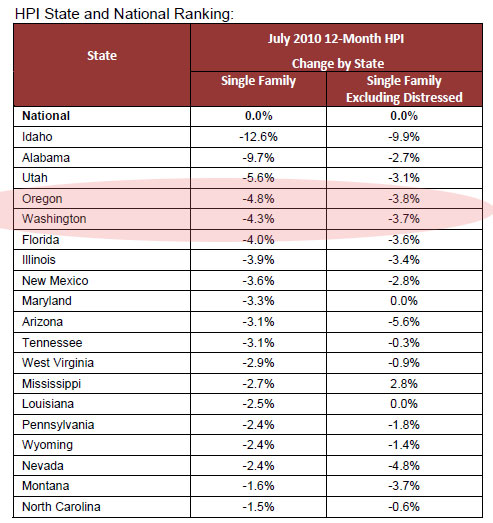
  • CoreLogic Home Price Index Spells Top Five Trouble for the Greater Northwest Real Estate Market, by Portland Housing Blog


    We all know by now that the Northwest region of the country was late to the housing bubble. CoreLogic’s latest report shows that NW states such as Idaho, Oregon, and Washington are showing up late to the bust, and we are now leading the way when it comes to declining prices.

    “CoreLogic (NYSE: CLGX), a leading provider of information, analytics and business services, today released its Home Price Index (HPI) that showed that home prices in the U.S. remained flat in July as transaction volumes continue to decline. This was the first time in five months that no year-over-year gains were reported. According to the CoreLogic HPI, national home prices, including distressed sales showed no change in July 2010 compared to July 2009.

    June 2010 HPI showed a 2.4 percent* year-over-year gain compared to June 2009. 36 states experienced price declines in July, twice the number in May and the highest number since last November when prices nationally were still declining.”


    “The top five states with the greatest depreciation, including distressed sales, were Idaho (-12.6 percent), Alabama (-9.7 percent), Utah (-5.6 percent), Oregon (-4.8 percent) and Washington (-4.3 percent).”


    “Excluding distressed sales, the top five states with the greatest depreciation were: Idaho (-9.9 percent), Michigan (-6.7 percent), Arizona (-5.6 percent), Nevada (-4.8 percent) and Oregon (-3.8 percent).”


    Whether your sale is distressed or you are holding out for bubble era pricing, it’s become obvious that if you are going to sell a property, you’re going to end up settling for an ever lower price the longer you wait to pull the trigger. Plan accordingly if you are trying to sell a home these days in the great Northwest. Sell now or be priced in forever!

    If you’re a potential buyer? My best advice is that you keep your powder dry, pay off any existing debts, stop borrowing money, and save as much as you can. Real home prices in OR, WA, ID have nowhere to go but downward as the pool of greater fools has all but evaporated at this juncture. Prudence takes immense patience in today’s real estate game.

    The days of EZ bank loans are long gone. All that matters now are savings and real wages when it comes to buying real estate. When the cost of capital funds are cheap, the capital asset appreciates in value. When the cost of capital funds become expensive, the capital asset declines in value. We are in the midst of a generational shift in that equation.

    Equity’s a cold hard bitch when it turns negative…


    http://www.portlandhousing.blogspot.com/