Tag: Mortgage

  • Market Update: $1,000,000 Houses in Portland, Betty Jung, All About Portland Blog


    The other day in a post, I said the low end and the extreme high ends homes are selling. This Million $ market segment is doing better overall than some of the other price ranges have been doing in Portland’s metro areas. Although total market time for areas such as Lake Oswego (268 days), West Portland (169 days), and Tigard (180 days) are high, this $1,000,000 price range has had shorter market times per RMLS™. These stats do not include condominium, attached or townhouses, they only include single-family residential properties.

    Below are the stats from RMLS™ at the Million $ price point and higher in areas 147 Lake Oswego (zip codes 97034, 97035), 148 SW Portland, and 151 Tigard (zip codes 97223, and 97224):

    MILLION DOLLAR HOUSES 147-Lake Oswego
    148-SW Portland
    151-Tigard
    2008-2009 Y.T.D.

    # Houses for Sale 131 98 7
    # Houses Pending 5 2 0
    # Houses Sold 47 57 2
    High List Price $19,500,000 $4,988,850 $3,999,000
    Low List Price $1,049,950 $1,080,000 $1,200,000
    Average List Price $1,956,593 $1,783,814 $2,423,800
    $ Sq. Ft. List Price $418 $331
    Average Sq. Ft. Listed 4679 5383 4751
    High Sold Price $3,150,000 $4,300,000 $3,749,000
    Low Sold Price $1,030,000 $1,000,000 $1,200,000
    Average Sold Price $1,496,919 $1,447,144 $2,474,500
    $ Sq. Ft. Sold Price $337 $280 $454
    Average Sq Ft. Sold 4646 5319 4951
    Average Days On The Market 85 122 121
    % Of Sold to Original List Price 89.93% 77.86% 88.9%
    2007-2008 Y.T.D.

    # Houses Sold 118 122 1
    High Sold Price $5,250,000 $4,000,000 $1,100,000
    Low Sold Price $1,000,000 $1,010,000 N/A
    Average Sold Price $1,467,497 $1,441,579 N/A
    $ Sq. Ft. Sold Price $332 $296 $394
    Average Sq Ft. Sold 4426 4866 2792
    Average Days On The Market 110 85 11
    % Of Sold to Original List Price 91.52% 91.92% 79.14%
    Source: RMLS™

    Use of this article, photos and images without permission is a violation of federal copyright laws. (Copyright applies fully and automatically to any work — a photograph, a song, a web page, an article, pretty much any form of expression — the moment it is created. This means that if you want to copy and re-use a creative work in another format, that you find online, you have to ask the author’s permission to re-use their information.)

    (For more national and local real estate information, go to my website at http://www.bettyjung.com)

  • Rate Environment, by Michael Dolan, Broker Pro Mortgage


    Mortgage interest rates continue an upward creep. You may be one of 100,000s who got interested in a mortgage loan when the best rate hit 4.5% briefly in mid January. Rates fluctuated for a while before moving up slowly but steadily for the past month. They still remain low compared to last year.

    The President’s Tuesday night speech failed to help with rates as they moved up again Wednesday. Over the past month, we have had many speeches, laws, policies and plans that could have pushed rates lower. However, rates never really dropped except for a brief window on 15-yr mortgages.

    It’s true that anything can happen in this volatile financial situation. But based on the financial structure in front of us today, I do not see how rates will reverse their trend.

    If you planned to re-finance only because we were at historic lows, your window has closed. You might as well wait.

    If you had other reasons to re-finance, you can still get a very good rate. It’s probably a good idea to act soon. Many homeowners have moved off the sideline over the past week as they see what is happening. You may want to revise your desired rate target.

    If you are planning to buy, rates remain attractive – better than at any time in 2008.

    Michael Dolan

    BrokerPro Commercial and Residential Financing

    1001 SW 5th Ave #1100

    Portland OR 97204
    503-220-2705
    Mobile: 503-287-4876
    Fax: 503-961-9937
    http://www.brokerpromortgage.com
    Start Informed – Finish Faster

  • MACPLAN – Foreclosure Crisis Analysis, By Dave McDonald


    There are several updates and issues to bring to your attention. As things transpire I may not have time to e-mail pertinent updates to you so I have set up a blog at macplan.blogspot.com where you can go for the information. I will try to e-mail you when there is a new update on the blog. Here is what is happening now and what I am working on:

    1) Late last week the largest mortgage insurance company, The PMI Group, instituted a policy that they would no longer insure mortgages that were originated by brokers. By implementing this policy the Mortgage Insurance companies will speed up the consolidation and nationalization of the banks, hasten the downfall of most if not all non-bank lenders that utilize brokers as their main source of business, and force the small mortgage broker to consolidate under a larger bank environment. This policy will also put most appraisers out of business.
    The public, once again, is getting the shaft. By not allowing brokers to originate loans with less than 20% down on a purchase or less than 20% equity in the property for a refinance borrowers will have to go to the few remaining banks the exist who will be able to charge what the want because they won’t have competition from the brokers. A client that is over 80% Loan –To- Value that goes to a broker will be limited to an FHA product….which is insured by the government ad has not one but 2 types of mortgage insurance which in many cases makes it more expensive for the borrower than it would under a conventional loans with mortgage insurance. Again, customers wanting high LTV loans will need to go to banks, put up with higher rates, longer lines and bad service.
    Yesterday I spoke to the upper management at the PMI Group to get their side of the story as to why they are implementing this policy. They told me, unlike published reports, that it was not due to quality of the loan originations submitted by brokers. Their take was that they do not have the capital necessary to reserve for future losses. They say that their low stock prices make it harder to attract new capital. They say that this a strictly a company survival mode tactic to make sure they don’t take on any more risk until the delinquency issues on the current loans in the market place have run their course. They say if they were able to raise more capital then the policy could change back.
    I made clear to them what the ramifications of their policy implementation will do to the average borrower. I made clear that it will cause a domino effect with closing of the remaining non-bank lenders, brokers, appraisers and everybody else in the industry leading to a lot more unemployment while giving borrowers less loan options and higher rates.
    The bottom line, there are ways to fight this which I will go into later.

    2) Obama’s Foreclosure Rescue Plan – I am currently reviewing this. It seems like a lot of the same old stuff and need a lot of questions to be answered:
    a) How are they going to implement the refinancing through FNMA and Freddie Mac for upside down borrowers? Where does mortgage insurance come in….are they going to do it without mortgage insurance. If mortgage insurance is required then San Diego is screwed again…because all mortgage insurance companies have designated us as a Declining Market. How is FNMA and Freddie going to get around that. Also, I understand that they will only allow up to 105% LTV….how is that going to help people that are upside down by 20-50%?
    B) The incentives given to servicers…are they going to be enough. The modification plan is still voluntary for the servicers.
    C) Throwing $400 billion more into FNMA and Freddie Mac to continue to buy mortgage backed securities that nobody else is buying and nobody can put a value on…is the govt over paying….and what are they paying for those securities. It is almost as if the government thinks that the securitization crisis has been solved. The buying up of the securities may have the effect of temporarily lowering rates but will those rates still be offset by the price and cost adjustments currently being added on by FNMA and Freddie.
    And when will the money that is printed to fund the buying of the securities get circulated….the printing of the money will no doubt cause inflation which will increase rates significantly.
    D) Currently in this plan there is absolutely no relief for people that have Jumbo Loan for more than the GSE Loan limit of $546250. Are we just going to let that deck of cards fall. One Jumbo default equals 3 or 4 condos…nobody has the guts to take this problem on.
    E) There is still no relief for people that own rentals. The Popular thing to say is that we don’t want to bailout speculators an investors. But what about they guy who has owned a rental for 20 years and did some refinancing to better his cash flow…but now his value is down, his payment is up, and it doesn’t cash-flow. He is not a speculator. He is one guy that owns a property that is rented out. He did not buy it recently and try to flip it. Most likely, he isn’t rich either. People like that need relief, as much as it is politically incorrect to say such things.

    3) The effect of the Stimulus Plan on mortgages – I am still digesting the 1100 or so pages. However, we do know that the loan limit for San Diego will go back up to $697,500. Once again, the key for this is how the loan limit is implemented and we are getting conflicting messages from the bond traders and the GSE’s. We do no that now there will a $8000 tax credit that does not need to be paid back for homebuyers that buy by the end of November. We do know that 2 Billion Dollars is going to be spent on local foreclosure prevention methods

    4) The Mortgage Crisis is an Urgent event that could eventually and pretty quickly cost Americans our Sovereignty. The fact that very little is being done correctly to break up the bank oligarchy, correct our financial problems, and produce solutions that will stabilize our economy is absurd.

    THE MACPLAN – An Action Plan For the Financial Crisis

    1) Currently, I am assembling plans and ideas from many various sourcesfrom bond traders to securitizers to asset managers to Realtors to come up with an overall, well thought out comprehensive mortgage crisis and foreclosure prevention plan. Most plans are there come from one view or the other….they are not comprehensive and don’t attack all areas. If you have any ideas please e-mail them to me. Once these ideas are collected, I will setup meetings where everybody can show up, voice their opinions, and add ideas to for speak against the plan. Unlike Congress, you will have ample time to read the initial plan before you go to the meeting.
    DEADLINE TO SUBMIT IDEAS AND PLANS: Sunday February 22nd
    SELF IMPOSED DEADLINE FOR PUBLISHING INITIAL PLAN: March 1st
    1st MEETING :tentatively March 1st at a place TBD

    2) The final plan will be put together based on the response of the meetings

    3) Once this plan is completed, then we will get it to our elected officials via e-mail, fax and regular. We will also post not only on my blog but several others.

    4) We will start not only an online petition but a handwritten petition to implement this that will be delivered to our officials

    5) SAN DIEGO ECONOMIC AND MORTGAGE REVOLT DAY – APRIL 1st

    This is where all of the mortgage and real estate professionals, our families, and our customers take to the streets to promote the plan that we come up with….yes picket the banks, picket intersections, rally at the park, etc.

    We will need a committee to put this on and I will be looking from leaders and non-leaders in all parts of the county to step up.

    Be looking for the MACPLAN to take form….we will eventually change the name but it’s good for now.

    Dave McDonalds Blog
    http://www.macplan.blogspot.com/

  • Home Purchase Tax Credit, By Paul Dean of Evergreen Ohana Group


    As you may know, I have been advertising and promoting the $7500 First Time Home buyer Tax Credit (which is really an interest free loan for 15yrs) expires on July 1, 2009. And there has been very little interest by the general public & buyers.

    THIS IS A NEWS FLASH: The new stimulus package may increase that credit to $15K for ANY purchase of a primary home, and IT DOESN’T NEED TO BE RE-PAID!!! This hasn’t been passed yet. But as soon as it is signed into law, I’ll let you know. This is the news from RIS Media today:

    “The enhanced $15,000 tax credit offers a powerful incentive for home buyers to get off the sidelines and represents the best opportunity for economic recovery,” said NAHB Chairman Joe Robson, a home builder from Tulsa, Okla. “Congress must make sure that the full $15,000 tax credit remains in the final stimulus plan.”

    The bipartisan amendment to the stimulus package, offered by Sens. Johnny Isakson (R-Ga.) and Joe Lieberman (D-Conn.) and approved by unanimous voice vote, would create a $15,000 home buyer tax credit available to all purchasers of a principle residence for one year after its date of enactment. The tax credit would not have to be repaid and buyers could claim it against their 2008 and/or 2009 tax returns.

    This could be HUGE for our industry. Stay Tuned.
    Thank you for the opportunity to serve you,

    Paul Dean
    Principal
    Evergreen Ohana Group
    5331 SW Macadam Ave, Suite 287
    Portland, OR 97239

    Toll Free: (800) 387-7355
    Office: (503) 892-2800 Ext.11
    Fax: (503) 892-2803

    Website: http://www.evergreenohana.com
    Email: pauld@evergreenohana.com

    OR ML-21, WA510-LO-33391, WA WA:520-CL-50385

    PS. Your business and loyalty are truly valued. I strive to provide all my clients with the very best professional service possible. If a friend or family member would appreciate this level of service, please don’t keep me a secret!

  • Point of Order by Matt Stashin, Pacific Residential Mortgage Company


    We’ve all heard the news: the dark storm clouds of the financial meltdown will cost the taxpayer hundreds of billions of dollars, if not several trillion by the time it is all said and done. Unemployment numbers are set to skyrocket. The U.S. automakers need a bailout, following suit after so many others. Retail sales were down substantially during the holiday shopping season. People are keenly aware of the possibility of layoffs. Are we done yet? Probably not.

    But amidst the ominous storm clouds lingering on the horizon, if one looks very closely, a platinum lining is visible amongst those clouds. One first reaction might be, “are you kidding?”. However, after a bit of reflection, one can begin to see the sun reflecting off that platinum lining.

    Regardless of an individual’s opinion of the bailout, the soon-to-be former administration and the role of the government in residential housing, the opportunities available in the market place today are unprecedented. We all recognize home values have dropped substantially in almost every neighborhood. And if this is coupled with extremely low interest rates (did someone say rivaling the lowest in 40 years?), the buying power of the consumer has not been more keen.

    One doesn’t have to look far to find a bargain. And with these interest rates, all factors have aligned in favor of the buyer. Sounds pretty good, huh? Well, it is for those who have put themselves in a good position to purchase a home. History will show them to have been very savvy. It pays to buy low, at the incredible interest rates, and watch one’s equity build substantial wealth over time.

    In today’s marketplace, 20% down isn’t the only option. There still exist a limited number of financing options with little to no down payment. In order to better prepare one’s self, a quick check of your credit scores are in order. Freecreditreport.com is a way to find out how your credit history will be analyzed by lenders; credit scores in excess of 740 give access to the best programs and pricing on interest rates. At least 2 years on the job, showing steady income will help on the employment front. Assets are nice to have, but not necessary to have in abundance for all programs. One will want to make sure that checking account statements (2 month’s worth) show no overdrafts. In today’s marketplace, lenders are more cautious than ever when it comes to loaning money to buy a home, but obtaining mortgage financing is still relatively painless when one chooses to work with a seasoned professional mortgage broker.

    With a mini refinance boom going on due to these record low interest rates, one issue the mortgage industry will have to face is the potential for a scarcity of funds. Today, due to the federal government’s conservatorship of Fannie and Freddie along with the strategy to have the Federal Reserve purchase mortgages, many fears have been eased regarding the availability of mortgage money. But a new problem may be just ahead. Wall Street, which capitalized about 60% of the mortgage market, has all but disappeared. Banks are publicly being told to lend money, while their regulators are telling them to maintain adequate reserves, which translates into holding onto their cash. Couple this with the mass exodus of foreign investment into the U.S. mortgage market, and one can imagine a market in which there is more demand to borrow than there is money to loan.

    Consider this: the Treasury department is issuing T-bills with very low yields that may not be attractive to buyers and the Federal Reserve will, at some point, rely on the funding created by the sale of T-bills to have enough capital to continue to purchase mortgages through Fannie and Freddie. If the appetite for low-yield T-bills drops off substantially, which may be a very real possibility, a liquidity crisis in the mortgage market could manifest itself.

    How does this apply to someone today who is considering purchasing a primary residence, a second home or an investment property? My point is this: don’t wait. A scarcity of funds will cause interest rates to skyrocket, overnight. Jumbo funds seem to be disappearing already, although conventional financing to loan amount limits of $417,000 is readily available. Banks don’t seem to be interested in tying up their liquidity in large loan amounts. To me, this is a sign. Not a “doom & gloom” sign, but a warning sign nevertheless. My interpretation here is now is the time to act. The banking system is sound, but mortgage financing is not the banking system. And when capital is being used at the current rate due to the refinance boom, it sets me to wondering how this will impact the availability of funds for mortgage lending throughout the course of this year.

    The federal government has a very tenuous road ahead of it this year. The conservatorship of Fannie and Freddie was meant to be a temporary situation and, as it is currently in place, will terminate at the end of 2009. Between now and then, the best and brightest minds in our country will have to reinvent the mortgage market. With many banks still teetering on the edge, one must think these low interest rates will take a toll on the availability of funds. Who will be interested, long term, in 4.5% paper? As the stock market starts to rebound, investors will be looking for higher returns on their money and interest in current mortgage paper yields will wane thereby creating a scarcity of funding for new lending.

    Thought the storm clouds continue to linger, and they may even get a bit darker in the near future, It is my opinion that today is perhaps the best opportunity to invest in real estate that has existed in decades. For the money, this seasoned mortgage professional thinks now is the time to get mortgage financing before it becomes a scarce resource. Those that buy houses now will likely look like a genius down the road.

    Am I saying this is a sure thing? NO; any investment carries risk and should be carefully evaluated. But I am saying when one peers into the storm clouds above and sees the shiny reflection of the sun off the platinum lining, one should strongly consider that the combination of low home prices and low interest rates is a sign to buy before the clouds all break up and disappear. And everyone knows the opportunity has slipped away once the storm has passed. And so I say, keep wear a raincoat and keep an umbrella handy while shopping for a home out under the storm clouds.

    Matt Stashin
    President/CEO

    Pacific Residential Mortgage, LLC
    2 CenterPointe Dr. STE 500
    Lake Oswego, OR 97035
    (503) 619-0482 Direct
    (503) 670-0674 Fax
    (800) 318-4571 Toll Free
    http://www.pacresmortgage.com


  • ‘Liar Loans’ Earn Their Nickname, Michael Corkery, Wall Street Journal


    The failure of Hope for Homeowners to prevent foreclosures is sparking a blame game in Washington. The Department of Housing and Urban Development, which runs the voluntary program, says Congress made it too restrictive and expensive for homeowners.

    Congressional leaders say the program’s failure — only 357 people have signed up since Oct. 1 — shows that lenders aren’t willing to modify loans voluntarily and they need to be forced to do so.

    But HUD officials say other problems are hampering the program’s success. In order to refinance through Hope for Homeowners, applicants must certify they did not supply false or misleading information on a previous loan application. The HUD program also requires homeowners to supply two years of financial records.

    HUD officials believe that people who used “stated income” mortgages which required no documentation of income, are having a hard time qualifying for Hope for Homeowners because of incorrect information on their previous loans. It might not all be the borrowers fault. In many cases, mortgage brokers and lenders fudged loan applications.

    Either way, it appears that stated income mortgages, which are known as “liar loans,” are earning their nickname.

    Here’s a list of the government sponsored and voluntary lender foreclosure prevention programs and how they are faring so far.

    http://blogs.wsj.com/developments/2009/01/02/liar-loans-earn-their-nickname/

  • In Foreclosure? Say No To Fakes and Frauds


    It is amazing that just as we move out of an era of fraudulent loan officers, fake “Mortgage Planners” and Financial Trusted Advisers we are now being over run by a hoard of “Foreclosure Experts”.   Could these people be one in the same.  Just the times and the opportunities are different?

    When in foreclosure there are experts out there that can help you develop a plan of action.  These people are beholden in one way or another to the state of Oregon as in they have an ACTIVE Real Estate license, Mortgage Certificate or member of the Oregon Bar.  Bottom line, if they rip you off they it is harder for them to hide.   Your legal representatives and the state of Oregon can track them down and hold them accountable.

    It is never good to be in foreclosure.  But remember you only make the situation worse by not seeking the information you need to develop a plan of action.   Maybe you can not keep your home.  Maybe you should sell and buy another home on seller contract or lease option.  Maybe you can work something out with the lenders.  You have to treat foreclosure as an problem that can be solved and not the end of the world.

    Information is power and with right power anything and everything is possible.   Do rot sit in place, do not allow shame to prevent you from doing what you can to resolve the problem for you and your family.

    Lastly, do not listen to anyone that does not hold an Oregon License, Mortgage Certificate or member of the bar that promises to save your home or help you make your payments.  Those people have nothing to lose and everything to gain by gaining your trust.   If it sounds to good to be true….it is.  If it sounds like it is not legal….there is a good chance is it not legal.   If that little voice in the back of your head says hang up the phone…..hang up.   Use your common sence and reach out to people that can help provide you with real solutions.

    Well that is enough ranting.  Keep an eye on this blog.  Will be posting possible solutions to the problems you are facing.   If they work for you….great.  If they won’t help you in your situation, feel free to send me an email or post the question on this message board. 


    Fred Stewart
    President
    Stewart Group Realty Inc.

  • Oregon Home Prices OFHEO DATA: Oregon Economics Blog


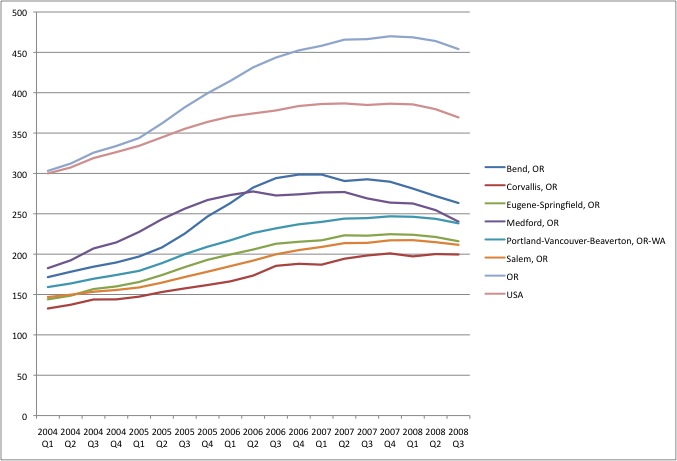
    The OFHEO has come out with its latest house price data. Remember that these cover much more of the US than the 20 cities of the Case-Shiller report, but are based home sales only with conventional mortgages. Anyway, we can see the data for Oregon cities, Oregon and the USA.

    Here (a bit messy) is the raw data since Q1 of 2004:

    Here (even more messy) is the quarter to quarter % change in home values:

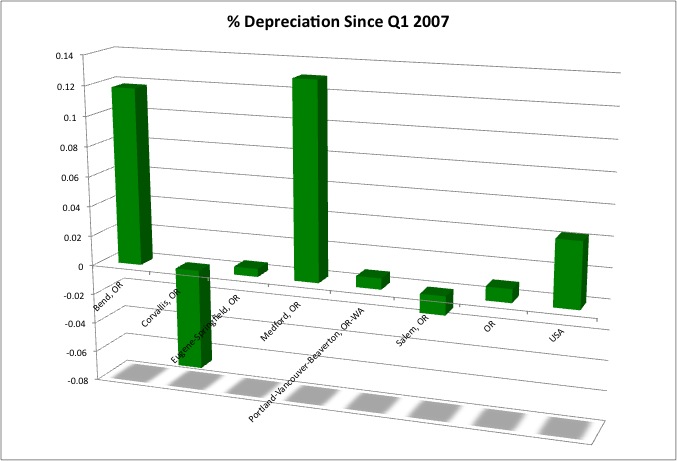
    Here is the overall depreciation (so positive numbers are bad in the sense that they represent loss of value) since Q1 of 2007 when the market in Oregon really turned:

    Overall, it is bad, especially for Bend and Medford which are seeing collapses of California proportions, but overall the state is not doing too badly in relative terms.

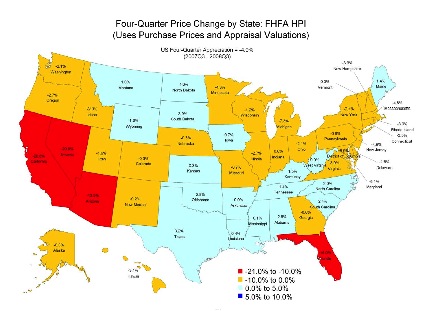
    Here is a nice picture from their summary report that shows the national picture. Oregon is the 35th best state in terms of home value appreciation (or limited depreciation):

  • Save Homes from Foreclosure, Here’s How – Please Share With Others: Daily Kos


    by War on Error

    This info has helped others.  Please pass this to anyone facing foreclosure with Mortgage Electronic Systems Registration on their foreclosure papers.

    HELP PEOPLE SAVE THEIR HOMES.

    To learn how the Ownership Society Scam was choreographed.  Read this website:
    http://loanworkout.org/…

    Read this diary for history, details, and some of people who put together what may be the biggest White Collar Crime in history
    http://www.dailykos.com/…

    MORTGAGE ELECTRONIC REGISTRATION SYSTEMS  (MERS) – Go to your newspaper’s foreclosure listing and look for MERS on the postings.  50,000,000 mortgages list MERS as the Trustee.  But MERS doesn’t have any promissory notes.  You have to read all this to understand.  But do give it to anyone facing foreclosure.

    Without MERS, the huge volume of Mortgage Backed Securities and CDOs could not have been created.  

    HERE IS THE SCARY possibility:  Countries, retirement funds, states, counties, etc. invested in these bundled products, based on ratings from the likes of Standard & Poors, Fitch, and Moody’s only to find, when they opened up the bundles, that they were filled with JUNK instead of GOLD. So they lost all of the money they invested. You can watch PBS NOW to learn how junk became traded as gold:

    http://www.pbs.org/…

    Is it possible that the real money, given to Hedge Funds to purchase MSBs and CDOs, by banks and pension funds throughout the world, left the banks and pension funds virtually empty?  Could this explain the rush to Capital Hill for huge infusions of Bailout Money?  Did banks and pension funds lose everything on their bad bets?  If you watch the PBS NOW program referenced above, it seems that is a strong possibility.  They lost their money gambling on products said to be gold that were, in fact, junk.  Good grief!

    The bundles of MBSs and CDOs couldn’t have been so quickly created without the electronic power of MERS.

    ….What many people refuse to admit is that because of the so-called MERS paperless “system” many of the so-called mortgage backed security trusts do not actually hold the promissory notes which evidence the debts that are supposed to be backing the bonds purchased by these investors.

    The situation is reminiscent of the great Great Olive Oil Scandal in the late 1800’s when banks were duped into investing millions of dollars into Olive Oil only to later discover that the tanks which were supposed to be holding millions of gallons of olive oil backing their investments were mostly empty.

    This problem with the missing trust assets/promissory notes manifests itself each time MERS and/or the trustees for the bondholders brings a legal action to collect on a debt through foreclosure.  Because neither MERS nor the bondholders trustees are holding the notes, they lack proof of standing to maintain their legal actions and the actions are subject to dismissal.

    Many foreclosure actions have been dismissed based upon lack of standing. This a problem that it is a direct result of MERS “system”….

    THERE IS HOPE HERE.  PASS THIS TO ANYONE FACING FORECLOSURE with MERS on their paperwork, PLEASE.  

    The details are found in the two sites listed in the INTRO.

    Together we may be able to help families avoid so much suffering.

    …….One informed lawyer who represents homeowners in Florida, April Charney, had foreclosure proceedings against 300 clients dismissed or postponed in 2007 for lack of standing. She is quoted as saying that “80 percent of them involved lost-note affidavits”. . .

    They raise the issue of whether the trusts own the loans at all,” Charney said. “Lost-note affidavits are pattern and practice in the industry. They are not exceptions. They are the rule.” Ms. Charney, started challenging MERS and it members lost note affidavits after becoming skeptical of the a lender could possibly lose hundreds of promissory notes.

    At least two Florida judges shared Ms. Charney’s skepticism regarding the copious amounts of MERS lost note affidavits and they issued show cause orders, sua sponte, challenging MERS to show proof that it held and/or lost notes in numerous actions. After evidentiary hearings these two alert judges dismissed twenty nine (29) MERS actions to foreclose for lack of standing. One judge struck MERS pleadings as being sham.

    A South Carolina court dismissed a MERS action to foreclose for lack of standing even though MERS filed an affidavit wherein a person claiming to be an officer of MERS claimed that MERS was holding a promissory note. The South Carolina court vetted the MERS affidavit claim that it was the holder of the note after being apprised of the fact that MERS had previously told the Nebraska Court of Appeals that it never held promissory notes.

    In late 2007 three Federal Court Judges in Ohio dismissed over fifty law suits brought by trustees of mortgage backed trusts where they could not produce the original promissory notes.

    Following these decisions the Bankruptcy Court in Los Angelas, California adopted a rule of practice which requires all foreclosing trustees or other plaintiffs to produce the original promissory note when bring an action to foreclose a debt or face sanctions for not doing so. Several court in New York have been routinely dismissing foreclosure actions brought by MERS or its memebers because they continually fail to produce promisssory notes.

    Here is a possible way to fight MERS or any foreclosure if they don’t have the proper, original documentation:

    ……To make matters worse many of the debts evidenced by these undelivered promissory notes were supposed to be secured by mortgage liens. However in place of mortgages being executed in favor of the original lender many of these mortgages were executed in favor of MERS. Because MERS never holds these notes or owns a debt it is not a creditor. MERS has no legal standing to enforce a debt, or so it told the Nebraska Court of Appeals in 2005. However this lack of standing defense must be raised by property owners who are sued.

    The most effective economic way to raise this lack of standing defense is by bringing a motion to dismiss in response to the complaint to foreclose. In many states and in federal court this is called a Rule 12 motion. This motion is brought in place of answering the complaint. An honest attorney in most areas of the country should be willing to prepare and bring such a motion for $500.00 to $1,500.00 for a distressed homeowner. Or you might be able to find a lawyer to do it for you pro bono and perhaps a legal aid attorney. At least five judges around the country have dismissed these actions for lack of standing sua sponte, which means they did it on their own volititia. Perhaps more judges will feel the duty to do the same thing in the future.

    http://loanworkout.org/…

    Lastly, what might be disconcerting.  Who at Fannie and Freddie Mac played along?  Democrats?  Republicans?  Both?  If both, now what?

    Or did the likes of CountryWide play Fannie and Freddie?  Playing within the rules?  Could they have succeeded without inside help?

    ADDITIONAL WEBSITES OF INTEREST:

    1999 MERS plans for future foreclosures, in place at launch.
    http://www.mersinc.org/…

    MERS list of Shareholders or a list of people getting bailout money:
    http://www.mersinc.org/…

    How to buy a foreclosed home from HUD for $1.00, yes One Dollar:
    http://www.hud.gov/…

    A very informative website sharing the methods used to steal homes from HOMEOWNERS:
    http://www.msfraud.org/

    In conclusion, defenders of MERS says it is just an easy way to pass paper.  Fine.  However, when MERS took a Trustee position on deeds filed with Registry of Deeds, the problems escalate.  Imagine, in the old days, listing your fax number as the Trustee on a deed, just because that is how the paper work was forwarded.  How can a homeowner, facing foreclosure, work out a deal with a fax machine or its fax number?

    For fun, here is Bush launching the Housing Crisis:


    http://www.dailykos.com/story/2008/11/24/114621/44/351/665802

  • Beware home equity credit freezesBy WAYNE HAVRELLY, kgw.com


    PORTLAND, Ore. — It wasn’t long ago when people were tapping the equity in their homes to pay bills.

    Now many of those home equity loans are being frozen by lenders because home values are dropping.

    It happened to Debbie Inguagiato who runs a massage therapy business out of her home. She says after 15 years of never missing a loan payment and creating a very high credit rating, shes about to lose her house.

    “I don’t think i have ever been this scared in my entire life”, said Inguagiato.

    She said a mortgage broker gave her some terrible advice as she was going blind from an eye disease.

    Inguagioto said, “I was advised by someone who said she was living off equity of her home for 25 years. She told me she knew what she was doing and she led me through this process of getting a home equity loan.”

    Inguagioto used the loan to help pay her first mortgage and start her massage business which has been very slow.

    Then, late this summer that home equity loan was frozen because her lender claimed her home plunged in value.

    Mortgage companies based in other parts of the country are not always fair when they freeze home equity loans in the Northwest according to realtor and attorney Holly Hummel.

    “Your dealing with someone in another part of the country pulling up data on a desktop appaisal that may not take into consideration that you have a brand new kitchen,” said Hummel.

    She says while real estate values have certainly dropped in suburban communities like happy valley homes in much of Portland have held up well. Debbie’s home is in one of North Portland’s hottest neighborhoods.

    Her home was appraised at $430,000 when she took out the equity loan 2 years ago. However, she says her lender told her the value had dropped to just $262,000, so they froze her loan.

    Debbie doesn’t buy it and nor do Portland real estate experts who say the best thing homeowners in this situation can do is immediately contact their lenders.

    Hummel said, “I have seen people renegotiate with their lender and have their lender come around to their way of thinking, that in fact their house has not dropped to that level.”

    Ronald Stroble, Vice President of Oregon based Umpqua banks mortgage division, said lenders are now working closely with homeowners looking to avoid foreclosure.

    Stroble said, “In the old days people thought they cant call lenders because they didn’t want them to know they were having financial trouble. The message to everyone in this financial meltdown is please, call your lender. Find out what options you have.”

    Debbie has sent her lender comparable sales in her neighborhood and a new appraisal showing her home is still worth about $420,000.

    She’s still waiting to hear back from her lender, Popular Mortgage Servicing Inc.

    The New Jersey based company did not return calls from Newschannel 8.

    Inguagiato said, “I’ve never been homeless, I plan not to be, but the reality is I don’t know how long a legally blind person would make it out there on the street and I don’t want to learn.”

    The mortgage crisis is close to claiming another victim, but Inguagiato is not giving in without exploring every possible option.

    If you find yourself in the same home equity loan is frozen and your lender won’t renegotiate, another viable option is to approach local banks and credit unions.

    Most local financial institutions had light sub-prime loan exposure and still have plenty of money to loan if you qualify.


    http://www.kgw.com/business/money/stories/kgw_110708_special_report_home_equity.18e3d6f85.html

  • Mortgage Implode: Time to Get Your Bailout…The ‘Gimme Mine Coalition’


    2% Interest Only 5-year loans available again?!? Yes, but beware.

    -Home Owners and Mortgage professionals, this one is for you.

    I am a big advocate of mortgage modifications that include a fully documented re-underwrite and re-qualification of every borrower in America allowing a maximum of 28/36 debt to income ratios with market-rate 30-year fixed mortgages.

    Yesterday, the video camera was calling my name so I decided to go into more color on mortgage modifications.  Pass this video around to friends and family. Take matters into your own hands because it is obvious nobody will be riding to the rescue anytime soon.

    That being said, I do believe a large scale home owner bailout will come, but it will likely involve giving up present and future equity in your home.  Right now you do not need to do that.  You can even negotiate into the modification a better reporting of this event to the credit reporting agencies with some banks.

    In recent weeks I have seen banks get very aggressive including reducing principal balances to lower than the present home values and giving borrowers 2% interest only loans for five years.  Wachovia offered to buy down a friends mortgage to 2% on a 30-year fixed, however, they had to refi through FHA and carry a silent second for the principal balance reduction needed to get them to the FHA limit for the area.  This sounds great but I do not advocate a super low interest only rate without a principal balance reduction. Getting 2% today with no principal reduction just kicks the can down the road and will cause major troubles then.  Without a principal reduction you are still stuck unable to move or refi.

    I truly believe that there is a small window in time that exists right now where banks can’t handle any more foreclosures and you hold all the cards. The last thing the bank wants is another foreclosure and 65% write down.  If you play your cards right you can win and the bank can have a long-term customer paying her mortgage payment each and every month who will some day own the home. That is what it is all about.

    I also went into great detail on mortgage modifications on July 4th and I urge you re-read the posts. There is information in here you must know BEFORE taking on this task. You have to know what to ask for because banks are a ‘for profit’ business, which means decisions are not going to be in your best interest. – Best, Mr Mortgage

  • Portland Tribune: Mortgage losses mounting, Steve Law


    More area homeowners at risk as foreclosure proceedings double


    Uncle Sam is bailing out Wall Street wheeler-dealers who invested in home loans, but there’s no relief in sight for the homeowners on Main Street.

    On Southeast Main east of 144th Avenue, stretching from outer Southeast Portland into Gresham, 14 homeowners have been hit with foreclosure filings in the past year, plus scores more in nearby blocks.

    • Judy Myer pawned her wedding ring and stopped taking prescribed medicines in a futile bid to save her Southeast Main Street home of 18 years, after husband Mark Myer lost his job and his unemployment benefits expired.

    • Judy’s son, Steve, who lives down the street, got socked with foreclosure after his 7-year-old daughter required heart surgery. Steve took out a second mortgage to cover the medical bills, then fell behind on house payments after suffering an on-the-job injury.

    • Across the street from the Myers, Ron Zitzewitz just got a six-month notice to vacate his mother’s home – one month after she died. Zitzewitz, 51, isn’t old enough to assume his mother’s reversible mortgage, and can’t refinance the loan because he’s permanently disabled.

    Portland is no real-estate basket case like Las Vegas or Phoenix. But the national foreclosure crisis that initially spared Portland has arrived here in a big way, bringing more human suffering and dampening housing prices.


    Foreclosure forum

    Oregon’s presumed next attorney general, John Kroger, along with state lawmakers and community leaders, will host a town hall for people facing foreclosure or who think they were victimized by deceptive lending practices.

    The event, called There’s No Place Like Home, takes place 9 a.m. to 2 p.m. Saturday, Nov. 22, at Portland Community College’s Cascade campus, Moriarty Auditorium, at the corner of North Killingsworth Street and North Albina Avenue.


    The number of Multnomah County residents in jeopardy of losing their homes has nearly doubled in the last year, based on the number immersed in foreclosure proceedings. Over the spring and summer, 300 Multnomah County homeowners a month got slapped with foreclosure notices – topping the peak levels reached in the last recession of 2001-02.

    In August 2007, the Portland area had an enviable 332nd-highest foreclosure rating among the nation’s 383 metropolitan areas. But by August 2008, Portland jumped to 254th-highest, according to First American CoreLogic, which provides real estate data services.

    “There’s a shakeout right now, and we’re failing on all cylinders,” said Portland real estate economist Jerry Johnson.

    Portland took longer than most cities to emerge from the last recession and didn’t get as overbuilt as other markets, Johnson said.

    But Portland home prices kept rising during the last recession, he noted. If banks and besieged homeowners try to dump too many discounted properties, he said, “you could swamp the market and kill the guys who are OK.”

    Home prices are sliding in large swaths of the metro area, especially in overbuilt sectors such as Portland’s condo market and suburban Happy Valley. In early October, in the 97086 ZIP code that includes Happy Valley, there were 247 homeowners facing foreclosure on top of 95 homes seized by banks, according to VisionCore, a division of First American CoreLogic.

    Short sales drive down prices

    Many overburdened homeowners, anxious to avoid foreclosures that soil their credit ratings, are resorting to “short sales,” in which they sell quickly for less than their home loan if the lender agrees to accept the lower amount. Banks also are auctioning off seized homes to investors looking for sweet deals.

    Dumping all those distressed properties on the market, sometimes at fire-sale prices, is depressing home values for neighboring residences.

    In a half-block stretch of Liebe Street southeast of Holgate Boulevard and 118th Avenue, four homes went into foreclosure in recent months. Investor Mark Bordcosh snapped up one of them, a three-bedroom townhouse appraised at $217,000, and offered it in an auction, with a minimum bid of $137,500.

    “I’m basically getting the house at a discount and I’m selling it at a discount,” he said.

    All parts of the city are seeing some foreclosures, though they are less common on the west side and close-in east-side neighborhoods, according to VisionCore. Portland working-class neighborhoods, especially in North Portland and the outer east side, are getting more than their share, as residents lose jobs or get burned by escalating interest rates on subprime loans.

    Main Street doesn’t necessarily have the highest proportion of foreclosures. But it is representative of the outer east side – meaning it is seeing plenty of angst and misery.

    Adversity is magnified

    Southeast Main east of 144th Avenue, dotted with modest one-story homes and towering firs, has long been known as an affordable place to buy a home. But it’s no longer affordable to many longtime residents.

    Mark Myer, 57, who lost his computer tech job after his company was sold, doesn’t expect any of the $700 billion Wall Street bailout approved by Congress Oct. 3 will trickle down to his end of the food chain.

    “The people that are stomping on the individuals are the ones that got bailed out,” Myer said. “If they share and start helping out some people, fine. History shows they’ll just turn around and stomp on us again.”

    Myer landed part-time work, but said employers have been reluctant to hire him now that there’s a foreclosure on his record. That’s despite 22 years’ service in the Navy.

    Judy Myer stopped taking medicines a year ago for her anxiety attacks, high blood pressure and cholesterol. After two heart attacks, two back surgeries and anxiety problems, she’s not in good shape to work outside the home.

    “I don’t know what’s going to happen. It’s just scary,” she said. “We’ll never be able to go out and have dinner and a movie.”

    Her son, Steve, an automotive technician, was denied workers’ compensation benefits after his 2006 on-the-job injury. The injury was deemed connected to a pre-existing condition. He qualified for short-term disability payments, but that only covered 60 percent of his salary. It wasn’t enough to make full mortgage payments and pay his $10,000 hospital bill.

    When his home lender demanded full payments on his mortgage, Steve threw up his hands. “I pretty much said, ‘Come and get it, there’s nothing I can do.’ ” he said.

    The lender backed down and offered him a payment plan, Steve said. He was able to save the house for now, but said he’s still tapped financially.

    A few doors down from the Myers, Trinidad Monje’s former Main Street home sits vacant, months after going into foreclosure. Judy Myer said it’s been languishing on the market at least two years.

    Down Main Street near 148th Avenue, Maxsim “Max” Lysack said he was forced into foreclosure after his roommate died. He wound up doing a short sale – selling the home for less than his mortgage – in a deal worked out with the lender.

    “I buy it for $285,000, and I sell it for $250,000,” Lysack said.

    Ron Zitzewitz has lived on Main Street off and on since childhood. He doesn’t earn much from disability payments and income from a knife-sharpening business, and moved in with his mother.

    Under her reverse mortgage, the lender takes a greater stake in the home’s equity each month, in lieu of mortgage payments. Zitzewitz can’t qualify for a new loan to refinance the $160,000 his mother owed.

    The house should be worth about $225,000, he said. But Zitzewitz doubts he can sell it for anything close to that because the market is so sour.

    Zitzewitz got married a few months ago, but so far his wife has been unable to find work.

    “We’re going to have to find somewhere else to live.”

    stevelaw@portlandtribune.com

  • Wachovia’s New Pay Option ARM Plan – ‘The Spend’


    Posted on October 8th, 2008 in Daily Mortgage/Housing News – The Real Story, Mr Mortgage’s Personal Opinions/Research

    There is a new pilot program Wachovia recently put into place intended to rid themselves of that nasty $122 billion Pay Option ARM portfolio while keeping borrowers in their home. While this program definitely has its flaws because it does not come close to addressing the real problem (HOUSE PRICES ARE STILL SIGNIFICANTLY OVERVALUED) it is the closest I have seen yet.

    Wachovia’s New Program – ‘The Spend’

    First, Wachovia selected a certain number of Pay Option borrowers based upon internal modeling. Each borrower was assigned to a participating mortgage banker/broker and given what they call ‘The Spend’.  The Spend is how much money that will be used to modify and refinance the borrower into a new 30-year fixed loan, primarily FHA.

    A portion of The Spend is used to buy down a 30-year fixed rate to a level at which the borrower can afford according to present day underwriting guidelines. A portion is also used to reduce the principal balance. From what I am hearing from early cases, the interest rate level on some first mortgages has been as low as 2%.  That’s pretty sad when it takes 2% to get borrowers to qualify for a fixed coming out of an Option ARM and just goes to show how leveraged up the borrowers still are. However, The Spend is not forgiveness of debt. It is put into the form of a silent second for a specified term and at an interest rate as low as zero that has to be repaid at some time in the future.

    The benefits to Wachovia are obvious. They get rid of these toxic assets sitting on their balance sheet; they get rid of predatory lending liability through the refinance, as the borrower must sign away all rights to future claims; they outsource the loan origination staff expense to other firms; and they get to bring back a portion of the loan loss reserves set aside on each loan refinanced IF The Spend is less than the amount reserved.

    If banks are going to start trying to get ahead of the game with proactive loan modifications/refinances, Pay Options are a great place to start. This is because they are truly toxic for the borrower and bank going forward.  Currently, Pay Option ARMs are being valued by the market as poorly as straight Subprime despite default rates being nowhere close…yet. This is because over time, most Pay Option borrowers will default due to the way the loan is structured and massive payment recast that occurs. Because Pay Option ARMs allow ultra-low teaser rates for up to 10-years at Wachovia , their Pay Option implosion could have been spread out over several years.  But, the market was smart with respect to this loan type realizing that despite the ‘high credit scores’ and ‘lower effective original loan to value ratios’ that they like to brag about, these are essentially all Subprime loans.

    But unlike other program types awaiting implosion such as Jumbo Prime ARMs that are still rated and valued as ‘Prime’, Pay Options have been written down to some degree by banks already. This makes throwing money at them more palatable by the bank because if it cost less to make them ‘right’ than the value at which they are currently written down, it can lead to a write-up. Since Pay Option borrowers by and large are of decent quality and if they catch these before they go into default, refinancing them into a new fully documented loan should not be a problem. This may not be the case when dealing with Subprime borrowers, borrowers who are currently delinquent or low documentation borrowers.

    There are significant problems with The Spend, however. Most obviously, they are artificially supporting house prices by giving borrowers extremely low interest rates such as a 2% 30-year fixed and a zero interest rate second. In addition, what if values are not at the bottom? The ‘negative equity effect’ is real and if values continue to tumble what’s to say that the borrower will not just walk at a later date. A good number of these may even turn into rentals because with a 2% fixed and zero% second, the property may cash flow.

    The thought process is that if the borrower can afford their payments, especially on a 30-year fixed, it does not matter what the value of the home does – they will stay and make their payments. Well, this has obviously been proven wrong, as we are seeing Prime and Jumbo Prime default in greater numbers as values fall. On the other hand with house prices down so far in the areas in which this program is going into effect, there is a much better chance that this fundamental will play out going forward.

    But then there is still the silent second hanging over their head and the fact that home owner is underwater by that large of an amount. This makes borrower repayment patterns totally unpredictable across all paper grades. This also makes typically life circumstances such as job loss or illness almost a guaranteed default.  If you have equity in your property, you have wiggle room.

    One thing is for sure, The Spend is worlds better that the recent BofA/Countrywide settlement scam, in which the AG sold hundreds of thousands of borrowers down the river at a ridiculously low price. Remember gang, once you do something with respect to a mortgage modification or refinance, you lose your rights to come after the lender for predatory lending violations and forced rescission/modification.

    The ‘relief’ the borrowers will get from BofA will be of the kind I mentioned in a recent post, ‘Countrywide/BofA – A Direct Threat to Borrowers’, where Countrywide gave a borrower a $900k five year 2% interest only loan on a $500k home essentially pushing the problem out five years and ensuring a foreclosure at that time.

    That is why it is so important to do it right with permanent principal balance reductions if you are going to do it at all. I talk about this in my new video, ‘Mr Mortgage – Time To Get Your Bailout‘.

    At my independent research firm, Field Check Group Real Estate & Finance, I can watch in real-time each and every loan default from all lenders so I will keep an eye out on how this program is working and how Wachovia’s portfolio is performing and periodically let you know.  If you get a call in the meantime by a Wachovia partner offering you something that is too good to be true, think very carefully because it just may be. -Best Mr Mortgage